
Every day there is another article.
Another court hearing.
Another politician making promises to anti-abortion activists.
Another television panel debating abortion as though it’s an interesting constitutional thought experiment.
People ask us what we think about the latest lawsuit, the newest state restriction, or Todd Blanche’s latest comments about ending telemedicine abortion.
The truth?
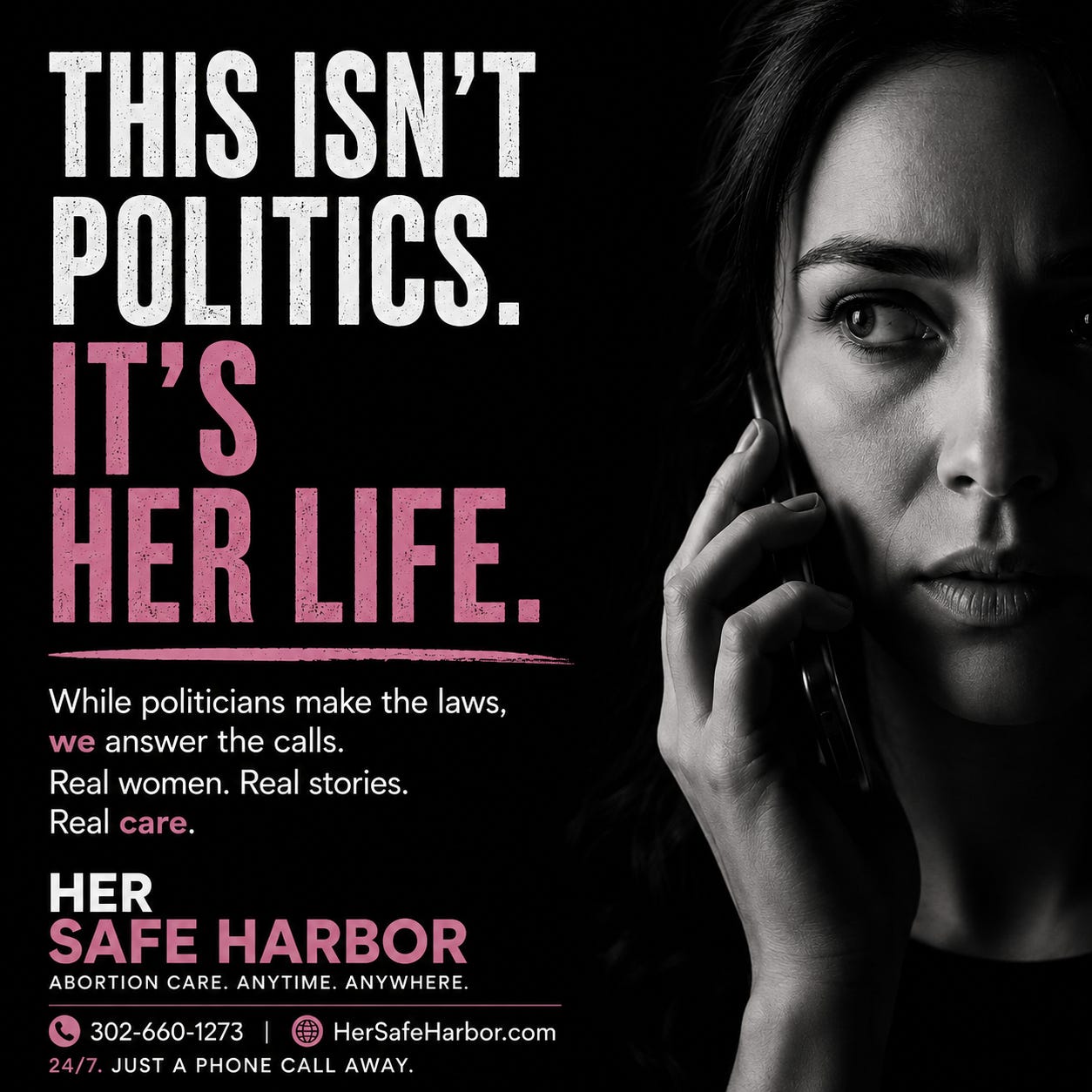
This isn’t politics for us.
It isn’t a headline.
It isn’t a debate.
It’s Tuesday.
It’s Wednesday.
It’s 2:17 in the morning when the phone rings.
At Her Safe Harbor, we don’t experience the abortion rights movement through press releases or cable news. We experience it through women.
We’re the ones answering the phone when a woman whispers because her husband can’t know she’s called.
We’re the ones talking to a college student who just learned that her state legislature has decided politicians know more about her future than she does.
We’re the ones reassuring a woman who has spent hours searching the internet because she is terrified she will be arrested for seeking medical care.
We’re the ones helping a mother of three who already knows exactly what another pregnancy would mean for her family.
We’re there for women pregnant after rape.
After incest.
Women carrying pregnancies with devastating fetal diagnoses.
Women trapped in abusive relationships.
Women with serious medical conditions.
Women who simply are not ready to become mothers.
Women who have already made one of the hardest decisions of their lives before they ever dial our number.
We don’t sit in judgment.
We don’t demand an explanation.
We don’t ask whether their reason is “good enough.”
We provide evidence-based medical care because women deserve healthcare—not permission.
There is something you learn when you spend your days talking directly to patients.
You learn what fear sounds like.
You hear the woman who has been told by protesters, politicians, and religious activists that she is a murderer.
You hear the patient apologizing for crying because she’s convinced someone will think she’s a bad person.
You hear the woman who has delayed care because she spent weeks trying to figure out whether what she was doing was even legal.
You hear the mother hiding the conversation from an abusive partner.
You hear the teenager who has no safe adult to call.
You hear women calculating whether they can afford rent if they have to travel hundreds of miles for care.
None of these voices make it into congressional hearings.
But we hear them every single day.
When Todd Blanche promises anti-abortion activists that he’s working to make Dobbs “permanent in every single state,” some commentators rush to debate whether he’s technically describing a national abortion ban.
We don’t.
Because technicalities don’t matter to the woman who can’t get care.
Whether they call it enforcing the Comstock Act, restricting telemedicine, banning medication by mail, or “returning abortion to the states,” the result is exactly the same if women lose access.
Medication abortion has become the primary way women obtain abortion care in the United States.
Eliminate telemedicine.
Block medication by mail.
Threaten providers.
Criminalize information.
Intimidate pharmacies.
The practical effect is obvious.
You don’t need the words “national abortion ban” if you’ve eliminated the way millions of women actually access abortion.
We know that because we’re the ones who would have to answer the phone afterward.
Every restriction creates another barrier.
Every barrier creates another delay.
Every delay creates another woman in crisis.
We’ve talked to women who drove across multiple state lines because lawmakers closed the clinic closest to them.
Women who borrowed money they couldn’t repay.
Women who skipped meals so they could afford transportation.
Women who hid pregnancies from violent partners because disclosure wasn’t safe.
Women who waited until later in pregnancy—not because they wanted to—but because politicians had forced delay after delay after delay.
Anti-abortion organizations call these “protections.”
We call them what they are.
Obstacles deliberately designed to make healthcare harder to obtain.
People sometimes ask whether we ever get tired.
Of course we do.
We’re tired of the lawsuits.
We’re tired of the threats.
We’re tired of watching politicians who’ve never answered a desperate patient call tell women what healthcare they deserve.
We’re tired of watching ideology masquerade as medicine.
But the women who call us don’t have the luxury of our exhaustion.
Their pregnancies don’t pause while the courts deliberate.
Their abusive partner doesn’t become less dangerous because Congress is on recess.
Their medical crisis doesn’t wait until after the next election.
So neither do we.
People imagine the abortion rights movement as marches, rallies, Supreme Court cases, and campaign speeches.
Those things matter.
But that’s not where most of this fight happens.
It happens in quiet phone calls.
It happens in whispered conversations.
It happens when a frightened woman finally hears someone say, “You’re going to be okay.”
It happens when healthcare providers refuse to abandon their patients despite political attacks, legal threats, and relentless harassment.
That is where we live.
That is where Her Safe Harbor exists.
Not on the sidelines.
Not in the comment section.
Not in a think tank.
In the trenches.
Every single day.
And while anti-abortion organizations gather in conference rooms and White House Faith Office meetings to strategize about taking away women’s healthcare, we’ll continue answering the phone.
We’ll continue telling women the truth.
We’ll continue providing evidence-based care.
We’ll continue fighting because our patients don’t have another choice.
One side is fighting for control.
We’re fighting for women.
Her Safe Harbor provides private, clinician-guided abortion care by phone for women across all 50 states. Our providers answer the phone themselves—day or night—because no woman should have to navigate one of the most difficult moments of her life alone.
24/7. Just a phone call away.
302-660-1273
HerSafeHarbor.com
If you believe every woman deserves access to evidence-based reproductive healthcare, please consider sharing this article or supporting our work. Every donation helps us continue providing care, education, and support to women across the country.
Comments
Nothing yet. Say the first thing.
Sign in to join the conversation.