
“The limits of my language mean the limits of my world.” — Ludwig Wittgenstein\
Words matter.
Every law begins with words. Every court decision depends on definitions. Every political movement succeeds or fails, in part, because of the language it persuades the public to accept.
The fight over abortion has never been only about medicine or morality.
It has also been a fight over vocabulary.
Over the past fifty years, anti-abortion advocates have carefully built an entirely new lexicon—one that reframes restrictions as protections, criminal penalties as compassion, and abortion bans as reasonable public safeguards.
The strategy is remarkably effective because it rarely asks people to change their values.
It asks them to change the words.
Once the words change, the law often follows.
George Orwell warned that political language is often “designed to make lies sound truthful and murder respectable.”
Whether or not you agree with his politics, the observation remains relevant.
Governments rarely call unpopular policies by names that reveal exactly what they do.
Mass surveillance becomes “national security.”
Civilian deaths become “collateral damage.”
Torture becomes “enhanced interrogation.”
Abortion restrictions have undergone the same linguistic transformation.
The public generally does not support the idea of government controlling pregnancy decisions in every circumstance.
So politicians increasingly avoid describing their proposals as abortion bans.
Instead, they adopt language that sounds measured, compassionate, or medically authoritative.
The result is a vocabulary that often obscures more than it explains.
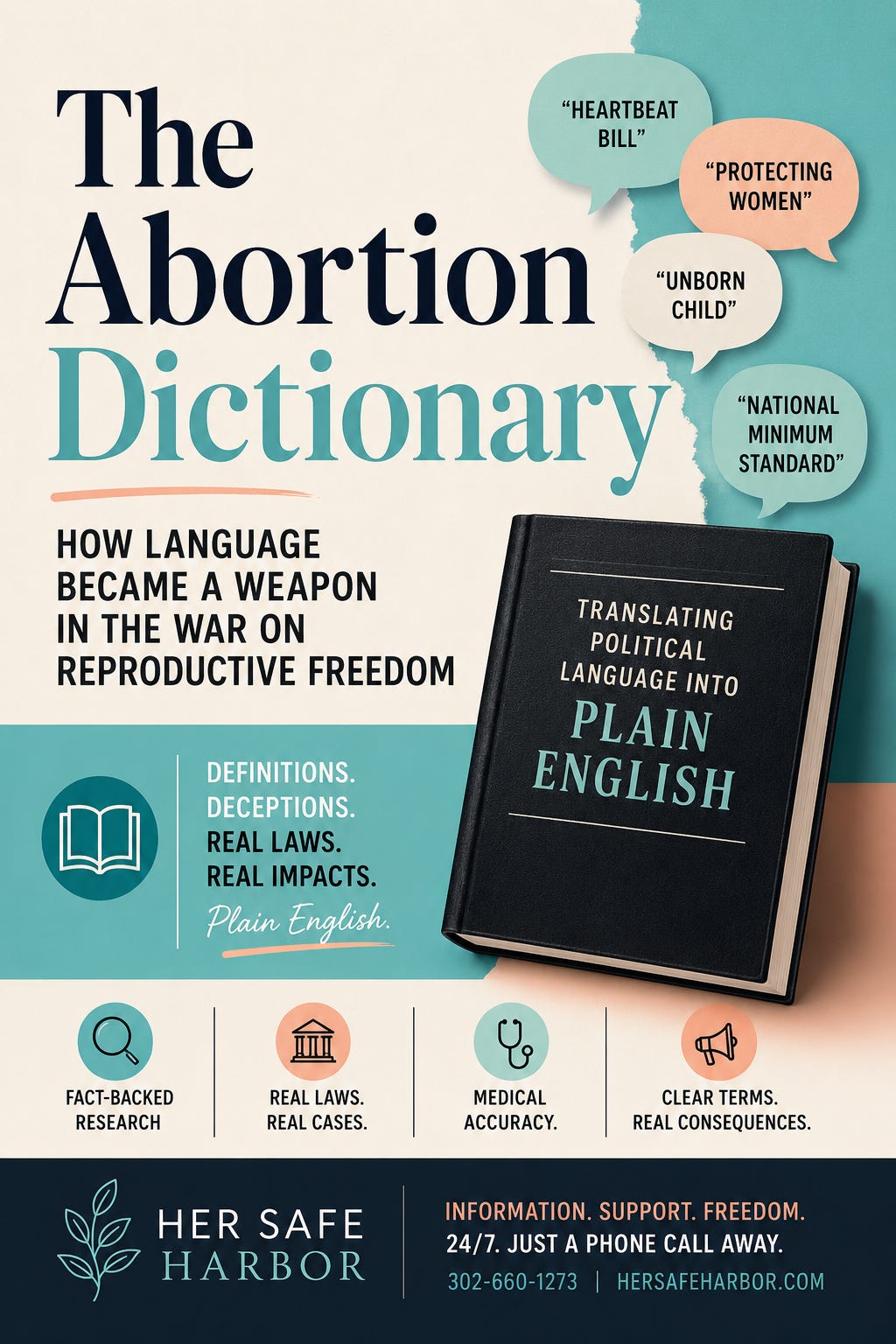
Few political phrases have been more successful than heartbeat bill.
The phrase immediately creates an emotional image.
Most people picture a tiny heart beating inside a developing baby.
That image is precisely why the term is used.
Medically, however, what ultrasound technology may detect around six weeks is electrical activity within developing embryonic tissue. A fully developed four-chambered heart does not yet exist at that stage of development.
Yet state after state adopted legislation using “heartbeat” in the title or public messaging because it communicates something far more emotionally powerful than “embryonic cardiac activity.”
Congress continues to use this language today. One current federal proposal is titled the Heartbeat Protection Act, framing the legislation around the emotionally resonant concept of a heartbeat rather than describing it simply as a nationwide abortion restriction after detectable cardiac activity.
Notice what happened.
The science didn’t change.
The branding did.
When Senator Lindsey Graham introduced a proposal to prohibit abortion nationwide after fifteen weeks, he increasingly described it as a National Minimum Standard instead of a national abortion ban.
Minimum standard.
It sounds reassuring.
We have minimum standards for food safety.
For drinking water.
For building construction.
Minimum standards protect people.
Except this wasn’t establishing a safety standard.
It prohibited abortion nationwide after a specified point in pregnancy.
The restriction remained exactly the same.
Only the packaging changed.
That’s political framing at work.
Perhaps no phrase carries greater legal consequences than fetal personhood.
At first glance, it sounds difficult to oppose.
Who could argue against personhood?
But personhood laws do something extraordinary.
They redefine fertilized eggs, embryos, and fetuses as legal persons with rights that may compete with—or even supersede—the rights of the woman carrying the pregnancy.
This isn’t merely symbolic language.
It has enormous legal implications.
If an embryo is legally a person, questions immediately arise about IVF, miscarriage investigations, emergency obstetric care, criminal liability, inheritance law, and constitutional rights.
The Alabama Supreme Court’s embryo decision dramatically illustrated how recognizing embryos as legal children can disrupt reproductive healthcare far beyond abortion, prompting IVF clinics to pause services while lawmakers rushed to respond.
The phrase sounds like expanding rights.
Its practical effect is often redistributing rights.
No one wants a newborn denied medical care.
That is exactly why legislation uses titles like the Born-Alive Abortion Survivors Protection Act.
The title suggests physicians routinely abandon living infants after abortion.
Existing law, however, already recognizes infants born alive as legal persons entitled to medical care.
The emotional force of the title comes not from what the bill does, but from what it encourages the public to imagine is already happening.
The title itself becomes part of the argument.
Some of the country’s most restrictive abortion laws have included references to women’s health.
That sounds reassuring.
Who opposes women’s health?
Yet courts have repeatedly examined laws requiring abortion clinics to meet standards unrelated to patient safety, such as medically unnecessary admitting privileges or ambulatory surgical center requirements.
In 2016, the U.S. Supreme Court concluded in Whole Woman’s Health v. Hellerstedt that Texas had failed to demonstrate health benefits sufficient to justify the burdens those requirements imposed on abortion access.
The title emphasized health.
The legal dispute centered on whether the restrictions actually improved it.
Who could oppose informed patients?
That’s why many states adopted legislation titled Women’s Right to Know Acts.
Real informed consent is a cornerstone of medicine.
But these laws often require physicians to deliver counseling scripts written by legislators rather than individualized medical counseling based on a patient’s circumstances.
The title invokes patient autonomy.
The mechanism often increases government control over the physician-patient conversation.
This phrase has quietly begun appearing more frequently in policy discussions.
It sounds clinical.
Almost pathological.
But most of the time it simply describes a woman who doesn’t yet know she’s pregnant.
That is not unusual.
It’s biology.
Many women discover pregnancy after six weeks because menstrual cycles vary, contraception fails, implantation timing differs, and early pregnancy symptoms are often absent or mistaken for something else.
Calling this an undiagnosed pregnancy subtly changes the narrative.
Instead of acknowledging that early pregnancy frequently goes unrecognized, it suggests pregnancy should already have been identified.
That shift matters enormously in states enforcing six-week abortion bans.
If pregnancy is expected to be diagnosed almost immediately, responsibility for missing the legal window quietly shifts from biology to the woman herself.
Trafficking is among the most emotionally charged words in the English language.
It evokes organized crime.
Exploitation.
Violence.
Human suffering.
Increasingly, however, some lawmakers have applied that same word to helping women travel across state lines or obtain abortion medication.
Helping someone obtain healthcare becomes “trafficking.”
The legal proposal may not have changed.
The emotional reaction certainly has.
Historically, “aiding and abetting” referred to participation in criminal conduct.
Today, similar language has appeared in abortion-related proposals targeting referrals, transportation, financial assistance, or simply helping women obtain legal care elsewhere.
The phrase transforms acts of support into language associated with criminal conspiracy.
The vocabulary itself changes public perception before a single prosecution occurs.
Medical professionals typically distinguish between embryos, fetuses, and infants because those words describe different stages of human development.
Many abortion laws instead consistently use the phrase unborn child.
Again, the choice is intentional.
The phrase encourages readers to picture a newborn rather than an embryo only a few millimeters long.
It is less a medical description than a narrative device.
This may be one of the clearest examples of political language becoming legal language.
“Partial-birth abortion” is not a medical term recognized as a specific clinical procedure.
It was created as a legal and political phrase before eventually appearing in federal legislation and Supreme Court opinions.
Once again, language shaped public understanding long before most people understood what medical procedures were actually being discussed.
Language doesn’t merely influence campaign speeches.
It shapes judicial outcomes.
South Carolina’s Supreme Court, for example, analyzed the meaning of language surrounding fetal cardiac activity when interpreting the state’s six-week abortion law. Even when legal disputes revolve around definitions, those definitions can determine when abortion becomes unlawful.
One word.
One definition.
One sentence.
Those choices can determine whether millions of women retain access to healthcare.
This isn’t simply semantics.
It’s democracy.
If lawmakers described every proposal in plain language, debates might sound very different.
Instead of:
Heartbeat Bill
They might say:
Government prohibition on abortion beginning around six weeks of pregnancy.
Instead of:
National Minimum Standard
They might say:
Federal abortion ban after fifteen weeks.
Instead of:
Fetal Personhood
They might say:
Granting embryos and fetuses legal rights that may conflict with the rights of pregnant women.
Instead of:
Abortion Trafficking
They might say:
Helping a woman travel for reproductive healthcare.
Those descriptions are less emotionally powerful.
They are also more direct about what the laws actually do.
Every political movement uses language strategically.
But reproductive healthcare has become one of the clearest examples of how changing vocabulary can change public understanding.
Restrictions become protections.
Bans become standards.
Government mandates become informed consent.
Surveillance becomes safety.
Healthcare becomes trafficking.
The language isn’t incidental.
It is part of the policy.
Because once the public accepts the words, accepting the law often becomes much easier.
At Her Safe Harbor, we believe women deserve something remarkably simple: honesty.
Call an abortion ban an abortion ban.
Call criminal penalties criminal penalties.
Call medical care medical care.
Women deserve evidence-based information, not carefully engineered political branding.
The debate over abortion will continue.
But that debate should begin with language that tells the truth.
Not language designed to hide it.
Her Safe Harbor provides confidential, evidence-based reproductive healthcare for women from all 50 states through private phone consultations with U.S.-licensed providers.
24/7. Just a phone call away.
302-660-1273
HerSafeHarbor.com
Comments
Nothing yet. Say the first thing.
Sign in to join the conversation.