
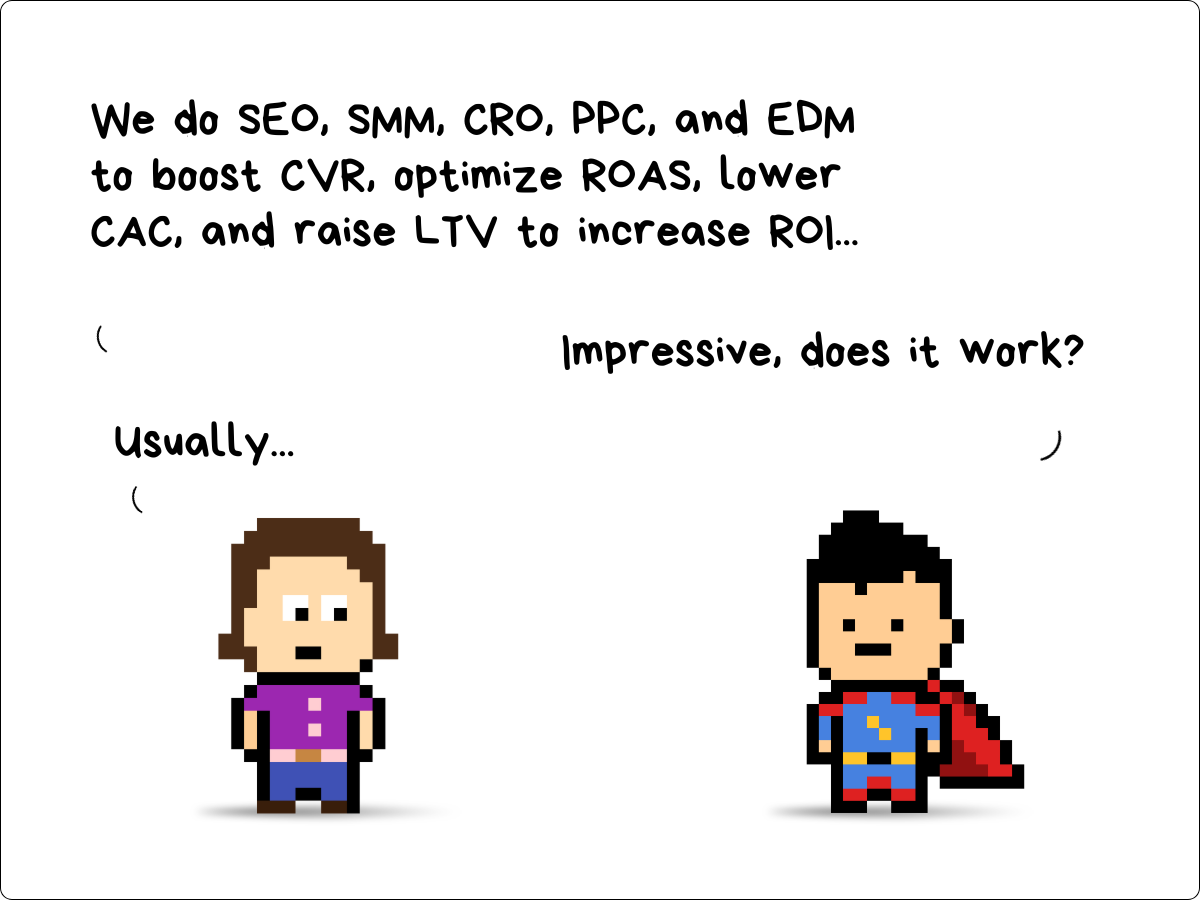
We are drowning in acronyms.
This isn’t even an exhaustive list:
SEO, SEM, PPC, CRO, SMM, EDM, CPC, CPM, CPA, CTR, CVR, ROAS, CTA, USP, UGC, PR, B2B, B2C, DTC, TOF, MOF, BOF, UTM, LTV, CAC, CLV…
That is a lot… but what if I told you that they are not really acronyms?
As it turns out, an acronym is a short word made from the first letters of a long name or phrase that is spoken as if it is a new word. Like the word laser:
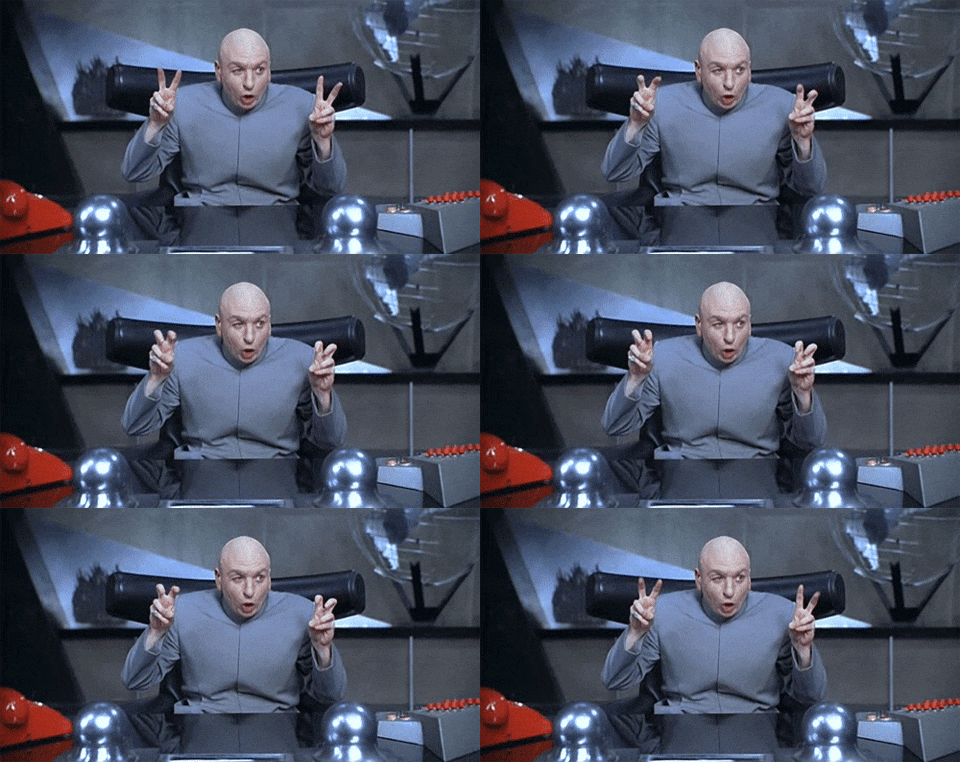
That’s right, laser is short for: Light Amplification by Stimulated Emission of Radiation… which doesn’t quite roll off of Dr. Evil’s tongue the same way as “LASER.”
Other ones you know — NASA, NATO, SCUBA, RADAR, CAPTCHA, and evem the ZIP in ZIP code.
The acronyms we are better suited to spout off in a weekly report of inflated numbers and obfuscated data are actually initialisms. Like mine, CRO, is not spoken the same as the bird. We have to spell it out.
Gimme a C!
Gimme an R!
Gimme an O!
What does that spell?!?
RETAINER FEE!!!!!!!
Something like that.
We spell out our industry niches’ names so we don’t have to spell out what it entails, because most people sell 3-letter words like they are 7-letter word because they themselves are 4-letter words.
Ok, back to the point. When it comes to any of the digital marketing acronym (big meaning services you pay for or spend way to much time trying to figure out), there are always 2 sides, and it is the same 2 sides for each one:
Customer-side
Technical-side
It doesn’t matter if its paid or organic traffic, spamming with “electronic-mail,” or changing button colors, there is always and only the customer-side and the technical-side.
This is as basic as business gets. A person has a need, you sell the solution. It doesn’t matter if it is a physical good, a professional service, access to something proprietary, or a piece of art… someone needs something.
Obviously it gets plenty complicated. There are market factors and competition that come into play to make it harder to sell to that customer. And it is up to you, the business, to understand their need and meet them with the most apt solution.
If you do, good. If you don’t, good for the next business that does.
This is a constant in business.
Since we are talking about ecommerce and digital marketing, the other constant is the technology we use to conduct business.
SEO is the best example to explain the technical side. And come to think of it, I can show you this by taking a screen shot of this right now:
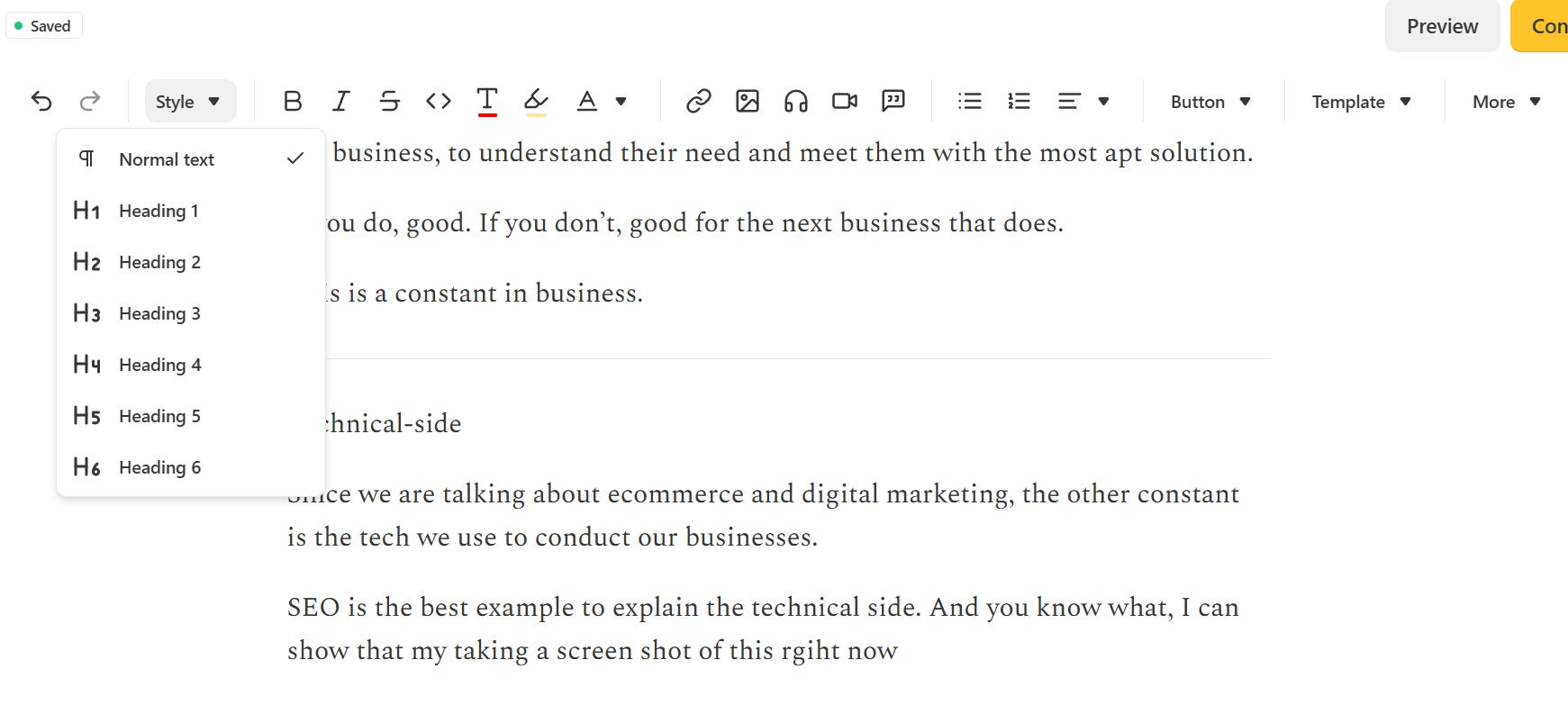
This is exactly what I am seeing this very moment in the text editor of Substack.
That bar at the top allows us to make it more fancy than a magazine article by adding highlights, links, images, bullet points, and a bunch of other stuff.
But first and foremost, this bar starts with the settings to make our text legible to search engines…. ohh the mighty SEO rears its ugly head before we have even emphasized a word.
¶ Normal text
When I choose one of these for a block of text, I see the font size change in front of my eyes... But that is not what we are really changing.
H stands for “heading” and an H1 tag tells search engines that this is THE heading. The big important one. That this is what the page is about.
H2 is a level down in importance but shows subsections that are important to understanding the body of the content… and so one.
These headings are technically distinct, and are important for SEO. If you write the best, most authoritative blog article in the history of blogging, and a search engine is confused because you mixed up your heading tags, you won’t be seen by many people. It doesn’t determine what is most important for you. You have to tag it with the the right “h.”
SEO and CRO both start by deep research on the customers’ behavior on both search engines and on your website. Those learnings are then translated to optimizations which, to varying degrees, requires technical implementation and dev work to see it through…
SMM (social media marketing), PPC (pay-per-click advertising), and EDM (email direct marketing) are also fun ones that requiring a deeper understanding of how customers interact with particular forms of content on particular platforms. And each platform has its own level of technical know-how needed to be successful.
Understanding your customer is the underlying factor of successful marketing and business. It’s a timeless topic in ecommerce because our day-to-day revolves around the technical-side so much that we forget to first focus on the customer-side.
It surprises me how excited business owners and directors get when you show them raw customer feedback… eyes widen as they look at it like its some oracle of wisdom.
Because it is.
So now let’s now tie this back to Mouse Whisperer. It was early this Monday morning when I started writing, so I went with whatever direction my Trader Joe’s cold brew coffee took me, but I ate breakfast and now I think I remember what I’m doing here…
If you are trying to optimize a website to get more sales, the very first question to answer is: How do customer navigate my website?
Whether you are driving traffic to product pages or collections, or the homepage or through blog articles, people come to your site and click around, trying to convince themselves that they found what they are looking for.
We want to know how they attempt to accomplish that. And it isn’t a secret, we just need to know what pages their visit.
So let’s start a Store Snapshot so we can see that data:
This shows you which pages your customers are engaging with and let’s you rank them according to what is important to you (sessions, CTR, CVR, or revenue).
When you have dozens of pages and hundreds or products, it’s hard to know which ones deserve the most attention… the Store Snapshot takes care of this without wasting a lot of time.
Tomorrow we will look at the results and see which pages we want to dig into to.
Until then, Like and…
- Shep
If you want to try out the app — https://apps.shopify.com/mousewhisperer; if you don’t want the app but need CRO, email me — shep@therealheroesofecommerce.com
Comments
Nothing yet. Say the first thing.
Sign in to join the conversation.