
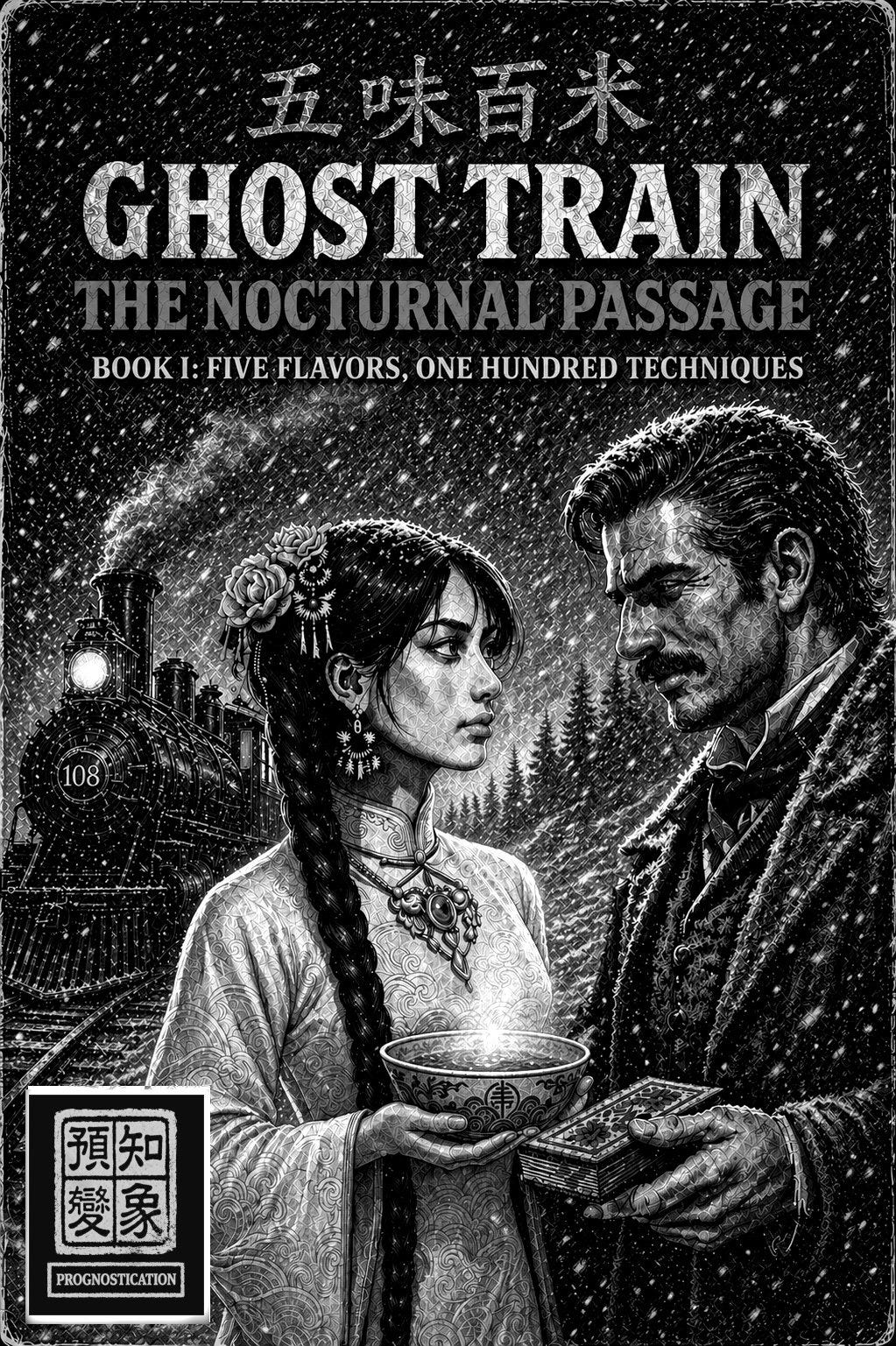
THE NOCTURNAL PASSAGE
1
Some lessons are worth dying for.
April 17, 1892
Every dog in Vacaville had been facing east since Sunday morning.
It was peculiar enough behavior that ‘the cause’ had become the popular topic of speculation around the poker table. In answer, Tuesday, the first tremor rocked the sleeping town at 3 A.M. We felt it first in our guts, then witnessed the ripples in our whisky tumblers, then the quake shuddered up through the Palace Hotel like a morning stretch waking all the sleeping guest where I lodged.
The deep rumble in the earth set the dogs to howling as if to say, ‘we warned you.’ As the tremor waned, however we found that the damage was modest. Aside from setting the crystal to chattering, then to destruction upon the floor of the smoking room where we played cards. We also found that a rosy-cheeked plaster cherub had been shaken loose from its perch atop the archway leading into the smoking room. The unfortunate chubby lad still had a smile on his cracked face as we swept him up into the dustbin.
It was already past time to go to find my arrangements and though the cards had been flowing as sweetly as was the whisky the disturbance was enough to dampen the spirits around the green felt. When at last we tucked back in to deal, the men had lost their jovial countenance and only managed to laugh in that thin way all men do when reminded that everything, including foundations, including their lives, are temporary especially this close to San Francisco.
We played two more hands to show that we were unaffected, then the game resigned itself with the veneer of excuses according to the time.
When I woke it was near enough to noon that the scuttlebutt was all around town, the track in Winters had been damaged. This was enough bad news for me so that I made my intentions to the desk clear, I would be checking out of my lodgings. I took a coach to the depot and secured a ticket on the Overland Flyer and cut my stay short. I had thought to stay in San Francisco until July and then travel east to secure a printing house for this journal in Chicago by Summers end, but with this unexpected change of plans Spring seems more reasonable.
I left California, from Sacramento, the next morning.
The Eastbound Overland Flyer carried me first along the old Central Pacific iron. I had overheard some small talk and whispered concern amongst the rail hands in Rocklin that the stretch of track known as the “40 miles of trouble,” the climb up over the Sierra summit, may have been damaged by the quake. That stretch was notorious and difficult, still waiting for the section gang to replace the old iron with new steel. However, once we were comfortably riding the mainline, through Palisade, Elko, to then make the southern dip into Ogden it became obvious that their whispers were misplaced. The Chinese hands that had coaxed the iron over the Sierras in ‘68, and then on to meet the Union Pacific at Promontory Summit, had done a proper job of it.
Say what you will, but the Chinese are an attentive, noble, and industrious people. The old iron hums a different tune than the new steel sings, if a man attends to it. As though the two were not made of merely different materials but drawn from different worlds. The steel is stronger, obviously. But the iron is flexible, like water, able to flow around any obstacle. The older rails have much more to say beneath a loaded freight train. The new steel answers with a firmer tone. It is a trivial observation, yet railroads, like card tables, reward the attentive.
April 20, 1892
I broke the journey along the way, and found three games. Reno was honest enough, played badly perhaps, but without design. In Elko I walked into what I can only describe as a Bacchanalia, we played cards, yes, but there was much more drinking and song than the muted tink of chips being tossed on to the felt.
The men gambling at the table with me were sinning certainly, it was just not their cards they were cheating on.
I am certain it was there that one of those revelers made off with my Ulster. That coat had come to me in my younger railway days from a silent northern clothier who spoke mostly in hmm’s and nods, and its wool had stood at my shoulder through more hard weather and long miles than most companions are willing to endure. I loved that coat.
I will confess that leg of the journey was not my finest hour. The soirée had been dancing for some time before I arrived and was still, at least breathing, when I left. My departure was not announced by my own good sense, nor apologies to the new friends, or handshakes and claps on the back. No, it was the Overland Flyer’s whistle, announcing its arrival to the city, which alerted me that I had quite nearly overstayed my ticket. I hurriedly collected my Gladstone bag from behind the bar and dashed to the station.
Spent from effort I was quickly lulled asleep by the rocking of the Flyer. When I awoke several hours later to the majesty of the Tetons and the cold of a fierce spring storm into Wyoming, I reached for my coat out of habit only to find it was not with me.
In my addled state I made the valiant attempt to piece the previous evening together, and when I surfaced from the effects of the whisky, I recalled a woman who had faded out the door behind the fog of cigar and cigarette smoke.
Sable haired, bright-eyed, her attire the sort that would earn her a $7.50 fine in Laramie if she was caught on the street after sun-up. She was dressed for bad behavior, not for bad weather. In looking back, as the party was winding down I recalled her leaving through that door. She waved at me and blew out a kiss, nodded to the bartender, he and I exchanged a look, each of us with the certain knowledge that the Sable vixen was up to no good.
With a small chuckle he nodded to her and I waved her goodbye. I didn’t think about it at the time, but she was certainly in that moment better clothed than when she had arrived. As I want to curl up in my coat I know for a certain fact she was wearing more going than she had been coming.
I shouldn’t be too hard on myself however, I was too far into my cups at the time to have put the caper together, and I bear her no ill will, it was a good trick, dishonest but well executed. That Ulster will certainly keep her warm and maybe save her a $7.50 fine.
With this storm outside the window now as I write, and we steam past Rawlins, I do wish I had that coat. I should remind myself to write more about the evils of alcohol and loose women as my journal is complete with regard to card sharps.
April 22, 1892
It was, however, the third game in Ogden that has occupied my thoughts.
The saloon was named “The Star.” Though if the name was meant to be used as a navigational reference, from what I witnessed, it only served to lead men astray. A somewhat untidy and unremarkable establishment, a short walk from my evening lodgings. Within its four walls sat a cast iron stove filled with coal and glowing red hot. Between the shutters and the stove set a poker table, filled with cold men. From the moment I sat with them it was obvious they had little desire to make pleasant conversation, nor invite it, nor give their names.
At the center of this homely tableau was a young, unskilled, strawberry blonde man, trying his hand at cheating the cards and doing it rather poorly.
It appeared to me as this was his first dance with cheating, at least publicly, and I further thought his choice of venue for his debut was rather poor. I resolved to observe him until I was certain his fumbles would earn him the business end of a Colt Army revolver of which I could see three seated at the table.
The strawberry man employed a corner wedge and crimp at the lower right of the deck, a technique executed well enough in its skeleton and detailed in an earlier section of this journal. He chose to secure his break with a pink wedge of flesh provided by his little finger, thus nullifying the cut when it returned to him allowing him to keep his stock on top.
His execution, however, was clumsy. He drew my attention by excess motion, and then in attempting to correct his fumble, betrayed the very cheat he hoped to conceal. The men at that table may not have known the name of what he was doing, but they would not need a name to draw their iron on it should they detect his cheat.
I caught his eye and let my expression do the work. It was enough. He understood immediately that his enterprise had been observed, and by someone who could describe it in terms he would not care to hear repeated at that table. He wisely chose to cease all artifice, lest one of these cold men introduce him to the hot end of his pistol.
Later, when I addressed him privately, he apologized and confessed to having fallen into hard times. He thanked me, professed to being a Mormon and a man of God, and agreed that drinking, gambling, and cheating were no proper way to conduct oneself.
At first, I thought my intervention sufficient, but somewhere before the continental divide near Creston, another thought slipped past my position and began to test my foundations. I sat quietly on the unsettled ground, staring past the frost that had built up on the glass of the coach car as we steamed through Wyoming and the inhospitable, frozen, countryside beyond.
As the miles passed behind me and I relived the chain of events, I turned the thoughts over in my mind until they took root. They were intrusive, noisy, ceased to feel like my own thinking, and began to feel like an obligation I had been willfully neglecting.
I returned to this journal the way some men turn to scripture, took up its pages, and in reviewing the passages I had previously written, found cause to make this amendment.
The technique this strawberry fellow employed I have referenced a few pages earlier pages as ‘The Mormon Shift,’ after this unskilled card mechanic and his confessed affiliation to that particular faith. While his technique was not unique in execution, it is novel as well as regional. I have observed this type of shift in Utah, California, Texas, and Nebraska before once more witnessing its employ last evening in Ogden.
Upon reflection, however, a man who repents that gracefully deserves better than to have his denomination attached to a piece of crooked card work. I feel geography makes the better argument for a suitable name. Until I should land on a more fitting designation, I shall refer to this technique as the ‘South-West Shift.’
The shift is, by its nature, more compact than the diagonal palm shift. (this method being already set down among the légère de main in the back of this journal) Similarly it is less exposed than the open shift when the pack is held face down in the left hand. The S.W.S., when properly executed, is all but undetectable.
In the course of correcting the gentleman from Ogden, I found myself demonstrating the proper execution of the thing no fewer than a dozen times before he could see where his own handling had failed him (and I could see where a slight variation would greatly benefit its utility).
It struck me then, with some force, that an illustration plate showing the exact offices of the hands would settle the matter at once. I need to mark this. I will endeavor to find an illustrator at once. I do feel I owe the strawberry mechanic, unskilled as he was, a small thank you for this lesson taught.
I should like to find a good illustrator for the completed work, as descriptions accompanied by illustrations will lend much to one’s grasp of the activity and office of the hands. I suspect there will be those who will defy anyone to learn any technique from reading my finished work!
To those readers I would say only that the fault lies not in the description but in the hands receiving instruction. A patient reader with sufficient time to practice is not so different from a patient student with a willing instructor. By demonstrating the location of my hands, placing them between us as such, I had become his patient instructor.
The South West Shift:
The break is retained at the inner end of the deck, between the lower packet of the cut and the upper packet. The little finger retains the break lightly, with a wedge of flesh, while the thumb rests at the outer edge and the second and third fingers support the right side. The right hand approaches as though merely to square the deck, the thumb contacting the outer left corner and the second and third fingers closing at the lower right. By pressure in opposite directions, outward with the left thumb and inward with the right second finger, the lower packet is pressed free and the upper carried beneath in one continuous action. The motion, if properly performed, resembles no more than a natural squaring of the cards; the packets reverse in a flash, and the break disappears of its own accord.
Its merit lies in its economy. There is no extravagant dip of the wrist, no suspicious elevation of the hands. The fingers appear at all times to lie above the deck. The action should be practiced slowly with a mirror until the hands learn their offices without complications.
April 23, 1892
The strawberry gentleman from Ogden possessed the skeleton of the cheat, but not its flesh. He relied too much upon a crimp and not enough upon pressure. A shift of this character must be felt more than seen. That is the mechanic of the deception, but not the reason behind my consternation.
I have long maintained that observation alone was sufficient justification for my attendance at certain tables; that by losing modestly and watching closely I did no more than tuition myself in the habits of men.
My sin, however, I have begun to suspect is that silence may be a quieter form of encouragement, perhaps even patient encouragement. For me to so fully understand the mechanism of artifice and refuse to name it is to leave it oiled for continued use.
My hope now, going forward from this moment, is that this book once published may enlighten those who look for a game devoid of craft and deception.
I am making note here, for myself, so that the incident in Ogden may serve as a suitable preface to the final work. If I am to place these matters before a publisher, Chicago being not without its houses willing to entertain a manuscript of peculiar subject, then the reader should be warned both of the dangers of the green cloth and the grace by which they may be enlightened.
As I went to close my journal, I was stopped by that persistent voice that like a hangover will not simply hush its mouth. I will close the pages, and sleep if I can the last few hours into Laramie, but not before scribing this note.
I’m not a pious man, but as it happens, I was this strawberry blonde man’s fellow parishioner, and I felt I must commit my confession to paper.
He was a man of faith on hard times, turning to vice instead of his congregation. I, myself a man of studied neutrality on the question of where morality and immorality conduct their negotiations, held his sin up to the light and showed him where his catechism lacked conviction.
Each of us, in our own way, donning the same vestments of green cloth for entirely different purposes. We are all communicants at the same altar, though not all of us come to praise skill. While cards may not be a holy pastime, cheating at them is wholly damnable.
Tomorrow I will give this an honest read, but now it’s time to rest. I reached for my Ulster, out of habit. I guess I’ll just have to tuck into myself for this last cold stretch into Laramie.
2
I put the journal away somewhere west of Laramie. Outside the window the plain ran flat and dark, covered in a thin white sheet of crusted snow. Here and there black tufts of sagebrush poked through what the storm laid down giving the world the appearance of black letters on white newsprint. As we drew closer a structure would make its presence known through the waning gray of the pre-dawn sky. A home, a barn, a fence line uncoiling down the track leading to the town coming up.
It had been twenty-four years since the end of track came through and what they called ‘Hell on Wheels’, the camp at the end of the track that moved west with the men, leaving behind whatever wasn’t portable. Which in the case of Laramie Wyoming turned out to be enough to build a city.
The barbed wire fences my eyes had been following ended abruptly in a corner reinforced with wooden fence posts shifting the angle of the run from following the track southwest to make the abrupt cut turning left towards the north and running off into the dark. At this corner the railyard came up on the right, three rows of track in all and the one closest one to us had a long freight train standing on it ready to go. Its headlamp was blazing a yellow-white as the coach I was sitting in passed it. As soon as we would come to a rest at the platform, I was certain it would begin its way west on the track we just cleared. The train was comprised of cars after cars of coal hoppers. Coal out of Carbon or the spur up to Hanna, on its way west to provide fuel to the industry there.
As we slowed, I counted cars for something to do and got to eighteen before I could see the depot up on the left. I lost interest as my eyes were taken up through the plumes of steam and into the thinnest line of light peeking up over Pilot Hill to the east. The dull purple spread across the summit to the east, a distant reminder to the sleepy town that winter was still in the fight. I pulled on the chain of my pocket watch and checked; it was just coming up on 4:30am. I didn’t know if this was early or late for Laramie, but the whole world outside seemed not bothered much by our arrival.
The snow lay not fresh, but wind-scoured like the rest of the State, packed hard against the side of the houses and in the places where the wind whipped it up to eddy down in the hollow and pack in to becomes tomorrow’s dirty ice. It would pick up the coal soot, dust and dirt from the ceaseless wind and be melted some in the cold sun before frozen solid again at night.
To the west, my right, the Territorial Prison rose from the plain in cold severity. The absence of morning light making it cut a cold dark hole out of the horizon where its walls hinted at its design of stone and iron bars with stark outline.
The coach began the familiar reorganization of anticipation. People stood before the Conductor announced the stop. Coats came off hooks. Scarves wound tight. A woman across the aisle buttoned her daughter into a wool jacket two sizes too large and told her to ‘stop her fussin’.
The Conductor walked through the four cars repeating, “This stop Laramie. Simpson & Campbell has food and coffee. Third street, hard to miss.”
I gathered my bag and what remained of my patience, which was not considerable. Outside the window, the wind had opinions, which it was more than willing to share with me on my choice of outer gear. Inside the coach so did conductor who offered, “I’d put your coat on sir, quite cold out.” I thanked him with a wordless smile, trying to be well mannered, as he made the passengers witness to my plight. My first order of business really must be to secure a proper overcoat for this weather. My prospects at this hour looked as dull as the morning sky.
The Laramie Range does not moderate weather so much as manufacture it, and the storm we felt accumulating since Rawlins was presently doing its level best to make the platform invisible. Still, the track looked clear enough, the way a swept floor looks clean until you wake up on it with pebbles and grit stuck in your cheek. I’m not speaking from experience, I’ve only heard such things.
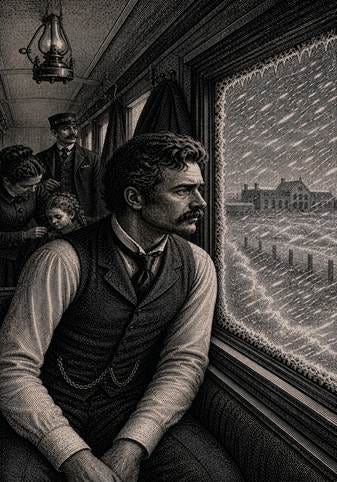
Since the conductor engaged me, I asked the rails between Laramie and Cheyenne would be like in this storm. As this was the next leg of my journey, possibly it would be just as well to hole up in Laramie for a few nights before pressing eastward. He gave me the kind of answer that told me he was bored and trying to stretch out the few words required into a performance.
“Fifty miles, more or less. Less than two hours in good weather. Three if you’re pullin’ allot and if the engine was working harder than it wanted to. On paper, a short run. A light afternoon’s work for the engine.” He adjusted his hat and pointed out the window, painting the scene for me with his hand scaling the imaginary slope.
“The problem is Sherman Hill in this weather” He elaborated.
He went on about the grade out of Laramie, “…not vicious, by mountain standards.” I lost him as his words stretched out like the climb out of Sacramento through Truckee. He mentioned something about the grade being under a percent for the better part of the climb. And though I found his knowledge useful to a degree, I was already dreading walking out into the blizzard and picturing myself chugging along the streets of Laramie, where the grade wasn’t a concern, but the wind stopped being polite.
I pulled back into the conversation as he got to the heart of the matter, “Sherman Hills’ a thousand feet up from Laramie, and the descent into Cheyenne on the far side Is plenty steep. We spend more time on the brakes than the boiler.” He fussed with his finger in the air, stirring around in the accumulated snow outside the window, “Three hours,” he said. “Could be four. Depends on Sherman and the snow.”
I wiped the fog from the glass with the heel of my hand as he passed. My skin squeaked against the cold and the fog came back almost immediately. In that short moment, through the window I made on the glass, I could see a few lights here and there. The town, not fully awake, was stretching into its morning.
This was just a water and passenger stop for the Flyer, it wouldn’t stay for long. Cheyenne was the real stop and, I supposed if the conductor was right they would be heading down Sherman by Dawn. The rails ran by the clock. The burst of activity pushed through the steam with dozens of porters and agents diligently working. The Flyer would stop for thirty minutes, to the second. You could almost always count on trains to run on time. Lives depended on it.
The engine needed tending to more than the passengers. After steaming across most of Wyoming it needed a drink of water, and to take on more coal and sand for the run down into Cheyenne. Most of the passengers weren’t getting off here, so we could move at a pace, watch the activity and wonder at the marvels of modern life.
As it turned out the only passengers exiting the coach were myself, a family of four; two children and too many bags, and a cattleman who’d been asleep since Rawlins.
The family was already in the aisle, the father wrestling traveling bags down from the overhead while the mother kept fussing over the daughter’s coat. The girl kept pulling toward the window. Excited. New place, maybe. New home. Their boy, quiet and well mannered, stood next to his father and helped with the bags.
The cattleman had almost woken up somewhere around the last curve into Laramie. He was in no hurry and was taking his time about actually committing to opening his eyes. Eventually when the Conductor announced, “All out! All out for Laramie!” He tilted his hat back to his forehead and measured the car the way men do when they want you to know they’re measuring it.
His eyes found me and stayed longer than was conversational. He had the size of me before He stood up. Didn’t take to what he saw, either. It was all over his face.
He wouldn’t be a very good poker player, but he certainly knew how to spot one.
I let him take a good look, no harm. Then followed the family down the aisle and out into the cold.
The platform was ice beneath my boots. No sun yet and I imagine I took on the pallor of the eastern plain, pale and cold. I rubbed my arms through the thin suit coat I was wearing and gently chided myself again at the loss of my Ulster. My breath hung in front of me like it was in no hurry to go anywhere, then whipped away in a burst of Wyoming’s notorious wind. I proceeded to a ticket window to inquire about a haberdashery that would be open soon.
A dog of no particular breed lay beside the station door on a folded blanket. He looked at me with curiosity, but unimpressed, he laid his head back down and showed me his back as if to make the point that one of us had a coat.
A young man in a porkpie hat was selling papers for a nickel, hollering something about Congress and the Chinese and whether the Exclusion Act would be renewed or strengthened. I didn’t stop to listen.
I would be the next headline if I didn’t get a coat soon.
The ice gave way to sand under my boots as I made my way to the ticket window. Someone had the presence of mind to throw handfuls of sand across the worst of the ice and there at the ticket window, with the heat rolling out I inquired as to the haberdashery. I was pointed to Second Street. In Laramie, everything could be found on Second Street. Gratuitously the ticket agent informed me, “You can buy a coat at Durlacher & Co.” Adding, “…if you need one.” Laramie was proving to be a very helpful town.
First, I secured modest lodgings near the intersection of Second and Grand. The window rattled in its frame as I stood in front of it staring across the street at Durlacher & Co. The ticket agent was right, nearly all of the commerce in Laramie was conducted along Second street. From my vantage I could see the black wall of weather descending from the Snowy Range, clouds stacking against the peaks, in a way that suggested they had business with the town and it had better be prepared. I was all too aware that I was not prepared, and so I watched the store front of Durlacher’s until I saw the first sign of movement and light from within.
Most of the shops on the street were still dark, but one showed lamplight through the window. I could see movement inside. That was enough for me. If I didn’t make this my priority, I, as well as the town would be buried by morning.
As I approached the glass storefront something about the window display and the careful arrangement of the items it held suggested the company had fallen on tough times. The economy of the display was sparse at best.
The bell rang as I tried the door. It opened.
Behind the counter, a woman in black looked up from lighting the lamps. She wasn’t old, I guessed in her early 30’s, my guesses were generally fairly good. She was tired however in a way that had nothing to do with the hour. Her hair was pinned with the kind of precision that comes from doing it alone every morning. Three girls moved around the shop, the eldest lighting lamps while the younger two straightened shelves with the practiced efficiency of children who’d learned to work early. I could feel it in her slow inhale as the bell shined out into the quiet space, that its trill woke up familiar words that she wasn’t ready to speak.
She took one look at me, and though her mouth opened to speak those words, ‘we’re not open yet.’ She saw me and something more like sympathy crossed her face, though it could have been humor.
“It looks as though you may have forgotten something, sir.” I believe I laughed out loud, which made her smile and the girls giggle.
“My coat, madam. Though I assert I did not so much as forget it…” My tone hinting at the fact that I knew I was hedging, slightly, “…as it grew legs of its own and abandoned me in Elko Nevada, where it was considerably warmer.”
“Well, you’ve come to the right place. I’m Mrs. Durlacher.” She glanced at the girls, which silenced their tittering, then back at me. “Though we don’t properly open for another hour. I think we can make an exception, you’ll catch your death out there today, there is a mighty storm coming.”
I took in the shop as I made my way forward. Neat, though sparse. On the shelf behind Mrs. Durlacher, above the collar boxes, a photograph in a simple frame. A handsome fellow with fine mustaches standing outside this very shop. A black ribbon crossed one corner.
“My apologies, madam. I did not mean to intrude upon your mourning.”
Her face changed, not with surprise, but something closer to gratitude that the thing that set on her shoulders and showed in her face had been named aloud by someone who didn’t require her to explain it.
“You are not intruding, sir. If not for our business, I would be even more lost.”
Her gaze dropped, quick and professional, taking me in without staring. My shirt. The suit jacket. My lack of anything resembling appropriate clothing for the storm brewing to the west.
“Without a coat. This is no way to live in Wyoming, in April, during a blizzard. Is the story interesting at least?”
“I’m of the same mind Ma’am. I had an Ulster, fine coat, I imagine it to be keeping someone with light fingers and a light spirit warm in Elko.”
She smiled, “Oh, a Light spirit you say?” She was quick, didn’t ask me to explain any further, but her small, practiced smile, nodded towards understanding that a woman was involved. It wasn’t a false smile, just the kind I would expect from your mother, or at least I from mine, rest her soul. Disappointed, but not surprised.
Mrs. Durlacher continued with a set in her jaw and a let’s get to it look, “I’ve seen my fair share of Wyoming in springtime. Shall we fix you properly?”
I smiled back, instantly enjoying her company, “Properly, if you please. Would you happen to have an Ulster coat in stock?”
The eldest girl appeared from the back with a cloth tape measure looped over her fingers. Twelve, maybe thirteen. She took a position beside her mother without being told, the tape already unwinding between her hands. She’d done this before. The two younger ones watched from behind a shelf of folded shirts, whispering, until their mother’s eyes found them and they became quite busy again with pretending to work.
The widow Durlacher pulled a dark wool coat from the rack, held it at arm’s length, considered it, put it back, “A coat that will fit, may be difficult, you’re rather broad.” She selected another men’s jacket, this one heavier and with a better cut. She had me turn, extend my arms, while her daughter measured and I was tugged at. All the while I sensed not just a tailors precision in fitting a garment but a keen eye making a judgment about the man inside it.
“You’ll want a shirt,” she said.
“I have shirts, madam.” I pulled the monogrammed cuff of the cotton shirt I was wearing.
“You do not have shirts suitable for April,” she said, her tone allowing for no argument, “…and no, no Ulster coats. I had two this season, but they both sold. I do think they would have been too small anyway. My apologies, however, I have a buffalo coat I think perfect for the weather,” she nodded to her daughter for her to go fetch it, “…and it will fit, of this I’m certain.”
I have been at enough card tables to recognize when someone is very comfortable with the hand they have been dealt. Suffice to say that when her husband was alive I’d wager she was still making the sales. Sales wasn’t a confidence game to her, it was quiet confidence. She knew exactly what a man needed before he did.
Her daughter came back with a massive coat draped over both arms. The hide had been sewn to a cotton and silk liner, and she was correct it fit me very well. I knew I wouldn’t need it a week from now, but I needed it today. I shrugged into and then out of it, agreeing to the purchase with a smile and added, “I imagine I could use a new shirt.” I have never seen the sense in competing with a woman. Not only is it bad manners, in my experience they tend to win, and here in Wyoming they were the first to make that a law.
I followed her through the store, past the hats, a barrel of nails, past rope and sealed gallon tins of grease. She selected a shirt and a tie for me, and I found that I liked the look of the ensemble.
When we returned to the counter, I noticed the display case. As she extended a wooden folding board from its slot under the counter and began to fold up the new shirts. Yes shirts. Plural, I had settled on two. As she worked, I let my eye wander over the baubles under glass.
My eye immediately saw the poker chips. There were also two Elgin pocket watches, of which I had a cousin resting in my short-coat pocket. One of the time pieces was silver and the other one gold. A selection of meerschaum pipes, men’s jewelry, women’s hair pins. And in a small wooden box, a modestly engraved derringer. The small two barreled pistol would fit well in the waist-coat pocket opposite my watch. It was the kind of pistol a gentleman carries for emergencies they shouldn’t have gotten into in the first place.
I must have stared at it a moment too long.
“Did you also lose your pistol in Elko, sir?”
I shook my head. “Oh no, ma’am. I find they generally just create more problems than they solve. But that is an attractive piece. Was the engraving done locally?”
“Really, “she nodded as if this confirmed something about me. “Not many men think that way. Especially traveling alone. I would tend to agree.” Stopping what she was doing she opened the sliding glass and removed the wooden box. She was careful not to touch the pistol, and I had no desire to either, “My husband had it engraved in Denver. For a gambler who never came in to pick it up.” We exchanged a look which I broke in a smile. She had figured me out in a quarter of the time as the rancher on the train.
“I’ve found that knowing when to walk away is better protection than knowing when to draw.” I pointed to the poker chips in the near corner of the case. They were a full set in a wood box with green felt lining. The same material of the table they were intended upon which to serve their function. It was a very handsome set. “Those are more to my liking. Ivory? Made by Suydam, if I had to guess from the beehive? For the same gambler?”
She turned to look at them with the mildly surprised expression of someone unused to having their own inventory identified. “William Suydam of New York, yes. My husband was not a gambler by any serious measure, but he did enjoy a social evening. Mr. Ivinson kept a table through the winter months. That sort of company.” She put the derringer away and closed the lid on it, that topic over with the finality of the wood snapping shut.
She ran a finger across the lacquered wood of the box the poker chips set in, touched the corner of the ornate box, briefly, and then pulled her hand away as if the memory was wool. “When he passed, there was no particular use for keeping them about. If they appeal to you, I could entertain a discount. You have been generous with us this morning.”
It seemed to me she would be quite happy to have this particular memory take flight from her store.
I looked at them a moment longer. Suydam’s chips have a particular quality to the engraving. Each chip marked with a beehive on the reverse. These were inscribed with scrimshaw denominations of 1¢, 5¢, 25¢, 50¢, $1. The kind of set a man buys when he imagines the game going on indefinitely with no real winner or loser.
“Penny chips. These were for a friendly game, with friends.” These simple words brought to her face a smile that told me I would buy them on the morrow, but for today, “Perhaps if they’re still here when I collect my collars in the morning,” I said. “They are handsome. But I do travel light.”
She accepted this without pressing, already aware I would be back.
From beneath the counter, she produced a western tie tack with an irregularly faceted garnet. “Like a pomegranate seed.” She offered and held the stone where the window light could find it. “My daughters have been studying a book by a Mr. Streeter on gems and have convinced me to purchase some men’s jewelry.”
She held the tie tack up near the center of my chest “Garnet is for cold months,” she said, though April had nearly come and gone. “…personally, I had always heard it was for travelers.” She nodded as if I’d already agreed to purchasing it, which if I’m being honest with myself, I had. She looked at me for a moment, gave me ample opportunity to call, but in the end I folded, and she wrapped it in a bit of light paper, which she handed to me to put in my trouser pocket. “I think you can wear it honestly.”
I did not ask her what she meant by all that. Looking back, I wish I had.
“We offer a launder service. Mr. Fong on Third Street does exceptional work. Better than I could manage with three girls and a shop to keep.”
It was said simply. One working person respecting another’s craft. I noted it.
I purchased a new set of collar and cuffs and left the offending ones for laundering. “As long as you return with that set in serviceable condition, I will trade you out for a monogrammed set.” She had noticed the D.R. on my cuff.
The eldest girl wrote the receipt in a careful hand. Her mother watched her do it without needing to correct her.
As the girl worked, I glanced at the three of them again. “Won’t they be missing school?”
The widow’s face didn’t change, but something shuttered behind her eyes, like a topic that had played itself through already. “We manage.”
“Of course.” I said understanding immediately.
I changed into my new collar and cuffs, folded the receipt into the breast pocket of my new buffalo coat, which was undeniably warm and already doing more for me than the sun had managed this morning.
When I inquired after diversion in the evening, the widow directed me to McGinty’s without hesitation. “Storm coming,” she said. “Drives men to cards. You’ll find company there whether you want ‘em or not.” As I was leaving I noticed her moving a box from the display case, and putting it beneath the register. This made me chuckle as the door shut behind me. She was of course correct. I would buy those chips.
By mid-morning, Laramie was fully awake. The land office had opened. The druggist was shoveling his stoop. And the saloon at the end of Second Street already showed light through its fogged windows.
The wooden sign nailed above the street-side door proclaimed in red and blue lettering that the saloon was named “McGinty’s.” It occupied a central lot but had an alleyway on its northern side that I walked past. The alley was a straight shot west and the storm blew a cold wind up it and past the side entrance to the saloon itself. I was already happy with my new coat. From the walk McGinty’s was not much to look at. But I could hear voices through the door and could tell already that the room was popular, even this time of morning.
Inside, the air was tobacco smoke and kerosene, and the sour sweetness of spilled beer soaked into wood over years. The bar ran along the left wall, tended by a heavy man with rolled sleeves and the expression of someone who had stopped being interested in his customers’ problems some time ago. This time of the day the patrons were men who worked nights and either had nowhere else to be, or the place they were supposed to be didn’t interest them.
There were two that stood out to me as obvious gamblers, men like me, who were looking for a game but hadn’t seen enough interest walk in the door yet. The tables on the first floor were staffed with the town’s professionals. The loud one populated by professional liars. The quiet one, with the professional drinkers. I inquired with the bartender as to games of chance and skill and he pointed to the staircase on the left side of the room, “Parlor’s upstairs.” Came easy for him and with no need to even make eye contact. I thanked him none-the-less and turned towards the stairs.
I have a peculiar habit of counting stairs, I blame the cards, again if I’m being honest. I was on nine when a fellow spoke up behind me, “You know I think today is a perfect day for cards.” I looked back and nodded to a squashed faced man who looked eager, then we finished the last four steps to the landing together.
The door to the parlor was just a single door with a brass lamp on the wall beside it. Upon entering the modest light from the lower saloon dimmed further behind heavy velvet curtains. There were four tables and a long bar.
Behind the bar was a full-width, big, expensive mirror. With a bullet hole in the dead center. Three cracks spread out from it in a pattern similar to holding up your right hand and looking at your thumb and first two fingers. “I hear there may be a game up here?” I mentioned walking the several steps across the wood floor to reach the bar. The bar took little notice, but the bartender nodded.
I took in the room quickly trying my best to weight what I was seeing. A table near the back wall was already laid. Five men, of which four of were the usual sort, working men with their day’s wages and no particular skill at protecting them. The fifth man sat with his back to the wall and his hands resting on the felt in a way that suggested comfort and authority.
His hands were clean. That was the first thing. Not scrubbed, not fussed over. Just clean in a way that suggested they were instruments and he maintained them accordingly. He wore a vest of good quality over a shirt that had been laundered with care. His smile, when he offered it, was warm and arrived at exactly the right moment.
I did not know his name yet. I would learn it before the day was through.
The table played several hands that I could observe from my station at the bar. The squashed faced man asked me to join a table with him and two cattlemen. I declined the offer, which was met with a low grumble, as I had come up to play cards. I was just at this point more interested in what was happening at the table that was already laid, with the man with clean hands. The grumble from the squashed face man found words in, “Hell you looked like a gambler, what is it you do for a living.” I replied, “I lose at cards. Professionally.”
That earned its laugh and the conversation made its natural way around from person to person, much like the deal, until one of the mid-day patrons inquired a bit deeper into my occupation. I introduced myself, “I’m Don Isaac Raven. My father was Donald, my grandfather Isaac, so I’ve been left with Don.”
For several hours I stuck to my post at the bar and engaged in the social talk that tends to find its way to the surface when men are trying very hard to not be concerned with their cards.
Eventually a seat opened up at the table with the man with clean hands and I moved to occupy the vacated position. The squashed faced man pressed after a time, “You said you were a writer, Mr. Raven?” he pressed. “Journalist?”
By this time I had gotten the impression that this fellow was a journalist himself. “Oh no, not me.” I offered, “…though my mothers brother is one.” I say this not as a student of dress or habit as much as the ink stains he had on his fingers from his press. “Oh, anyone I may have heard of?” I shrugged as I tucked in saying, “Quite possibly, he is a cartoonist on the East coast, Louis Dalrymple?” This earned a rumble of recognition in the room as my uncle was a known satirist for his political cartoons. I rarely speak of him, but the room was social enough that I offered more as I rolled a cigarette, “He’s the one that convinced me to put my travels to use.” I said in a slightly affected manner, “Tuition yourself in your vocation Don.” And as I struck a match, I concluded the matter with, “So, I’m writing more of a textbook than anything. A catalogue of pastimes observed while on the road. I call them “Portable sins,” I motioned to the bar and the tables of felt, “…and their remedies.”
At this I felt the weight of my notebook in the breast pocket of my short-coat. I inhaled and adjusted it slightly when I put the tobacco back in its place on the opposite side.
The man with the clean hands regarded me with genuine interest. “A textbook? Sounds ambitious.” He scooted his chair around the table to make room for another seat at the felt and motioned with his hand towards the offer should I wish to pull up a chair.
“We are always very happy to welcome a man of your profession to the table,” he said, extending his hand across the table. “Milton Frederick Andrews.” I shook his hand. His grip was firm. Honest. “Which profession is that?” I wondered with a bit of humor I should think, “A writer?” this made him laugh as I settled in.
“A gentleman willing to contribute to our afternoon.” This was my first impression of Milton Andrews, and I must admit he was skilled in his craft. I was fooled.
He dealt with a smoothness that suggested years of practice but no particular deception. The cards came off the deck naturally. The shuffle was clean. The cut was respected.
Even though I watched him carefully I detected no artifice, and I did watch carefully.
He had none of the tells of cheating. It didn’t appear as if he was exerting extra pressure at the inner end of the deck. There was no momentary stillness before squaring up the deck, adjusting the break in an unseen manner. I saw nothing to raise my suspicions, nor had I during the few hours I watched before sitting at the table to raise my suspicions.
Only clean dealing.
Perhaps my luck was turning. Perhaps I had found an honest game in this frontier town.
We played for an hour. Then two. The conversation was easy. Andrews asked about my travels and the cards fell my way more often than not. Small pots. Nothing remarkable. But by the time the afternoon light began to fail, I was up five dollars.
I attributed it to luck. To the honest shuffle. To the natural variance of cards played fairly.
At one point we slowed the pace of the game. One man excused himself, having lost somewhere on the order of fifteen dollars. I rolled another cigarette as Milton questioned, “You play as if you play a lot, Mr. Raven,” he said then motioned for a new deck. “You can’t lose all that often to want to continue the profession?”
“Well as I say, I travel, and fortunately, or unfortunately, there seems to be drink and cards in most towns.” He nodded understanding of the pastimes.
“And your book documents these... diversions?”
I clarified slightly, “Observations I would say. We are a curious land, and along the road I try to note the differences in how we entertain ourselves,” I waved my hand with the lit cigarette between my fingers and the smoke curled around in the waning light of the afternoon. Outside, the bitter temperatures of the high plains turned the golden sunset into hammered brass with no warmth in it, ringed out on the plain by a corona of color, like a rainbow surrounding the fallen sun. Sun dogs, they’re called. I called them cold as hell.
“Portable sins and their remedies,” he said, recalling my earlier phrase.
“That’s right.” I nodded holding up my cigarette and again gesticulating to our current surroundings, the whiskey, the smoke, the felt, and the cards. “In places like this coast to coast now.”
He nodded at me, shuffled the cards with clean hands paused at the cut, as he considered the topic, “I can see that. I spend quite a lot of time in gambling halls myself. I say it’s for the cards, but honestly, I think it’s for the company. Good conversation.” He dealt the cards and ordered the table a “Last deal for me, time for some dinner.” He won that last hand before dinner.
I was satisfied. I had found good company in Laramie. A fellow who appreciated the craft. Who understood that cards were more than gambling.
Someone lit the lamps. The crowd had thinned as men headed home for supper.
“Before it gets too dark and cold, I think I’ll find a meal as well. Would you care for some company? I’m not entirely sure where to go, and I’ll buy.” I gestured at my modest stack of chips. “I mean, I’ve been winning. Would only be sporting.”
Andrews’ smile was warm. “As it happens, I know an acceptable location, Mr. Raven. Just around the corner. Nothing fancy, but the beef is tender and the coffee’s hot.”
“Lead the way.” I was completely fooled.
I had invited the devil to dinner.
No posts
Comments
Nothing yet. Say the first thing.
Sign in to join the conversation.