
Why does quitting feel like I’m grieving? — B
Have you ever tried to quit something that was bad for you? Perhaps you use your phone too much, or watch too much TV. Or perhaps you eat really well and then for some reason find yourself bingeing on junk food every Friday after work. Or perhaps you wish you didn’t need that vape in your pocket. Or the diet soda in the fridge.
Many of us have some kind of vice whose grip on us is a little too tight for comfort — a vice that interferes with higher values like health, fitness and general wellbeing in some way.
A vice that seems impossible to quit, no matter how many times you try.
You might have succeeded for a time, abstaining for many days — perhaps even weeks or months. Some days it may have felt almost easy. Other days it may have felt like you were holding onto the side of The Cliff of Abstinence with white knuckles, trying desperately not to fall into the Pit of Indulgence below. But at some point, something inevitably happened and you found yourself tumbling down, ending up right back where you started — in the grips of that vice.
On any given attempt, only about one in ten smokers trying to quit on their own will succeed.1 And behavioural addictions like binge eating are no easier — most people cycle through relapse for years before recovery, if they recover at all.
The rest find themselves trapped in the interminable loop of cravings.
I myself was caught in that vicious loop for 12 years. To everyone around me I had it together — I was finishing a PhD and ‘winning’ at everything that showed, yet losing at the one thing that didn't.
I tried all manner of approaches to quit. Standard white-knuckling. CBT. MBRP. ACT. CET. Some of it ‘worked’ for a time, but never for very long and I invariably found myself right back in that pit. (And if you wind up back in the pit, did any of the intervention even truly ‘work’?) No amount of well-meaning acronyms could save me from myself.
I couldn’t understand it. My brain helped me achieve such great things. Why did it also make me feel so powerless?
So I decided to try and understand it. In researching the neuroscience of addiction, I peeled away the layers to reveal that the problem is one of motivation. I had too much of it, and it was pointed at the wrong thing. How do you become less compelled to do something?
In answering this question, I realised something that changed everything for me, something that helped me see the pain of quitting in an entirely new way.
And the next time I quit, it stuck.
A craving is a spike of motivation so intense it feels like a pull towards something, often something that runs counter to your higher values. And denying this pull feels awful. It feels like deprivation, frustration, sadness. In extreme cases, it can even feel almost painful, like you are denying the existence of a core part of you.
But what actually causes this ‘pain’?
Imagine you’re driving home from work and a juicy, five-foot-tall Big Mac on a billboard passes you by, and you suddenly have an irresistible desire for a burger. That sudden craving is a spike of dopamine. Your brain registered a cue (the image of the burger) that represents a high value reward, and supplied you with a spike of motivation to go get that reward — to pursue it.
You think, “Why not? I’ve been good this week. I deserve a little treat.” So you decide to swing through the drive-thru and buy yourself one. As you pull into the carpark, you feel another spike of craving (another cue that promises ‘burger’). When you see its image on the menu, another spike. Buying it at the window: another spike. None of these spikes feel bad. In fact, they feel almost good. An anticipatory kind of good.
Any time you find yourself ‘looking forward’ to something, that is a spike of dopamine driving you, and you happily pursuing what it points to.
Now, let’s wind back to the drive home and this time imagine you’re on a health kick. When you see that ad and feel that almost irresistible pull, you consciously remember your health decree. Your brain then registers this as denial of pursuit. The prediction your brain made — that you will now go get a burger — is not coming true. And a failed prediction results in a dopamine dip.
If a dopamine spike is what strengthens the ability of a cue to trigger a spike of motivation, dopamine dips are the mechanism the brain uses to reduce the motivation, to weaken the predictive power of a cue. The dip is what hurts. It is the source of those feelings of frustration and deprivation.
When cues around and within you continually trigger a spike of craving, denying it triggers dip after dip after dip. These dips stack together to feel like one persistent state of deprivation — a state of profound discomfort for which there appears to be only one source of relief: the vice.
Someone who has run the quit-then-give-in gauntlet so many times over has amassed an extensive list of cues, each of which triggers a powerful dopamine spike of craving. Each cycle makes the list grow longer, and the spikes grow bigger.
And the bigger the spike, the bigger the dip at denial.
At some point, after traversing dip after dip, you break. When this happens, the vice delivers two rewards at once: the hit itself, and relief from the dip. Early on, you might be chasing the hit. But every cycle deepens the dip, until one day you realise you’re not chasing the pleasure anymore, you’re just fleeing the pain. The hit becomes almost incidental and the relief becomes everything.
And the dip becomes a new cue that predicts it.2
Now the dip itself triggers the spike. You deny the spike — which causes another dip. Which triggers another spike. Round and round, like a Groundhog Day full of cravings you can’t wake from. When the whole world becomes full of cues, each one triggering an overwhelming spike of craving, and when each dip itself triggers another spike, it can feel like you’re living in a constant state of deprivation.
Some people call this “food noise.” For others, it might be “phone noise.” In all cases, it’s the sound of living in the dip.
When the dip is a near-constant fixture, a break is all but inevitable. And when you finally give in, the relief is extraordinary. The deprivation that has been pressing on you for hours, days, weeks... gone, instantly, the moment you give in. Behaviour finally aligns with prediction, and the dip disappears.
So your brain draws the obvious conclusion. It ran the experiment thousands of times and got the same result every time: the bad feeling comes, I take the vice, the bad feeling stops. What else could that mean, except that you needed it?
This is the trap. You come to believe the deprivation is the vice’s absence, that the pain is what not having it feels like, and the vice is the only thing that will make you feel whole again.
But the opposite is true. The deprivation was never the absence of the vice.
It was the presence of healing.
That negative state is direct evidence the ‘need’ is being downgraded, that the cue’s grip is loosening, dip by dip. The painful dip is the synaptic grip of the cue being depressed (LTD) and the discomfort is simply what that depression feels like from the inside.3 The pain you’ve spent years reading as “I need it” was the exact opposite: it was the need being dismantled.
The most devastating part of all is that when the break inevitably occurs and relief is temporarily delivered, all the healing is instantly undone and the cues and their spike are restored back to full strength.4 You’re right back where you started (or worse, the cues are even stronger).
The pain is the healing. It is the only way through — the only way to stop falling back into the pit.5
So why has no one told you this?
Every behavioural intervention out there agrees on the two things that matter: that the vice eventually becomes about escaping the pain rather than chasing the pleasure, and that the only way out is to stop answering the urge — again, and again, and again.
On both counts, I agree. You have to traverse the dips of every spike’s unmet prediction over and over again in order to weaken the cue’s predictive power over time. You have to repeatedly let urges pass unanswered until their cues no longer trigger such a pull.
So if we all agree on the hard part — let the urge pass, again and again — why is it so hard to actually do? I think it’s because no one tells you what the pain is.
None of the methods below told me the one thing that would have made “letting it pass” bearable: that the dip was evidence of healing, not evidence of need.
Controlled exposure therapy (CET) asks you to deliberately expose yourself to cues that historically trigger a huge spike of craving, but in a controlled setting. If done strategically and carefully, this can work. But without experiencing those powerful cues in their natural setting, the learning doesn’t easily transfer from clinic to real life. The more ‘controlled’ the exposure, the more ‘pain’ is avoided. And if the exposure didn’t hurt, no cue actually fired at its full strength and very little weakening can take place. This is likely why CET reduces cravings in the clinic but barely seems to reduce real-world consumption.6
Mindfulness-based relapse prevention (MBRP) gets a little closer. Here, you’re instructed to observe a craving until it passes — a technique known as “urge surfing.”7 This method lets the cue fire at full strength. You don’t chase it, you don’t fight it — the dip happens, and it works its weakening magic.
And it does work. For many people this is enough.
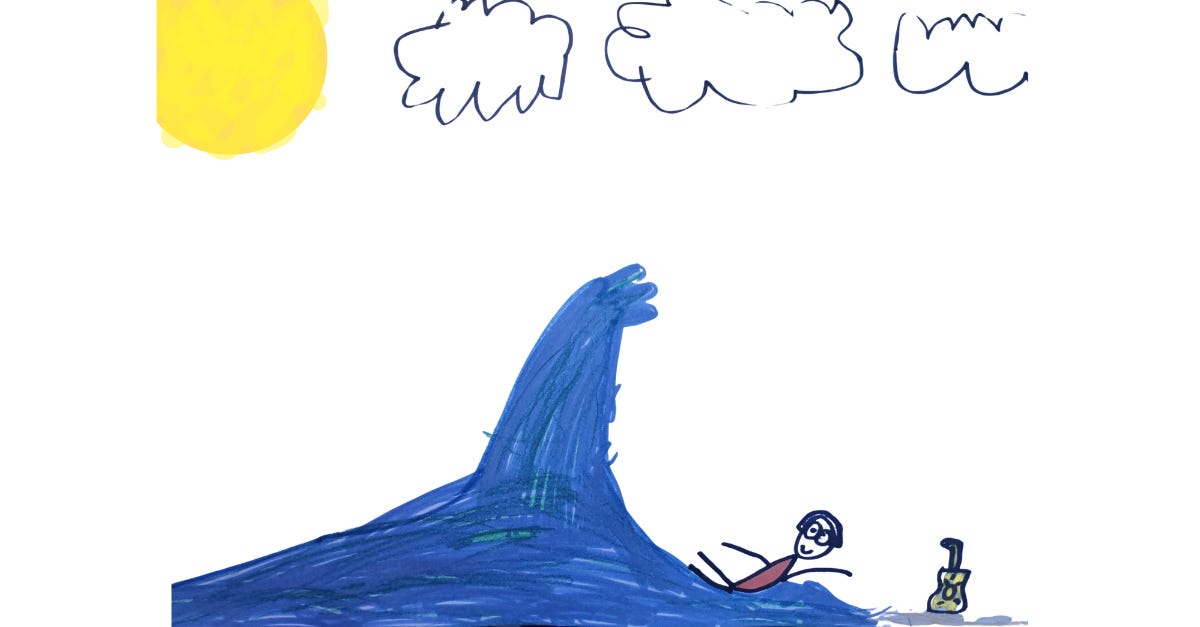
But MBRP treats the dip as an ocean to ride out and survive. You’re told to surf the wave until it sets you down. If you knew the waters you were surfing were the very waters that could heal you, wouldn’t you dive in?
Other approaches (like Jud Brewer’s) build on urge surfing and attempt to dismantle the belief that you’re still getting some kind of reward from the vice. A staunch proponent of mindfulness, Brewer asks you to get curious about the urge and to stay present with the experience of its reward — to notice whether it’s really all it’s cracked up to be.
It’s surprisingly effective. The smoker who’s been lighting up on autopilot for years (just to relieve the last craving) finally notices the acrid taste and the heaviness in their limbs. That noticing is itself a prediction error: the reward underwhelms, and the brain downgrades its value.8 His emphasis is on disenchantment — devaluing what the behaviour delivers. Curiosity becomes a substitute for indulging the urge, something better to do with the craving than answer it.
It's an elegant approach, and for many people it's enough. But every time I tried it, I couldn't rise above the pain of not answering the urge. It pulled me under until I fused with the craving and succumbed. What I was missing wasn't a better way to sit with the discomfort — it was a reason to believe the discomfort was worth sitting with.
Because what if that higher-level curiosity was enhanced with knowledge of what’s happening underneath, at the neural level? In my opinion, that’s the last layer missing from all the methods for breaking addictions and unwanted patterns: knowledge.
Knowledge that the deprivation is the weakening.
For me, this changed everything.
When the deprivation is evidence of healing, you realise that the most painful moments are the ones doing the most work. No amount of discomfort thrown your way can assail your conviction when you know that every moment of it means the vice’s grip is being weakened.
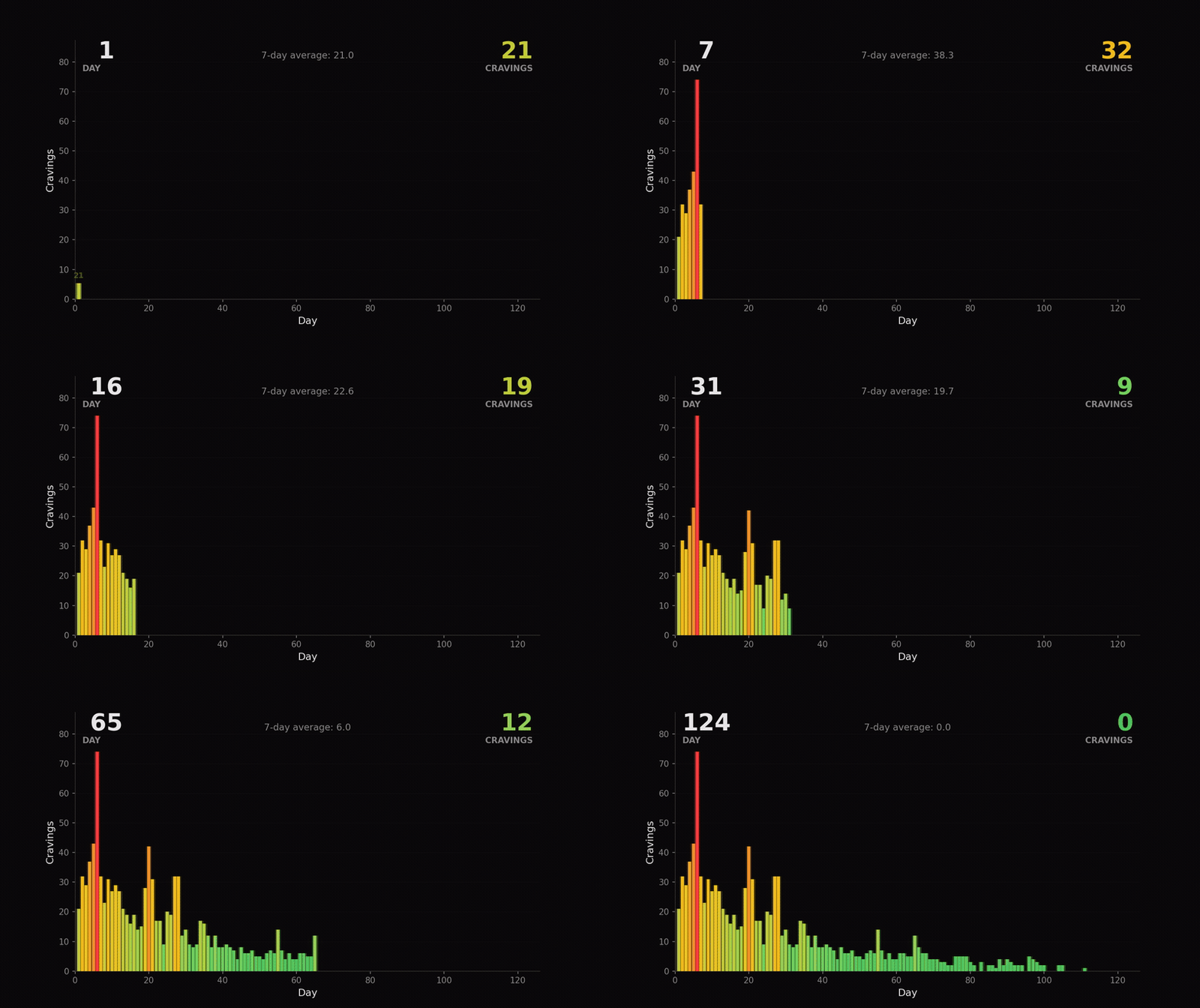
Armed with this revelation, I welcomed the discomfort. I traversed 1,164 dips over 105 days, knowing that each one was weakening the next spike of craving.
I took meticulous notes of my journey (of course I did), and at the start, my thoughts were all laced with grief — an emptiness so acute it felt almost physical. Day 6 was the worst, when uncertainty was supercharging all the cues around me. The spikes were like explosions in my head and each dip detonated the next.
But I wasn’t surfing the waves of craving on some surfboard of detached enlightenment. I kept diving right into those healing waves and bodysurfing them to shore, before being yanked back out to do it all over again.
On day 10, I reached the first turning point. I started to notice gaps between the cravings — moments of peace at the shore before the next wave pulled me back in. I think this was when the dip had stopped predicting the next spike. I had neutralised it as a cue.
On day 25, I wrote, “There is pain either way and I know both of them now. Which one is more tolerable? The pain of abstinence, which is healing and only gets less over time? Or the pain of addiction, which is harmful and only gets worse over time? I choose the pain of abstinence.”
And by day 105, I was able to stand and look out at the calm ocean while the waves gently licked at my ankles.
So many of us interpret the pain of quitting as evidence that we need the vice.
It isn’t. It’s the evidence of becoming free.
If you'd like some help overcoming cravings — no matter what they're for — I've built a free app to help people do exactly that. People are currently using it to quit smoking, vaping, binge eating, phone addiction, and more. It's still in beta, so places are limited (I'm customising the protocol for each person), but you're very welcome to sign up here.
References for this essay, and for the wider series, are available as a collection in the Research Library, specifically:
Fewer than 5–10% of unaided quit attempts succeed long-term; most smokers need several attempts before quitting for good. (Jackson, West & Brown, Addictive Behaviors, 2020; Hughes et al., Addiction, 2004.)
It is well established that negative emotional and interoceptive states can become cues for craving. In fact, negative affect is one of the most reliably documented relapse triggers.
What could possibly be the evolutionary reason for a dip feeling so “bad”? I think the answer lies in what a “cue” used to mean to our foraging and hunting ancestors. To them, the reward wasn’t a sure thing. They had to go out and truly seek it. They looked for clues that the reward was near, not cues that the reward was imminent. And if one of those clues didn’t pan out, the brain had to discourage them from following it again in future. “Don’t take that path again in future. You’ll feel bad!”
Strictly, one relapse re-strengthens the cue rather than perfectly resetting it to full power — but it undoes much of the recent weakening, which is why the streak matters. "Right back where you started" is certainly how it feels (particularly when you add in the uncertainty reinstatement brings to the dopaminergic equation).
We know that a dopamine dip (a negative reward prediction error) downgrades the synaptic weight of a cue. And it is acknowledged that such dips feel... well, not great (deprivation, letdown etc.). It is from these two facts that I make the central claim of this essay: if the dip does the weakening, and the dip is what you feel, then feeling it means the weakening is underway. (When I go one step further and call the discomfort “what the depression feels like from the inside,” I’m exercising a little bit of poetic license to avoid saying the bland “felt correlate of.”)
The principle of CET rests on Pavlovian extinction, but its real-world efficacy is a little weak. A meta-analysis of cue-exposure addiction treatments found no consistent evidence of effectiveness which most attribute to context — extinction learned in a clinic tends not to generalise to the natural environment where the cues actually live (Conklin & Tiffany 2002).
This state of cognitive observation likely brings online prefrontal control at a time when it is usually dominated by limbic activity (where the dopamine spike acts). By tipping the balance of the cortical-limbic seesaw in favour of the cortex without “fighting” the urge, it prevents the urge from being kept alive and perpetuated in working memory. It is a way to allow the craving to pass without pursuit.
Brewer’s approach targets the reward, reducing the value of the vice by noticing it under-delivers (a reward-side prediction error). It’s well supported. My argument works the other side: not the reward’s value (R) but the cue’s predictive power (V) (Brewer et al. 2011). The two are distinct, and a matured vice driven by relief rather than pleasure is largely untouched by reward-downgrading, which is why Brewer’s method, effective as it is, wasn’t enough for me.
No posts
Comments
Nothing yet. Say the first thing.
Sign in to join the conversation.