
This might sound like an unusually existential way to start an essay, but I’m going to take a stab at answering a question that has plagued philosophers for thousands of years.
What is free will?
Our brain is a machine built to do one thing above all else: to adapt to its environment so that the least amount of effort is required to satisfy basic needs.
To automate whatever can be automated.
This might sound very animalistic, but by automating the basic sourcing of needs, those lower-level trivialities can be abstracted away, leaving room for exploration and growth. For humans, this assimilation of efficiency is all in the service of freeing up expensive ‘manual’ cognitive resources for the next layer of learning.
In a way, life is like one big video game, where the goal is to assimilate more and more abilities in order to grow in power and capability, levelling up as you go. When these assimilated abilities are actions, we call them ‘habits.’ When these assimilated abilities are learned behavioural policies, we call them ‘motivation.’
The way we collect habits and motivation is through repeated interaction with our environment over time. As we repeat certain patterns, not only does our brain learn to automate those patterns, but it learns to predict when such automation should be triggered.
When our brain encounters a cue that historically promises or leads to a reward, it triggers a dopamine spike of motivation to pursue that reward (or avoid that effort). Over time, we become highly efficient stimulus-response (or cue-pursuit) machines, reacting automatically — almost instinctively — to a variety of learned cues within our environment. All of this is meant to leave room for levelling up in the game of life, yet many people reach a certain level and stay there, trapped in a life of routine.
When your alarm goes off and you reach for your phone without thinking, that’s a learned motivational pull towards a historically plentiful source of rewards.
When you walk into the kitchen and suddenly find yourself peering into the fridge, wanting a snack, that’s another learned motivational pull.
Or suppose you’ve made the resolution to start working out and the time comes to put on your gym shoes and you feel a sense of aversion. That’s yet another learned motivational pull towards the path of least resistance.
In each case, an environmental cue — the alarm, the kitchen, the gym shoes — triggered a dopamine-driven pull: toward a reward, or away from effort. Either way, the cue, not you, set the direction.
If the alarm makes you reach for your phone without thinking, who is in control of your ‘will’? You, or the alarm? When the kitchen makes you walk to the fridge without thinking, who holds your will? You, or the kitchen? When the time comes to act in accordance with your decision to be fit and you feel aversion, where is your will to be found?
The cognitive effort to resist these dopamine spikes — to act against your own conditioning — is what we call ‘willpower.’
But if the spike has grown big enough over time, willpower is woefully outmatched.
Anything worth calling free will must remain available no matter the magnitude of motivational pull being exerted. Which means the ability to exert willpower — a force with a structural ceiling — cannot be free will.
If willpower were enough, there would be no addicts, none of us would have bad habits we are constantly trying to break and it would be easy as pie to create ‘good’ ones.
Willpower is at the same level of the dopamine spike — a finite force pitted against a scalable one. It is fighting fire with fire. And when that spike has grown blazingly hot, all you’re often left with is the ashes of your own surrender.
Ask an addict if there is such a concept as free will and they will likely say no. They move through life feeling as if all their will has been ceded to their environment. An addict is at the mercy of hundreds of cues — time of day, places, moods — all of which trigger a powerful spike of dopamine that compels them to pursue their vice. And every time they follow the spike, they cede another portion of their will to their environment.
Ask a successful entrepreneur if there is such a concept as free will and they will likely say yes. But the entrepreneur may have also ceded their will to their environment, just like the addict. The difference between them is that an addict’s environment pulls them in a direction counter to their higher values. An entrepreneur’s environment has been crafted over time to pull them in a direction that aligns with their higher values.
But the environment still holds their will.
So far, it probably looks like I’m making a case against the existence of free will. But the opposite is true. I contend that free will does exist, but on an entirely different plane to the falling dominos of stimulus and response, or the tug-of-war between spike and willpower.
There is a door to another realm of existence and free will lies on the other side.
Every time you automatically follow the pull of a dopamine spike, you cede a small portion of your will and the gap between stimulus and response shrinks. When you fight the pull of a dopamine spike, victory is not always certain — sometimes the spike wins, other times you do. Both cases drain your willpower reserves and the gap between stimulus and response widens in fits and starts.
But if you neither follow nor fight but instead observe — notice, recognise, acknowledge — the spike shrinks and the gap grows. And so does your ability to access free will.1
In one case, your alarm goes off, willing you to reach for your phone.
In another, your alarm goes off and you try to fight the urge with willpower, “No, I’m cutting back on my screen time!”
But above this pulling and pushing lies the third option. Your alarm goes off, the spike hits and… you simply observe it. Where is it? You search for the wanting and find it has almost no substance — a sensation, a flicker, narrated by your mind as “I want,” but not you. You aren’t the wanter, you’re the observer. There is no tug-of-war because you’re no longer holding the rope.
This is known as meta-awareness.
It doesn’t always make the pull disappear. The spike is a neurochemical blast to your neurons that cannot be put back in the bottle. But with repetition, the blast tempers, and the gap widens.2
Meta-awareness is the skill of noticing a thought, feeling or even motivational pull. It is a layer of detached curiosity above the swirling currents of emotion and inner voice. And it is indeed a skill.
Yet it’s one most people don’t even realise they have access to.
Whenever you slip from the wanter to the watcher, you practice it. Whenever you feel a pull and look away from the tugging source and instead at the tension of the rope, you practice it.
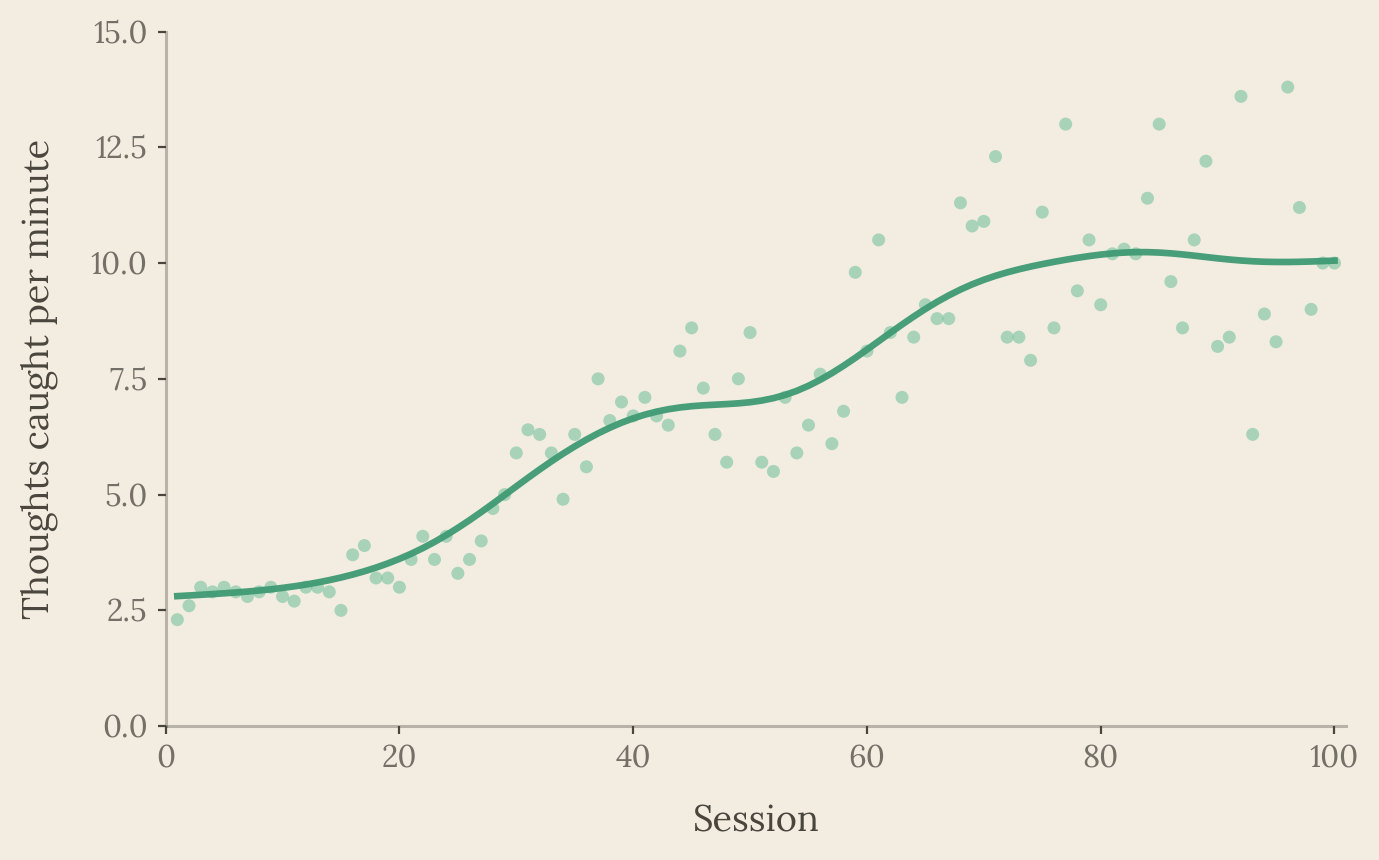
With ten minutes of focused practice a day, and countless other opportunities that life threw my way, I was able to train my ability to readily access free will in the span of 100 days. Every day, I sat and quietly counted how many times I caught my own mind wandering, a rough proxy for how readily I could step back and observe.3
As time went on, the gap noticeably widened. I found myself becoming less reactive in everyday life — slower to snap and quicker to catch the spike behind any impulse.
After weeks of practice, I distinctly remember having a few squares of dark chocolate after dinner one night and the faint pull of “I want another” tugging at me afterwards, a little baby spike triggered by the cue of delicious taste. In the past, I would have taken that thought as me saying “I want another” and either indulging or fighting it.
But by then I knew it was just a neural pattern automatically wrapped by my language networks to narrate a present motivational pull. I remember feeling the craving, stepping back and (deliberately) thinking, “Where is this pull? It’s just words in the brain.”
The wanter had become the watched.
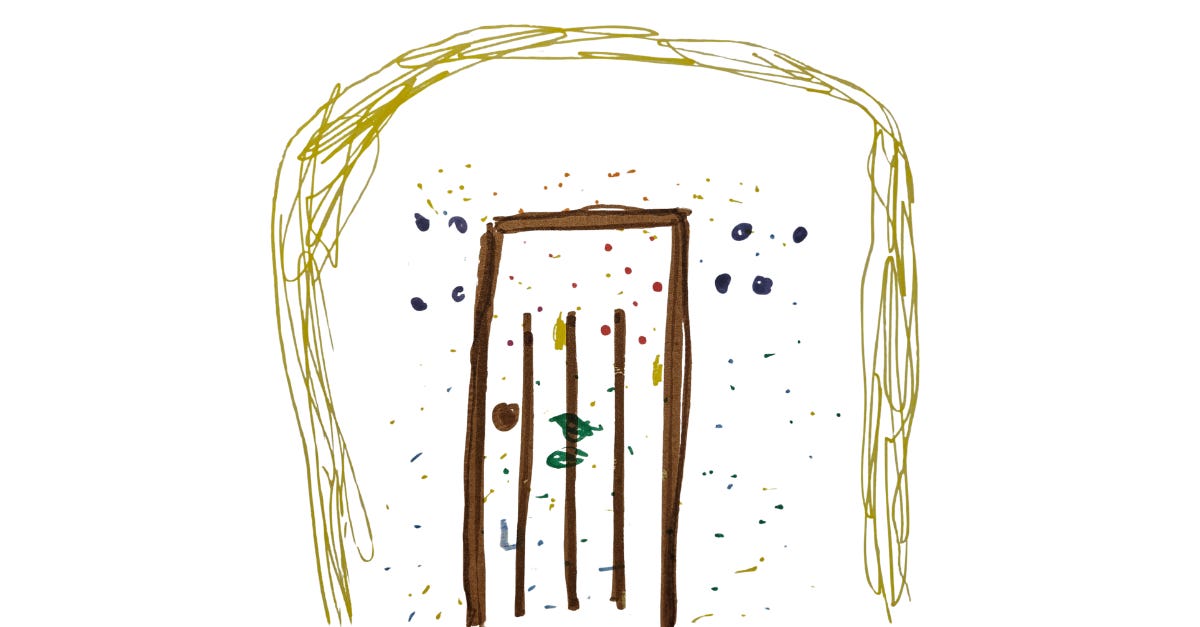
There is no magnitude at which an urge, feeling or thought becomes impossible to watch.
You can be out-willed by a craving, but you cannot be out-willed by the act of simply seeing it. Willpower has a ceiling, yet observation has none. But it’s a door you have to train yourself to walk through, and one that unlocks more easily with practice.
I won’t pretend that I always walk through it. (I do still have chocolate because “I” want it. And there are days when “I” don’t want to go for a run.) A spike can run hot enough, and fast enough, that you’re swept from stimulus to response before you realise the act of observing it has passed you by. But if you walk through the door enough times when the spikes are small, it will still open for you when they run hot.
This makes the conditioned ability to access meta-awareness quite possibly the most important habit you could ever learn. And it invites a strange paradox — training a habit to access the one ability habit can’t touch — but it’s where the highest freedom is reached. What waits on the other side of that doorway cannot be automated, for the bare act of observing has no content to repeat, no response to cache. It is the most unautomatable thing you can do, and the very core of what it means to be human.
So, do you have free will?
You always did. You always do. It’s a door that has been present for every moment of your life, whether or not you noticed it. What meta-awareness practice gives you is the ability to access it, to walk through it at any moment you choose.
Stimulus, response.
Doorway.
In an upcoming essay, I'll dig into the experiment behind the graph in this essay — exactly how I measured my own meta-awareness growing, the ten-minutes-a-day protocol I used to train it, and the neuroscience of why it works.
References for this essay, and for the wider series, are available as a collection in the Research Library, specifically:
A determinist might counter this by saying that whatever widens the gap was itself set in motion by upstream states, and therefore free will is still an illusion. While I grant that the gap does not escape causation (nothing does), my argument is that causation does not dictate its width. Causation fixes that a gap between cue and response exists; it does not fix how wide it is. The gap can be one frame wide or many, and the practice that widens it is the only kind of freedom we have access to. So while free will might not be exempt from any causal chain, it is the widening of the gap in which to inject attention.
Two things contribute to the spike shrinking in size, but on different timescales. In the moment, moving attention off the cue and onto the raw sensation lowers the pull directly by making the cue less salient. Then, over time every cue you observe without pursuing is essentially an extinction trial. The reward was not pursued, so the cue’s predictive weight decays a little.
The trend going upwards doesn’t mean I was having more thoughts. It means I was getting better at catching them. This is an observation I’ll explore further in an upcoming essay.
No posts
Comments
Nothing yet. Say the first thing.
Sign in to join the conversation.