

A black hole gives off no light. Not one photon. Everything anyone has ever photographed of one is the disc, the ring of matter spiralling in, torn apart, glowing white-hot on its way down.
The disc is bright. The disc is measurable. Every instrument we own points at the disc, because the disc is the only thing there is to point at.
The hole itself is a place where the equations stop returning finite numbers.
Prosperity 2030 is a serious document. Thirty policies, costed to the pound, no new borrowing. It says, correctly, that the cost of living and the fiscal gridlock and the crumbling infrastructure and the sense that ordinary life has become precarious are not four problems. They are one problem. The only difficulty is, they have picked the wrong problem.
It is a photograph of the accretion disc, mistaken for a photograph of the black hole.
This is the document you write when you can see every consequence except the thing causing them. It is not stupid. It is what intelligence looks like from inside the tidal gravity. One eye open, the mostly blind will lead the blind on a journey faster and faster into the black hole.
The corpus this essay draws on rests on three things being true of an asset. Not on ideology. Not on greed. Not on anyone's intentions. Three mathematical conditions is all it takes.
One. You cannot make more of it. (E)
Pour money into land and no more land appears. Pour money into a factory and you get another factory. This is the difference that does all the work.
Two. You can borrow against it, and the more it is worth, the more you can borrow. (C)
The bank lends against the price. The lending raises the price. The higher price supports more lending.
Three. Its returns are taxed more lightly than the returns to actually building something.(T)
Hold those three and everything follows. The return you get for the risk you take rises as more money floods in, which is the exact reverse of how productive assets normally behave. There is no resting point. The productive economy contracts because capital keeps leaving it. Wages compress. The cost of living becomes the visible burn mark of the compression. And the crisis that would force a reckoning never quite arrives, because the pain is spread thin and paid weekly rather than delivered all at once as we are all forced down, and pressed to the subsistence floor.
Insecurity. A Decayed social fabric. A democracy nobody trusts. That is the disc. That is what the configuration radiates while it eats.
Now score the report against the three conditions.
There is no planning reform in the document. None. The supply measures are a public housebuilding programme, a scheme for councils to buy homes from their existing owners, the abolition of Right to Buy. But fundamentally nothing, that puts building land back into productive hands, and no mechanism other than the same state that has failed to build sufficiently for generations, promising for the umpteenth time, that this time is different.
Nothing. Not one word on how banks value the collateral behind a mortgage, on loan-to-value limits, on capital risk weights, on any part of the credit machine. This is the single lever the framework identifies as the one that works. It is the difference between Britain and Germany. It is written down, in regulation, in a form any government could amend on a Tuesday. It does not appear in thirty policies.
The word mortgage appears once, in the passage explaining that when councils buy homes out of negative equity, the debt will be converted into long bonds in order to protect the mortgage finance companies. That is LITERALLY a put option on property for owners.
Here they act, and here they barely graze the Rentier asset, with a tax that is empirically a failure in any economy it is tried in, simply passed on to its tenants and disincentivizes building.
To be clear, it’s a tax that gets flopped onto the renters, stops building, and does nothing to the core dynamic
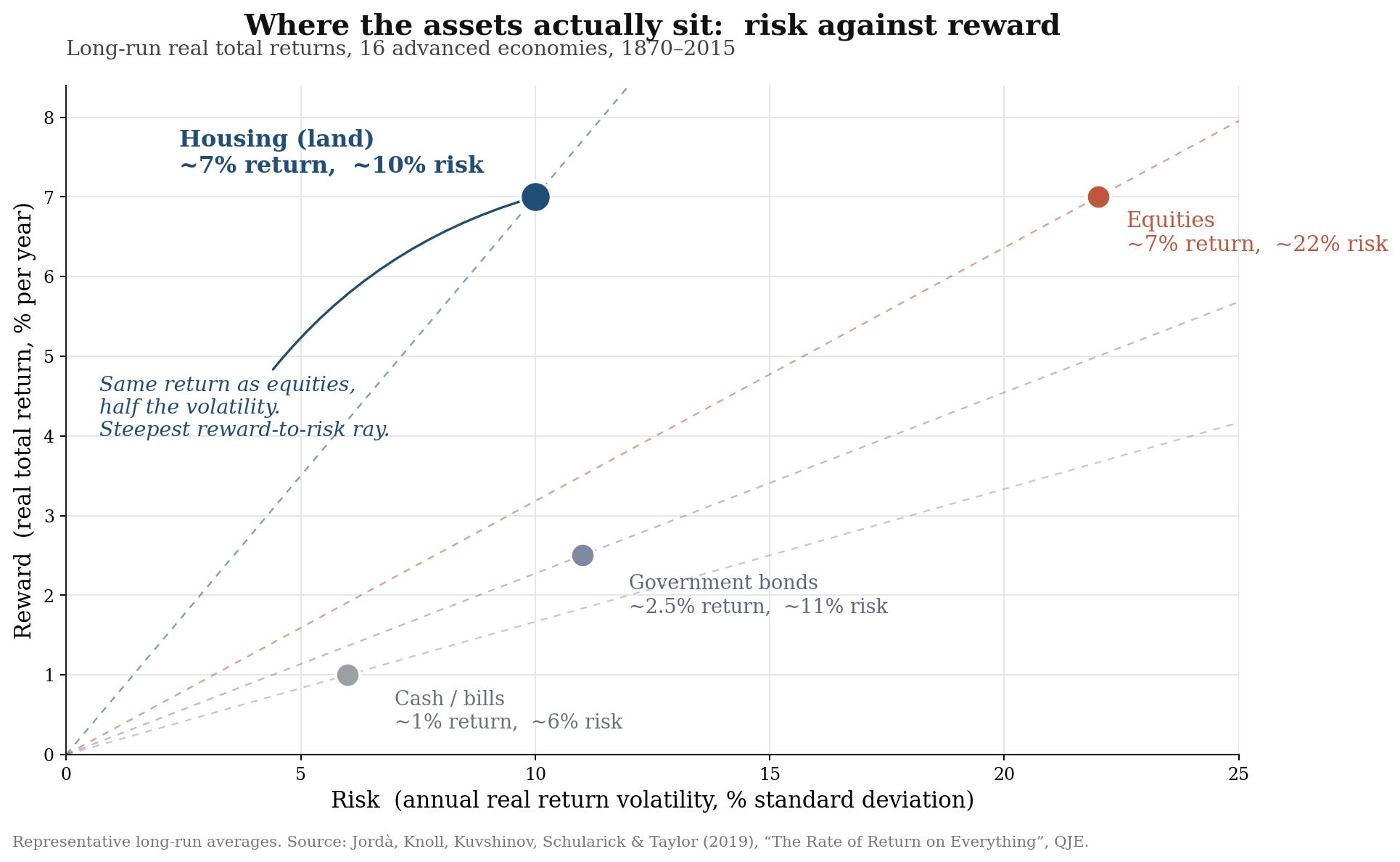
Over 145 years and sixteen countries, housing and shares returned roughly the same: about seven per cent a year after inflation. Housing did it with less than half the volatility. Same reward, half the swing. That is the steepest reward-to-risk line in the recorded history of capitalism, and it is not close.
Its flagship tax, National Contributions, taxes realized gains. You sell a company, you pay. You sell shares, you pay. Land does not have to be sold. That is the whole point of it. The gain accrues quietly, untaxed, year on year. If you want to spend it you do not sell. You borrow against it, and a loan is not income, so nothing is taxed at all.
A tax on selling is not a neutral tax. It is a tax on the people who have to sell in order to eat, and a gift to the people who never sell anything.
The founder who spends eleven years building a business and sells it once pays the top rate on the lot. The man with forty flats pays nothing, because he never sells a flat. He does something better with them.
He does not own them personally. They sit in a limited company. Company landlords deduct their mortgage interest against rental income in full, which individual landlords have not been able to do since 2017. So the rent comes in, the interest goes out, and there is very little profit left to tax. That is not a loophole. That is the structure working as designed.
He never sells, Not one. So there is no realised gain, and National Contributions never touches him.
He wants liquidity, of course. So he borrows against the portfolio. Ten million of equity across the book, a facility drawn against it, drip-fed to his current account. Borrowed money is not income. There is nothing to declare.
He wants more flats. So he levers to the ceiling, because every pound of debt buys another pound of exposure to an asset that cannot be made more of, in a country that has just announced it will not build any.
And his one tax under this programme? One per cent of the value of the buildings, annually.
Which he passes to his tenants. Who can pay it or leave, to find the next man with 40 flats, doing the same.
Buy. Borrow. Die. Two of those three legs are visible in the report as published. The third leg, what happens when he dies, unless they also intend to remove the zero-ing of gains at death to then settle through inheritance tax, he will continue to pay nothing until the grave. combine this with the litany of off-shore shenanigans that are not commented on and are a book in themselves, and the brief summary of the taxes due on the man with 40 flats is pretty simple to calculate.
Fuck all.
Meanwhile the founder pays the top rate.
This is what a set of policies looks like when the people writing them have not asked what the money will do on the morning they commence.
It is the simple textbook answer and It says, the landlord already charges the highest rent he can get. If he could charge more, he would already be charging more. So a new tax comes out of his pocket, not the tenant's.
Look at Canada. Look at Toronto and Vancouver, the tightest metros in the Anglosphere, where the same argument was made and where the costs went straight through into rents anyway. It happens because the textbook is describing a landlord who has already solved an equation. Real landlords have not solved anything.
Rent is not calculated. It is felt out. There is a floor and there is a ceiling.
The floor is what the rent must cover, the mortgage interest, the void weeks when nobody is in it, the management, the insurance, the repairs, and now the property tax. That floor is not soft. A landlord levered to the limit cannot charge below it and stay solvent. Because the tax has to be paid out of rent that is itself eaten by voids and costs, every extra pound of tax needs roughly £1.25 to £1.40 of extra rent to cover it.
The ceiling is what the tenant can pay before they stop eating.
Between those two lines is a corridor, and the rent lives somewhere inside it. Where exactly? Nobody knows beforehand. The landlord discovers it. He puts the flat up at a number based on what the neighbors listed it at last month on zoopla. Twelve people view it in a weekend. He learns something. Next year he puts it up higher. Eight people view it. He learns something else. Over a decade, in a market where nothing is being built, the rent walks up the corridor towards the ceiling, one tenancy renewal at a time.
Now watch what the report does to the corridor.
It raises the floor. The property tax is an operating cost, it lands in the same bucket as the boiler and the letting agent, and the levered landlord will recover it.
And it raises the ceiling. The report gives the tenant free water. Free bus travel. Free basic energy. It says so proudly. One pound of universal service replaces about one pound twenty-one of private cost. Every pound of that is a pound the tenant is no longer spending on anything else. Which means it is a pound the tenant can now pay in rent.
They have not passed a tax onto the tenant and given them services to compensate. They have raised the tenant's capacity to pay rent, in a market where rent rises to meet capacity, and then given the landlord a cost he must recover from exactly that capacity.
And notice who sets the rent. Not the little landlord with one inherited flat and no mortgage. The rent in any market is set by whoever is closest to going under, and that is the man with forty flats and maximum leverage. The one-flat landlord raises his to match, because why would he not, zoopla told him to, and pockets the difference as pure unearned gain.
The programme lowers the price of buses, water, energy, food, care and broadband. Housing is the one thing in that list it does not touch.
It lowers the price of everything except the thing whose price is set by whatever is left over.
Take each policy. Ask the only question that matters: does it make land a better bet relative to building things, or a worse one?
Free water is not nationalization. The water company keeps its pipes, keeps its licence, keeps its regulated return, and now the state guarantees the volume. Demand risk gone. Cash flows certain. The equity is worth more the day it passes, without earning a penny more. A gift, capitalised.
Right to Sell hands leveraged homeowners and their lenders a floor under the price. That is literally a put option, written by the taxpayer, given away free. Options are worth money. The value goes into the asset.
The one per cent falls on the value of the property, land and building together. So it taxes the bricks. Tax the bricks and you tax the only part of the thing that can actually be produced. The developer's margin on the marginal site disappears, and with it the site.
And it is deferrable. Anyone can postpone it until the property changes hands. So it becomes a note against the estate. The holder feels nothing, sells nothing, and keeps every penny of the appreciation. The bite is on paper.
One instrument in the entire document does real structural work. Compulsory purchase at use-value, before planning permission is granted. That confiscates hope value, which is the purest unearned gain in the British economy, at the exact moment it is created. However, I am somewhat hesitant to applaud this, given the structuring of the rest of the rest of the paper, the devil is in the detail.
Here is the part that should disturb you and disappoints me , the framework predicts this document. Even the best and brightest are merely variables in a mathematical model.
It predicts that in a late-stage rentier economy the national accounts will report health, because imputed rents from housing are counted as output, so the instruments say the economy is fine and the instruments are not lying about what they measure.
It predicts that the professional class, the people who write reports like this one, will by now own property and earn their living in the industries that service property, and that the coalition capable of reform therefore shrinks towards the people who own nothing and command nothing.
It predicts that the pain will never concentrate into a crisis, because it is dissipated continuously into the weekly shop, the rent renewal, the energy bill as we are all pressed down to the subsistence floor. Food bank use rose roughly tenfold in sixteen years and nothing broke. Nothing was ever going to break.
Put those together and you can predict the shape of every reform programme that will be published between now and the end. They will aim at the cost of living, because the cost of living is what is felt. At insecurity, because insecurity is what is measured. At public services, because public services are what the state controls. They will be funded out of the asset, because the asset is where the value is, but never too harshly, just a nibble from the fringe, stamp duty, as a perfect example, to a real citizen a burdensome sticky tax, to institutional landlords a tiny hurdle to uncapped returns. They will not touch the collateral channel, because nobody is looking at it, because it does not glow.
Nobody in that room wanted to raise the risk-adjusted return on residential land. Nobody set out to write a free option to leveraged landlords or hand a capitalised gift to a water monopoly. Every instrument was chosen to address a real harm by people who meant it. The configuration did the rest blinding them, drawing attention to what is visible, not what created it.
That is what a structural attractor is. It does not need your consent. It does not require anybody's malice. It requires only that the three conditions hold, and that the people who could disable them are looking somewhere else.
This is the exact prediction of the Rentier Black Hole.
The best and brightest among you, academics of real repute, sit inside its tidal field and look only at what they can see. The glowing disc. Never the thing at the centre.
The anxiety is palpable now. The panic is palpable. The suggestions come faster and more frequently, each one arriving as the thing that will save us.
You will not be saved.
Your academics, your politicians, your people, are dazzled by the flash around the singularity in your economy. They will treat the cost of living. They will comment on inequality. They will lament the state's failure to balance its books.
They will fail.
This document is not your salvation. It will sit only as a damning confirmation of the prediction, and the prediction is simple.
This inelastic, collateralisable, tax-privileged asset at the centre of your economy is a hole. It was diagnosed almost a hundred and fifty years ago, and read, and admired, and set aside.
The word mortgage comes to you from the Old French. ‘Mort gage’. The dead pledge.
In a financial system of sufficient scale, that pledge holds a weight that is very nearly infinite. It tears a hole in the fabric of an economy and reveals, at the bottom of it, a singularity of slavery. The infinite darkness of a new feudalism.
We will be in a nation that produces nothing, that lives hand to mouth crushed to the subsistence floor. Each new frantic remedy recommended, will never see the heart of darkness, just the burning rings around it, representing our old reality collapsing into damnation.
Don’t worry however, the GDP will look fine. the housing market will be called ‘stable’, it is only you my dear reader who will be beyond the event horizon.
Welcome to the Rentier Black Hole
Return and volatility figures from Jordà, Knoll, Kuvshinov, Schularick and Taylor, "The Rate of Return on Everything", Quarterly Journal of Economics, 2019. The floor-and-ceiling mechanism, the amplification of cost shocks through voids and operating costs, and the result that the most leveraged landlord sets the market rent are derived in the monetary working note. Figures attributed to Prosperity 2030 are taken from its published summary and policy pages.
No posts
Comments
Nothing yet. Say the first thing.
Sign in to join the conversation.