

This recent AI boom has drawn in hundreds of billions of dollars in investment, and trillions of dollars of valuation paper gains.
But the industry itself is built in concentric rings of diminishing quasi-rents. Empires worth billions eroding in front of our eyes, stacked from top to bottom, ordered by a careful logic, of the extent to which each rings rent, is temporary or permanent. Each ring is an imitation, a quasi-rent, each more transient than the last, ordered almost perfectly like stacked dominoes waiting to be pushed.
Here we will walk through all the layers of an increasingly fragile industry built on the sand.
At the surface you find the most fleeting and almost non-existent returns. Those of the AI firms themselves, the model creators.
In 2025, OpenAI booked $13 Billion in revenues, yet lost some $21 Billion, about a $1.6 loss for every $1 in revenue. By its own arguably optimistic forecasts, it will not break even until 2029.
This isn’t the balance sheet of a failing company, it’s the balance sheet of the company with arguably the most successful product launch in history, serving a billion people a week approximately.
Yet, it seems to be a victim of productive returns in a competitive market. The cost of a million tokens has utterly plummeted, falling from some $60 per million tokens in late 2021, to $0.06 per million in 2024 for GPT-3 standard models. The median rate of decline according to Epoch.ai is some 50x cheaper annually across all benchmarks.
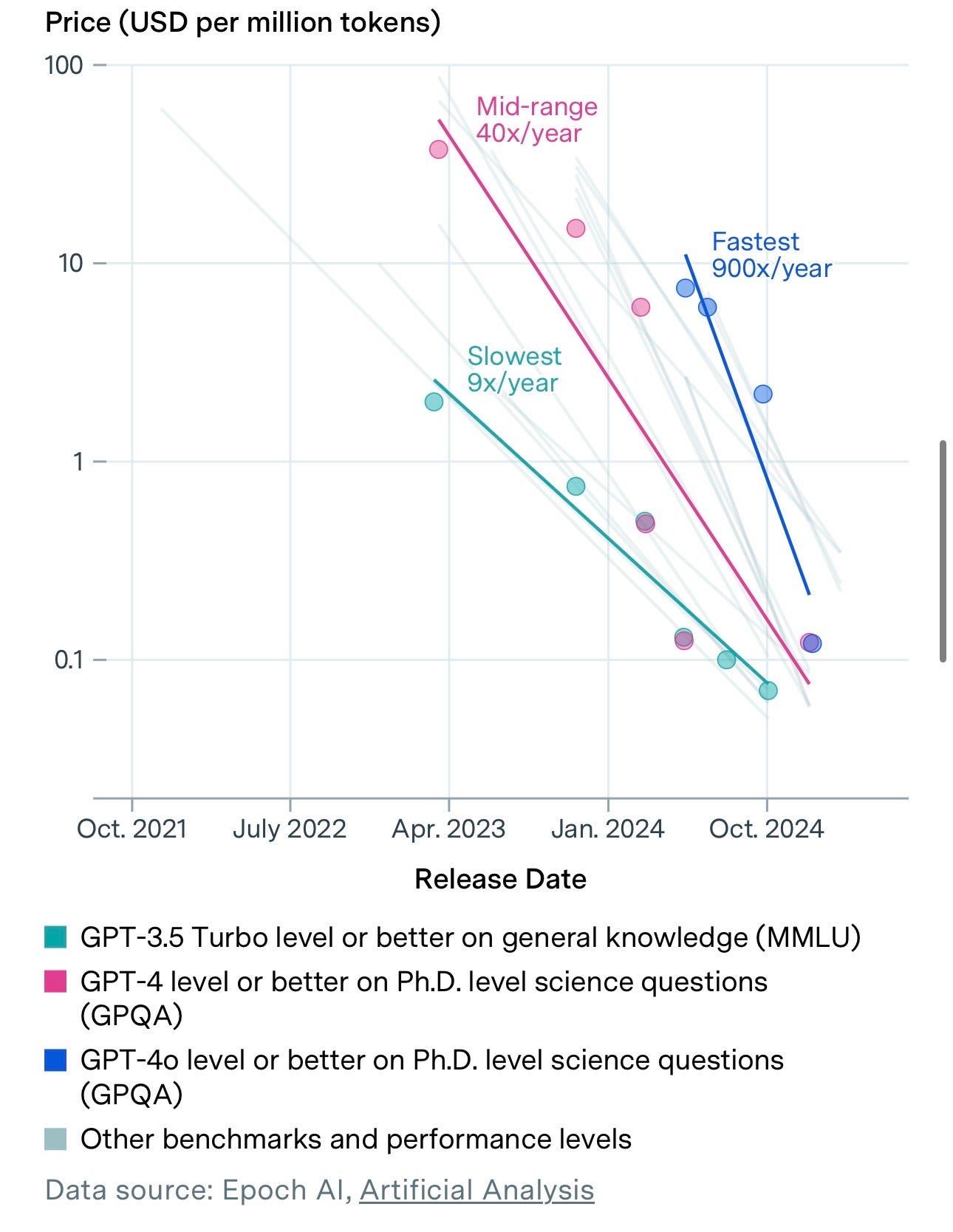
Simultaneously, the frontier of the industry is burning through money at an alarming rate, while its core product erodes its own pricing power. The usual term for the money flooding into this sector would be ‘a bubble’. An industry spending wildly on a product it cannot yet truly or reasonably monetise. But that definition is shallow and simplistic, on deeper review, we find a structure organised almost linearly around a simple property, the quasi-rent and its half life. The surface level of the model developers is simply the start, and the interesting question is not whether this is a bubble, it is where the money through the stack comes to a rest, and how quickly each layer hands its surplus down the chain, given how little of it each level seems to retain.
Every return on capital fits within two simple categories, a return to production or a return to position.
A return to production is what is earned from manufacturing a good or a service, its most defining property is that it simply does not last. If a good or service can be reproduced, the market will reproduce it if the profits are sufficiently enticing to a competitor. Over time with free entry, the price paid falls toward the cost of producing it under fair competition. The ‘surplus’ of these reduced prices and expanded quantity made, is passed to the consumer. This isn’t something going wrong, it is the entire premise of free market capitalism, simply that fair competition allows for efficient production, and better prices and services for the consumer.
A return to position, is simply earned from owning something scarce that cannot be reproduced, the critical case being our rentier asset, the land and property, but many other examples exist. Returns to position, are sticky, the competition that would erode these returns simply never erodes as it cannot be reproduced. The easiest naming for this, is that these goods or services are supply inelastic, in the extreme perfectly so.
Most assets sit on the spectrum between these two, neither perfectly elastic or perfectly inelastic, but in the case of the AI industries and its many layers, you find a clean demonstration. The industry is laid out in order, from the most reproducible to the least, the most supply elastic, to the most inelastic, and the returns of each layer behave almost perfectly as their elasticities would predict. So we must follow the money down, from the eroding surface, to the structurally inelastic core.
At the top of this stack is the reproducible layer, and the returns play this out in public, with token costs being competed to zero in real time.
The model providers generate a clear productive surplus, a billion people now have access to cheap on demand inference, that four years ago would have cost small fortunes, and it would seem that they are able to keep essentially none of it. The collapse is not strictly a price war anyone is particularly losing, it is simply the ordinary behaviour of a highly reproducible (supply elastic) good under competitive pressure. Open weight models and local hosting have pressed the price floor to essentially zero for near perfect substitutes for the centralised private models we all know well from Anthropic and Openai. The revenue lines are still climbing, under a principle known as Jevons paradox, but while revenues continue to boom the operating margin on the product itself is collapsing.
Any temporary Schumpeterian rent model designers thought they could have from designing the best model is eroded within weeks, the average top spot model stays at the top of the leaderboard these days for an average of 35 days, it stays within the top 5 for some 5 months, and top 10 for some 7 months, and the rate of change is accelerating. The benefits of even being the leader given how fast the top spot is changing hands is diminishing rapidly, with platforms now focusing on customer lock in and third party integrations.
The compute spend behind training new models is progressing at some 5x year, with model creators brute forcing training quality with compute size and spend, all to realise a simple fact their own models could have parroted back to them in a simple query. Training expenses and leading the market is exhibiting huge diminishing marginal returns to capital, as is expected of any return on production. Spending 5x the amount on training does not yield a 5x better model, and the resulting new model most certainly won’t deliver decent returns in the 35 days on average it sits at the top of the leaderboard.
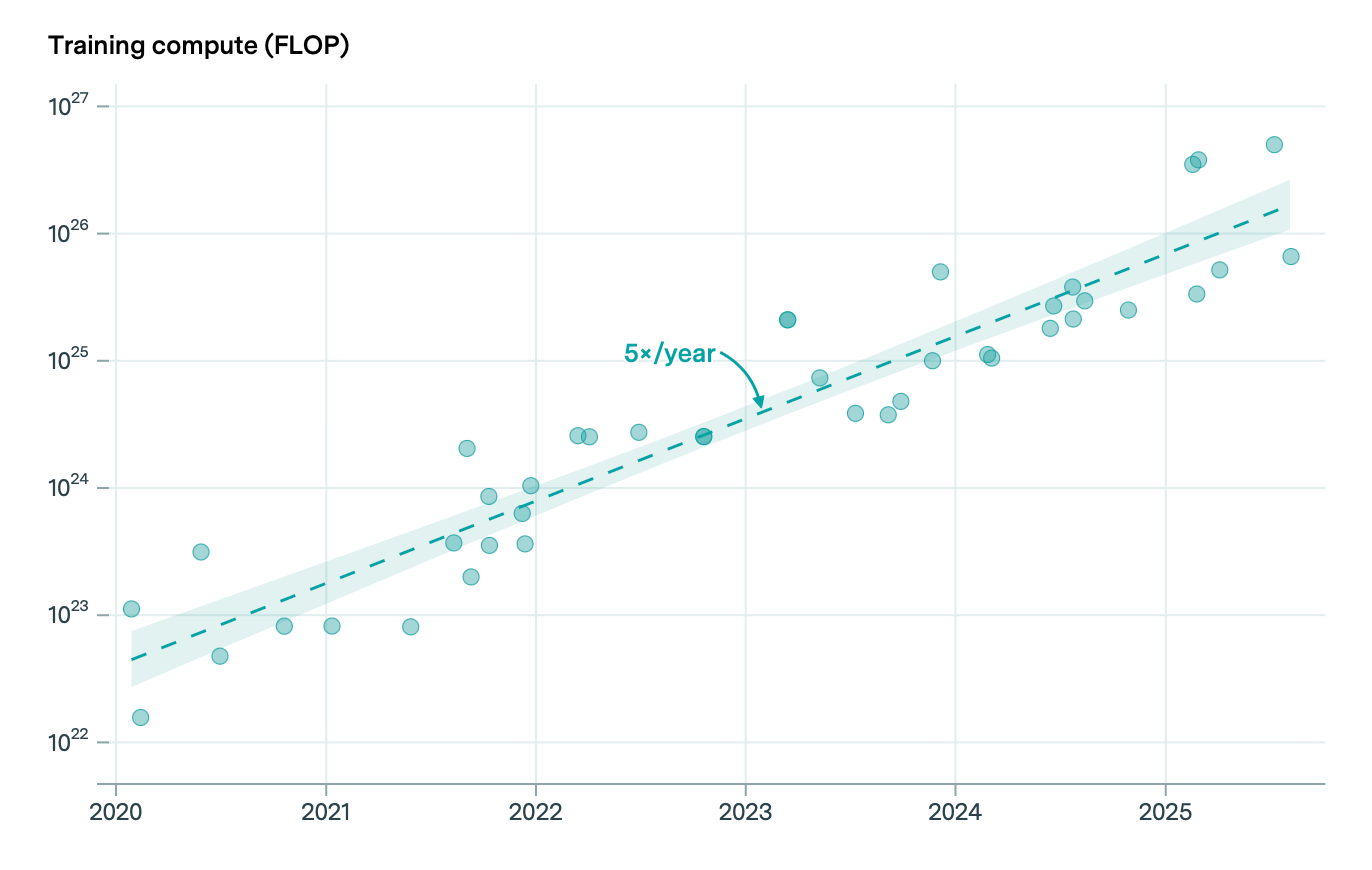
What we are witnessing is the decay of productive returns at a scale and a pace that has never been seen before in human history and the deflation of intelligence annually measured better in factors not percentages that all cluster over 99%. The most productive layer, and competitive layer of the entire AI market is performing exactly as expected, washed away as soon as it is built.
The greatest difficulty of these systems is simple, it is a return to production, whose inputs are increasingly as you go down the stack, returns to position. A company whose margins erode in days, paying rents that do not erode at all, is playing against a clock that is not ticking in its favour.
Fundamentally, on any reasonable timescale, these firms are loose sand, washed easily by the tide of time.
Below the loose sand, you find a slightly tighter packing, the cloud providers, AWS, Google, Oracle, Microsoft Azure. These currently seem like the landlords of the boom, or as Yanis Varoufakis might say, the ‘technofeudalists’. To a limited extent, they are, collecting a toll or a rent on every model trained and every token served. But fundamentally, this rent is reliant on systems that in principle can be reproduced, as is quite simply demonstrated by Coreweave, who pivoted out of crypto mining in 2019 after their founding in 2017.
The top 5 providers currently own 70.7% of the total market for compute, and are locked in a CapEx arms race to defend their market positions. This is not the expected output of a monopolistic system, this is an industry realising that the simple cloud rent they used to generate can be competed away with a dedicated and well capitalised new entrant, and are now scrambling to retain their market shares.
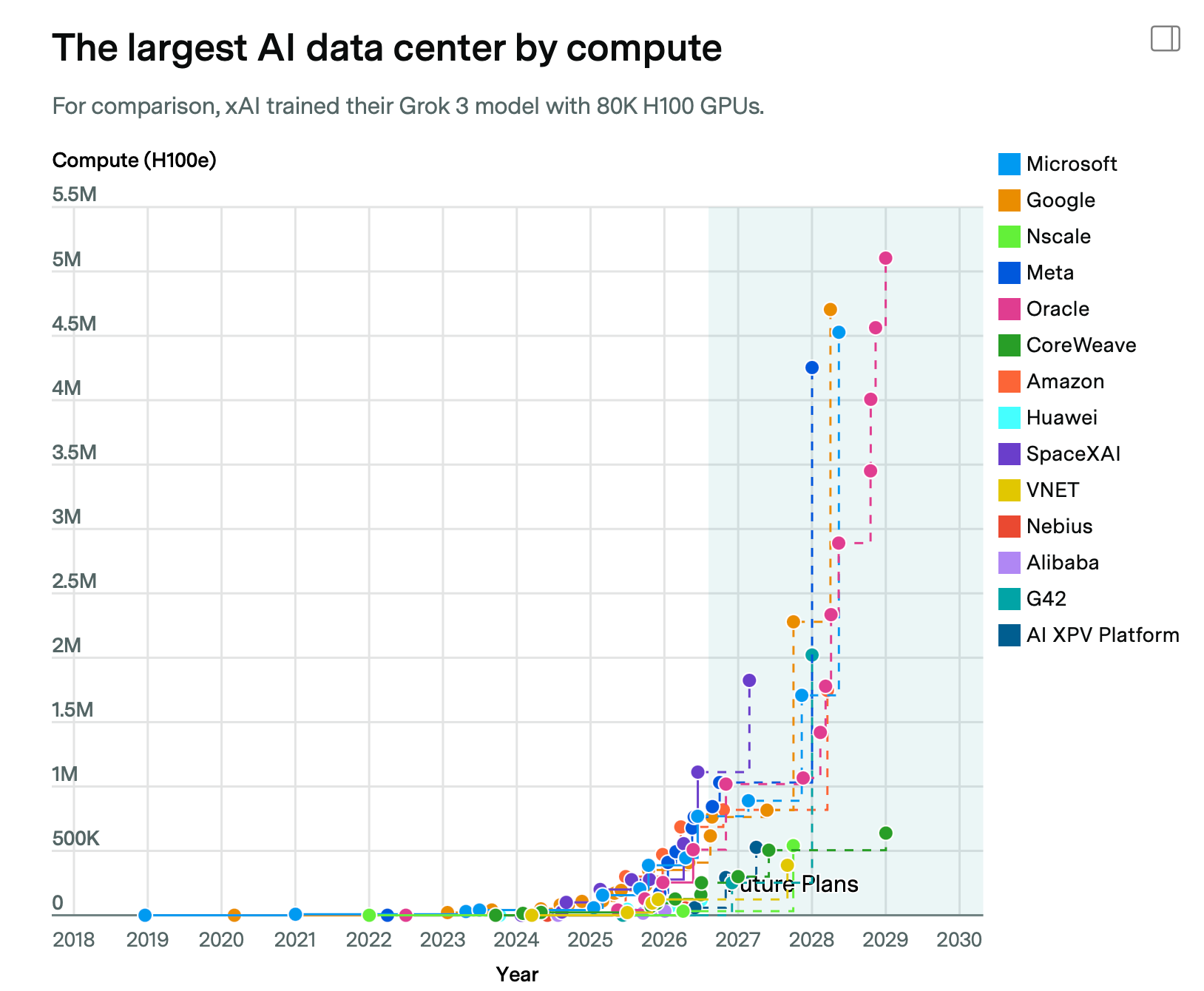
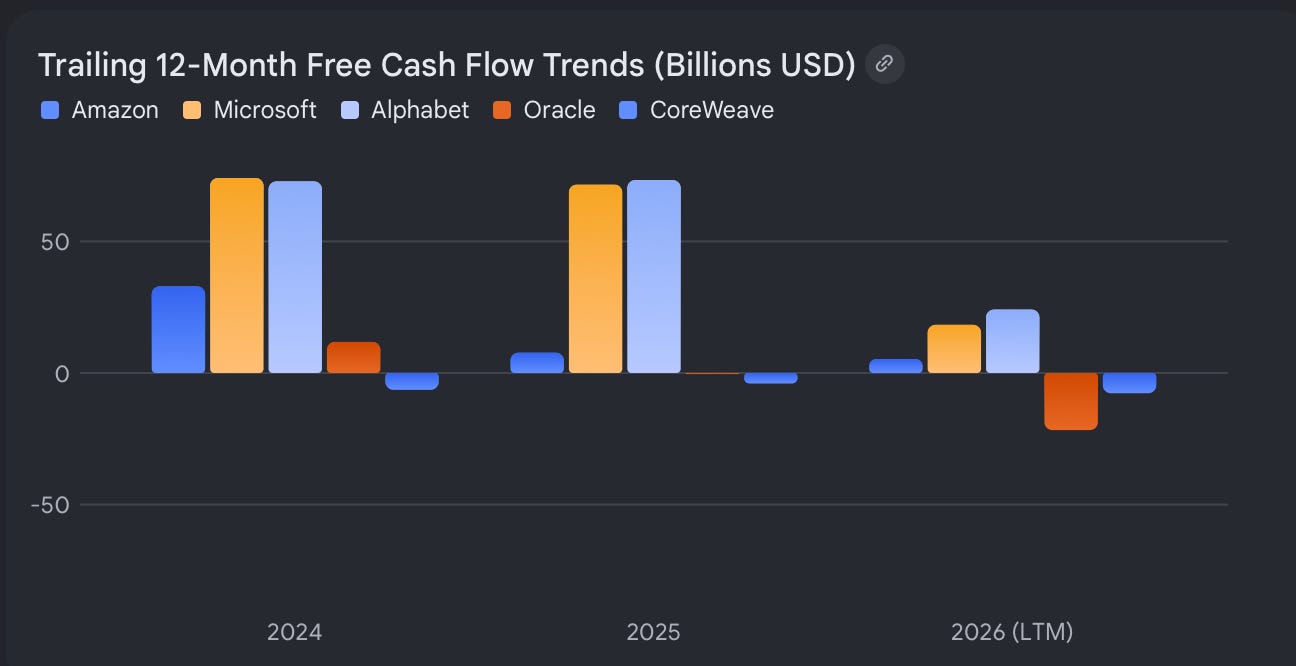
While they retain a stronger position, and are more supply inelastic, they are not perfectly inelastic. Their infrastructure moats, distribution, scale, are real moats, but shallower than publicly stated, a cloud position is a strong return but quite evidently not a permanent one, and it would seem by their actions, they know it also.
Many consider the true winner of the AI boom or bubble, to be Nvidia. currently valued at some $5.3 Trillion, and dominating some 8% of the largest investment index in the world the SP500.
The company that designs the chips, can be easily mistaken for the man selling shovels in a gold rush, earning an extraordinary margin that seems somewhat permanent. It isn’t.
Nvidia generates a schumpeterian quasi-rent, a very big and complex term that translated into plain english, it generates high margins from its innovation, that innovation takes time for its competitors to imitate, during that period, it sees greater sales and greater pricing power for its latest generation of chips. This premium an innovator commands has a cost, it is not a true return to position. Nvidia’s R+D has scaled at an annualised rate of around 37% compounding annually and will need to continue to do so, to justify the prices of its new chips and its preference from its clientele. The supply elasticity of a new innovative chip design starts at near zero allowing Nvidia to generate a super normal profit, and rather rapidly decays as competitors become able to imitate the designs, back to a normal elastic good.
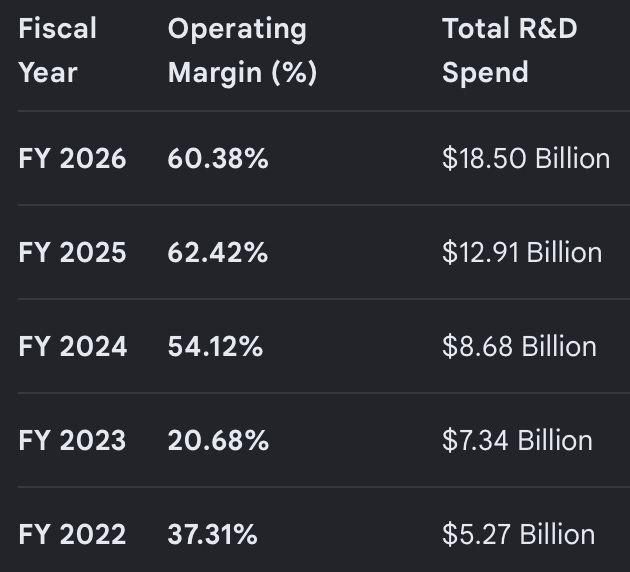
The chips themselves, are reproducible goods, their supply elasticity is relatively high, and rivals are pouring billions into catching up. What the research buys Nvidia is not permanence, it is a lag. Simply an interval before the competitors arrive with the same chips or same quality reproduced. The premium they generate is not a property of the asset, it is the property of the gap that is becoming increasingly expensive, in research that exhibits diminishing marginal returns.
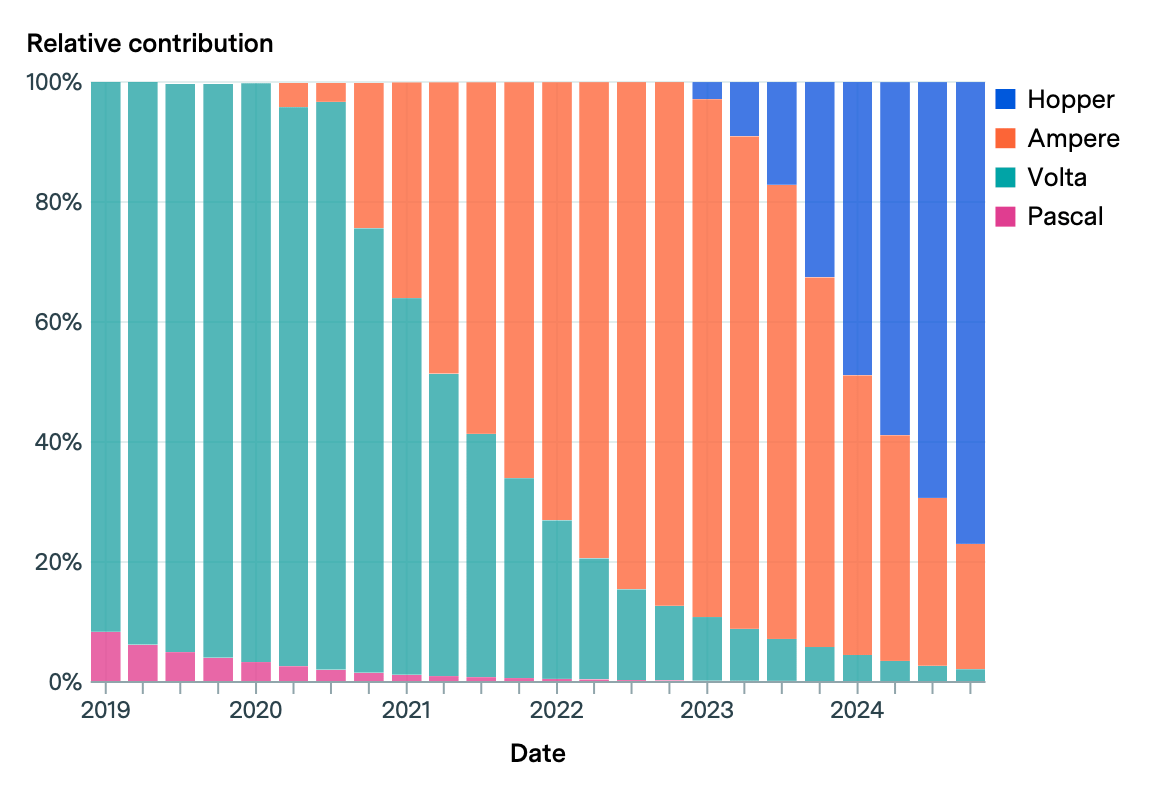
Nvidia is currently fighting against power costs, ASMLs EUV machine capacity, and physics itself to continue to deliver the kind of performance jumps its shareholders and its customers require. It can no longer deliver the performance from a single die chip, and must rely on dual die chips with exorbitantly expensive connectors to tie them together as it hits the lithography reticle wall. The build costs of this added complexity have jumped from its Volta series in 2017 at approximately $800 per unit, up to $6400 in its new Blackwell units in 2024, an annualised cost base compounding jump of some 34% per year across the series, or from its last hopper H100 units at approximately $3000 a unit, some 46% annualised. The unit cost jumps are not just increasing but they are accelerating.
In fighting with increasing difficulty, to defend and expand its temporary Schumpeterian rent, this knight of the sandcastle, must innovate constantly at exponential cost, with diminishing returns, to maintain a margin that is permanently washed out to sea.
The cruel irony being, the faster it innovates to maintain this rent, the faster it erodes the value of its installed base. the pace of new chips, now close to annual upgrades, means every buyers installed chips are outdated almost by the time they are installed in the racks. The frantic speed that maintains the rent is the speed that guarantees the thing that earns the rent will not last more than a year.
The sandcastle being built here is quite clear to see, the cloud providers have been scrambling to maintain their fortress positions in their markets, as technofeudalists, built to be rented, by model providers who’s returns have already washed away, and they have built these fortress walls out of silicon… quite literally sand.
I am sure even Jesus had a fitting line about houses and sand, that probably would have been worth reading for the technofeudalists. But, given the existence of Bill Hwang, I might avoid quoting Jesus in markets.
The mistake being made, of building these sandcastles and triumphantly declaring them as impregnable is quite easily revealed in the financial statements, where bold claims of their leaders quickly become accounting reshuffles and blurring.
Depreciation schedules. A fundamentally quite boring element of accounting until this recent AI frenzy and now they are the accounts most pawed over pages. Choosing a long useful life, allows them to spread the costs over longer financial years in smaller segments, the annual charges low and giving a smaller dent in the reported profits. Choosing a short (and more honest) useful life, incurs chunky charges, across shorter periods, and notably more dents in the reported profits.
The assumption broadly in the industry for the sandcastle, is some 5-6 years. The effective rate is closer to 3-4 including burn outs and maintenance, and the innovation rate screams back a much more harsh 1-2 years. The auditors at various firms, seem to have looked at the same sandcastles, and come to staggeringly different conclusions. Amazon shortened in 2025, and took a $900m additional charge on the additional depreciation, Meta instead lengthened, saving itself some $3bn.
Generally it is a good filter, between those who believe in their new silicon walls, and those who acknowledge it for the rapidly washing away sand it truly is. The two actions divide two major allocators between understandable strategies of sandcastles, one realizes it was pretty while it lasted, the other rather foolishly is fighting the tide that washes it away by frantically scooping on more sand to keep it standing for a moment longer.
Michael Burry, by our analogy usually bets on the sea not the sand, estimates the industries overstated profits by delusional depreciation schedules at some $176 Billion between 2026-2028. By Goldman Sachs’ measure, the whole industry moving to a 3 year depreciation schedule rather than a 5 year schedule, would add nearly $1 TRILLION to cumulative depreciation over the next five years. For most reasonable investors, it is generally good practice to watch the cash not the adjusted earnings, amazons free cash flow is down some 95% in a year.
Fundamentally the depreciation schedules and their varying adjustments amongst these sandcastles are a poor costume on a fundamentally ugly business being washed away.
We have at the top, the models, who pay a rent to the layer below, but whose core product margin is washed away faster than it can be built. Tens of Billions spent on model training to gain a top spot that lasts a month.
The cloud operators receive a rent from this top slice, but to maintain their position over a cloud fief, they have rushed against their competitors to build silicon walls, that are simply sand eroding on a one to two year schedule, with the cost to build them accelerating, dressed up in a costume cosplaying this crumbling structure as one made of stone.
The chip designer is paid a handsome fee to build the walls, but is only chosen for the quality of its sand, an advantage that lasts a year at most, and at this point they are fighting physics itself to generate this premium, while competitors nip at their heels, their customers increasingly aware, that the sand seems to be sand, regardless of how innovative or new it might be.
A cascading layer cake of quasi rents in real time, each with decreasing elasticity and time lags to trend to competitive elasticity, all exhibiting diminishing marginal returns.
At the bottom of it all, the most inelastic un-reproducible factor, the land for the data centers, the water for the cooling, the grid connections and transformers that have a 5 year back log of approvals and installations. A parcel of land, in a country with cheap enough power, and cheap enough and abundant enough water for cooling, is near to unreproducible on a 5 year schedule, it is also precisely where the money from private credit and pension funds seems to be flowing.
It is tempting to read this as a designed system, a layer cake of increasingly sticky rents, but simply it is capital doing what it does naturally, seeking the highest risk adjusted return. The reason the investors are fighting for the data centers, the well placed land with adequate grid connections, is not that they have conspired to become landlords.
The most secure returns are found in the most inelastic factors, the ones where competition cannot rapidly enter to compete such returns away. The capital flows to the inelastic factor in the same way water flows to low ground, unintentionally but as a simple process of gravity.
Yanis Varoufakis, in his fantastic work describes what he sees as capitalism distorted into ‘technofeudalism’ a new order where cloud platforms extract a cloud rent that has replaced traditional profit. He is on to something we also observe, but he has stopped half way through the layer cake and has not found his way down to the true foundation, the land. By our mechanism, the Capital is naturally drifting in order down from a return to production to a return to position, simply by a rational process of seeking risk adjusted returns, a rational sleep walk of the Rentier black hole. The cloud providers, are not the lords of this system, they are at best the lords of sandcastles eroding in real time. The returns they derive at their scale and market dominance, require a tithe to maintain in capital and expansion, in this intense scramble to retain the position they once had in the market, they have burned their cloud rents to build bigger walls made of sand, they have realised with quite a blunt shock, these were not lords of technofeudalism, they are barons at best, in a war they cannot afford, to maintain lands they never truly owned, that are being washed out to sea.
Their master is whomever can provide them the sand for their crumbling walls at extended costs annually, and their murderer is a clock that ticks against them on the balance sheet.
A Mortgaged Peasantry
The peasant paying the tithe in this sandcastle, has already determined how this will crumble.
In their attempts to maintain the competitive edge, a Schumpeterian rent that lasts some 35 days, the model operators are leveraging themselves to the hilt to acquire compute at scales that boggle the mind to eek out tiny and fleeting advantages over their competitors with diminishing marginal returns.
With $73 Billion in cash on hand, OpenAI burns some $15 Billion a year, while token prices depreciate at a median rate of 50x a year, and somehow has commitments to acquire and spend some $750bn until 2030. Even without a calculator you can notice a pretty sizable gap, and here lies the problem. The runway relies on the next fundraising round, and the next, and the one after that. A borrower whose income covers neither its losses or its commitments, betting on a future fundraise, while its product devalues by some 50x per year. This is definitionally what Hyman Minsky describes as ponzi financing.
Now, the issue here is not a single model provider failing, equity hitting zero, while sizable, is isolated generally. The shareholders take a hit to the chin, but the system stands, the result is the kind of short clearing market crash à la 2001 Dot-com. The issues only truly start once the integration is made into the machine, of credit, securitization and lending.
The issue lies in these unfunded commitments being treated as bankable collateral. The commitments of Ponzi financing being pledged against true lending in the cloud providers. As can be seen in particular with Oracle, recently downgraded to barely above junk rating at BBB- by S&P ratings, as half of their receivables are against OpenAI alone, who have the cash today excluding burn to cover approximately a fifth of their commitment to just Oracle.
The rest of the machine has been funneled into SPVs for the construction of data centers, some $500bn in total lending is against brand new vehicles to keep debts off the balance sheet and in isolated vehicles. The assets with the data center comprised some 70-80% in the sand that is depreciated by a new generation of chips within 24 months.
The investments solicited from the chip designers into the model providers, under this guise, are simply loans to acquire its chips, thrown through equity to avoid regulatory scrutiny it’s previous $100bn cash for chips deal it structure was victim to.
The structure now, contains trillions in securitized debt structured against the ponzi finance of a handful of companies whose product is subject to the fastest erosion in true returns to production.
The difference between a pop and a bang is the credit integration, which is now at heights not seen since the financial crisis, and is built on returns that never existed and erode faster than they arrive.
The current outstanding CMBS on data center financing deals is expected to hit $115bn this year according to Bank of America. With other securitized credit around this AI financing extending beyond $500bn already.
Suppose the correction comes. The tide arrives to wash away the sandcastles, what remains, what is left standing?
Not the model providers, who seem to be superseded every 35 days. Not the ‘technofeudalists’ that without a customer or the financing, sit on silicon that turns to sand within 3 years. Not the cloud providers receivables, who disappear in a flash with the model providers.
The only thing that remains is the return to position, the thing that could not be competed away, the land, the grid connection, the substations. The thing that made them valuable, their inelasticity, the thing that made them truly valuable, is not a promise that can be broken. When the elastic tower crumbles, what remains is the inelastic floor.
Even if this tide does not arrive, the Ponzi financing is reformed by Jevons paradox, the revenues boom and AI turns out to be all it was promised to be. This technology changes the world in some positive manner boosting the productivity of all workers and industries leading to real wage growth across the whole economy. In an economy where the housing market and its land is close to perfectly inelastic, it does not stay as higher wages, it becomes higher bids for a fixed factor absorbing whatever income chases it. In the case AI turns out to be all its largest believers want it to be, the result is the same that we see in the sandcastle, the value and the cash drains to the most inelastic factor as higher rents and higher prices.
The effect can already be seen in a perfect microcosm of San Fransisco, where the burgeoning salaries of AI engineers, the exits of RSUs, have converted themselves into a 19% annual jump in real estate prices, and a commensurate bump in rents.
AI itself, for the doomer conversation of a financial collapse, or the deluded notion of Elon Musk, of a world free of scarcity, is a simple demonstration of an older fundamental system. Enormous value is created, it is subjected to competition across every layer that can be reproduced, a network, a minimum efficient scale, a product, an innovation, recreated and handed forward as a lower price. This surplus settles to the last drop in an inelastic system to the one thing that cannot be reproduced and cannot be competed away. The chips depreciate, the labs bleed, the clouds ignite themselves as the Cashflow burns to zero, the consumer pockets the difference in cheap intelligence, just another product subject to the process of capitalism. The only true beneficiary is the land, fertilized with the blood, the sweat, the tears of its inhabitants toil.
These castles made of sand will fall, the tides come in. The labour, the fortunes, the castles, are all subjected to a natural process of erosion, the only survivor is the beach itself.
What I see is a structure built upon the sand, regardless of which sand castles are built, how high they may be, how intricate they are or the talents of their designers.
Until we build on the stone not the sand, all structures must fall. There is no techno-feudalist on a sufficient time scale, there is only a feudalist.
An ephemeral capitalism of sandcastles, built on a dark remnant of feudalism, will always revert to feudalism by the same rationality of capitalism that seeks risk adjusted returns, capitalizing into a plot that always was and always will be.
For what comes from the earth must return to it. Even you, my dear reader will one day fertilize the soil you toiled upon, and your labours, your innovations and your productivity is merely capitalized within it.
We are all upon a beach, assisting in the productive construction of better sandcastles, but while the beach is rented, and the tide exists, what happens above it past a day is irrelevant, and on a risk adjusted basis, I would rather always own a beach, and watch you build a sandcastle.
No posts
Comments
Nothing yet. Say the first thing.
Sign in to join the conversation.