
On July 16, 1945, J. Robert Oppenheimer, Director of the Manhattan Project, and his fellow scientists watched in awe as the world’s first atomic explosion vaporized the steel tower below and washed over them in a blinding flash of light. In a moment the relations between nations changed forever and put humanity on a course that for the first time could destroy itself. Later when he reflected on what he and his team had done, he quoted the Bhagavad Gita.
Video credit, the Atomic Archive. Fair use.
“Now I am become Death, the destroyer of worlds,” he said. The bombing of Hiroshima and Nagasaki in 1945 ended the Second World War. The Bomb had brought death to hundreds of thousands of people, mostly civilians, from burns, blast, and radiation in a single moment. Later, more would die from radiation induced cancers. The world was filled with awe and lust for the new atomic weapon. After nearly a decade of nuclear dominance by the US the Soviet Union began to produce its own nuclear weapons. A balance came into existence between the two nuclear superpowers as the policy of “Mutually Assured Destruction,” ominously acronymized as MAD, in which the arsenal of one side would deter the arsenal of its enemy since an attack on one would unleash a nuclear exchange by the other leading to mutual annihilation. Over the years an arms race ran up a tally of terror between two superpowers. Ironically MAD was credited by some to have prevented nuclear war for seventy years.
But today with nine countries possessing nuclear weapons, that policy is on the verge of falling apart. There are more than 12,000 nuclear warheads worldwide, enough to kill billions of people. The game of deterrence the two original superpowers played may have provided a margin of predictability, but conventional game theory no longer applies. Nine players create an exponential growth in the number of possible outcomes. In the minds of world leaders nuclear weapons may be viewed as simply bigger conventional bombs. Pakistan and India nearly came to nuclear blows a year ago. Both Donald Trump and Vladimir Putin have made nuclear threats against their enemies, and China is on the path of increasing its nuclear forces. In the lingo of our times, MAD does not “scale.” In down-to-earth language, deterrence is dead. What comes next? Enter the promise of artificial intelligence, which like the Trinity test may be a path from which there is no return.
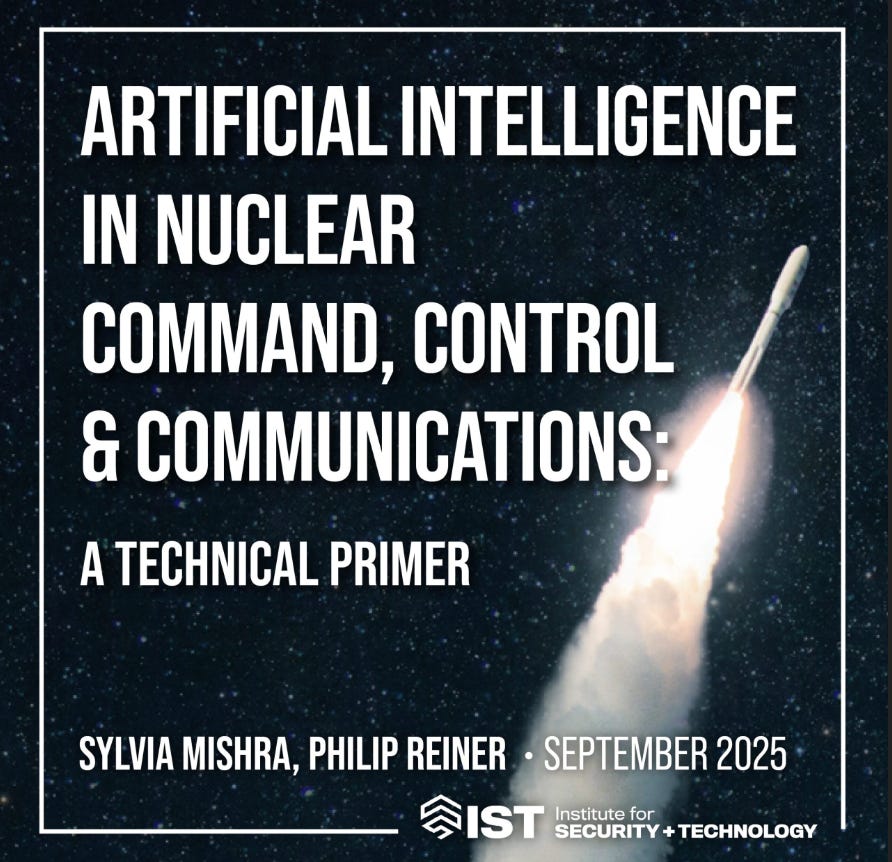
Cover credit, securityandtechnology.org. Fair use.
At least three nuclear powers, the US, Russia, and China, are on paths to build autonomous war machines that decide whom, where, and when to kill. Transfer this power to nuclear forces and we turn over the survival of the human race to an algorithm. This is no longer a sci-fi dystopian fantasy, but a growing part of war planning by the superpowers. This short list of AI actors does not yet include smaller nuclear powers such as North Korea, Israel, India, or Pakistan, but no doubt their nuclear war planners lust for AI and autonomous nuclear war fighting as well. Nor are non-state actors likely to be oblivious to the possibilities for them. Given the growth in worldwide computer hacks, the future of secure cyber systems does not look bright. Cyber-attacks involving nuclear weapons are not unlikely. Non-nuclear weapons have already been developed including artificially intelligent missiles, autonomous vehicles, drones, and robots. AI systems can make vulnerable each nation’s so-called nuclear triad of delivery systems, missiles based on land, air, and sea, forcing nations into a use-them-or-lose-them status. The complete non-human control of nuclear weapons systems is not likely to be far behind. Surviving, let alone “winning,” a nuclear conflict with a field of nine players is like betting the fate of the earth on a roulette wheel with thousands of possible outcomes. Why wouldn’t an AI system launch its nuclear weapons before they were destroyed in a preemptive strike by an enemy’s autonomous weapons?
Its advocates in the military and among its developers (who are racing each other for dominance and profits), argue that AI may confer a number of benefits to modern war fighting. By removing human operators it will remove the possibility of human error. By being machine driven, its reaction time will be far quicker than that of mortals. By not being human, its decisions won’t be muddied by the messy human processes of judgment, doubt, compassion, and, of course, ethical or religious values. War between two or more AI systems might even come to be waged without human casualties, like videogames, albeit expensive ones.
There is the downside to AI. Artificial systems continue to report “hallucinations,” the developers’ euphemism for AI output that comprises errors, lies, and misdirection based on sloppy input, algorithmic bugs, or hacking. AI can also be too good. Anthropic’s offering, Mythos, was recently blocked from export by the federal government because it was deemed too powerful a tool for hackers. Full disclosure: I use Anthropic’s AI tool Claude for research, though with a firm policy is to verify all of Claude’s seemingly oracular results by factchecking it against original sources. When I’ve found that Claude was wrong and told him so, he apologized, though that’s small comfort if the survival of the human race is at stake. Missing from this inventory of dangers is the proverbial machine running amok as in Kubrick’s classic 2001, to seize control and dispense with us entirely.
Even with AI out of the picture, human control over nuclear weapons does not promise indefinite safety from accidents or intentional use. History is rife with system errors thwarted only by luck or common sense, such as the 1983 Petrov incident, in which a Soviet early warning system signaled that five nuclear missiles were heading towards the country. Instead of alerting his superiors, the engineer, Stanislav Petrov, reasoned that an American attack on the USSR would hardly consist of five missiles, so he waited for corroborating evidence. None came. By waiting, Petrov prevented a Soviet counterattack against the US based on a false alert. Later it was learned that the faulty signal had come from a rare alignment of sunlight on high-altitude clouds and the system’s satellites. “Deterrence” nearly destroyed the modern world. One thoughtful human saved it.
If deterrence is dangerous or dead, it’s insane to revive it by placing the fate of the human race in the hands of artificial intelligence. If we believe that AI can still be developed for the good of all, then the path is clear for dealing with our own Oppenheimer moment. Every nuclear weapon on earth must be abolished. To that end my friend and colleague, Dr. James Muller, a pioneer in educating world leaders about the dangers of nuclear war, has arranged a conference at the Vatican next month called the Global Nobel Laureates Assembly on Artificial Intelligence and Nuclear War. Nearly 100 world leaders in science, peace activism, academia, artificial intelligence, and the Catholic Church are expected to attend. Will such an assembly unanimously call for the immediate abolition of nuclear weapons? Unlikely. But will such a meeting empower leaders to reconsider the path we are on, to rekindle commitments to move beyond lip service, and impel them to take actual steps towards that end? One hopes so. The templates for verifiable treaty protocols for denuclearization already exist. To believe that the abolition of nuclear weapons is possible is an imperative to make it happen. To believe otherwise is to allow our second Oppenheimer moment to tragically pass us by.
No posts
Comments
Nothing yet. Say the first thing.
Sign in to join the conversation.