
Begin with the definition, because everything downstream depends on it. The United States has never refused a payment, and it never will. Sovereigns of its rank do not default by failing to pay. They default by redefining what payment means after the money has been lent. Rating agencies do not count this. Creditors count nothing else.
The 1933 original was crude: default by statute. Federal bonds carried the gold clause - a covenant to repay in gold coin of the 1918 standard - and Congress abrogated it retroactively, the government’s own obligations included, before cutting the dollar’s gold content 41 percent. Every obligation was met in full, on schedule, in a unit worth 59 cents of the one promised. It took the Supreme Court to write the epitaph: in Perry v. United States, February 1935, eight of nine justices held that Congress had no constitutional power to void its own bond covenant - and awarded the creditor nothing, because owning the gold he was owed had itself been made a crime, and an unenforceable promise pays no damages. Unconstitutional, and remediless. Roosevelt supplied the genre’s founding euphemism, faithfully preserved in the first panel: we do not default; we reform. Reinhart and Rogoff’s eight-century ledger of sovereign default was less diplomatic. It enters the episode without ceremony - the United States, 1933 - and their later work sizes the haircut at roughly 16 percent of GDP.

The US is about to Default for a 3rd time. Study the three panels above in sequence, because the sequence is the argument.
The 1971 refinement dispensed with the statute. No act of Congress, no court, no litigation risk - a weekend, sixteen men, and a television broadcast announcing that gold convertibility was suspended “temporarily.” The suspension is in its fifty-fifth year. The middle panel records the world’s verdict in the world’s own words: de facto default. And note the panels’ numbering, because it is historically exact. The world counts Default I and Default II - the original was never counted at all, the official position, per the first panel, being that it never occurred.
Hold 1933 and 1971 side by side, and the anatomy of a great-power default becomes legible. No missed coupon. No negotiated haircut. Every creditor paid in full, and every creditor poorer. Both times, the alternative - honoring the promise as written - meant deflation at home: higher rates, fiscal contraction, recession into an election cycle. Both times, Washington repriced the promise instead.
Which brings us to the third panel, and to the masterpiece. The 2026 refinement requires neither statute nor suspension. Nothing is abrogated. Nothing is closed. On July 31, 2026 - fifty-five years, almost to the week, after the second panel’s weekend - the US Treasury bought yen for the first time in more than a decade, and asked the Federal Reserve to enlarge the facility that lets America’s largest creditor raise dollars against $1.1 trillion in Treasuries without selling a single bond into the market. The creditor requested it. The press release spoke of cooperation. In 1971 it was America’s gold that went behind the bars; this time it is the creditor’s collateral inside the cage - and the creditor holds the receipt, and calls it liquidity.
That is the tell, and it is the thesis of this essay. The first two defaults had dates. The third has an architecture.
Return to the first weekend, because the choreography is the template.
On Friday, August 13, 1971, sixteen men were flown by helicopter to Camp David and sworn to secrecy - no outside calls, by presidential order. Over two days they settled the largest change to the world’s monetary arrangements since the war. On Sunday night the networks cut into their evening programming, and Nixon announced he was closing the gold window: suspending, “temporarily,” the right of foreign governments to convert dollars into American gold at $35 an ounce. The suspension is now in its fifty-fifth year.
Treasury Secretary John Connally was dispatched to face the allies and delivered the sentence that still governs the arrangement: the dollar is our currency, but your problem.
One detail from that August is routinely omitted, and it is the hinge of this essay. In the final two weeks before the window closed, the most loyal defender of the system was the Bank of Japan, which absorbed roughly four billion dollars - an enormous sum at the time - holding the yen at 360 to preserve the parity Washington itself was about to abandon. Japan spent a fortune defending a promise in the last days of its life, and was repaid, like every other creditor, in the smaller unit.
Hold the name. Japan returns at the end of this story, on the other side of the same position.
For now, note the playbook, because it fits in three sentences. Keep paying. Redefine what payment means. Call it temporary.
Why does the world permit this - twice, and counting? Because reserve-currency status does something to its issuer that no other monetary arrangement does: it suspends the external constraint.
The world trades and saves in dollars; to save in dollars, foreign governments and central banks must hold dollar claims - overwhelmingly, US Treasuries. The issuer’s deficits are therefore financed by creditors who are structurally required to keep lending. Jacques Rueff, the French economist who understood the machine earlier and better than anyone, gave the condition its permanent name: the deficit without tears. His finance minister, Valery Giscard d’Estaing, gave the asset its name - the exorbitant privilege. And the privilege is measurable, not rhetorical: Gourinchas and Rey have documented the persistent excess return America earns on its external balance sheet, paying its creditors less than it earns from them, decade after decade - a seigniorage no other sovereign collects.
The privilege is real, and it is immense. I have argued elsewhere that it is America’s single greatest economic achievement - a capitalized asset worth roughly a year’s GDP. But an achievement can be both genuine and overdrawn, and inside the privilege runs an engine that has now completed one full cycle and is deep into its second. It runs in three strokes.
First, the privilege suspends the rule. Ordinary sovereigns that overspend eventually meet their creditors. The reserve issuer’s creditors must keep lending, so the reckoning is deferred - seemingly without limit. There was even a structural flaw guaranteeing it: the postwar system needed American deficits to supply the world’s liquidity. Triffin identified the contradiction in 1960. The flaw was load-bearing.
Second, the slack gets spent. Every domestic coalition - guns and butter alike - learns that the constraint is missing and borrows against its absence. The claims compound until they visibly outgrow the credible backing.
Third, the exit gets closed. When creditors finally act on the arithmetic, the issuer faces a fork: honor the promise as written, which means deflating at home - or protect domestic objectives and change the rules for the creditors.
America has stood at that fork twice, and chosen the same branch twice.
The first full cycle compresses into a single chart. Through the 1950s and 60s, the American gold stock stood still - fixed in quantity, fixed at $35 - while foreign official claims on it compounded relentlessly. In 1964 the lines crossed: from that moment the promise was mathematically unkeepable if called. By the Camp David weekend, coverage had fallen to roughly a quarter. The default of 1971 was arithmetic years before it was politics.
On the right side of the same chart sits the present: the identical X-shape, drawn by the identical logic, six decades later. Foreign central banks’ gold has just crossed above their Treasuries. How that came to pass is the second half of this essay. First, the scale of the claims this time.
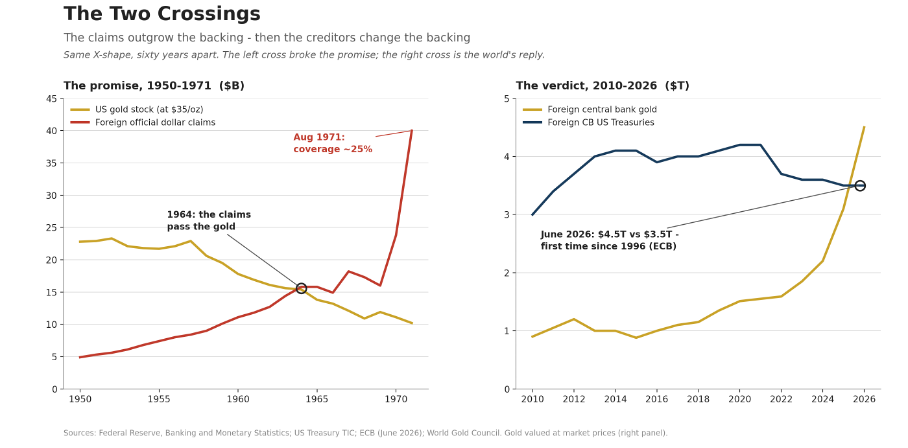
Left: fixed gold against compounding claims - the promise breaks mathematically in 1964, politically in 1971. Right: the same X, 2010-2026.
Twenty years ago, marketable US Treasury debt - the bills, notes and bonds that trade, the claims creditors actually hold - totaled some $4.4 trillion. Today it stands near $31 trillion, inside a headline gross debt closing on $40 trillion. Over those two decades the claims grew a little more than sevenfold; nominal GDP slightly more than doubled. The claims have compounded at three times the pace of the economy backing them.
The shape of the climb matters more than its size. It is a ratchet. The financial crisis added roughly $4 trillion in three years; Covid added roughly $4 trillion in twelve months; and between and after the crises the level never retraced - not once, in any year. Each emergency resets the baseline, and the new baseline becomes the launch point for the next emergency. The fiscal position no longer mean-reverts. It accumulates.
Comments
Nothing yet. Say the first thing.
Sign in to join the conversation.