
In 1999, two senior colonels of the People’s Liberation Army sat down to answer the question that had haunted Beijing since Desert Storm: how do you defeat the United States?
The Gulf War had shocked the Chinese military to its core. The Americans had dismantled one of the world’s largest armies in 42 days, at almost leisurely cost. Whatever illusions existed in Beijing about winning a conventional war against the United States died in the Kuwaiti desert. So Qiao Liang and Wang Xiangsui wrote a book - Unrestricted Warfare, published by the PLA’s own press - built on a single, cold admission:
America cannot be defeated on a battlefield.
Not then. Not now. Not for decades. The book’s conclusion was that the contest would have to move to arenas where aircraft carriers are useless. And the arena its authors returned to, again and again, was finance. Its first rule: there are no rules.
Qiao spent the next twenty years refining the argument. By 2015, now a Major General lecturing at a Chinese Communist Party study forum, he had reduced it to its essence. The most important event of the twentieth century, he told his audience, was not either World War, nor the collapse of the Soviet Union. It was August 15, 1971 - the day the dollar left gold and became a currency backed by nothing, which nonetheless obliged the entire world to work for it. The Americans, he said, can obtain material wealth from the world simply by printing a piece of green paper. The first financial empire in history.
And when Qiao analyzed a future war over Taiwan, he did not warn his countrymen about the Seventh Fleet. He warned them about the dollar. America’s greatest deterrent, he concluded, is not its aircraft carriers. It is its currency - the one weapon that could rupture China’s capital chain, sever its maritime lifelines, and devalue its reserves without a single shot being fired.
Read that again. The PLA’s foremost strategist spent a career searching for America’s weakness and found, instead, its most unassailable strength. The dollar’s reserve status is the fortress China could not breach, the weapon it could not counter, the privilege it could not replicate.
Which brings us to March 2023, and a Senate hearing room in Washington, where a freshman senator from Ohio - today the Vice President of the United States - looked at the same fortress and called it a burden. The reserve currency, JD Vance argued, is “a massive subsidy to American consumers but a massive tax on American producers.” A driver of mass consumption of mostly useless imports. Something, perhaps, to be given up.
Beijing could not break the dollar from the outside. Washington is now debating whether to dismantle it from within.
Let us try to take Vance seriously - and it does take trying. Because what he is proposing, stripped of its Senate-hearing politeness, is that the United States should reconsider the most valuable asset it has ever possessed. The facts he builds his case on are real enough. The conclusion he draws from them is one of the most reckless ideas voiced by a senior American official in decades - and by the end of this section, the ledger itself will show why.
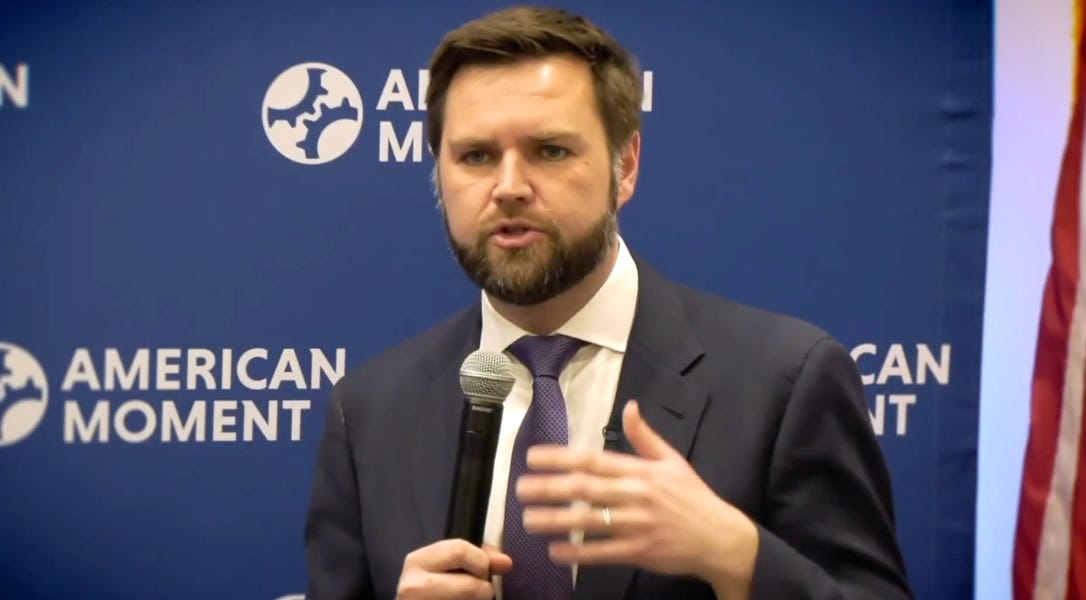
His case runs as follows. Global demand for dollars keeps the currency permanently stronger than trade flows alone would justify. A strong dollar makes American exports expensive and foreign goods cheap. Cheap imports delight the consumer and hollow out the producer. The factory closes in Ohio, the container ship arrives in Long Beach, and the whole arrangement is celebrated as prosperity. In his Senate exchange with Jerome Powell, Vance reached for the analogy of his own Appalachia: a resource curse. Coal made the region rich enough to consume and too comfortable to diversify. The dollar, he suggested, has done the same to the nation - a subsidy for consumption, a tax on production, and a quiet engine of deindustrialization.
There is real substance here, and it deserves to be acknowledged rather than waved away. The dollar is overvalued relative to a world without reserve demand; serious estimates put the effect at 5 to 10 percent. American manufacturing employment did collapse. Stephen Miran, now one of the administration’s most influential economic voices, built an entire policy architecture on exactly this diagnosis in his 2024 paper on restructuring the global trading system, and his description of the mechanics - inelastic foreign demand for reserve assets propping the currency above its trade-clearing level - is textbook Triffin. The cost side of the ledger is real. Anyone who denies it is not being honest.
But here is what should stop every reader cold. Vance has read the cost line of the ledger and mistaken it for the ledger.
He has priced the burrito. He has not read the balance sheet. And the balance sheet is where the reserve currency lives - because the privilege was never about cheap imports. Cheap imports are the loose change that falls out of its pockets. The privilege itself is something far larger, and it is worth putting numbers on it, because almost nobody ever does.
Start with the estimate the skeptics love, because even the skeptics’ number is enormous in cumulative terms. In 2009, the McKinsey Global Institute tried to compute the net annual financial benefit of reserve status and arrived at $40 to 70 billion in a normal year - seigniorage on the physical dollars held abroad, plus cheaper government borrowing, minus the competitiveness cost of a stronger currency. Ben Bernanke leaned on figures like these when he wrote in 2016 that the exorbitant privilege was no longer so exorbitant. Case closed, said the fashionable view. The privilege is a rounding error.
The fashionable view measured the doorknob and called it the house.
Go one layer deeper and the numbers change character. Foreigners hold roughly a trillion dollars of physical US banknotes - about 45 percent of all notes in existence and two-thirds of all $100 bills - an interest-free loan of a size no other country has ever enjoyed. The academic literature on the Treasury “convenience yield” finds that the safety and liquidity premium has reduced US borrowing costs by roughly 73 basis points on average across nearly a century. Deeper still lies the finding of Pierre-Olivier Gourinchas and Helene Rey, who reconstructed the entire US external balance sheet back to 1952: America earns roughly 2.7 to 3.3 percent more per year on what it owns abroad than it pays on what it owes. The United States operates as the world’s banker - it borrows from the world in safe, cheap dollar liabilities and invests the proceeds in risky, high-return foreign assets. That spread, compounding for seven decades, is why America has been able to run trade deficits for half a century while its net investment position deteriorated far less than the arithmetic of those deficits implies. No other nation on Earth is allowed to run its affairs this way.
And in 2026 the literature finally produced the number that settles the debate. A new NBER study by Krishnamurthy, Jiang and co-authors - the leading scholars of safe-asset economics - modeled exactly the scenario Vance flirts with: the world stops treating US assets as its reserve. The result is not a rebalancing. It is an amputation. The lost seigniorage is worth about 1 percent of GDP per year, in perpetuity. Capitalized, the privilege is worth approximately 107 percent of GDP - roughly $33 trillion of national wealth. And the competitiveness gain that Vance covets? A one-time real depreciation of about 9 percent. Against it: US real interest rates roughly 90 basis points higher on everything, forever, as $30-odd trillion of dollar bonds must be reabsorbed by domestic savers who demand a real return. The study’s lead author put it plainly: the trade-account benefit exists, but the interest-rate cost is orders of magnitude greater.
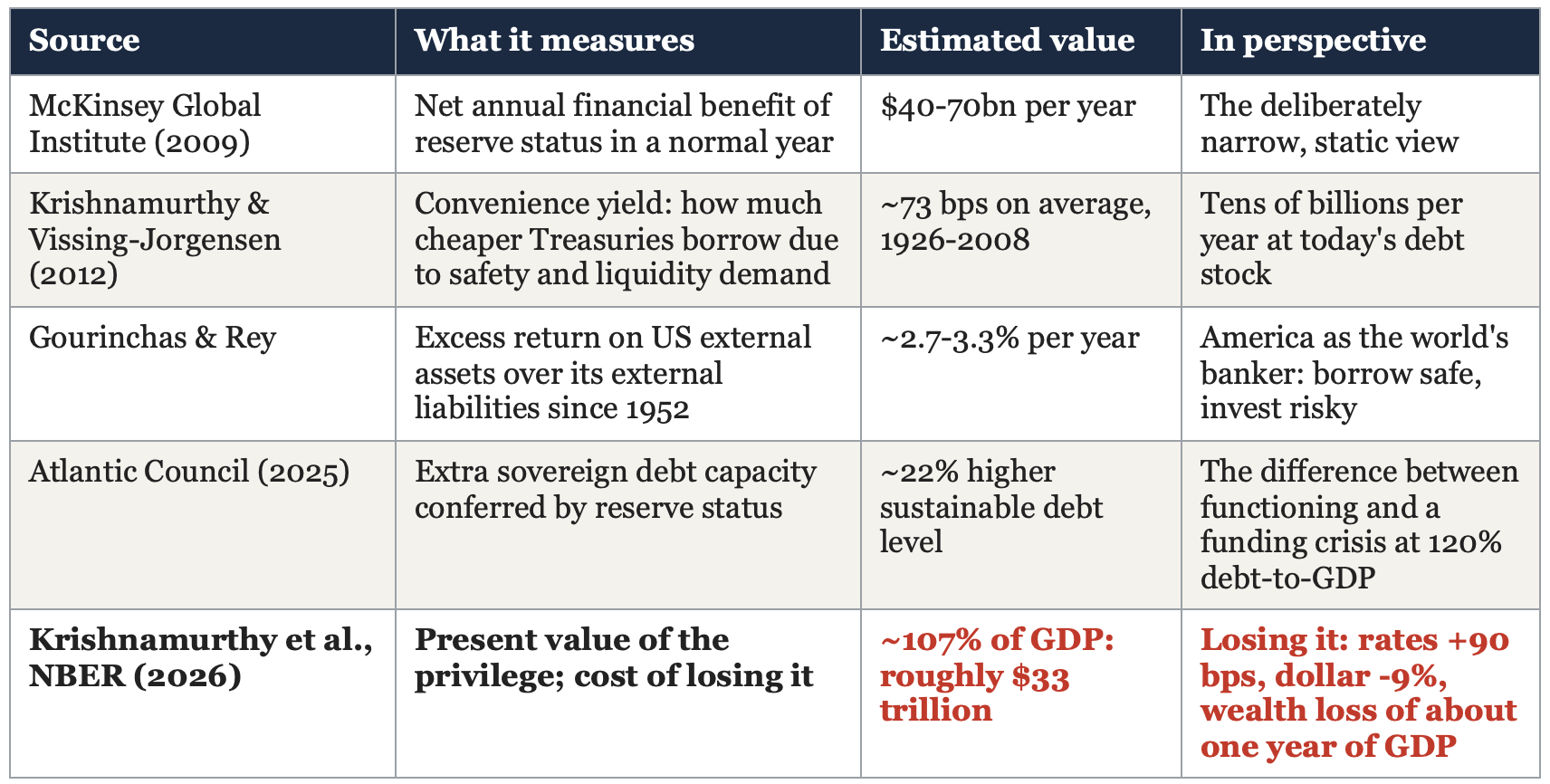
Caption: The ladder of estimates. The narrow accounting view (top) is the one the sceptic’s quote. The balance-sheet view (bottom) is the one that matters: the reserve currency is a $33 trillion asset, and the price of losing it is roughly one full year of American GDP.
The privilege is not the cheap burrito. It is the $33 trillion balance sheet.
If the numbers above feel abstract, there is a simpler way to see the privilege. Look at what America has been allowed to get away with.
Since 1970, the United States has run a federal deficit in 50 of 55 fiscal years. The four consecutive surplus years, 1998 through 2001, required a once-in-a-generation technology bubble to produce. In fiscal 2025 the deficit ran at 5.8 percent of GDP - a Great Recession-sized shortfall - with the economy at full employment. This is not counter-cyclical policy. It is a permanent structural condition, financed year after year, decade after decade, without a funding crisis, without a currency collapse, and without the inflationary punishment that the economics textbook promises any other country behaving this way.
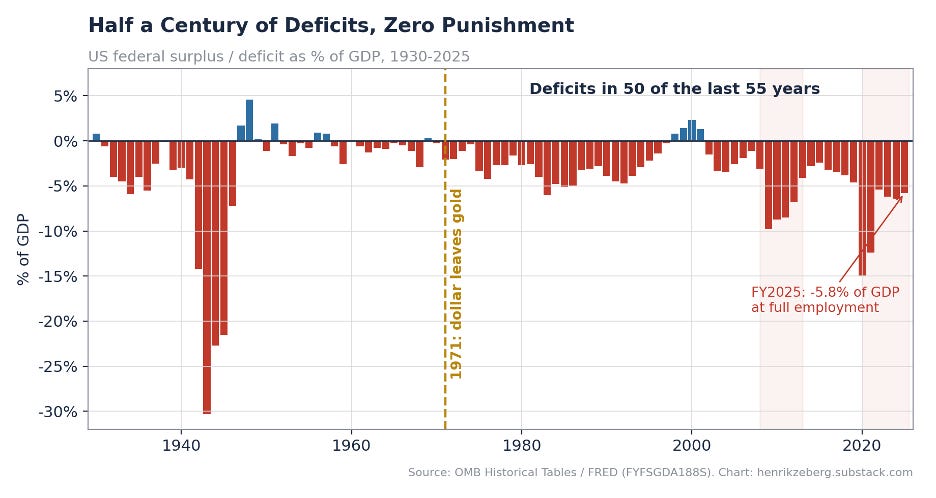
Caption: The privilege made visible. No other nation in modern history has been permitted to run deficits this persistent, this large, for this long - and be rewarded with the world’s lowest risk premium while doing it.
Who financed it? The world did - voluntarily, and at a discount. Foreign investors held about 2 percent of GDP in US federal debt in 1970. Today they hold roughly $9 trillion, around 30 percent of GDP. Every one of those bonds is a foreign saver choosing to fund American consumption at yields lower than the fundamentals would otherwise demand. That is the machinery of the exorbitant privilege, operating quietly in the background of every American mortgage, every Pentagon budget, every tax cut, and yes - every $20 burrito.
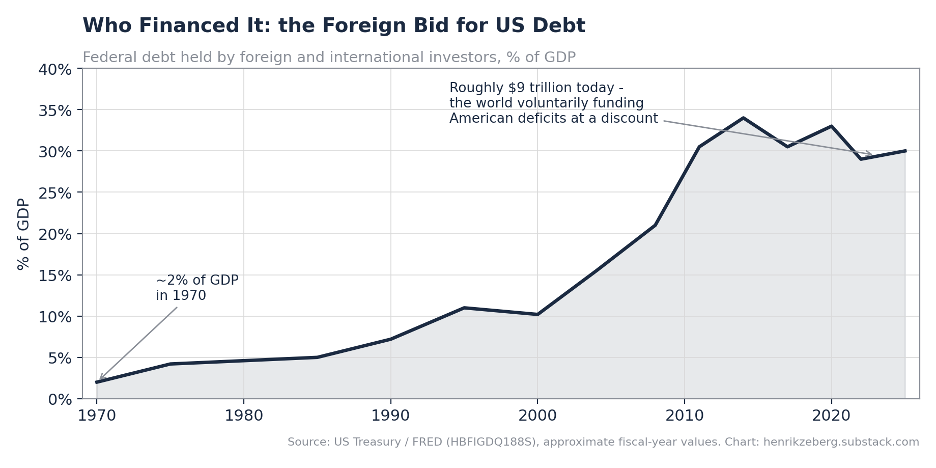
Caption: The other side of the ledger. Reserve status converts the rest of the world into a permanent, price-insensitive creditor of the United States.
Now consider the control group - the countries that tried something similar without a reserve currency. In September 2022, the United Kingdom announced unfunded tax cuts amounting to a fraction of what Washington routinely legislates. Within days, gilt yields spiked, pension funds faced margin-call spirals, the pound crashed toward dollar parity, the Bank of England was forced into emergency bond-buying, and the Prime Minister was gone in 45 days. Analysts later noted the telltale signature - yields rising while the currency falls, capital exiting the country entirely - a pattern common in emerging markets and almost unheard of in the G10. Emerging economies face funding stress at twin deficits of 4 percent of GDP. The United States runs larger deficits than that as a baseline, and is rewarded for it.
The pound - itself a former reserve currency - bought its issuer 45 days of tolerance. The dollar has bought its issuer 55 years.
That difference is not virtue. It is not productivity, and it is not fiscal discipline, of which Washington has none. It is the privilege - and the fact that America’s political class has stopped noticing it is precisely how privileges die.
The dollar is not the first currency to rule the world. It is the sixth. And the history of its predecessors is the most underused dataset in this entire debate - because every one of them tells the same story, and none of them ends the way Vance imagines.
A note of honesty first: strictly speaking, the modern concept of a reserve currency - foreign central banks holding another nation’s financial assets - only truly begins with sterling under the gold standard. The earlier cases were the dominant trade and settlement currencies of their eras. But the underlying phenomenon, one nation’s money serving as the world’s money and conferring power on its issuer, is the same across all six.
Portugal’s currency rode the Age of Discovery for roughly 80 years, and died not of economics but of politics: a succession crisis destroyed the credibility of the state behind the coin. Spain inherited the crown along with the silver of Potosi, and here Vance should pay close attention - because Spain is the actual resource curse he thinks America is. The flood of unearned bullion rotted Spain’s productive base, financed endless wars, and masked a fiscal decay punctuated by repeated sovereign defaults. But note the lesson carefully: the curse was real, and the cure was never to refuse the silver. No Spanish minister ever proposed handing Potosi to the Dutch to encourage domestic manufacturing. Decline came anyway, through fiscal incontinence - not through the privilege itself, but through what the privilege allowed politicians to avoid confronting.
The Dutch case is the one that should keep American policymakers awake. The guilder was the first genuinely modern reserve currency, resting on the first modern financial system: the Bank of Amsterdam, deep securities markets, standardized credit. It reigned for nearly a century and a half. Then the Fourth Anglo-Dutch War arrived in 1780, and the entire edifice collapsed in less than a decade. The mechanics deserve to be spelled out. The war crushed the trade of the Dutch East India Company, the too-big-to-fail enterprise of its day. The Bank of Amsterdam - which had held reserves of roughly 97 percent against its deposits in 1779 - began printing credit to rescue it. By 1783 the reserve ratio had fallen to 28 percent; by 1788, near 20 percent. Meanwhile the debt of the Province of Holland already exceeded roughly 250 percent of GDP. War-scale spending, extreme indebtedness, and a central bank monetizing the rescue of a systemically vital borrower: within ten years, the world’s reserve currency was dead, and the crown had crossed the Channel to London.
If that combination sounds familiar, it should.
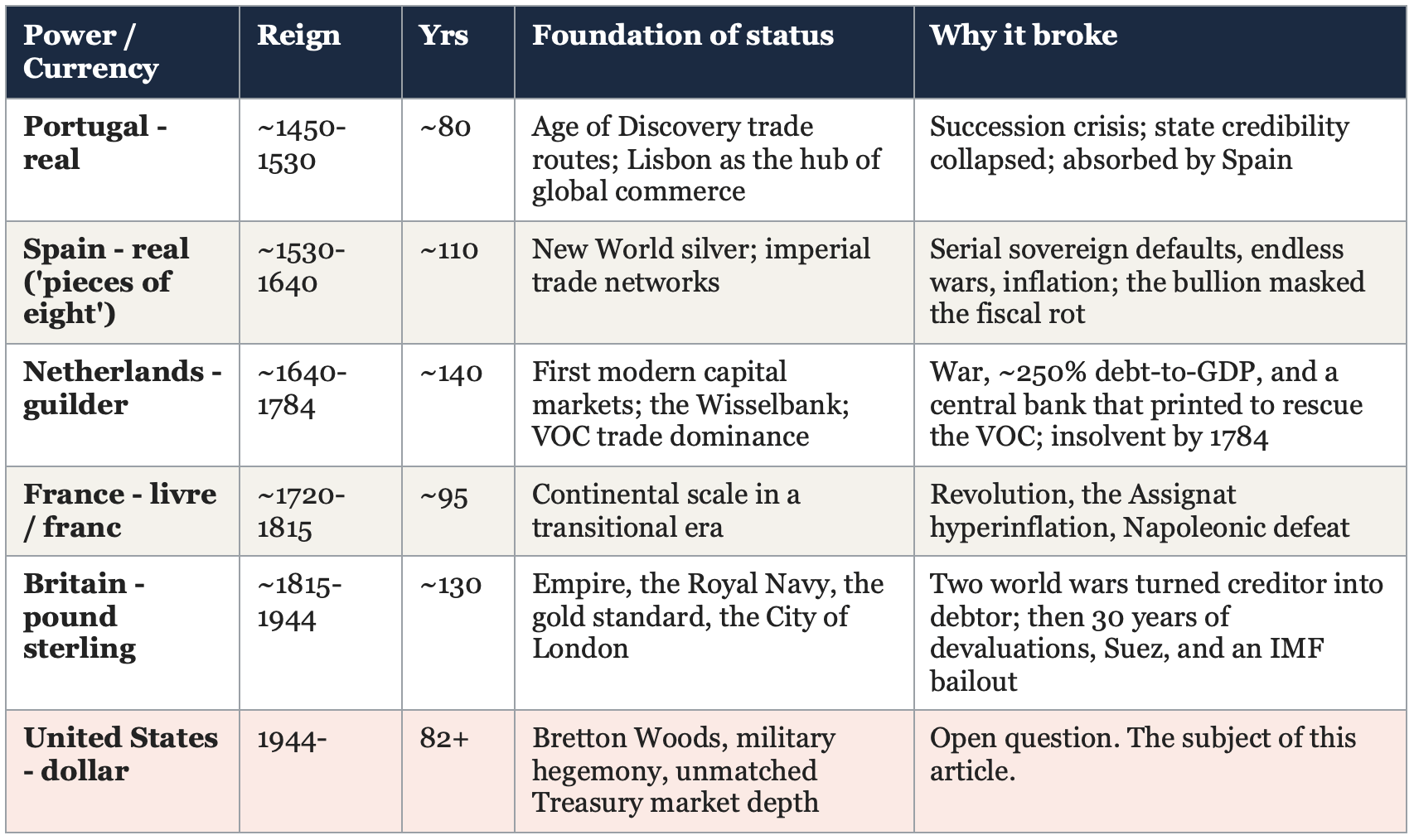
Caption: Five centuries, six crowns. The average reign is roughly 94 years. Every predecessor lost the status involuntarily, fighting to keep it to the last devaluation - and the killer is always the same combination: war-scale spending, extreme debt, and monetization. The dollar turns 82 this year.
Sterling deserves its own chapter, because it is the only predecessor with a full modern data trail - and because it answers the question every American should be asking, which is not “will the dollar lose its status?” but “what does losing it feel like from the inside?”
It does not feel like an explosion. It feels like a ratchet.
In 1950, five years after Bretton Woods formally crowned the dollar, more than 55 percent of the world’s reserves were still held in sterling. The crown did not fall in 1944; it bled out over three decades, crisis by crisis. In 1949, Britain devalued by 30.5 percent in a single stroke. In 1956 came the moment that revealed what reserve status actually purchases: Suez. Britain and France invaded Egypt to retake the canal - a military operation well within their capabilities - and were stopped not by armies but by a run on the pound. Washington, controlling the IMF lifeline Britain needed, simply declined to support sterling until London withdrew. A nuclear-armed empire was ordered home by its currency. British officials had dreaded applying to the IMF precisely because it would mark sterling as a currency of the second rank. That is what the loss of monetary hegemony means in practice: your foreign policy acquires a creditor’s co-signature.
The ratchet kept turning. Another forced devaluation in 1967. Inflation above 20 percent by the mid-1970s. And in 1976, the terminal humiliation: the United Kingdom, birthplace of the industrial revolution, received the largest bailout in IMF history to that point - $3.9 billion, with austerity conditions attached - rescued like an emerging market. By 1970, sterling’s share of world reserves had fallen below 10 percent. And the coda arrived in 2022, when a mid-sized fiscal announcement destroyed a British government in six weeks, because a post-hegemonic currency enjoys no tolerance at all.
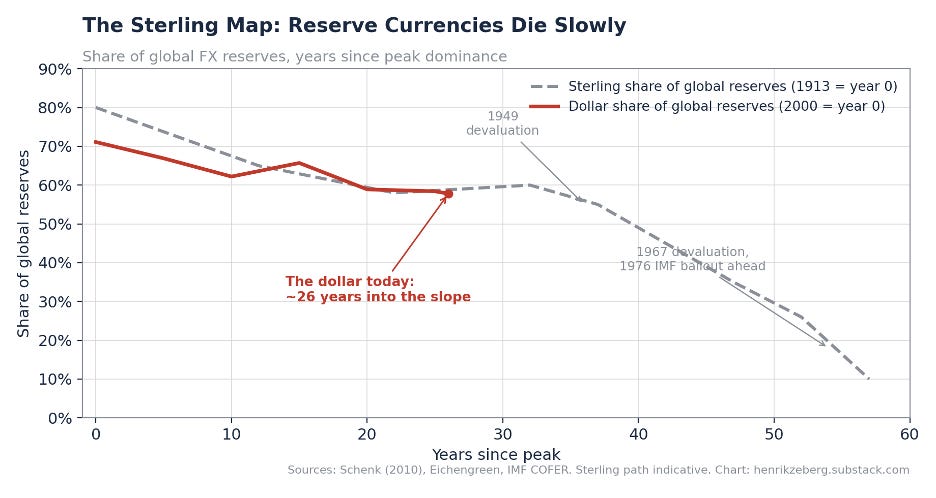
Caption: The most important chart in this article. Sterling’s decline from its 1913 peak, overlaid with the dollar’s decline from its 2000 peak of 71 percent of global reserves to roughly 58 percent today. The two slopes are uncomfortably similar. Reserve currencies do not collapse; they erode for decades - and the dollar is about 26 years into the same descent.
Notice what the British experience did not include: hyperinflation, Weimar wheelbarrows, apocalypse. What it included instead was arguably worse for a proud nation - thirty years of managed decline, recurring funding crises, permanently higher inflation, forced austerity, and strategic irrelevance. That is the realistic template for a post-hegemonic America. Not a bang. A long, expensive whimper.
Translate the loss into American terms, line by line, because this is where the debate stops being academic.
Start with the military, since Pax Americana is supposedly the thing conservatives want to preserve. In 2024, for the first time in history, the United States spent more servicing its debt than defending itself: roughly $880 billion of net interest against $851 billion for the Pentagon. The Congressional Budget Office projects interest reaching $2.1 trillion by 2036 - nearly double projected defense spending - with interest consuming more than 20 percent of all federal revenue by 2034. And that trajectory assumes the reserve-currency discount survives. Strip it away, and the roughly 90 basis points of additional yield applies to a debt stock heading toward $54 trillion. Every basis point of lost privilege at that scale is roughly $5 billion a year of foregone carriers, munitions and research. The Dutch discovered this arithmetic in the 1780s: debt service ate the war fleet. Suez demonstrated its modern form: the money ran out before the military did. A post-hegemonic America does not choose between guns and butter. The bond market chooses for it.
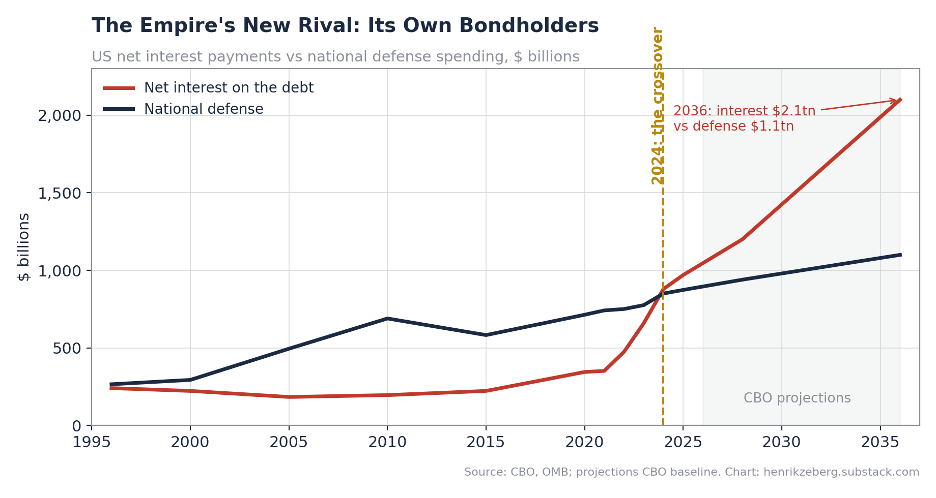
Caption: The crossover, 2024. Pax Americana’s true rival is not in Beijing or Moscow. It is the coupon payment - and this chart still assumes the reserve-currency discount survives.
Now the household. The NBER framework is brutally specific about what the average American loses. Interest rates rise roughly 90 basis points across the entire economy - not just Treasury yields but mortgages, car loans, student debt, small-business credit - permanently, because tens of trillions of dollar bonds that foreigners no longer want must be absorbed by domestic savers demanding real returns. Simultaneously, the dollar depreciates about 9 percent in real terms, so everything imported becomes permanently more expensive. Vance’s $20 burrito becomes a $23 burrito, and the mortgage behind it costs several hundred dollars more each month. The combined hit to national wealth: approximately one full year of US GDP - roughly $29 to 33 trillion. As the Stanford economist behind the study observed, a one-point rise in mortgage rates dwarfs any conceivable gain on the trade account.
And the reindustrialization that is supposed to justify all this? A 9 percent depreciation. That is the entire competitiveness prize - less than the dollar’s ordinary cyclical swings, purchased at the cost of the largest wealth destruction in American history. The producers Vance wants to help would inherit an economy with permanently higher capital costs, a poorer domestic customer base, and a government forced into austerity. There is no version of this trade that nets out positive. There never was.
Losing the reserve currency does not bring the factories back. It brings the bill.
Here is the uncomfortable part - the part where I have to be honest with readers who might now expect a reassuring conclusion. The status will eventually be lost anyway. Not because Vance argues for it; his musings are a symptom, not a cause. Not next year, and in my view not within the next decade - the coming global downturn will, if anything, produce a violent dollar spike first, as collapsing asset prices force the world to scramble for dollar liquidity to service dollar debts. Readers of my work know the sequence: the dollar is the cleanest dirty shirt, and in the bust it gets bid before it gets abandoned. Sterling, too, rallied viciously in every crisis on its way down. Each rally was weaker than the last.
No - the dollar will be lost the way every reserve currency has been lost: slowly, involuntarily, and by its issuer’s own hand. Two engines are already running.
The first engine is weaponization. In February 2022, the United States and its allies froze roughly $300 billion of Russia’s central bank reserves and severed its banks from SWIFT. Whatever one thinks of the policy’s morality, its monetary consequence was instant and universal: every finance minister on Earth learned that dollar reserves are only assets until Washington decides otherwise. American sanctions designations have grown more than tenfold in two decades, increasingly deployed for routine foreign-policy leverage rather than existential causes. The response is now measurable. Central banks have bought more than 1,000 tonnes of gold every year since 2022 - triple the historical pace - precisely because gold is the one reserve asset no foreign government can freeze with a keystroke. The dollar’s share of global reserves has fallen from 71 percent in 2000 to about 58 percent today. China has sold hundreds of billions of Treasuries while accumulating gold outside US jurisdiction and wiring up alternative payment rails. This is Qiao Liang’s thesis operating in reverse: every use of the weapon teaches the world to build armor against it.
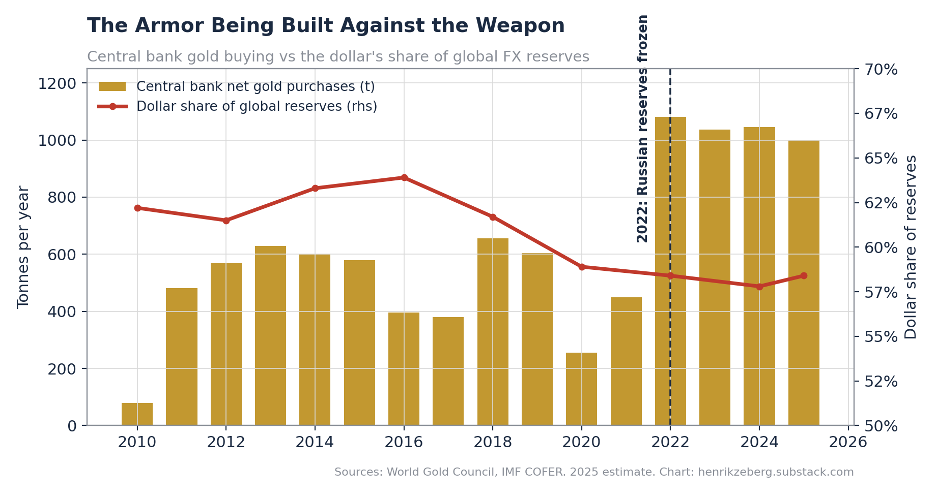
Caption: The armor. Central bank gold buying tripled the moment Washington demonstrated that dollar reserves can be confiscated. The dollar’s reserve share grinds lower. Erosion, not collapse - which is exactly how sterling went.
The second engine is the fiscal incontinence documented above - 6 percent deficits at full employment, interest compounding past the Pentagon, and a political class in which neither party even pretends to propose a balanced budget. The market is already repricing the privilege in real time: the Treasury convenience premium has roughly halved in recent years, and in April 2025 the world briefly saw something genuinely new - Treasury yields rising while the dollar fell, the classic emerging-market signature, flickering for the first time on American screens. The European Central Bank now formally lists US fiscal credibility among global financial stability risks. When your own allies’ central bank writes that sentence, the erosion is no longer theoretical.
And the accelerant is geopolitical. Consider what has happened at the Strait of Hormuz since the Iranian confrontation began this year: Tehran has been conditioning tanker passage - through the chokepoint carrying roughly a fifth of the world’s oil - on payment of transit fees in Chinese yuan rather than dollars, while Indian refiners settle Russian crude in yuan and dirhams. The volumes are still small, and no serious analyst expects the petrodollar to vanish. But mark the qualitative shift: the US Navy still commands the water, yet the invoice has started leaving the dollar. Leverage over a strategic artery of the world economy, partially lost, without a shot fired at the currency itself. That is what the early stage of monetary decline looks like - not a crash, but a slow subtraction of places where the dollar is indispensable.
Map it onto the sterling timeline and the shape of the future emerges. Sterling took five decades to travel from 80 percent of world reserves to irrelevance, punctuated by crisis step-downs: 1931, 1949, 1956, 1967, 1976. The dollar is roughly 26 years into its own slope, from 71 percent to 58. If the rhyme holds, the dollar’s 1967 - the first forced, undeniable capitulation, perhaps yield-curve control dressed up as policy, perhaps a funding crisis resolved by a Mar-a-Lago-style accord signed under duress - arrives somewhere in the 2030s. Its 1976 follows within a decade or so. Along the way: the deflationary bust, the dollar super-spike, the panicked monetary response, and the long inflationary erosion that follows - the sequence regular readers will recognize, now extended to its final act.
None of this is destiny in its timing. All of it is destiny in its direction, unless the two engines are shut down - and nothing in American politics suggests they will be. Washington spends as if the privilege were infinite and sanctions as if it were costless. Those two assumptions, compounding together, are the entire mechanism of decline. The average reign of a global reserve currency is roughly 94 years.
The dollar turns 82 this year.
Step back and look at what is actually being discussed so casually in Washington.
The dollar’s reserve status is the single greatest economic achievement in American history. It is worth roughly one full year of GDP in national wealth. It finances the most powerful military ever assembled at a discount the rest of the world pays voluntarily. It caps the mortgage rate of every American household. It allowed the United States to run an empire without an emperor’s taxes - Pax Americana itself was a structure the world helped fund because holding America’s money was safer than holding anyone else’s. Britain needed colonies to sustain its system. America only needed trust.
China’s sharpest strategic mind spent twenty years studying the United States for a fatal weakness and concluded there was none - only a single, magnificent strength that made all other American power possible. His entire doctrine reduces to waiting for that strength to fail. And now the Vice President of the United States describes that same strength as a subsidy problem, as though the crown were a burden and the fortress a tax.
It will not be lost his way, and it will not be lost soon. The coming crisis will, paradoxically, crown the dollar one more time. But the direction is set, one sanction and one trillion at a time, and history’s verdict on reserve currencies is unanimous: the benefits are enjoyed cyclically, and the loss is suffered terminally. Spain never got the silver century back. Amsterdam never regained the crown. London still lives with a currency that gets emerging-market treatment for a mini-budget.
Empires do not surrender the reserve currency. They spend it away.
When the dollar’s turn comes - and on the current path it will come, sometime in the decades ahead - the $20 burrito will be the least of what got more expensive. The tragedy is that America’s enemies never needed a plan to break the dollar. They only needed America to stop understanding what it had.
They may not have to wait as long as they feared.
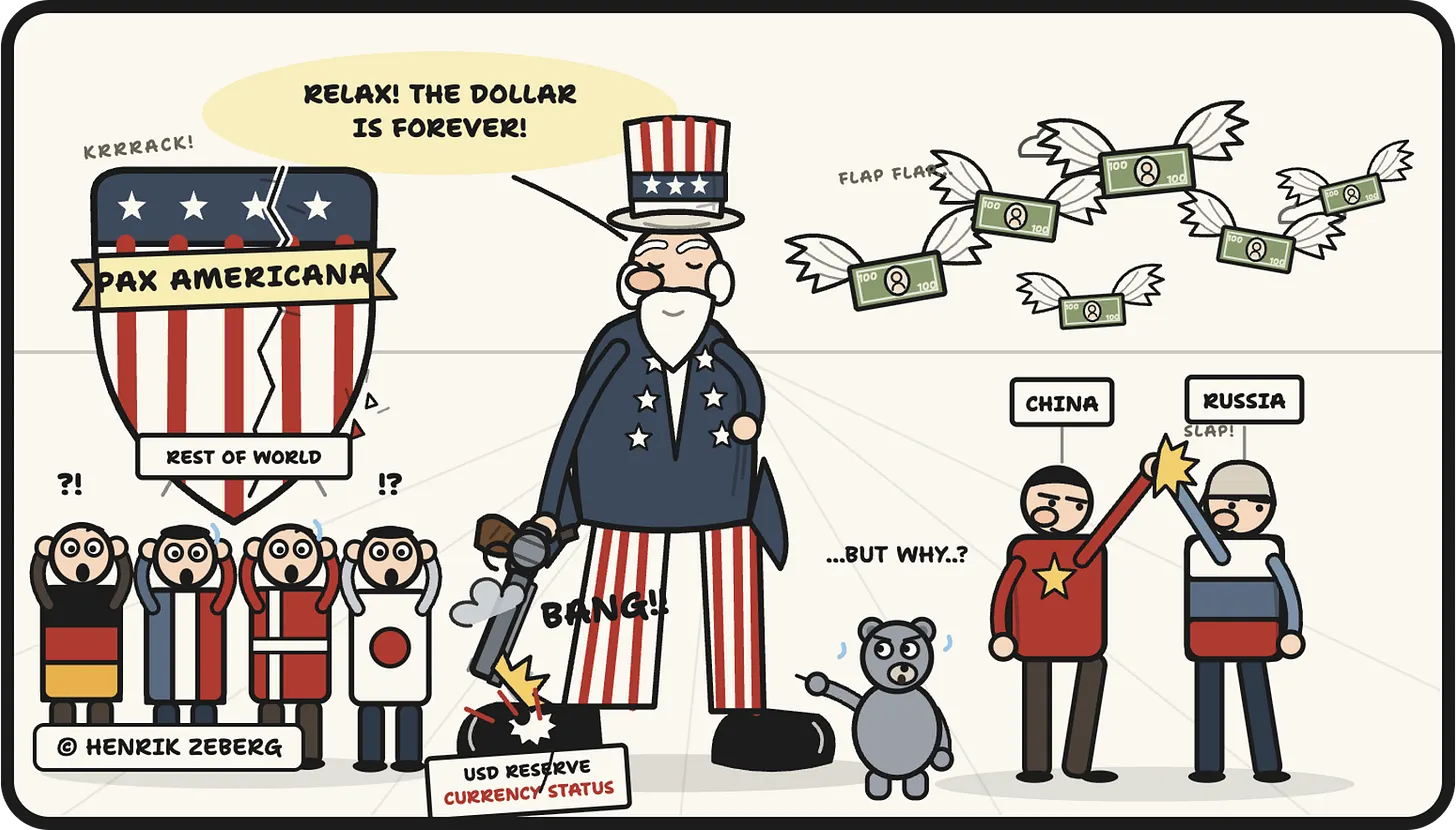
- Henrik Zeberg (August 16th. 2026)
Sources and further reading
Qiao Liang & Wang Xiangsui, Unrestricted Warfare, PLA Literature and Arts Publishing House, 1999 (FBIS translation).
Qiao Liang, speech to a CCP Central Committee study forum, April 2015 (Chinascope translation); Taiwan Insight, “Qiao Liang on China ‘Unifying’ Taiwan,” June 2021.
Senate Banking Committee hearing, March 2023: Sen. JD Vance questions Chairman Powell on the dollar’s reserve currency status (vance.senate.gov).
Stephen Miran, “A User’s Guide to Restructuring the Global Trading System,” Hudson Bay Capital, November 2024.
McKinsey Global Institute, “An Exorbitant Privilege? Implications of Reserve Currencies for Competitiveness,” December 2009.
Gourinchas & Rey, “Exorbitant Privilege and Exorbitant Duty,” and related work on the US external balance sheet since 1952.
Krishnamurthy & Vissing-Jorgensen, “The Aggregate Demand for Treasury Debt,” Journal of Political Economy, 2012.
Jiang, Krishnamurthy et al., “Dollar Erosion: Understanding the Loss of Reserve Currency Status,” NBER Working Paper 35328, 2026; CEPR/VoxEU summary; Stanford GSB Insights.
Atlantic Council, “Why the US Cannot Afford to Lose Dollar Dominance” and “How to Dismantle a Reserve Currency,” 2025.
Quinn & Roberds, “Death of a Reserve Currency” (the Bank of Amsterdam and the guilder); BIS research on the fall of the Bank of Amsterdam.
Catherine Schenk, The Decline of Sterling (2010); NBER WP 14657, “Sterling in Crisis: 1964-1967”; EH.net, “The Sterling Area.”
Congressional Budget Office, Budget and Economic Outlook; Committee for a Responsible Federal Budget; Visual Capitalist compilation of net interest vs defense outlays.
IMF COFER data on reserve currency composition; World Gold Council, central bank gold demand.
ECB Financial Stability Review, November 2025; Robin Brooks (Brookings), on the “Liz Truss” signature in bond markets; reporting on yuan-denominated transit arrangements at the Strait of Hormuz, 2026.
This article is for informational purposes only and does not constitute investment advice.
No posts
Comments
Nothing yet. Say the first thing.
Sign in to join the conversation.