
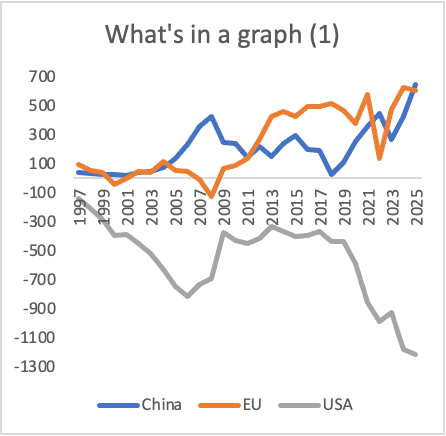
Sometimes even the biggest elephants are going unnoticed. The European Union is running a current account surplus worth more than 626 bn US dollars this year, according to forecasts by the International Monetary Fund. That’s about as big as China’s (see chart, data: IMF). The subgroup of EU countries that form the Euro area are up for an external balance of 419 bn dollars. What’s more, Europe has run consistently high surpluses over the past one and half decades.
The numbers are huge, and so are the underlying problems. Still, they have been widely ignored by the European public and politics. But they are backfiring, and that’s bad news for the world economy.
There are three areas of conflict involved: First, big external surpluses imply that other countries are in deficit, and potentially not very happy about it. Second, surplus economies rely on foreign demand that may subside suddenly, for economic or political reasons, rendering them vulnerable. Third, if positive external positions persist over longer periods of time, the economic costs are considerable as revenues earned abroad are not invested at home, thereby depressing underlying growth.
All of these problems are haunting the EU. Europeans should brace themselves for trouble ahead.
For one, US president Donald Trump and his MAGA camp are obsessed with trade imbalances, claiming that US deficits have caused the destruction of decent American jobs. However flawed the argument that bilateral goods trade balances should equal out one by one may be, Europe’s surpluses are an invitation to attack. (Never mind that the euro area’s services balance is in deficit vis-à-vis the US, what matters politically is the trade in goods. And it’s not just Trump whose instinctive protectionism puts Europe in the pillory.
On the other side, the EU, dependent on external demand for its lackluster economy, is an easy target. Brussels officials might argue that an overall external position of less than three per cent of GDP is no big deal. But given the size of the common market the nominal sums involved are gigantic.
The scary outlook gets even scarier. Europe’s disadvantageous position is a result of a marked slowdown in underlying growth, which in turn can be traced back to neglecting external surpluses.
Running large capital outflows while starving the domestic economy of funds is hardly a sustainable strategy for a big economy that’s neither an exporter of natural resources (like Norway or the United Arab Emirates) nor a smallish low-tax safe haven (like Switzerland or Singapore). It should come as no surprise, then, that investment, both private and public, has been disappointingly weak for a long time. Now the devastations are showing: productivity has actually started to decline recently.
In Germany, the EU’s biggest member country, potential growth is estimated to have slowed to an annual rate of a mere 0.5 per cent, down from three times the figure a decade ago. The Federal Republic is by far the largest contributor to Europe’s current account position. A crucial part of the story involves successful exporting manufacturers, often family-owned, investing their profits abroad, typically in foreign affiliates. Eventually, the home base deteriorates due to inadequate domestic capital formation. That’s when workers, and other stakeholders, are being hurt by weak wage growth or job losses, while prosperous entrepreneurs enjoy blooming family fortunes – a socially explosive constellation.
It has not always been that way. The EU’s and the Euro area’s surplus only began to soar in the course of the Euro sovereign debt crisis starting in 2010. Until then, external accounts had been broadly in balance.
The reason for this upward shift is Europe’s peculiar response to the Euro crisis. Before, some countries had been running surpluses, while others, particularly in the South, drifted into deficit. Internal imbalances widened, but vis-à-vis the rest of the world Europe was in balance. After the sovereign debt crisis hit, deficit countries were forced to turn to austerity, cutting back budgets, investment and consumption. Consequently, virtually all Euro countries’ current accounts turned positive. The EU sought to ease its internal tensions by exporting them.
In politics and public discourse solid positive external positions were interpreted as a sign of regained competitiveness, a development to rejoice, not to despise. Hence, there was no push for improving an inadequate institutional set-up, thereby cementing the high surplus-low investment status.
To this day, the EU only possesses a mini budget (1 per cent of GDP), that’s neither used as a systematic stabilizer nor for funding trans-European infrastructure projects (but rather flawed subsidy schemes). The Euro area doesn’t have a joint budget at all. It neither has liquid common debt instruments that banks across the area could use as collateral, nor a common deposit insurance scheme. Why? Because some Northern member countries are scared of transferring default risks across borders.
As a result, capital markets remain fragmented, which in turn makes it unattractive to invest domestic savings in Europe – thereby supersizing current account surpluses and weakening domestic investment. Mario Draghi’s report, published in the fall of 2024, has had little material impact so far.
The reluctance to acknowledge the underlying mechanisms is both deeply saddening and comically tragic. The EU urgently needs to escape from this trap.
Completing the common market and creating a borderless capital market to turn Europe into a more attractive investment destination should be prime priorities for the incoming European Commission. To be sure, ambitious reforms would need the solid backing from national governments, particularly Germany’s. Don’t bet on it.
Comments
Nothing yet. Say the first thing.
Sign in to join the conversation.