
My husband has been in the fashion industry for decades. Fashion is the language of our home. I have sat through more conversations about draping and bias cuts than I ever expected to, and I have come to love the industry’s seriousness about innovation and beauty.
So when I say John Galliano is one of the most gifted designers alive, I am repeating what everyone in fashion already knows. My husband knows it better than most.
Years ago, at one of the biggest fashion houses in the world, Galliano came to the store and my husband refused to work with him. Everyone understood why.
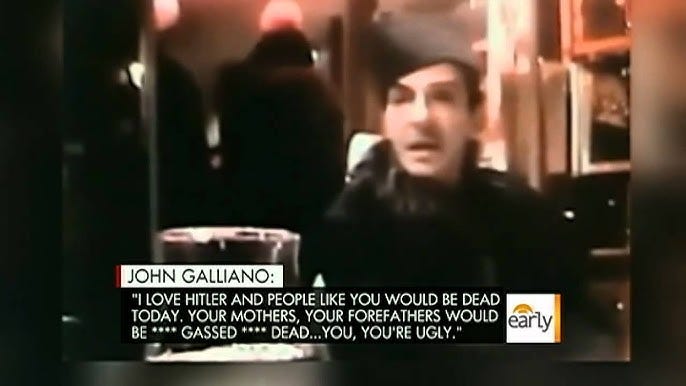
Here is what everyone understood. In 2011, at a restaurant in Paris, Galliano told strangers at the next table that he loved Hitler. He told the women filming him that their mothers and their forefathers would have been gassed. On another night, at the same restaurant, he abused a woman with antisemitic slurs. It was on video. A French court convicted him. Dior fired him.
On Friday, the New York Times reported that Galliano will be the subject of the Met’s next Costume Institute exhibition, the show that sets the theme for the Met Gala. The exhibition is called Horizons. It makes him the third living designer in the museum’s history to receive a solo show, after Yves Saint Laurent and Rei Kawakubo. There is no higher honor the institution can give.
I’ll start with the strongest counterargument: Judaism has a word for return from error: Teshuvah. It demands recognition of the wrong, repair toward the wronged, and changed behavior when the person is tested the same way again. Galliano spent years in recovery. He studied with a rabbi in London and with the late Abe Foxman, who led the ADL, survived the Holocaust as a hidden child, and vouched for his sincerity until the end of his life. Rabbis who sat with Galliano this spring came away believing him. The ADL accepted his apology years ago and says his repair should be applauded. I take all of that seriously. If the question were whether John Galliano the man deserves a path back to his craft, that question was answered in 2014, when Margiela hired him and the industry exhaled. That was a question about one man’s soul. This is a question about an institution’s risk management.
In 2024, Anna Wintour and curator Andrew Bolton planned this exact exhibition. The Cut reported what happened next. The museum’s leadership panicked, board members stepped in, and the show was killed. The replacement theme, assembled at the last minute, was Sleeping Beauties. Bolton now tells a different story: the board simply needed more time, and the hesitation had nothing to do with Galliano’s past.
He is entitled to that account. He gave it on launch day, with a show to sell, and it asks us to believe the museum shelved its biggest exhibition over scheduling. Meanwhile a person familiar with the deliberations told the Times that the Met’s own leaders understand this decision could be a mistake with serious repercussions. A fashion journalist I spoke to after the announcement told me the same: the museum knows exactly what it is walking into. Institutions do not brace for repercussions from a scheduling choice.
The canceled show got its coronation anyway. Galliano dressed two of the four celebrity co-chairs at the replacement gala, and Zendaya wore him twice, arriving in his Margiela and returning to the carpet in a gown from his first Givenchy collection. The board had killed the retrospective. The industry staged it on the steps.
So the Met’s own board looked at a Galliano retrospective two years ago and would not touch it. Then the same institution looked at the same designer, with the same record, and announced him as the centerpiece of fashion’s biggest night.
Galliano did not change between those two decisions. The video did not change. The conviction did not change. His apologies were already a decade old when the board said no.
The only variable that moved is us.
In 2024, honoring a man convicted of antisemitic abuse carried a cost the Met was unwilling to pay. In 2026, the board ran the numbers again and found the cost had fallen to roughly zero. That is a market read on how much anyone cares when Jews object, delivered by the people best positioned to know.
They did not reach that conclusion in a vacuum. Last fall, Glamour named Ms. Rachel a Woman of the Year while she flooded her feeds with accusations against the Jewish state, advocacy she wraps in her Christian faith. She accepted the award in a dress embroidered with drawings by Palestinian children and told the room they were victims of the Jewish nation targeting non-Jewish children. The magazine called her a trailblazer.
A few weeks later, Anna Wintour sat beside Sheikha Moza bint Nasser at the Fashion Trust Arabia gala in Doha. Moza is Qatar’s most glamorous export and a woman who publicly mourned Yahya Sinwar, the man behind October 7. I wrote about that evening, and about her own fund, which bought Valentino outright in 2012 and still controls it.
Vogue never addressed any of it. There was nothing to address, because nothing happened. No advertiser flinched, no invitation was rescinded, and the woman who eulogized the architect of the largest massacre of Jews since the Holocaust remained a perfectly acceptable seatmate for the most powerful person in fashion.
In January, Galliano sat front row at Dior’s couture show, his first time back at the house that fired him, and was mobbed afterward by Bernard Arnault and his family. The owners embraced him where the cameras could see. In March, Zara signed him to a two-year collaboration. The response to both was excitement.
In June, Prada named Saint Levant a global brand ambassador. His music claims Haifa, Jerusalem, and Gaza as one Palestine, from the river to the sea. After the Amsterdam attacks on Maccabi Tel Aviv fans, he suggested the Israelis had it coming for setting foot in a country that “isn’t theirs” and thanked the violent mob. Prada studied that record and saw a marketing asset. I wrote then that hate sells, and that the brands know it. The ambassadorship stands.
This is how antisemitism actually returns. It does not arrive in boots and uniform. It arrives as a series of quiet tests, each one small, each one deniable, each one watching the one before it. A magazine crowns a woman who claims Jews intentionally murder non-Jewish children for pleasure, and pays no price. An editor sits beside a eulogist of Sinwar and pays no price. A fashion empire embraces the man it once fired, a retailer signs him, a luxury house hires a man who celebrates attacks on Jews, and none of it costs anyone anything. A museum board that said no in 2024 studies those outcomes and says yes in 2026. I have spent this year documenting the influence operations built to make hating us feel organic. The incidents look unrelated. They are the same experiment, run at different scales, returning the same result.
And this time, the museum saw the objection coming and planned for it. The announcement did not just arrive. It arrived through an exclusive in the Times, by Vanessa Friedman, on a Friday, as Jews were heading into Shabbat. It arrived with a year of closed-door meetings between the museum and rabbis and Jewish leaders in New York, meetings that included Wintour, Bolton, and Galliano himself. It arrived with accountability language already drafted. Some of the rabbis in those rooms told the Times they worried they were being used as a Band-Aid. They said it themselves, in the paper that broke the story. The consultation was real. So was its function.
Bolton’s own defense threw me off: “I completely understand why the timing might feel particularly difficult now, given the alarming rise of hate,” he told the Times, “but I do feel it makes the current questions more urgent — not less.”
Follow that logic in one direction only: antisemitism is surging, therefore the museum hands its grandest stage to the most famous fashion designer alive ever convicted of it. Our pain is the exhibition’s justification, and the worse this year gets for Jews, the more urgent the celebration becomes.
No museum would run that argument about anyone else.
A surge in anti-Asian violence would not make a convicted anti-Asian abuser’s retrospective urgent. It would make it unthinkable. And notice when the urgency arrived. In 2024, when confronting these questions carried a price, the museum’s sense of responsibility told it to wait. The responsibility to confront arrived together with the all-clear. Notice, too, the vocabulary. He speaks of “the alarming rise of hate,” of “a moment of heightened division.” Hate. Division. Weather. Conditions that rise and fall with no one committing them. A man told women at a restaurant table that their families would have been gassed, and the curator honoring him fifteen years later, in a statement about accountability, prefers not to say the word for what that was.
There is a world in which a legitimate Galliano exhibition could take place. It would show the Givenchy years and the Dior years in their full brilliance, since the brilliance is real. And it would place the fall at the center of the room. What he said, who was wounded, what repair he attempted. It would treat his Teshuvah as an open question the visitor has to answer. That show would honor Jewish pain and Galliano’s craft at the same time, and I would buy a ticket.
Bolton has promised something close to it. He plans to open the show with an orientation gallery about what he calls “the rupture.” He says euphemisms should be avoided, a standard he credits to the Jewish leaders he met. He says his job is the most accurate version of events, and Galliano’s own words will carry much of it. Good. Write it down. Those commitments were made in public, on the record, before a single gown was hung, and they are now the test. The rupture has a name, a date, a video, a conviction, and a firing. If they appear in the galleries as themselves, at the same scale as the dresses, the Met will have built the first honest show of its kind, and I will say so. If “the rupture” turns out to be a soft gray panel near the coat check, we will know that “ethical accountability” was a phrase drafted for a press release, and that the rabbis’ worry was the most accurate sentence in the whole announcement. The catalog and the wall text lock long before May. The checking can start now.
Wintour is her own line item. The Times calls her Galliano’s most powerful champion. She orchestrated his return and was among the first to wear his clothes in public after the disgrace. She has argued for years that our culture condemns too quickly. She planned this show twice, chairs the gala that funds the department, and the Costume Institute’s galleries are literally named in her honor, which means the institution weighing the risk and the person who spent a decade eliminating it are not at arm’s length. She sat in the meetings with the rabbis this spring, months after sitting beside Sinwar’s eulogist in Doha. She has never been made to answer for the pattern on the record. Every journalist with access to her between now and May has the question ready. Someone should ask it with the cameras on. Several of you reading this have that access. You know who you are.
And the stakes are larger than one museum. The show is planned to travel after New York, a rare honor, and the leaders of those institutions are watching the reaction closely. They are not waiting to see the gowns. They are waiting to see what the Met gets away with. Whatever survives the reaction in New York ships to the next city as settled precedent, wall text and all.
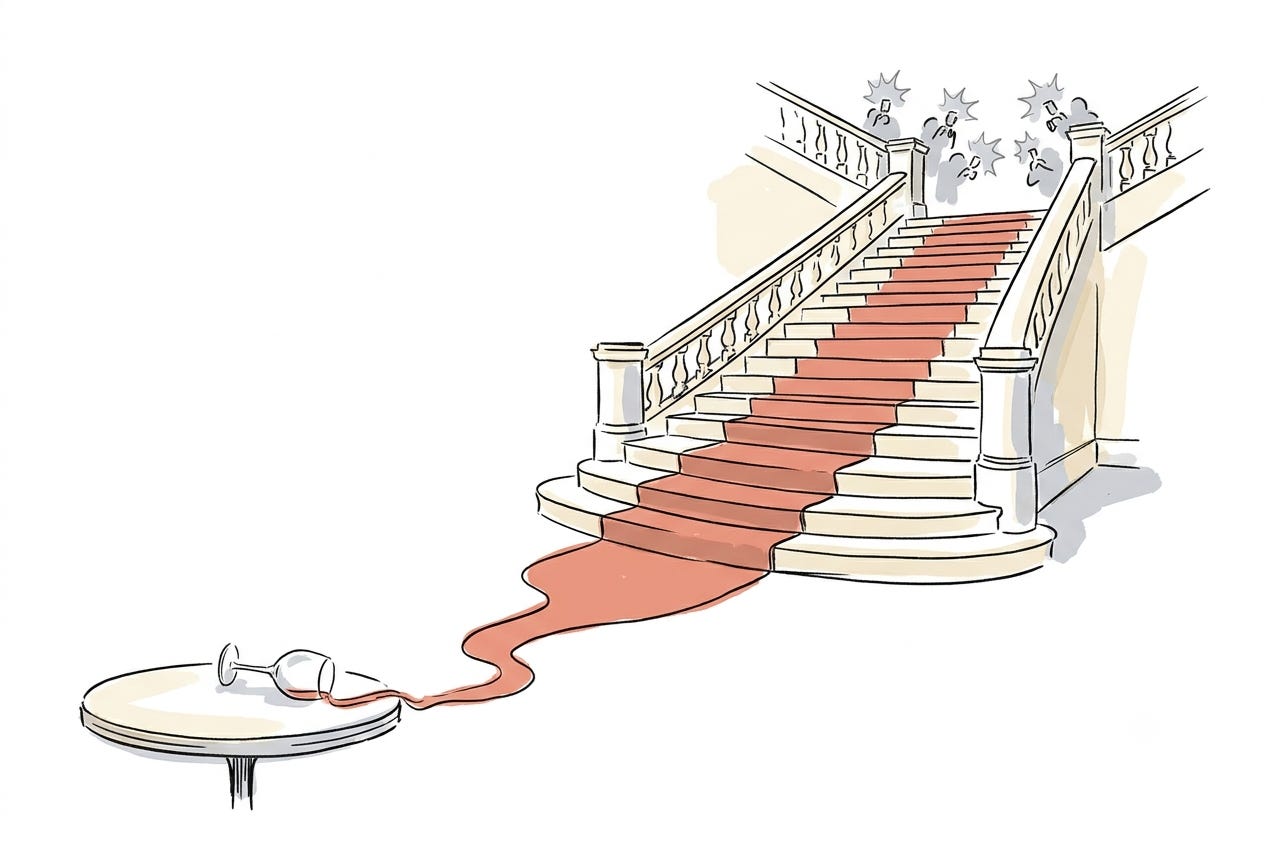
And the women from the restaurant, the ones who were told their mothers and their forefathers would have been gassed, have no names in this story. They never did. In May, a thousand cameras will climb the museum steps. Every gown will carry a credit. Every guest will be announced. They will still be women who sat down for a drink in Paris and found out what they were worth. The exhibition will tell his half of the story. Someone has to keep theirs.
No posts
Comments
Nothing yet. Say the first thing.
Sign in to join the conversation.