

I have a feeling this post won’t be universally popular. Those who believe in unregulated capitalism will not like my suggestion to impose enormous regulations on data centers. On the other hand, those who are opposed to data centers entirely will not like my argument that data centers should be allowed to be built because, well, they will be anyway.
Binary choices are almost always unproductive and only lead to polarization. So bear with me while I explore some nuances and options related to this hot issue.
Today’s main argument is that data centers might offer a rich opportunity for local communities to advance and prosper if it is done correctly.
The Brookings Institution recently argued that local governments should think beyond ribbon-cuttings and construction jobs. Their report, "Turning the Data Center Boom Into Long-Term Local Prosperity," asks communities to negotiate for lasting public benefits rather than accepting whatever deal is placed before them. That got me thinking about what those negotiations might actually sound like.
So let me start with a mock conversation that could take place in “Anywhere County, Iowa” should one of the big-ass AI companies come calling. The setting is a County Board of Supervisors Meeting. Imagine this conversation taking place:
County Board Chair speaks:
Mr. Google Representative, I spent the weekend reading a Brookings Institution report. They said communities should turn the data center boom into long-term local prosperity. That's exactly what we're here to negotiate.
Before you have a seat, let me review the agenda. We're glad you're here, but if we can't agree on the framework for negotiations, this could be a very short meeting. Oh, it’s not that we aren’t hospitable; after all, we are Iowa Nice, but if you can’t agree to our agenda, then it could be a short meeting. Ok, here are the agenda items:
First - Utility prices. If your data center causes consumer energy rates to go up, we will require an “energy assistance rebate check” from you. It will cover the additional energy costs that your center might cause. These checks should go out quarterly.
Second - Water issues. We know that there are environmentally friendly ways to use less water for a data center. For instance, large data facilities consume up to 5 million gallons daily, driving major tech operators to shift away from precious municipal drinking supplies. We will need you to deploy non-potable reclaimed wastewater, closed-loop recycling, and advanced liquid cooling designs.
Third - Daycare Centers. We have some families in our County who can’t afford daycare, and it is a tremendous burden on them.
Fourth - Food Assistance. A lot of the same families that can’t afford daycare also struggle to afford food…you know, inflation. Our goal is to end poverty in our County, and we believe you can help.
Fifth - Healthcare fund. We will need you to invest a portion of your profits in a fund that will be used to help people in our County who cannot afford healthcare.
To achieve access to healthcare, childcare centers, and food assistance, we expect Google to contribute $5 million annually to a locally governed Community Investment Fund. Anywhere County—not Google—will decide whether those dollars support childcare, housing, healthcare, food security, libraries, or broadband.
Sixth - Property tax rates. If the presence of your project increases assessments or infrastructure costs, that shifts tax burdens onto residents; we will negotiate with you to establish some or all of these profit-sharing vehicles.
revenue-sharing agreements
payments instead of taxes (PILOTs)
infrastructure contributions
community trust funds
One last item: Transparency. Every year you'll publish a public report detailing your water consumption, electricity use, taxes paid, local employment, wages, environmental compliance, and community investments. If we're going to be partners, our citizens deserve to know how the partnership is working.
In exchange for the tax breaks that I’m sure you are seeking, we will need assurances that Google will help with road repair after construction, broadband expansion, electrical grid upgrades paid for by Google, emergency response funding, wastewater system improvements, and public parks or conservation land.
You see, Mr. Google representative, if you receive hundreds of millions in tax abatements, please help us understand why the public investment is justified if the completed facility only employs 75–150 permanent workers. That doesn’t benefit very many citizens in our county.
Well, there might be a few more items that we can talk about along the way, but if you agree to include these items in negotiations, then pull up a chair and have a seat. On the other hand, if you feel these are deal breakers, well… here is your hat, and there is the door. Take the Google Big-Ass Data Center elsewhere.
For decades, the citizens of oil, mineral, and gas-rich states like Alaska and North Dakota have received direct payments from oil revenues through state-operated entities like the Alaska Permanent Fund and the North Dakota Legacy Fund. More recently, New Mexico created a $7 billion fund for universal childcare, using endowment revenues from the oil and gas industry.
What if regions or states that invest heavily in data centers were able to end state income taxes, or give periodic rebates to citizens based on the profitability of AI? Or, fund universal childcare, provide tuition-free education through college, or insure every citizen with healthcare benefits.
I ask ‘Why Not?’
For many Americans, the words data center evoke a familiar set of real concerns: acres of concrete, enormous warehouses, towering transmission lines, massive electricity demands, water consumption, and tax incentives for some of the world’s largest technology companies.
It is understandable and necessary that communities ask whether the costs outweigh the benefits. Those are legitimate questions.
But they are not the only questions.
As artificial intelligence rapidly transforms the economy, the debate over data centers is becoming increasingly emotional and polarized. On the political right, the temptation is to view data centers simply as economic development and to minimize concerns about water use, energy demand, or local quality of life.
On the political left, the temptation is to oppose them as another example of corporate overreach and for their environmental impact.
Both reactions are incomplete.
If artificial intelligence is becoming as essential to the twenty-first century as electricity was to the twentieth, then the challenge is not deciding whether to build digital infrastructure. It is deciding how and where to build them responsibly and in a way that benefits the local communities that host them.
I believe there is a better way beyond the binary of the right-left argument.
Increasingly, data centers are becoming the infrastructure of the AI economy. Just as railroads powered the Industrial Revolution, interstate highways fueled the automobile age, and broadband enabled the digital economy, data centers provide the computing power that will underpin artificial intelligence, scientific research, manufacturing, finance, education, health care, and national security.
Whether we welcome it or not, the AI economy is arriving. The challenge before us is not stopping technological change. It is ensuring that technological change serves the public interest.
Rather than framing data centers as inherently good or bad, Brookings, which is not a conservative think tank by any means, argues that
the central question is not whether data centers are ‘good’ or ‘bad,’ but how benefits and risks get allocated and what forms of governance, local authority, and transparency can help leaders maximize local benefits while protecting community interests.
I believe that is exactly the conversation Americans should be having.
Notice what is significant about this observation. It does not come from a business lobbying organization or a technology company seeking government subsidies. It comes from one of the nation’s leading public policy institutions, one generally regarded as center-left. Even Brookings recognizes that the debate is not about whether data centers should exist. It is about how democratic communities govern them.
Brookings is offering a pragmatic solution rooted in both technological reality and local concerns that must be mitigated. It falls back on the quintessential American trait of practicality.
Moreover, history offers an important precedent for how a democratic society can handle such changes. Every generation has confronted new forms of technological infrastructure that reshaped the nation.
Railroads crossed farmland and transformed rural communities. Many people objected.
Electric power plants altered landscapes and polluted rivers. Citizens fought back.
Highways divided neighborhoods while connecting entire regions. Residents have sued and pushed for redress.
Cell towers appeared on hillsides. They spoil the view.
Wind farms changed rural skylines. Again, they spoil the view.
Each innovation generated fierce local opposition. Citizens worried about environmental damage, property values, corporate power, and quality of life. Many of those concerns proved justified. Others were eventually addressed through better regulation and technological improvement.
What history teaches is not that communities should passively accept every new technology. It teaches that progress requires governance.
The Progressive Era of the early twentieth century provides perhaps the best model.
Progressive reformers did not argue that America should reject industrialization. They understood that factories, railroads, electricity, and mass production were transforming the economy. Their objective was to ensure that these powerful forces operated within rules that protected workers, consumers, and communities.
That vision produced food safety laws, public utility commissions, workplace protections, antitrust enforcement, conservation policies, and modern systems of democratic accountability.
The lesson remains relevant today.
Artificial intelligence may become as transformative as electricity itself. If so, then the question is not whether America should build the infrastructure necessary to support AI. It is whether we establish twenty-first-century guardrails that ensure the benefits are broadly shared while the costs are responsibly managed.
This perspective also helps move us beyond simplistic arguments about economic development.
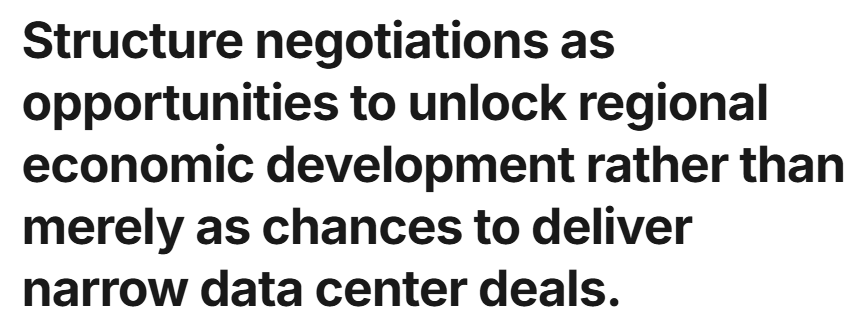
Brookings recommends a proactive local community process for negotiating eco-friendly contracts. Their report recommends:
“Regions should treat data center negotiations not as isolated real estate transactions but as ecosystem-shaping moments that trade infrastructure access for commitments to advance local innovation, talent, and industry strengths.”
That is where local governments possess far more leverage than they often realize.
In other words, local governments can govern and regulate rather than merely react.
This is precisely the point Brookings emphasizes. Communities possess opportunities not only to reduce harms but to negotiate long-term prosperity if they approach these projects strategically. It can be a win-win scenario.
There is another reason this conversation matters.
The United States is engaged in an increasingly intense global competition to develop artificial intelligence. Computing capacity has become a strategic national asset.
Countries that build advanced AI infrastructure will likely enjoy advantages in scientific discovery, medical research, advanced manufacturing, cybersecurity, defense technologies, and economic productivity. Those that fall behind may become dependent on technologies developed elsewhere.
This does not mean local communities should sacrifice their interests in the name of national competitiveness.
It does mean that refusing to build data centers altogether is unlikely to prevent their construction. They will be built somewhere else, perhaps in another state, perhaps in another country operating under weaker environmental protections and lower standards of public accountability.
The more constructive question becomes: if this infrastructure is going to exist, where should it be built, and under what rules? And, who decides?
That is a question democracy is well equipped to answer.
Too often, however, our public debates encourage us to choose between ideological extremes. We are told to embrace technology uncritically or reject it reflexively. We are encouraged to see every issue as a battle between corporate interests and environmental protection, between economic growth and community well-being.
The truth is much more complicated.
The AI economy will require physical infrastructure. That is not speculation; it is already happening. It has been for nearly a decade.
The responsibility of democratic government is not to pretend otherwise. It is to establish rules that ensure innovation strengthens rather than weakens the communities in which it occurs.
That may be the most important lesson of the Progressive Era. Our predecessors did not stop industrialization. They civilized it.
Now it is our turn.

Data centers are likely to become as commonplace in the twenty-first century as electrical substations and interstate interchanges became in the twentieth. Future generations may view them as ordinary infrastructure supporting everyday life.
The question is whether we build that infrastructure with foresight or with conflict.
Communities should absolutely insist on responsible environmental standards. They should demand transparency, fair taxation, meaningful local benefits, and careful stewardship of water and energy resources.
But they should also recognize a larger reality. Artificial intelligence is not a passing trend. It is rapidly becoming foundational to modern economic life. The challenge before us is about deciding whether to participate in that future.
It is deciding whether we will shape it—or merely react to it.
Democracy has always been strongest when it resists false choices. This is one of those moments. We do not have to choose between surrendering to corporate interests and rejecting technological progress.
We can do what Americans have done at our best throughout history: embrace innovation, insist on accountability, and build institutions capable of serving both prosperity and the common good.
What I would hate to see is twenty years from now, local officials waking up and saying, “Darn, we should have built those data centers years ago. We missed a golden opportunity.”
Share Things We Don't Talk About Like Politics & Religion

Available for iOS and Android
Comments
Nothing yet. Say the first thing.
Sign in to join the conversation.