
When Donald Trump stood on the Capitol steps in January 2017 and declared,
“From this day forward, it’s going to be only America First,” he revived a slogan that had largely disappeared from presidential politics for many years.
To supporters, the phrase meant putting American workers, American borders, and American interests ahead of those of other nations. To critics, it carried echoes of an earlier movement associated with isolationism, xenophobia, and even antisemitism.
Both reactions contain enough credibility to approach the truth, however, as usual, the truth is complicated.
The history of “America First” is not linear. It is better understood as a recurring political idea that resurfaces whenever Americans experience periods of rapid social, economic, or geopolitical change.
Each generation has given the phrase new meaning while preserving a recognizable core: the belief that America has drifted from its proper identity and that restoring the nation requires distinguishing between those who truly belong and those who do not.
Understanding that history helps explain why the slogan continues to resonate—and why it remains so deeply divisive.
Although the phrase and idea had 19th-century manifestations, it re-emerged in the 20th century in national politics during Woodrow Wilson’s 1916 reelection campaign. Facing growing pressure to enter the First World War, Wilson’s supporters appealed to voters with the message that he had “kept us out of war.” “America First” largely meant avoiding European conflicts and focusing on domestic concerns. At that point, the slogan carried little of the ideological baggage it would later acquire.
The end of World War I, however, transformed both the country and the phrase.
The years immediately following the war were marked by labor unrest, the First Red Scare, bombings by anarchists, economic uncertainty, and unprecedented levels of immigration from Southern and Eastern Europe. Millions of Americans feared that the nation was changing too quickly. Anxiety over Bolshevism blended with long-standing prejudices against Catholics, Jews, and recent immigrants.
It was in this environment that “America First” evolved from a foreign policy slogan into a broader cultural and political identity. An identity that equated being an American with being a white-skinned American.
Perhaps most influential was the revived Ku Klux Klan of the 1920s. Unlike the Reconstruction-era Klan, the second Klan expanded its targets beyond African Americans to include Catholics, Jews, immigrants, and anyone perceived as threatening Protestant cultural dominance.
The Klan rarely branded itself as “America First,” but it relentlessly promoted “100 Percent Americanism,” a phrase nearly interchangeable with the slogan during the decade. By the mid-1920s, the organization claimed between three and five million members, making it one of the largest mass movements in American history.
Its vision of America rested on an explicit racial and religious hierarchy. Native-born white Protestants occupied the center of national identity, while immigrants, Catholics, Jews, and African Americans were portrayed as threats to the nation’s character.
The Immigration Restriction League also reached the height of its influence during this period. Its leaders argued that immigrants from Southern and Eastern Europe were culturally and biologically less suited (inferior) to American democracy than immigrants from Northern Europe.
Today these claims sound overtly racist, but at the time they were often presented as objective science.
That scientific veneer came from organizations such as the American Eugenics Society and the Eugenics Record Office. Their researchers claimed that intelligence, morality, and civic virtue were inherited traits tied to race and ethnicity.
Harry Laughlin, one of the movement’s leading figures, testified before Congress in support of immigration quotas that favored Northern Europeans while severely limiting immigration from Italy, Poland, Greece, Russia, and elsewhere.
These arguments helped shape the Immigration Act of 1924, also known as the Johnson-Reed Act, which fundamentally reshaped American immigration policy for decades.
Not every organization associated with “Americanism” embraced the Klan’s extremism. Groups such as the American Legion and the Daughters of the American Revolution promoted patriotism, civic education, and loyalty to the Constitution. Many members sincerely believed they were strengthening national unity rather than excluding minorities.
Yet even these mainstream organizations often supported immigration restriction, aggressive assimilation programs, English-only instruction, and campaigns against radical political movements.
This complexity is important to understand.
It would be historically inaccurate to suggest that every person who embraced “America First” or “100 Percent Americanism” was motivated by racial prejudice or religious intolerance. Many Americans simply feared another devastating European war.
Others worried about revolutionary violence after witnessing the Russian Revolution and domestic bombings. Still others believed immigration should proceed more slowly to encourage assimilation.
Reducing the entire movement to white supremacy oversimplifies history. Yet, at the same time, it is equally inaccurate to ignore how frequently the slogan became intertwined with exclusionary definitions of who counted as a “real American.”
Throughout the 1920s, “America First” was repeatedly adopted, or closely associated with movements that sought to preserve an America defined primarily by native-born, white, Protestant cultural norms.
Those associations became even more visible on the eve of World War II.
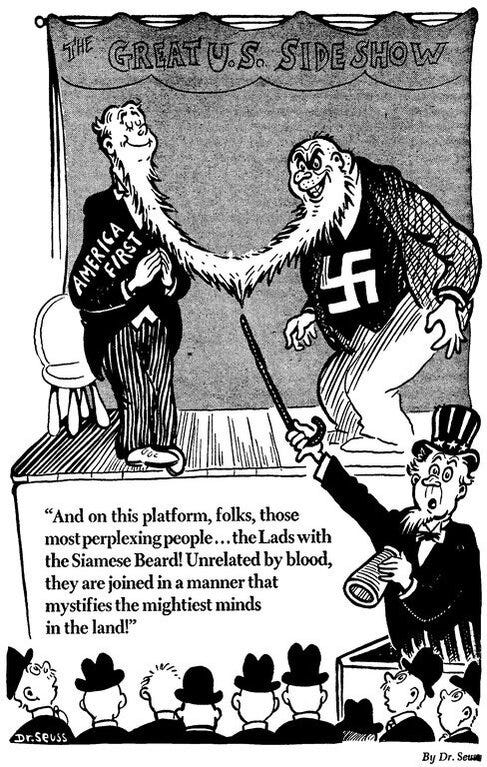
In 1940, the America First Committee emerged as the nation’s leading anti-intervention organization. At its peak, it attracted roughly 800,000 members, including conservatives, liberals, Midwestern farmers, business leaders, and students. Most simply hoped to avoid another catastrophic European war.
The committee was not a fascist organization, nor were most of its members antisemitic. Nevertheless, it became increasingly associated with some of the darker currents already embedded within the broader “America First” tradition.
No figure better illustrates that tension than Charles Lindbergh. A celebrated aviator and one of the committee’s most prominent spokesmen, Lindbergh argued that Britain, President Franklin Roosevelt, and “the Jewish groups” were pushing America toward war.
His notorious speech in Des Moines in September 1941 permanently damaged the movement’s reputation by giving public voice to ideas many Americans recognized as antisemitic.
After the Japanese attack on Pearl Harbor, the America First Committee dissolved almost immediately. National unity replaced isolationism, and the slogan largely disappeared from mainstream politics for generations.
During the Cold War, presidents of both parties embraced international leadership. The Marshall Plan, NATO, and a network of global alliances reflected a bipartisan consensus that American security depended upon engagement rather than withdrawal.
Even Ronald Reagan, remembered for his robust patriotism, envisioned America as what he famously called a “shining city upon a hill.” His nationalism was outward-looking rather than isolationist. Reagan celebrated legal immigration, championed free trade, and framed American leadership as beneficial to the wider world.
Following World War II, “America First” largely disappeared from presidential politics. Republicans from Dwight Eisenhower through Ronald Reagan generally embraced free trade, robust international alliances, and an American-led international order.
The slogan, however, never entirely vanished.
In 1992, conservative commentator and former Nixon and Reagan adviser Pat Buchanan challenged incumbent President George H. W. Bush for the Republican nomination. Although Buchanan did not build his campaign exclusively around the phrase “America First,” he repeatedly invoked its underlying themes.
He criticized free trade agreements, opposed mass immigration, warned that globalization was hollowing out American manufacturing, questioned interventionist foreign policy, and argued that America’s political and cultural elites had become detached from ordinary citizens.
Perhaps most memorably, Buchanan declared at the 1992 Republican National Convention: “There is a religious war going on in our country for the soul of America.”
His speech framed politics not merely as a contest over policy but as a struggle over national identity, a theme that would become increasingly prominent over the next two decades.
At the time, Buchanan was viewed as representing the insurgent wing of the Republican Party. His calls for tariffs, immigration restriction, economic nationalism, and skepticism toward global institutions placed him outside the party’s dominant Reagan-era consensus.
Looking back, however, Buchanan appears less as a political dead end than as a transitional figure. Buchanan provided an on-ramp for more extremist positions to infiltrate and overwhelm the Republican Party.
Many of the issues he championed in the early 1990s such as trade protection, border security, criticism of global elites, and appeals to cultural nationalism, would later become defining features of Donald Trump’s “America First” or MAGA agenda.
Donald Trump intentionally resurrected “America First” as the organizing principle of his campaign and presidency in 2015.
His version differed in important respects from earlier movements. It focused less on avoiding foreign wars than on economic nationalism, immigration enforcement, border security, skepticism toward international institutions, and criticism of globalization.
Yet the MAGA slogan also echoed older themes.
Like previous “America First” movements, it emerged during a period of rapid demographic change, economic anxiety, and declining trust in institutions. It appealed to voters who believed political elites had neglected ordinary Americans while prioritizing international commitments, multinational corporations, and immigration.
The most revealing continuity, however, lies not in specific policies but in political storytelling. Whether in the 1920s, the 1940s, or the twenty-first century, “America First” has consistently told a similar story:
America was once stronger. Something valuable has been lost. Powerful outsiders or disloyal insiders are responsible. National renewal requires recovering an earlier vision of the “greatness” country.
The villains change. In the 1920s they were radicals, immigrants, and internationalists. During World War II they included interventionists and, for some extremists, Jewish influence. In the modern era they may be globalists, undocumented immigrants, multinational corporations, or the so-called “deep state.”
But the underlying narrative remains remarkably stable.
This does not mean today’s MAGA movement is simply a continuation of the America First Committee, nor does it mean everyone who embraces “America First” shares the prejudices of earlier generations.
History is more complicated than that.
Political slogans evolve because each generation projects its own hopes and fears onto familiar language. “America First” has meant isolationism, economic protectionism, immigration restriction, patriotic renewal, and national sovereignty at different moments in history.
Yet history also reminds us that slogans accumulate layered meaning. They carry memories of earlier movements, even when later users emphasize different priorities.
That is why “America First” remains such a powerful political Rorschach test. Supporters hear patriotism, national self-interest, and accountability to American citizens. Critics hear echoes of exclusion, nativism, and a narrower definition of who belongs.
Both interpretations are rooted in history.
Perhaps that is the enduring lesson of the phrase. For more than a century, “America First” has been less about specific policies than about competing visions of American identity. Every generation that revives it answers the same question in its own way:
Who is America for? Who is a real American?
The answer to that question has never been settled. And as long as Americans continue debating the nation’s identity, “America First” will almost certainly return—adapted to new challenges, attached to new movements, but carrying with it the weight of its complicated past.
Comments
Nothing yet. Say the first thing.
Sign in to join the conversation.