
Note: August is the anniversary of this newsletter. It has been five years now that I’ve been sharing my posts. To celebrate I’m offering a 25% discount on an annual paid subscription. See below for the details.
PLUS
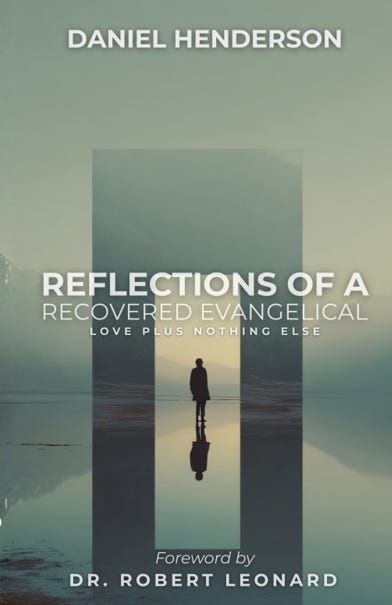
My new book will be published on August 18. Please check it out and purchase a copy. If you would like a signed copy, message me. Here is the link to the book, Reflections of a Recovered Evangelical: Love Plus Nothing Else. Paid subscribers will receive a 25% discount on any of my books. Comment or message me for details on the discount.
In 1980, when I was a young evangelical Christian school teacher, it became incumbent on me to vote Republican to show my Christian credentials. That peer pressure was strong and only grew stronger over the decades.
For much of the past forty years, one assumption has shaped American politics: if a politician spoke openly and often about Christian faith, chances were they were a Republican. Ignore Jimmy Carter.
That assumption is beginning to crack.
It isn’t because America has become more religious. It hasn’t. Surveys consistently show that religious affiliation has declined over the past two decades. In 1980, approximately 90% of American adults identified as Christian, compared to about 62% today according to the Pew Research Center Religious Landscape Study.
Rather, a growing number of Democratic candidates are becoming more comfortable speaking publicly about their Christian faith, not as a personal footnote, but as a source of their moral and political convictions.
That shift raises an intriguing question. It isn’t whether Christianity is “on the ballot” this fall. Christianity never appears on a ballot. The real question is whether competing interpretations of Christianity are becoming part of our political conversation.
If so, white Christian nationalism may be confronting a challenge it has not faced in a generation. Justin Douglas, a minister running for a House seat as a Democrat in southern Pennsylvania, commented:
We’re seeing the ways Christian nationalism is corrupting the church and public life, and the way our faith is being misused in legislation. That’s something we feel an obligation to push back against — to not legislate our faith, and show a faith guided by love and justice.
For decades, many Americans came to associate public Christianity with a fairly predictable set of political positions: opposition to abortion, resistance to expanding LGBTQ rights, support for school prayer, and a belief that America possesses a distinctly Christian identity.
Whether those positions accurately reflected Christianity as a whole is another question. But politically, the association became deeply ingrained.
Beginning with the Moral Majority in the late 1970s and continuing through the Christian Coalition, the Tea Party, and today’s MAGA Christian nationalist movement, conservative Christianity has developed an influential political infrastructure. Churches became political organizing hubs. Christian media expanded. Candidates learned to speak the language of evangelical faith.
Meanwhile, many Democrats largely ceded that terrain. They often spoke about values, justice, and equality, but many avoided explicitly theological language, fearing it would be dismissed as inauthentic or alienate secular supporters.
There were exceptions to this rule, usually Black candidates such as Jesse Jackson and, more recently, Raphael Warnock and the Rev. Martin Luther King Jr. They were and are able to speak clearly and genuinely from a historical Biblical social justice tradition of the Civil Rights movement. Yet, most white Democrats have been silent.
That dynamic appears to be changing.
At least 12 pastors, seminarians, and former clergy have run for federal office as Democrats this year, and seven have already become the Democratic nominees as of Wednesday (Aug 5).
Candidates such as James Talarico in Texas, Adam Hamilton in Kansas, Frederick Haynes in Texas, Sarah Trone Garriott in Iowa, and others are openly discussing how their Christian faith shapes their understanding of public service.
Although they differ theologically and politically, they share one notable characteristic: they are comfortable quoting Scripture while defending pluralistic democracy and the constitutional separation of church and state.
Rather than presenting faith and progressive politics as incompatible, they argue that one informs the other. Their language sounds familiar to Christians across traditions.
Love your neighbor.
Welcome the stranger.
Care for “the least of these.”
Seek justice.
Walk humbly.
These are hardly new biblical themes. What is new is hearing them advanced so explicitly and articulately within Democratic campaigns.
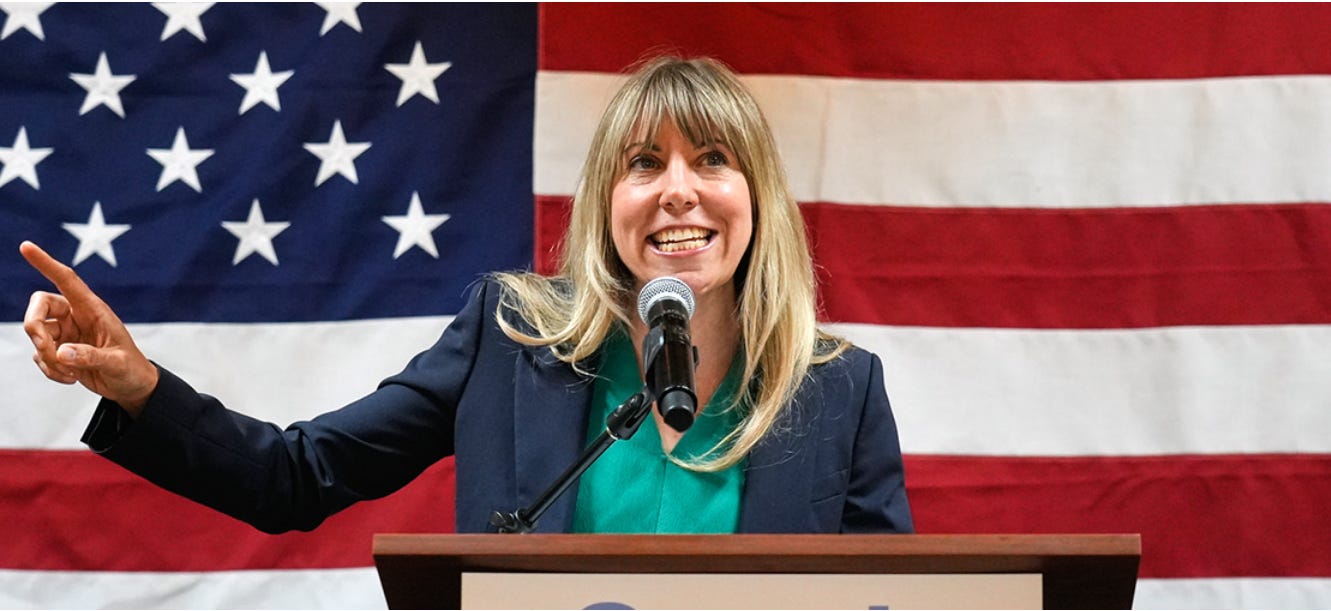
That creates an interesting dilemma for Christian nationalism. For example, the case of the Rev. Sarah Trone Garriott, a Lutheran pastor running as a Democrat for Congress in Iowa, is giving Republicans in the state a difficult target to attack.
The Religion News Service reported the attack in an August 4 post:
At last month’s Family Leadership Summit in Des Moines, Iowa, Joe Mitchell, a Republican running for U.S. Congress in the state’s second congressional district, jabbed at his Democratic opponent, state representative the Rev. Lindsay James, saying she “calls herself a pastor.” He then turned to the crowd of conservative evangelical pastors and coined a term he said applies to James, a Presbyterian minister, and other faith-forward Democratic candidates — namely, Lutheran minister the Rev. Sarah Trone Garriott, an Iowa state senator also running for another seat in Congress, and James Talarico, a state senator and Presbyterian seminarian running for U.S. Senate in Texas.
“I call them PINOS,” he said, explaining the term is an acronym for “Pastors in Name Only.” “Because they’re not real pastors, right? They don’t profess the true gospel of Jesus Christ,” added Mitchell, who has attended an evangelical church in the past.
Other Republican officials have referred to Garriott as the “Wicked Witch of Woke.” Republican evangelicals have never been challenged so directly on their own turf. Attacking the faith of an opponent directly does not seem to be an effective strategy.
Political movements are often strongest when they enjoy a near monopoly over a powerful symbol or identity. For years, many Americans implicitly equated “Christian voter” with “Republican voter.” That assumption simplified political identity even though millions of Christians never fit neatly into that category.
As more Democratic candidates speak openly about their faith, that equation becomes more difficult to sustain. Christian nationalists now find themselves on the defensive and try to articulate what is the “true gospel of Jesus Christ.”
This changes the debate. It is no longer simply whether Christianity belongs in politics. It becomes which understanding of Christianity is being presented. For Christian nationalists, their version was the assumption; now they must defend it.
Voters will be presented with that choice this fall, whether or not it is officially on the ballot. It is implicit now in the conversation.
Scholars generally describe Christian nationalism not simply as religious devotion but as an ideology that closely links American civic identity. Many do not even equate Christian nationalism with the religion of Christianity.
“Christian nationalism is a political ideology, not the gospel of Jesus Christ.”
— William J. Barber II
Christian nationalists often argue that the nation’s laws and institutions should explicitly reflect that identity. Researchers note that supporters vary widely, but common themes include viewing America as a fundamentally Christian nation and believing that Christianity should enjoy a privileged place in public life.
Many Christians who reject Christian nationalism do so not because they reject Christianity but because they understand the faith differently. For them, Jesus’ teachings about humility, compassion, forgiveness, and concern for marginalized people point toward a different vision of civic responsibility.
That disagreement is not only political but also theological.
One of the more interesting aspects of this emerging conversation is that criticism of Christian nationalism is increasingly coming from Christians themselves.
James Talarico, for example, has argued that Christian nationalism distorts the Christian message rather than fulfilling it. His opponent, Texas Lt. Gov. Ken Paxton, who has a long rap sheet, has said he has “never seen anyone commit so much blasphemy against the word of God and the Bible” as Talarico, and insisted he believes the seminarian may end up “going to Hell.”
That is an interesting campaign tactic.
William Barber II has long maintained that concern for the poor, voting rights, and economic justice are deeply rooted in biblical ethics. Rev. Adam Hamilton, running for governor in Kansas, has frequently emphasized that churches should resist becoming extensions of political parties while encouraging Christians to bring moral reflection into public life.
None of these leaders agrees on every policy question.
Yet together they illustrate something significant: Christian faith does not inevitably produce a single political program. And that reality presents a more complicated environment than the one that has existed for much of the past generation.
Christian nationalist leaders now encounter fellow Christians who know Scripture well, affirm historic Christian beliefs, and challenge nationalist claims using theological rather than secular arguments.
It is one thing to dismiss criticism from atheists or secular political opponents. It is another to engage Christians who quote the same Bible while reaching different conclusions. The outcome of this development remains uncertain.
It is entirely possible that voters will continue to associate public Christianity primarily with conservative politics. Political identities formed over decades do not disappear overnight.
It is equally possible that this marks the beginning of a broader realignment in which Americans become more accustomed to seeing multiple Christian voices participating in public life without assuming they all belong to the same political movement.
If that happens, the cultural significance will extend well beyond any single election. It could reshape how Americans think about the relationship between faith and democracy into the future.
The Constitution never asks citizens to leave their deepest moral convictions at the voting booth. Nor does it grant any religious tradition a privileged claim over public life. The American experiment has always depended on people of many faiths and of none, bringing their convictions into public debate while accepting that government belongs equally to everyone.
Perhaps that is the most important question raised by this election season. Not whether Christianity is returning to politics. Christianity has never really left.
The more interesting question is whether Americans are entering an era in which no political movement can plausibly claim to speak for Christianity by itself. If that is happening, then Christian nationalism’s newest challenge is not secularism.
It is competition—from fellow Christians who read the same Scriptures, worship the same Jesus, and offer the country a markedly different understanding of what faithful citizenship looks like.
That is something white Christian nationalists have never had to face before.
Share Things We Don't Talk About Like Politics & Religion

Available for iOS and Android
Comments
Nothing yet. Say the first thing.
Sign in to join the conversation.