Artificial intelligence is transforming medicine. But what will be the direct impact in the coming years? A project by M1 – Munich Medicine Alliance takes a look into the future. Using fictional patient stories, experts describe what prevention, diagnosis, and treatment might look like in 2036. The project is funded by the Federal Ministry of Research, Technology, and Space (BMFTR) as part of the…
Modern drugs for obesity and type 2 diabetes are based on a simple insight: metabolic pathways are not controlled by a single signal, but by many acting together. Prof. Timo D. Müller is Director of the Institute for Diabetes and Obesity (IDO) at Helmholtz Munich and Professor at the Ludwig Maximilians University of Munich (LMU). Together with his team, he investigates how these biological…
Research fully realizes its value where it reaches people – when findings translate into new treatment options from which those affected can benefit. How this can be achieved in practice for type 1 diabetes is demonstrated by the Institute of Diabetes Research at Helmholtz Munich through its participation in four clinical trials at the study center of TUM Klinikum and Helmholtz Munich, which are…
A new interdisciplinary team at Helmholtz Munich aims to bridge one of healthcare AI's longstanding challenges: translating promising algorithms into tools that perform reliably in clinical practice. The M1 Clinical AI Consultants, based at the Institute of AI for Health (AIH), were established to support healthcare professionals in transforming preclinical computational approaches into validated,…
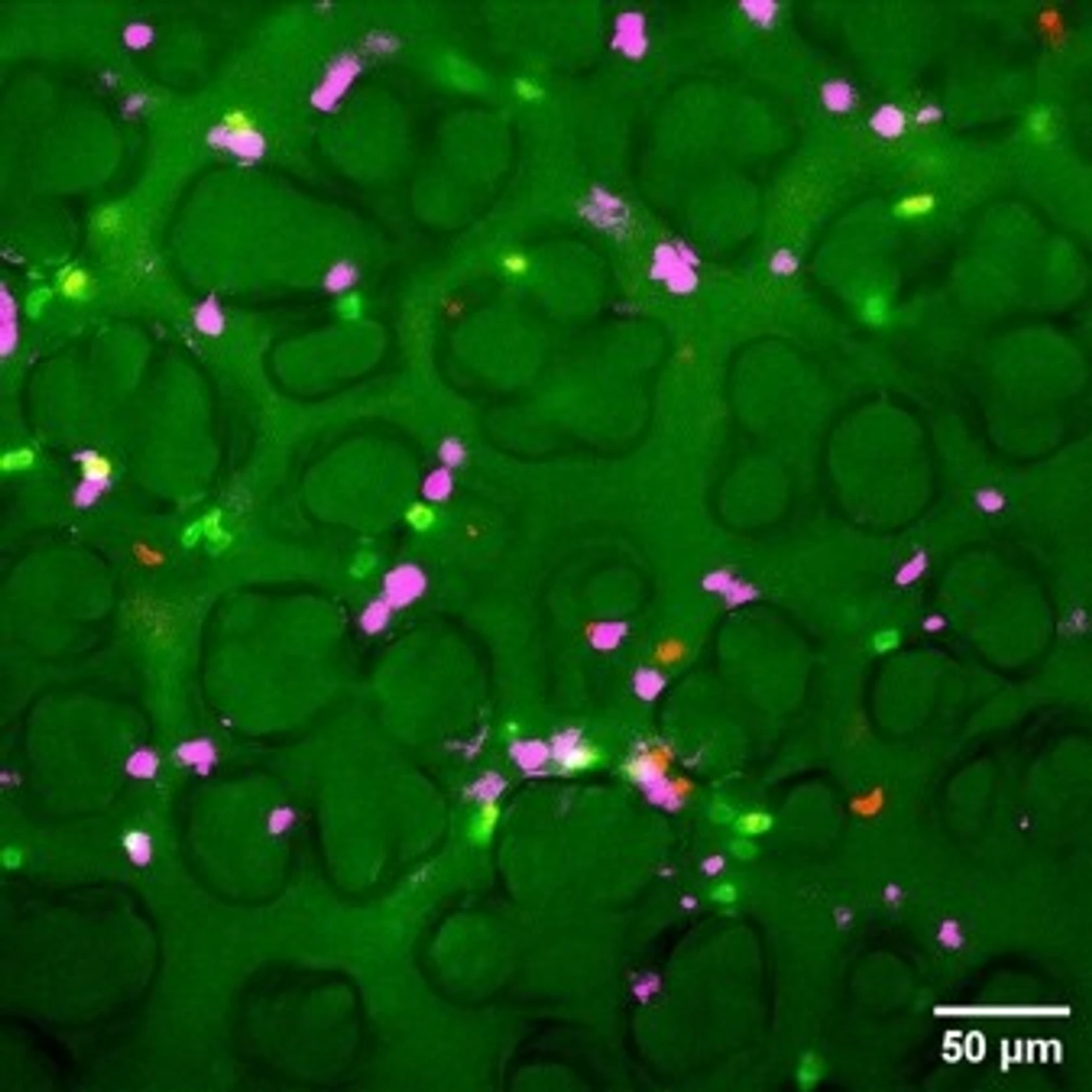
Using advanced intravital microscopy, Helmholtz Munich researchers have been able to observe early immune reactions in the living lung in real time. The images show that specific T cells are activated within hours after contact with components of SARS‑CoV‑2. They migrate into the lung and accumulate there. The findings point to a previously unknown mechanism that links innate and adaptive immunity…
A research team led by Prof. Stefan Stricker at Helmholtz Munich and Ludwig Maximilian University has developed TAPIR, a CRISPR-based technology that enables precise control of protein production in cells. The method provides new insights into the regulation of stem cells, cancer, and rare diseases, while opening up new opportunities for biomedical research.
As of July 1, Dr. Michael Frieser will take on the role of Administrative Vice-President of the Helmholtz Association. Together with Diana Stiller – also Administrative Vice-President – from Helmholtz-Zentrum Dresden-Rossendorf, he will represent the interests of administration on the Executive Committee.
From 5 to 8 July 2026, Munich’s Muffatwerk will become a unique space where the worlds of scientific research and artistic creation converge. The exhibition “In Formation” brings together four international artists – Anna Dumitriu, Solveig Lill, Pei-Ying Lin, and Helen Pynor – with stem cell and epigenetics research. Initiated by Helmholtz Munich and Maria-Elena Torres-Padilla, the project…
Prof. Vasilis Ntziachristos has been awarded the Future Insight Prize 2026 by Merck. The prize recognizes his pioneering contributions to non-invasive health sensing and is endowed with a research grant of €300,000.