
How we spend our time and attention is how we spend our life, and death is what makes that matter. In life, there is beauty and wisdom in taking our time, working hard to complete something, and taking a gamble on what we’re passionate about. A culture that removes these steps from the act of creating is a culture that lacks respect for life, as well as death.
I was reminded of this recently as I was one of the estimated 7.5 million people who saw Christopher Nolan’s The Odyssey during its opening weekend. Going in, I knew what to expect plot-wise—a story based on a famous epic poem about a man trying to get home. What I didn’t expect was that, afterward, learning how the film was made, I would have so much reverence for it. Nolan didn’t take any shortcuts in the process, and it made me think of a piece we wrote a while back on reading books as an act of resistance. In it, we discuss how choosing the harder, slower, more human way to make or consume something is a kind of defiance in an age of the attention economy.
Today, fewer people are leaving the comfort of their own homes to go to the movie theater. With streaming libraries that grew significantly during the pandemic, there’s more to watch on our personal screens than ever, and social media is monopolizing more of our time, so we never have to leave the house. Meanwhile, the movies themselves have gotten more expensive to make and attend, between production shutdowns, the writers’ strike, and the rising cost of living.
Great movies also feel scarcer these days—or at least, fewer of them break through. Every form of art—from architecture, web design, furniture, and film—seems to be made cheaper and faster, with AI accelerating that process, leading to more slop and less being handcrafted by humans.
But last week, as I sat in a dark theater for three hours—surrounded by strangers, phone off, no way to pause or skip ahead—The Odyssey reminded me of the rewards that happen when we don’t take shortcuts in life.
This film took Nolan years to make, and it risked real human bodies. In one scene, instead of digitally rendering the dead rising out of the ground, Nolan had his stunt crew buried in the sand, alive, breathing through hidden snorkels. And that wasn’t even Nolan’s biggest gamble. He shot the whole movie on IMAX film and in a new way that has never been done before. Only 41 theaters in the world can project the film the way he made it. Nolan’s work is a fantastic example of what we can do when we don’t take a shortcut and are instead, willing to actively sacrifice, to sit with struggle, discomfort, and the unknown.
We’re living in a world where many promote, praise, and value hyperproductivity, where quantity seems to beat quality. We’re told that we can and should, with the help of AI, launch a website before lunch, build a company in a weekend, and produce a film in a week. New technology is helping us create things faster with less effort and money involved, so it feels like less of a risk.
But rushing to create something doesn’t make that creation better. As famed music producer Rick Rubin writes in The Creative Act: A Way of Being, “If there is a rule to creativity that’s less breakable than the others, it’s that the need for patience is ever-present.” When we go quickly, we’re not taking the time to actually understand, appreciate, and master what we’re making.
Writing this Substack has given me a firsthand understanding of this. I’ve spent years now writing weekly contemplations on how to live well in the face of impermanence, and I still don’t feel like I’ve come close to being an expert on the subject. I don’t think I ever will, and I don’t think anyone does. There’s always something new to learn, some angle I hadn’t considered, some part of it I got wrong the first time.
The book Zen Mind, Beginner’s Mind by Shunryu Suzuki describes shoshin, a Japanese Zen Buddhist concept meaning “beginner’s mind,” as: “In the beginner’s mind there are many possibilities, but in the expert’s mind there are few.”
The moment you think you've got life—or death—figured out is the moment you've stopped learning from it. And it’s staying with this topic, week after week, rather than rushing through it once and moving on, that makes me appreciate it more. For that, I'm grateful.
Death teaches us that life unfolds at its own pace, whether we like it or not. We don’t get to shortcut the years it takes to get to know and love someone before we lose them, we can’t fast-forward through grief, or rush a diagnosis. Yes, those may be the messy and hard parts of life, but they’re also the ones that come from living fully immersed.
Nolan seems to understand this sentiment too, at least when it’s applied to filmmaking. “The wonderful thing about cinema, and IMAX in particular, is that you can take an audience to a place of immersion, feeling close to events like storms, turbulent seas, high winds,”
If you haven’t seen The Odyssey yet, consider this your spoiler alert warning.
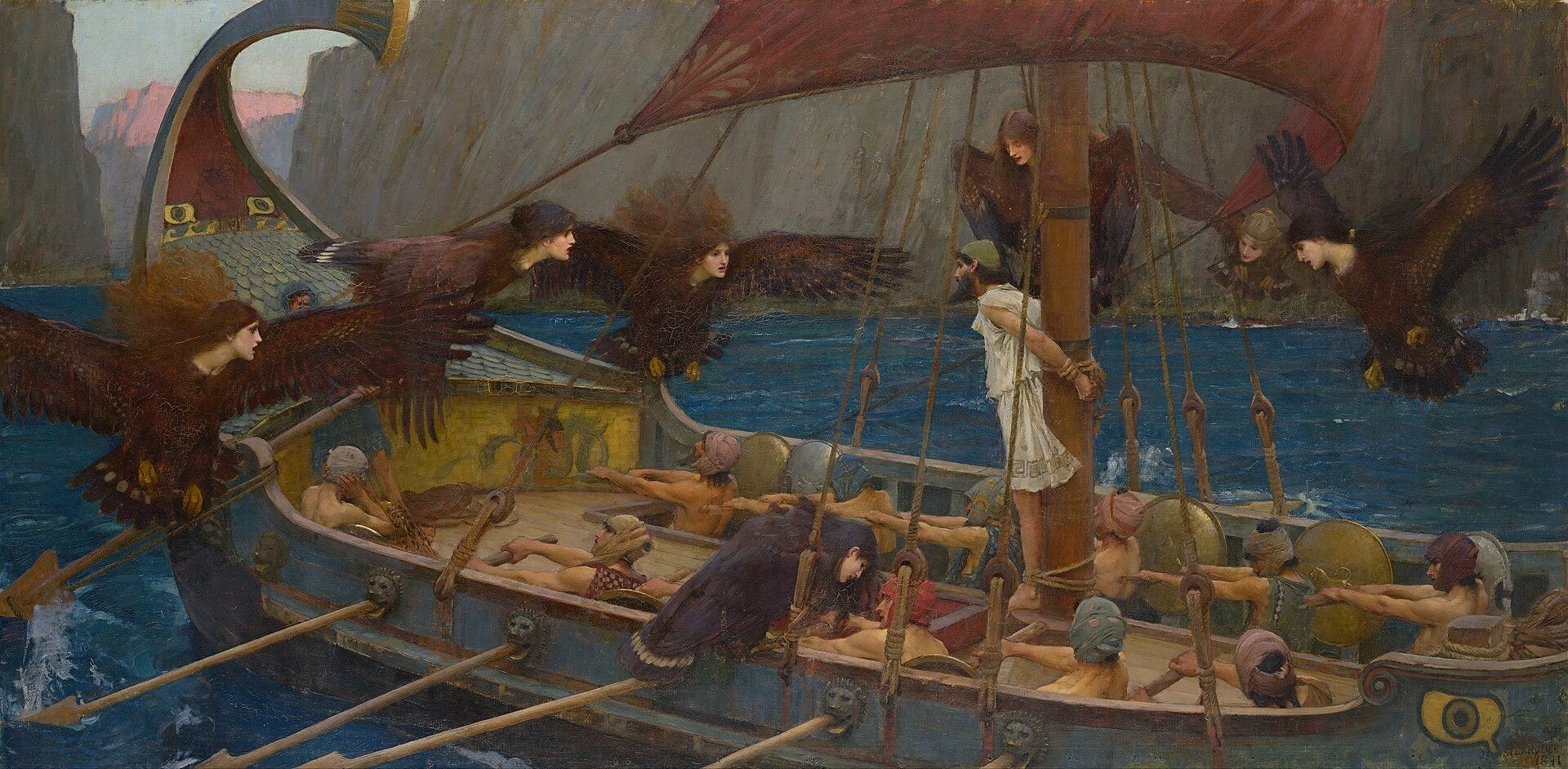
Sirens, in Greek mythology, are creatures who sing an irresistible song from the rocks along the coast. The song is so irresistible that any sailor who hears their tune is compelled to throw himself overboard and swim toward them, only to drown or be torn apart on the rocks.
There’s a scene in the movie where they must sail by the sirens, and to protect his men from their song, Odysseus instructs them to put wax in their ears, but he refuses to do the same. Instead, he has his men tie him to the mast, so he can be the one person alive to have heard the song and live.
As Odysseus hears the song, we, the audience, do not. Nolan makes the genius choice to not let us experience it, because giving us the lyrics would ruin the whole myth that depends on it staying unheard. So we just watch Odysseus scream desperately, fighting the ropes that have him tied up, in what looks like agonizing pain.
When asked by one of his men what the song sounded like, Odysseus replied: “All the things you wanted it to be, then all the things you wished you never wished for.” He goes on to say the sirens told him: “What you most want is what you most can’t have, and what you most can’t have is what you already had and lost.”
The phrase was similar to what some use for near-death experiences: your life flashing before your eyes. Not a song, exactly, but the same sentiment. Everything and everyone you love, every promise you didn’t keep, every version of yourself you left behind, all of it arriving at once, and no way to look away from it.
The sirens also act as a temptation, pulling you off the path you’re actually supposed to be on. They are a distraction, a shortcut, offering false promises that you’ll finally get what you want if you just follow it a little further.
When Odysseus doesn't use the wax, I thought he was being a little crazy and dramatic. But he’s also testing himself and opting to take the harder path. That’s not so different from what Nolan did with this film. Both Nolan and Odysseus refused the easy route in favor of the one where the struggle produces clarity.
Consider this your invitation to get out of your house and head to the movies this weekend!
I’m curious: What did you think of the film? Were there any scenes that stood out to you? What dream have you given up on that you should maybe pursue again? What are you rushing toward that maybe you should slow down for?
— Maura
P.S.
Here’s a fun fact: Nolan was actually rejected from film school, but instead of giving up on his dream, he pivoted to studying English literature at University College London, a decision he credits with strengthening his screenwriting, deepening his understanding of language and metaphor, and shaping his philosophy on failure. Moral of the story? Like Nolan, and many characters in The Odyssey, don’t give up or take no for an answer when it comes to pursuing what matters to you.
Comments
Nothing yet. Say the first thing.
Sign in to join the conversation.