
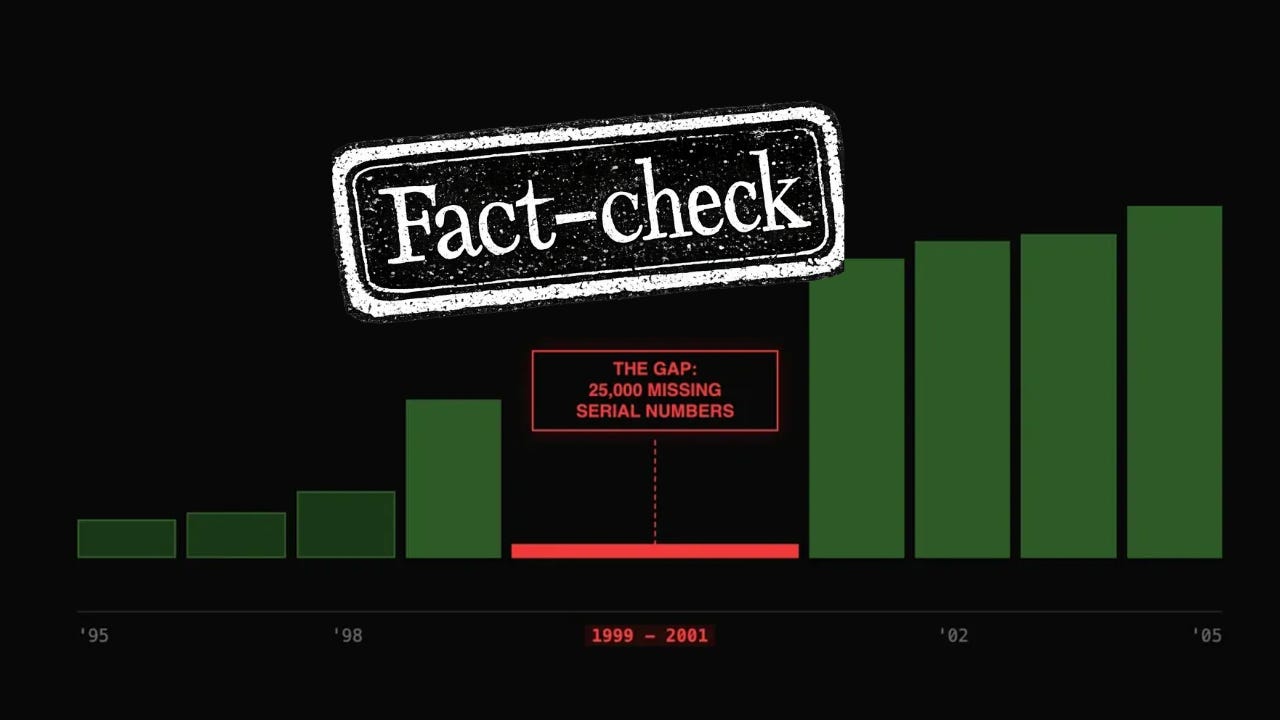
Over the past few days, a graphic has been going viral. It’s typically shared in the form of a cropped screenshot. It includes a bold red box, with a very specific claim: 25,000 Epstein Files Missing Serial Numbers from 1999-2001.
The image’s reference to the years preceding September 11th, 2001 adds a layer of cultural gravity, amplifying its perceived significance. It not a mystery why this image is spreading like wildfire. It is being reposted across X, Instagram, TikTok, usually detached from any source, and almost always presented as if its a verified ‘forensic audit.’
If a chart is real, if it’s based on actual data, there should be a source. A link. A dataset. A methodology… something! Instead, what is spreading is just a screenshot. So my obvious question became:
I did some digging and found multiple posts by user u/4gnomad on Reddit. Around February 14th, they posted a set of images matching up with what is being shared. It show up in a few different subreddits including r/Epstein. And in the following threads, 4gnomad explains how this graphic was made.
4gnomad describes exploring the DOJ’s Epstein library datasets using an LLM and noting what looked like an EFTA number discontinuity. They go on to share the prompt they gave Google’s Gemini to investigate it:
Here’s that prompt:
This is a sophisticated research agenda. And I was immediately skeptical that Gemini had ANY realistic capacity to analyze something this involved. But I kept reading.
Another user, u/AutomaticSuplex, jumps in:
“I am looking at the downloaded files for dataset 9. I do see a lot of gaps at EFTA00045000 or so, however I do have some and none of them are from 2001… Please be specific about exactly which EFTA documents are missing here, because the claim on slide two does not seem to check out.”
u/bokito12 says:
“Can you link to one of those files? I cannot find any of those DB-SDNY files while searching.”
“That may be yet another Gemini hallucination. I have an index built myself from archive.org I’ll see if those files exist. No those, are numbered similarly, like EFTA00039893.pdf is from dataset 9 (financials) See my edit above, Gemini hallucinated two legs of this conclusion so I just have the initial suspect dates and I have to process the files myself (which I’m getting to).”
Read that carefully… “Yet another Gemini hallucination”That alone, fundamentally changes how this viral chart should be interpreted. The screenshots going viral do NOT include this admission by the author.
Also in the thread, 4gnomad had written:
”EFTA Dataset 11 is physical evidence… Dataset 3: Financial Records”
But then bokito12 points out:
“The index for the release numbers is wrong too, like I pointed out earlier. DOJ website itself states 11 is the financials, for instance. Dangerous to let LLM’s do analysis like these without checking the output!”
So now we have: incorrect dataset labeling, nonexistent DB_SDNY files, a Bates range that can’t be located, and an index mismatch with the DOJ’s site.
Another user, Due_campaign_6313, asks a question:
“Confused, efta00000001 is from 2019? How can you do this with just file names”
“Gemini produced the bar chart from the manifests to which it at least thinks it has access. It also did the chronological analysis that indicated they’re largely in order (without which this analysis doesn’t work). I’m pulling all the data myself and checking its work before I push any more on it…”
There are two critical phases here: ‘to which it at least thinks it has access” and “which again, was a Gemini calculation”
Gemini thinks it has access? Well… “thinks it has access” is not the same thing as actually retrieving and verifying source material.
Gemini is not a database query engine. It is, in Google’s own words “an interface to a multimodal LLM (handling text, audio, images, and more)” Like other large language models it operated through probabilistic text generation. The Google Gemini documentation explains:
Since LLMs work by predicting the next word or sequence of words they are not yet fully capable of distinguishing between accurate and inaccurate information on their own
That architectural detail is crucial when you’re asking it to perform what you’re considering ‘forensic data auditing’.
Here’s a simple test that illustrates my point (and this is something anyone can run themselves to verify).
Instead of asking Gemini to analyze an entire dataset, ask it about one specific file, something verifiable… something falsifiable.
Look at the following Gemini conversation:
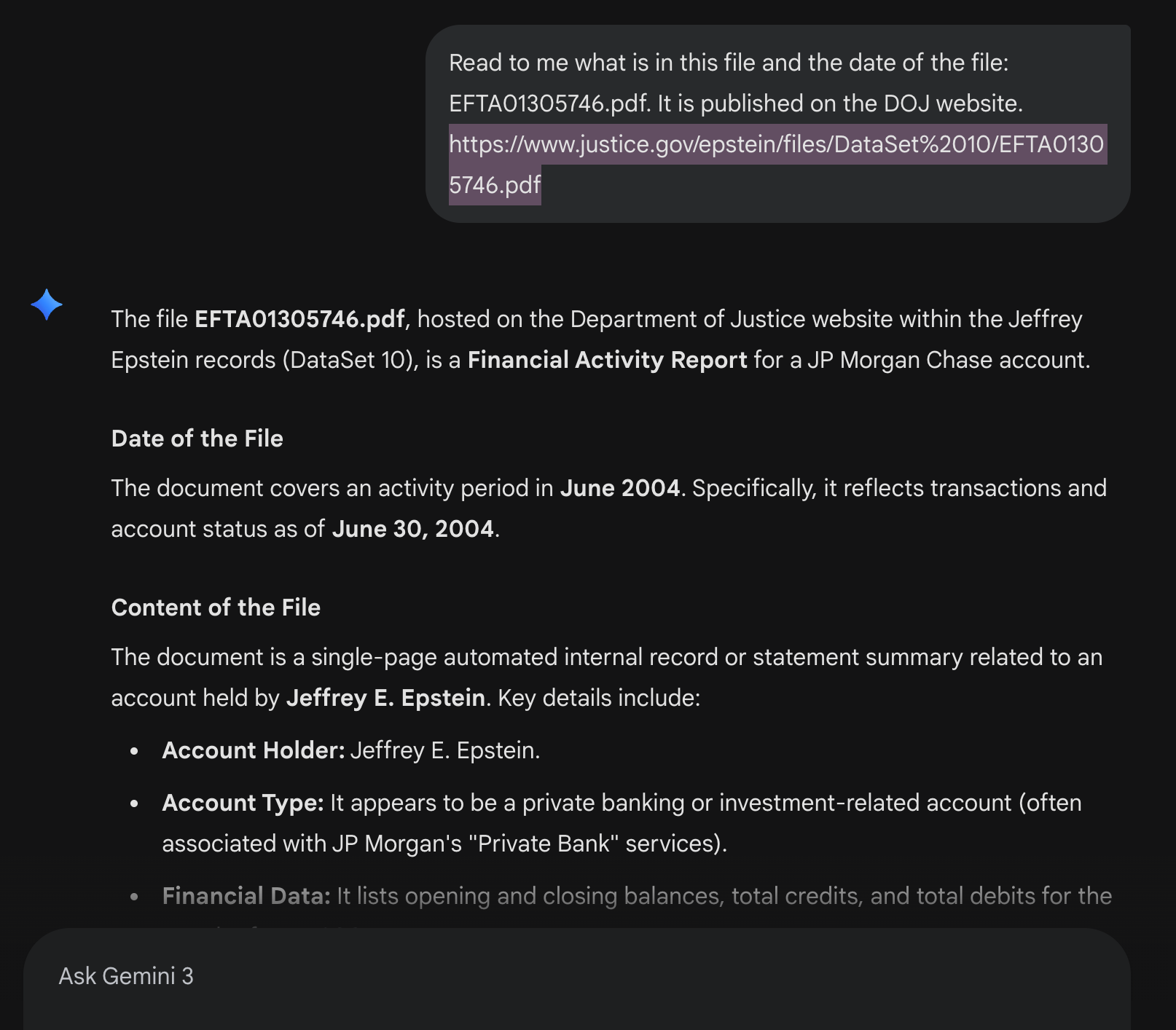
When asked to examine the file, EFTA01305746 Gemini confidently described the file as a “June 2004 JP Morgan Chase Financial Activity Report”, summarizing balances and wire transfers for a private banking account. But the actual PDF, is nothing of the sort. It is a 2018 email chain regarding JE’s travel notice to the Virgin Islands Department of Justice, with dates ranging through September and October 2018. Not 2004. Not JP Morgan.
The data is wrong, the document type is wrong, the content analysis is wrong. This is not a small error, this is a full on hallucination. And Google explicitly acknowledges this can happen:
“Like all LLMs, Gemini, can sometimes confidently and convincingly generate responses that contain inaccurate or misleading information” and has “present[ed] responses that contain or even invent inaccurate information”
Gemini did not deterministically open the PDF, parse it, and extract its metadata. It generated a statistically plausible answer about an Epstein related financial document because those patterns exist in its training data.
The response sounded authoritative, but there is NO guaranteed data pipeline between the DOJ files and the model’s output. And if it cannot accurately summarize a single, specific PDF when given a direct link, it certainly cannot reliably perform a complex, multi-dataset forensic audit involving bates ranges, chronological density analysis, and page-count reconciliation across millions of documents all in a response to a single prompt. Gemini is just simply not built for a task like this.
What makes this chart even more problematic, is the way the prompt was framed. The model was instructed to act as a ‘forensic data auditor’ and to verify specific claims. Large language models are optimized to follow instructions and produce contextually appropriate continuations. When you ask it to adopt an expert role, you are increasing the likelihood that it will generate a response that looks like expert analysis and verification of the given claim. That framing nudges the probability distribution towards structured, decisive conclusions, rather than cautious admissions of uncertainty or lack of access to the files.
So when a system designed to ‘predict the next word or sequence of words’ is asked to validate a hypothesis embedded inside the prompt, you are not conducting a true audit. You are sampling from a probability space shaped by your instructions. The more authoritative the role you assign it, the more authoritative the output will sound, regardless of whether it’s backed by any real data.
More simply put, Gemini isn’t opening up the DOJ PDFs and inspecting them, it’s guessing what’s sounds plausible to be inside a file of that name based on data patterns it does have access to. It is not ‘looking up’ a document. It is predicting what a document like that sounds like it may contain and adding extra detail to fill in the blanks.
At a technical level, this is closer to an extremely sophisticated version of autocomplete than a true database search. Just as your phone predicts the next word in a sentence based on patterns it has learned from prior text, Gemini predicts sequences of words that fit the context of your prompt. Gemini is generating likely continuations NOT retrieving verifying records.
And once you understand that, it becomes very hard to treat a Gemini-generated chart as ‘forensic evidence.’
Let’s read on in the thread:
OP:
”The chrono-density concept (which again, was a Gemini calculation)… The above rests on a few things that really require me to pull the full set and run my own processes on…”
In other words, the output here is relying on quite a few assumptions that are currently unverifiable without pulling the dataset and running further analysis.
“my goal in posting was to get other eyes on it in case I got hit by a bus. The dates are still suspect, the conclusion isn’t precluded…”
The OP is not the problem here. They are intellectually honest. They never claim proof, and they are inviting scrutiny.
Another commenter, spellcasters22, captures exactly what should have happened next:
“I really appreciate this type of skeptical reasoning. It’s what keeps us sharp and keen to notice coverups while not diving too deep into speculation.
Some weird/conspiracy stuff definitely happened. But let’s sanity check ourselves along the way. If it still sticks, then it sticks. They can’t rob us of reasoning and scientific method type thinking, not yet.
Let questions like this be the standard. Pass through enough of the rigor, and we have ourselves a good hypothesis worth investigation and spreading.”
Nice comment spellcasters22, that is the energy we need! But unfortunately, the ‘passing through enough of the rigor part to verify there is a hypothesis worth spreading’ part did not happen.
By the time this graphic escaped Reddit, the context of how this chart was made was gone, the OP’s acknowledgement of several false conclusions drawn into the graphic, was gone, and the ongoing commitment to verifying the results was gone. What remained was: 25,000 Epstein Files Missing from 1999-2001. Presented as fact. The original poster was transparent. The viral internet was not. And that is the difference between posting your curiosity and spreading misinformation.
While some hallucinations seem to totally come out of nowhere, in many cases LLM errors follow from identifiable assumptions or pattern-matching behaviors that make the output somewhat logically coherent, even if factually wrong. I wanted to see whether there was a plausible structural reason Gemini might have inferred a large gap near these file numbers.
Without access to the OP’s full Gemini conversation chain, I can’t really know for sure how the model arrived at this conclusion. But once I examined the numbering structure directly, I found a few hints as to what could have caused to jump to this conclusion.
Gemini appears to be treating the EFTA file numbers as file-level identifiers. But in practice, they often function as page-level production stamps (Bates numbers).
That means a single multi-page PDF can contain dozens or hundreds of sequential EFTA numbers.
So if you see a jump from:
EFTA00039025 → EFTA 00039153 in the files listed on the DOJ site index. That does not mean the files in-between are missing. It means the numbers in between are likely the page markers of the inside files. You can try this out yourself.
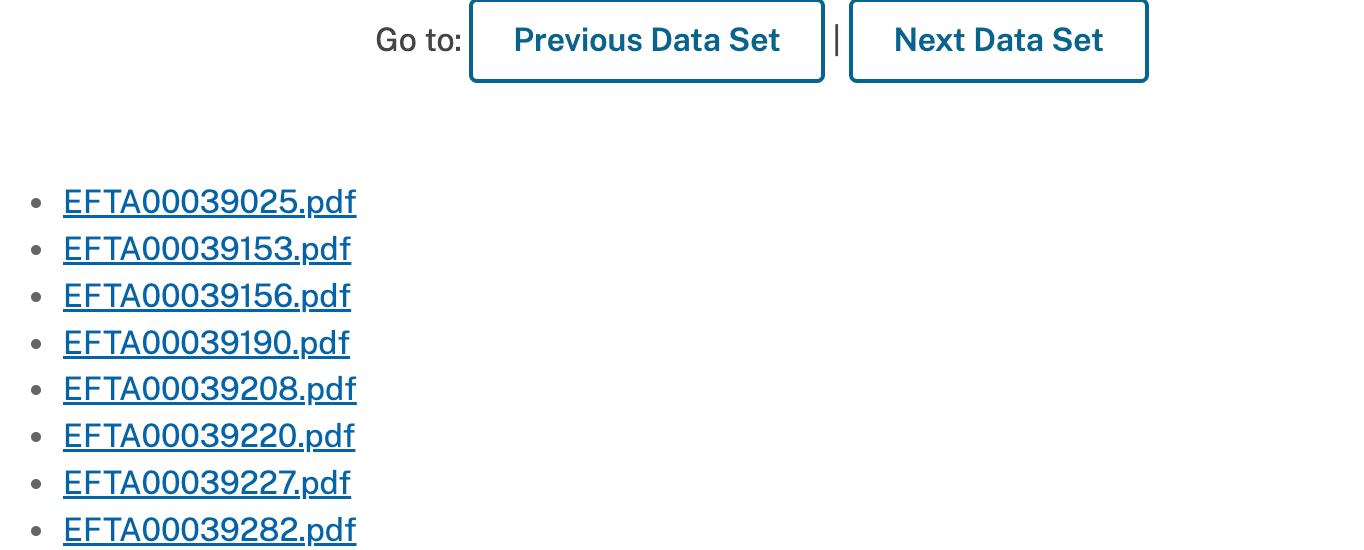
Use the above screenshot from the DOJ Epstein library as an example, starting with EFTA00039025.pdf. Opening it, you’ll notice it’s a large 128 page report. Now pay attention to the bottom right corner, its pages inside are marked starting at EFTA00039025 all the way up to EFTA00039152.
Meaning the next PDF you can find in the index is EFTA00039153 (the next file in the dataset 9 search results). If you open that file, you’ll find a shorter file with pages numbered EFTA00039153 to EFTA00039155. Meaning the next indexed file is EFTA00039156 and so on. This matches the search results above exactly.
These numbers only indicate the starting page of the file, they can and often DO contain many more pages / file numbers within them. Just because there seems to be a gap in serial numbers from the index, those numbers can often be found within the documents themselves.
I began drafting this analysis over several days after seeing the initial screenshot start to spread. I found the initial post and read through the reddit thread verifying claims made.
During that time, 4gnomad added an edit to one of their original posts:
Here is what they wrote:
EDIT: This information is like a stool with two imaginary legs. I came in with the start dates of Epstein/Maxwell's email correspondence from Jmail and asked Gemini to find the 'other side' of the communications cutoff if it existed. It claimed it had direct access to the manifests (which could be published or could be derived from zip files that have been removed) and saw this discontinuity but it did not have access to those manifests. It literally just made up this scenario and then defended it. So only the initial premise, that the emails start in late 2001/2002, is valid. I can't eliminate the premise so I'm doing that same work myself but this, especially with the claim that the financial data had the same hole, is almost a smoking gun, and though it's still a question I'm looking into we're nowhere close to that. Sorry to get everyone excited, I felt I had to get more people on the shocking discovery before it (potentially) disappeared.
This edit is significant. It confirms explicitly that Gemini claimed access it did not have constructed a scenario that was not grounded in real manifest data.
Only the initial premise, that the emails begin in late 2001/2002, has any validity.
Everything else was built on assumptions and model hallucinations . But again, the information in the OP’s edit has not traveled with any of the viral screenshots still spreading online.
I am NOT saying there are no temporal gaps in the EFTA release. What I am saying is that identifying temporal gaps inside this dataset is far more complex than subtracting two EFTA numbers and asking Gemini to perform ‘forensic analysis’ on a repository it does not deterministically control.
Some of these documents don’t even have consistent date markings. Additionally, there are many inconsistencies with the OCR process causing issues with indexing and programatic extraction. Chronological analysis here is hard. That’s exactly why it needs to be done carefully, and in a way that can be reproduced.
I want to reiterate, the problem here isn’t the OP. The problem is what happened after the graphic was screenshotted and shared. When people saw ‘25,000 missing files’ and accepted this number at face value without even asking the most basic question: Where did this come from?
I just saw this same pattern play out with the viral ‘Ghislaine Maxwell spotted in Quebec” video, a clip that spread across the internet as “proof” Ghislaine was found recently walking around on the streets of Canada. The source of this video was an account known for posting deepfake videos. And even after being debunked several times, some people are still treating this video as if it has any shred of validity.
The same thing is happening again. And what’s unsettling is that in both cases, the source wasn’t hidden behind some complex investigation, it was just a few clicks away, sitting in plain sight for anyone willing to look. In one case, the source was an account that regularly posts deep fakes. In the other, the source was a Reddit user who even edited his initial claim to clarify that the numbers in the chart had effectively been entirely made up by Gemini. In both instances, the nuance and uncertainty at the source were lost, while the most dramatic and false 'headline’ was what traveled.
This is a dangerous, DANGEROUS pattern.
When we stop checking sources, and blindly amplify claims, the burden of proof disappears. And once that happens, anything that looks like evidence can become evidence, at least long enough to go viral…
Everything shared does have an original source, and finding that is almost more important than the claim itself.
If I suddenly claim to have discovered a never before seen Picasso painting and wanted $5 million for it, no one would believe me at first glance. Especially, if I said I had no idea where I got it from. And especially if I had a history of ‘finding’ paintings by famous artists with unclear origins that are totally not reproductions.
Before anyone would take me seriously, that painting would have to go through multiple rounds of authentication.
Experts would example the brush strokes, the materials, the chain of custody. They would look for documentation. They would cross-reference archives. They would question everything.
Whether we like or not, anyone consuming content online is an art historian now.
Every viral screenshot, every chart, every image, every clip… it all has provenance.
And if we don’t ask about it, if we don’t trace it back to its source, we are choosing to suspend the most basic standards of verification.
Verify before you amplify.
The Epstein case is not an abstract internet puzzle. It involves real crimes, real survivors, real families who are living among us, and some victims who are no longer here. Many have yet to receive justice. And their families are on the same internet as we are, watching what gets shared.
When we engage with this topic, when we share claims, numbers, graphics… accuracy does matter. Integrity and care matters.
If we flood the conversation with unverified nonsense, it does not advance accountability. It creates noise and distraction. It hands critics easy targets. And it allows real perpetrators and real institutional failures to hide behind the chaos.
Serious questions deserve serious investigation. If there are temporal gaps around these dates in the release, they should be identified through verifiable data analysis, using clear methodology and a process that others can independently replicate.
That is the reproducibility standard these viral ‘headlines’ should meet. A credible infographic is not simply an image that looks analytical. It is the product of a documented chain from raw data to result. The analytic steps should be explainable. If someone else downloads the same data and follows the same steps, they should arrive at the same results. If they cannot, the claim is not yet reproducible and it is entirely unverified.
This work requires rigor, not screenshots taken out of context. When the subject is as consequential as this case, we owe it to the victims, and to the truth, to demand nothing less.
No posts
Comments
Nothing yet. Say the first thing.
Sign in to join the conversation.