
Stephen King’s The Dark Tower (1982-2004) series is in many ways his magnum opus. Of course, there’s The Shining (1977), there’s The Stand (1978), and there is It (1986) to contend with, but in sheer scope TDT beats ‘em all. The series brings together the many interconnecting strands that pulse out through his other literature, in some capacity creating a mythology that a good deal of his work centres around.
It’s also ultra fucked up.
Heavy spoilers ahead for The Dark Tower series, bar The Wind Through The Keyhole (2012), which I’m yet to read.
This last novel in the epic series has left me feeling dazed. I’ve been reading up on the general consensus, and the book still receives mixed responses even now. For me though, it was largely brilliant, and tragic in the extreme.
Let’s begin by discussing the narrative. The Dark Tower packs shitloads into its 700ish pagecount, and almost none of it is filler. The stuff in Algul Siento is hard work, given the blunt tonal shift from full-on body horror to sixties/seventies sci-fi, but otherwise things stay compelling throughout.
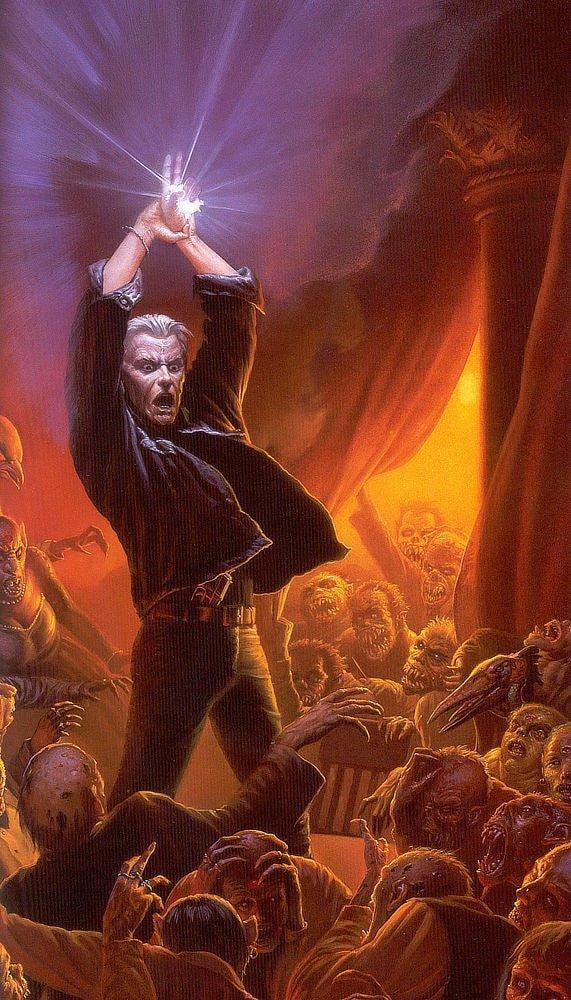
Highlights of the story include:
The heroic last stand of Pere Callahan.
The nightmarish birth of Mordred and the events immediately following.
Sheemie :)
The price of victory in Algul Siento.
Jake’s sacrifice and the aftermath, which left me a shell.
The brutal death of the Man in Black.
The Thing Under the Castle.
The ongoing mystery of Dandelo, and the masterfully tense sequence in Odd’s Lane.
The ending, which we’ll touch on later.
There are more, but we’ll leave it at that for now. What I want to illustrate is that the text sets a fucking grim tone early on, and sticks to it like a fly to flypaper. We barely get a moment’s reprieve, and when we do, it is bursting with grief and exhaustion. It is, in other words, a major bummer.
Many people hate the absence of hope in a story, but I feel that when it is replaced with burning curiosity and strong character dynamics, it can work just fine. There are dim snatches of hope in The Dark Tower, but what truly keeps you reading is the characters, and an unrelenting search for answers.
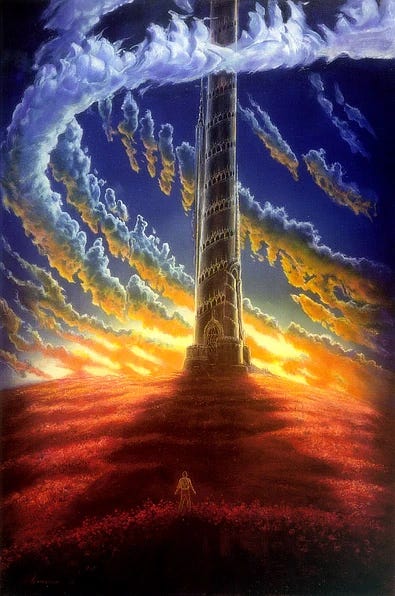
At this stage, I’ll do what I do best, and touch on the horror. I was promised some strong horror in this story by my older brother, who set me on my path to the Tower (and read some of the last book to me directly).
He did not overstate it.
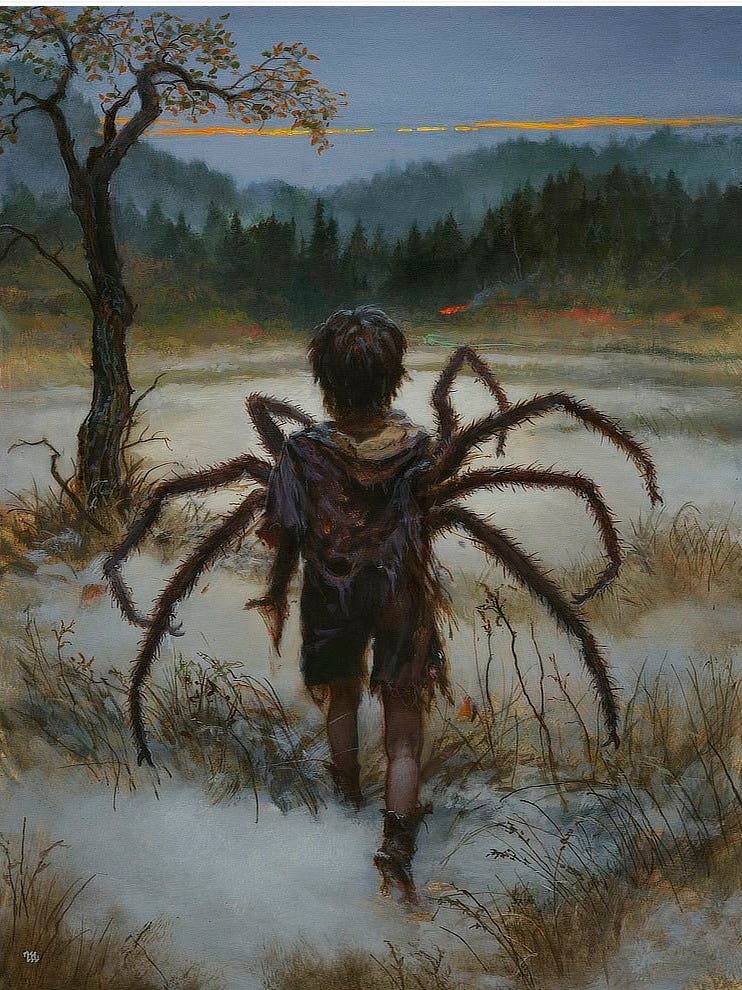
The core of the horror stems from Mordred. He is, firstly, physically repulsive. A half-human, half-spider thing, near pure evil, and full of a sick hatred for the characters we’ve come to love. Scenes with Mordred are liable to include some horrific injury, mutilation, or raining of bodily fluids. He is pathetic, and we almost sympathise with him, and this in itself is horrific. He is a Gollum-type, repugnant but long-suffering. When Gollum dies, it is not an unhappy moment, but equally, you do feel he has been doomed from the start, and this elicits some empathy, even if it is short-lived. King dials the villainometer up to 19 for Mordred, and his freakishly adult mind in his hours-old body is disturbing. It vaguely rings of Alia in Dune (1965). Even Mordred’s corpse gets the horror treatment, covered in shit, charred, with seven segmented legs curled up into a ball.
There are many more elements of horror though. Our opening scene in the Dixie Pig, where bestial Taheen, creatures straight from The Island of Dr Moreau (1896) drink cups of human fat, and mutant vampires shriek and screech bloody murder, is absolutely fucked. We’ve had some of this imagery used already in Song of Susannah (2004) and even so it remains deeply disturbing.
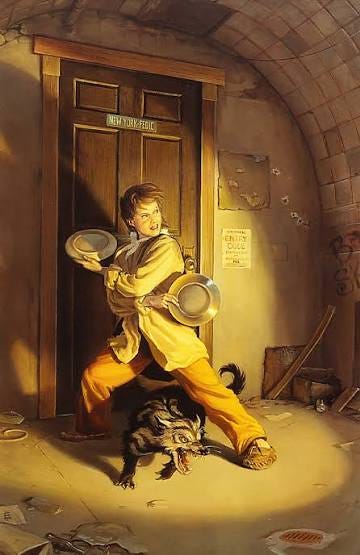
For me, the horror highlights (beyond Mordred) are certainly the setpiece ones. Let me clarify my meaning there - what I mean to say is, King sets up a location or situation that is inherently creepy, into which he throws a blatantly frightening monster, and these are the scenes that make for some of the strongest scares. For instance, Roland and Susannah fleeing an unseen THING in the subterranean darkness, something huge and wet, stumbling over hundreds of bones. This is classic King - that uncertainty brings the fear up to its height before we finally get the reveal. Think Stanley Uris in the Standpipe, or Danny and the fire-hose.
Uncertainty is the key tool in the writer’s toolkit used in the sequence with Dandelo, also. This is another set piece horror, but in this case we don’t see the danger until it is nearly too late. What really got me in this scene is the pacing, where unease creeps up on you. The moaning sounds of the wind, that you at first attribute to Mordred (creepy as hell), and then to something else, something in the basement, and then by the time you begin to question if this is merely a distraction (which it kind of is) the real monster springs out at you. While this scene is all very It I think that is to its benefit. We are familiar, at least loosely, with the kind of danger our characters are in. Even after it passes, the implications and realisations that follow are just as bad. Patrick Danville adds a new layer of horridness onto the scene.
For me, the most effective bit of horror is undeniably the book’s climax, but I’ll save my thoughts on that for later, because it’s absolutely mental.
At this stage of the article, I want to touch on the character work. The way these characters come together after so much danger and terror is beyond heartwarming. However, every interaction is in some way painful, as you wait for the unseen bullet, or the biting teeth, or some strange sickness to overcome one of the Ka-Tet. It makes for intense and emotional reading, and each death is a serious heartbreak.
My only character complaints are this - I found Ted Brautigan excruciatingly dull. Just a slog to get invested in this far into the wider story. There were some cool concepts he had to share, and he had an interesting story to tell, but Christ, I could not be arsed. It seems unfair, as he has his part to play, but still. No thanks.
As for Patrick Danville, well. Having not read Insomnia (1994) I wasn’t familiar with him, and given that he effectively determines whether or not we see the Dark Tower, I felt I really ought to have done my reading. He was fine, is what he was. His powers were cool, and you felt really sorry for him given the appalling time he spent with Dandelo. Still, I didn’t have strong feelings about him. He did his part, and had some interesting moments.
I felt uncertain about my emotions regarding Sheemie Ruiz. I really loved Sheemie in Wizard and Glass (1997), but it was strange seeing him here. That, and the fact that he’s been magic all along. What the fuck? This again, is standard King. Those with ailments, disabilities, or even just minority status fall again and again under the gun of Magic Character in his fiction - enough so it’s been widely commented on, as I understand it. That said, it was nice to see Sheemie, even if he was a bit convenient, and met a tragic (offscreen) end. Not my favourite part of the novel, but forgivable.
Right. Time to tackle the Coda. If I don’t start writing about it now I’ll only get stuck on a hundred other points. It is time to enter the Tower.
This shit was plain fucked up, man. The warning!? The suspiciously happy ending (which I suspect is grimmer than it seems - a door into the Clearing, perhaps)? These things did not prepare for me what was to come. Every floor of the Tower increasingly raising the tension, that gut-wrenching fear and curiosity about what was at the top. And then that door. That door that leads to the desert. Our hero’s realisation, his desperate pleas ignored in the cruel face of Ka. This was a truly horrific ending, and has left me legitimately shaken. I have forced myself to hope that the Horn of Eld is enough to make this next the final cycle, but we will never know (and no, the film doesn’t count, fuck that noise). This uncertainty, this move by which I am forced to begin my own journey again. Not only is Roland doomed to suffer the myriad pains and torments of the quest, so too are we. King, you are a real bastard. A genius, but twisted. I feel downright tortured over here!
I can’t dwell on it any longer in this post or it’ll go a very different direction, so let’s talk about some less organised thoughts I had.
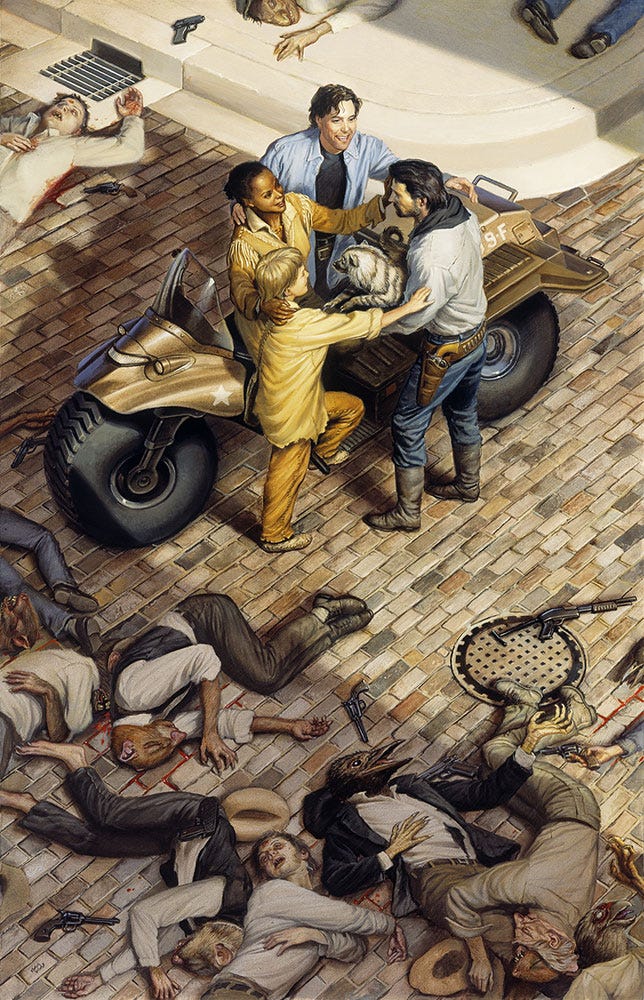
The deaths were extremely painful, and very well done. I had predicted the van incident, but the other genuinely caught me out of nowhere. It was a bold move to half the Ka-Tet around midway through the book, and came as a shocking surprise. The grieving was done very well, too.
The Crimson King was, as many have said, a bit of a letdown. I can forgive it, as he is completely mental, and trapped for a long old time outside the Tower, but even so. It was a shame. I was expecting a spider monster.
Mordred was really great. Disturbing and gross. Pitting him against Oy was brutal.
Susannah’s boil was an interesting element, as was Roland’s increasing illness. I wish we’d had more of the latter.
The drawing stuff was cool, even if it was a bit fantastical. This was, in many ways, a tale of convenience.
The rose cutting Roland’s finger was fucking gnarly.
The slower points of the story were really strong. The travelling was a grind, but one that I really enjoyed reading.
The stuff with the Three Kings was fucking weird. Not bad, but weird.
I was really hoping we’d spend some time in the Castle of the Crimson King. No dice, which sucked.
The Thing under Castle Discordia was not what I expected, but I enjoyed it nonetheless. I was anticipating a death, honestly.
The mysteries of Arthur Eld are killing me. Fuck you, Callahan, for not sharing that book with us.
I think if you’ve made it this far in, I reckon you deserve a ranking.
Without further ado, my first read-through of The Dark Tower series, ranked by Hellish Views.
Wizard and Glass (1997)
Wolves of the Calla (2003)
The Drawing of the Three (1987)
The Waste Lands (1991)
The Dark Tower (2004) and The Gunslinger (1982) - both of which I loved.
Song of Susannah (2004)
I already feel extremely uncertain about this, and I suspect my answers will change every time I’m asked. I loved every book. What I will have to do is revisit each one through audio, and see how the new context, as well as my pre-existing visions of the characters and locations, shape my enjoyment. How many things will I notice on this second journey? Delah, I have no doubt.
For now, I’ll cry off from writing about the series. Hard to do, because I can’t get it out of my mind, but tomorrow I’m off to see Teenage Sex and Death at Camp Miasma (2026), so that will help.
As ever, say thank ya for reading, and sharing khef with me.
Long days and pleasant nights,
H.E.
P.S. These artists are amazing - I claim no credit. All rights remain with the original creators.
No posts
Comments
Nothing yet. Say the first thing.
Sign in to join the conversation.