
The online noise about Pangram joining up with Substack seems to have calmed down a little now, though I still see the occasional note about it.
Two weeks ago, or thereabouts—time is a bit post-holiday blurry at the moment— Substack announced that it was partnering with Pangram so that readers of your work, if they suspect generative ai involvement in your writing, can run it through the Pangram programme and be told whether it’s human-written or machine-written.
Initially, you might think that's a good thing, right? After all, most of us are opposed to ai ‘slop content’. Part of the reason why we came to Substack is to avoid that sort of thing.
But when I read the news, my heart sank. Not because I use ai to write my essays. But because I knew what would come next.
It was going to create another barrier to entry for unconfident writers and creatives.
What’s more, it’s not just that these ai detectors (rightly or wrongly) identify suspected machine-written writing - but what they’re doing is unfairly shifting the burden of proof onto every human creator, a burden, by the way, that falls largely on people who already doubt themselves.
In order to explain this, I need to give you some background information, so bear with me.
I first read about the Substack/Pangram news from Katie Clapham’s Notes, as I don’t particularly keep myself abreast of what’s new with Substack itself. This is one of a number of them below:
At the time Katie wrote her first Substack Note about this, the decision by Substack was that all new articles we write and publish, from 21st July onwards, would be available to readers to be checked by Pangram, the ai scanner.
As writers, we could opt out. Woohoo. But—get this. If we wanted to stop readers from putting our writing through the ai scanner, we had to run our writing through the scanner first. So, whichever way, our writing would be scanned by a machine. Make it make sense.
As I understand it, the highly vocal feedback from the Substack community made them change this overnight, so now writers can opt out without ‘feeding the ai beast’ first by clicking on ‘disable ai detection’.
From now on, I’ll be clicking on disable. Not because I will be writing with ai and want to hide it (I’m not). And not really because I don’t want my writing to be run through a machine.
I’m disabling it because Pangram is not accurate. Someone could run my writing through the scanner, and it might come back 60% machine-written when I’d written it entirely by myself. And I would immediately be accused of something I haven’t done, with no comeback.
Because the machine said so. Therefore, it must be true.
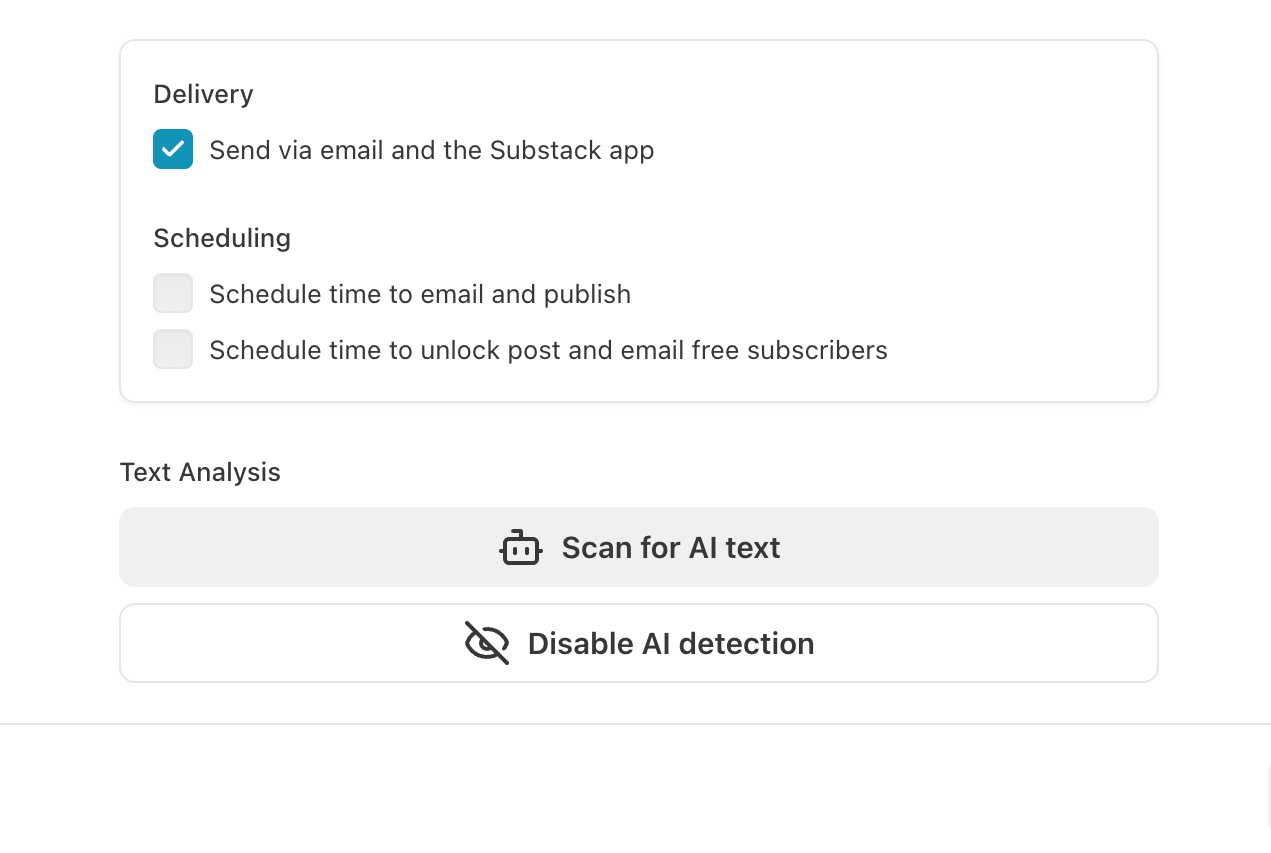
I am disabling it, for my own peace of mind. So that my brain doesn’t give me another reason not to publish my writing. I already have enough reasons.
Now, I’m not going to get into the ethics of ai here. I know there is an environmental impact from using ai. I also understand Amazon is swamped by ai slop. And I know many readers, including myself, don’t want to read something written by a machine; rather, we want to read about human experiences written by a human hand. Regardless of what you think about it this technology, false detection has career-ending consequences.
I’ve recently read on Substack that many of us have critical thinking skills and can detect for ourselves if an essay or an article is written by a machine. And if you can’t detect ai then you’re not a very good reader, or writer.
But I would argue that some ai writing is very difficult to spot. I admit, I certainly struggle. I’d also argue that some writing reads like ai when it isn’t. (This could be because we’ve been coached to write like ai, or our writing is similar to ai anyway.) This ambiguity is why we must be so careful when accusing others of writing with generative ai.
Do we really need a machine to tell us that what we’re reading has been written by another machine? Can’t we simply vote with our feet (or eyes)?
Incidentally, I’ve just seen that Take a Break magazine (a short story magazine in the UK) has replaced a lot of their short stories, written by real humans, with ai. In an email to their regular fiction writers, they said:
“We have also introduced the use of AI tools exclusively for our in-house stories, so our editorial team has more time to do what they do best and focus on quality and creativity. And we will be exploring this further in the coming weeks.”
It’s going to be interesting to see if this gamble will pay off, or if regular readers will become bored with machine-written short stories.
My big concern in terms of this essay, though, as I said above, is that ai detection software and humans’ reaction to it are going to create another barrier to entry for unconfident writers. Because on the internet there are people who believe they are pure. And if they think you aren’t, if they suspect you’ve written with ai, they’ll do everything they can to bring you down.
It’s the witch trials all over again. I’m not saying that to inject a bit of hyperbole into this essay. I’m alluding to the fact that once you are accused, it’s very difficult to prove your innocence. The amount of proof you’d need is huge, and just by being accused, your reputation will be tarnished.
This was my initial reaction to the news on my own Substack Note:
In full it says:
I’ve been reading through all the AI stuff that Substack has implemented and people’s reactions to it.
My first thought was, oh god, what if my work is flagged as AI? Because, as an unconfident creative that is always a worry. Even before AI existed I would worry that someone would read my writing and accuse me of being inauthentic, or plagiarising someone else (or producing ‘slop’!) Because that’s what we do. We overthink. And it stops us from sharing our writing.
I get what Substack is trying to do, but I know it’s going to make unconfident writers more anxious than they are already. It just feels like another barrier to overcome.
My daughter hates going through airport security. It’s not like she’s carrying any contraband: too much liquid, some nail scissors, or something really dodgy. She just worries that she’ll be unfairly pulled out of the line and shamed in front of everyone else.
It’s the same with the introduction of ai and the purists who will hound you for using it. I don’t fear being caught cheating, because I’m not. I fear being falsely accused of cheating. The unjustness of it all. The shame.
It makes me want to purge the internet of everything I’ve written and hide away, underneath my desk, where no one can see me.
My thoughts in the note above were in reaction to an article called Nobody Made a Detector for the Rest of It by Lisa-Marie Cabrelli, Ph.D. where she wrote:
Substack just implemented a mechanism to do out loud what women have been made to do their whole lives silently. We check ourselves for authenticity, prove we’re real, worry we’ll be flagged. The detector isn’t a new kind of surveillance. It’s an old one being cheered on by the witches who worry about your easily grown beautiful gourds.
And just like the ducking stool, the game is rigged. Write plainly, you’re flat. Write well, you’re artificial.
Lisa-Marie’s article is worth reading in full.
Since the news of the Substack/Pangram announcement, I’ve been made aware of several false accusations about using ai.
Amber Eve wrote very recently, in a brilliantly titled piece (borrowing from Ms Swift) called They’re Burning All the Witches, Even if You Aren’t One. (Proving that there really is a relevant Taylor Swift lyric for every occasion.) In the piece, Amber shares that she’s had her first accusation of using ai and how awful that felt.
Amber quotes a person on Instagram Threads who says you should be able to prove you haven’t used ai (basically, you’re guilty until proved innocent) by sharing your writing process online. And Amber, quite rightly remarks, “If I thought I was going to have to do all of those things I would give up right now: not because I have something to hide, but because when you’re as awkward and introverted as I am, it’s hard enough showing up on social media every day, without having to essentially livestream your entire life just to prove you aren’t a filthy AI user.”
Amber is basically saying she’d be put off going through all of this if she were starting her writing career now. How many others, who are at the beginning of their writing journeys, are being put off because of this mess?
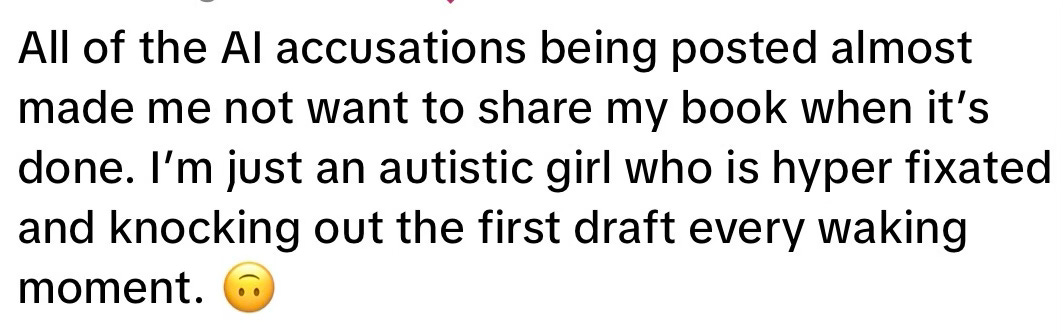
As if to prove my point, I found a number of comments on social media like this one below just yesterday:
Another example I found was on Instagram by an artist called illustoryart. Meta had labelled their traditional artwork as ‘likely made with ai’. And it wasn’t. They had no way of arguing against this; Meta said so, and that was that. They’d been labelled a cheat with no right of reply.
As someone summed it up in the comments: “First they steal your art to train their AIs, then they turn around and accuse the original creator of using their tools to fake their own art style.”
This is exactly what has happened with writers, too. The ai companies stole thousands of books, copied the writers’ styles, then accused those same writers of having machine-written writing, because they’re basing it on the original writers’ writing. It’s madness.
Then there are the more high-profile examples:
The Atlantic wrote a hit piece accusing H M Wolf, the author of Daggermouth, of writing a novel using a ‘chatbot’.
And in the last week, a debut author had his seven-figure book and movie deal cancelled because of ‘ai-suspicions’. Just devastating. From what I’ve read so far (bearing in mind this situation is still evolving and I’m not privy to what is going on behind closed doors), they hadn’t even asked the author for proof.
When you’re an unconfident writer, you might have a specific fear, or several fears. One of these might be a fear of success. I used to fear becoming so well-known from my writing that paparazzi would go through my dustbins and take long-range photos of me on the beach (like JK Rowling back in the days of Harry Potter hysteria).
Now, my fear of success is being accused of having ai write my novel for me. Because either way, if I sink or float, I can say goodbye to my writing career. I will be judged. I will be shamed.
The thing is, confident writers won’t be affected by this. It’s the unconfident ones; heartbreakingly, mainly women (although I am aware it affects some men too). Confident writers will just tell the accusers to eff-off and think no more about it.
Unconfident ones will never get that far. Because they’ll never publish in the first place. Or, they’ll give up early, or start self-policing to the point their writing and self-expression is totally flattened—which, ridiculously, might make them more susceptible to being accused of using ai.
Ai detectors like Pangram don’t simply risk misidentifying machine-written work.
They risk convincing unconfident human writers that it’s safer not to write, for their words to stay in their head rather than online or in a book, than being accused of being a fraud. Their creative ambitions just disappear into the dust as the machines take over, and the humans believe everything these machines say.
I’ve read many articles and Notes about this ai drama over the past couple of weeks. I’ve listed a few of them below:
This article above is by Kathleen Schmidt who works in the book publishing industry. She’s been sharing some really interesting and insightful notes on ai in the book industry. Worth a follow.
Again, Jessica Smock from Midstack has been sharing a lot on her Substack Notes.
Click on the Note above to read it in its entirety.
Comments
Nothing yet. Say the first thing.
Sign in to join the conversation.