
Happy Friday!
The first bit of my reporting from the Midwest went up this week—looking at why Francesca Hong did not manage to become the most high profile socialist candidate in the midterms (gift link). Somehow I managed to resist a riff on how, within five minutes of seeing a politician on stage or interacting with normal humans, you can usually tell if they’ve “got it” or not. One of the things that usually stands out is whether they like to win people over—whether they have that faintly psychopathic quality of assessing which version of themselves to present to the person in front of them. Really good politicians appear bathed in an aura of fame but also interested in you, which can be a heady combination.
I wish I had seen Bill Clinton in his prime; apparently he used to grab people’s arms with both his hands and stare into their eyes, and they loved it.
Helen

This 2007 Esquire article by Luke Dittrich, on a career lawyer who shot himself after a televised sting operation to catch “predators”, has been turned into a film starring Robert Pattinson. (The trailer looks incredible.) Unfortunately, it has also prompted me into an existential crisis. The way it’s written is too good. And I’m not sure that you can get away with writing like this any more.
Large sections of this story are written in what theorists call “free indirect narration,” blending a third-person narrator with the thoughts and feelings of characters in the story. For example: “Schrack had assumed so many different identities during the last few days that he had to actually pause a few moments before in order to quiz himself on some of the vital stats of his newest alias to make sure he didn’t screw anything up.” How does the writer know this happened? Presumably because he interviewed Schrack at length—enough to give him the confidence to summarize his thoughts in this confident, muscular way.
This style of writing is now out of fashion: younger readers, who haven’t been exposed to endless novels that use it, seem to struggle with the idea of POV narration like this, and the literal-minded have never liked it. As a reporter, you can only get away with it if your subjects completely trust you; if you get enough time with them to unspool their thoughts like this; and if your editor trusts you too. All those things are harder in the modern media environment. For a start, interviewees are more savvy, or more guarded. (As Tina Brown writes: “There is no such thing as a source anymore. Everyone is hoarding their insights for their own podcasts.”)
The other beautiful piece of artistry here is how Dittrich uses tenses. Everything is grounded on the day of the operation. We start off in medias res—outside the house where the sting will go so badly wrong—but the image of a wheelbarrow outside takes us back to a scene decades earlier, where a local man got drunk and had to be taken home: “The reason people remember this story and still tell it twenty years on is that it is so remarkably uncharacteristic of the man inside.” (Dittrich hasn’t even named this man, the subject of the story, yet—and won’t for another two sections!) The story also throws us forward repeatedly, with everything that happens after the sting referred to in the future tense: “When Dateline airs the episode documenting this sting operation a few months later, Chris Hansen, narrating, will offer one explanation . . .”
All this contributes to a piece where you know what’s coming, and yet the suspense and tension and unfolding horror ratchet up anyway. I’ve never written a piece like this, and honestly I wonder if I ever will. Hence the existential crisis.
While I’m here, have you ever seen a paragraph that so beautifully telegraphs “the supposed good guys in this story are actually nutters too”:
Everyone here knows the man with the conspicuously incognito look as Frag, though Frag is not his real name. All the members of Perverted Justice have fake names. For example, the person who spent the last two weeks conducting an on-again, off-again chat-room relationship with Bill Conradt calls himself Jay Alternative, though his real name is Greg Brainer. Ostensibly the members of Perverted Justice adopt these fake names so that the men they trap do not seek them out in the real world, but the cartoony, superherolike aspect of most of their aliases perhaps also says something about the way the members of Perverted Justice perceive themselves. Online, Jay Alternative is a faceless crusader patrolling the dark side of the Internet. Offline, Greg Brainer is a middle-aged man who lives in Milford, Michigan, and spends upwards of forty hours a week sitting at a computer pretending to be a sexually available boy. Sometimes the fake names become real. A few years ago, Phillip John Eide, the founder of Perverted Justice, legally changed his name to that of his alter ego, Xavier Von Erck.
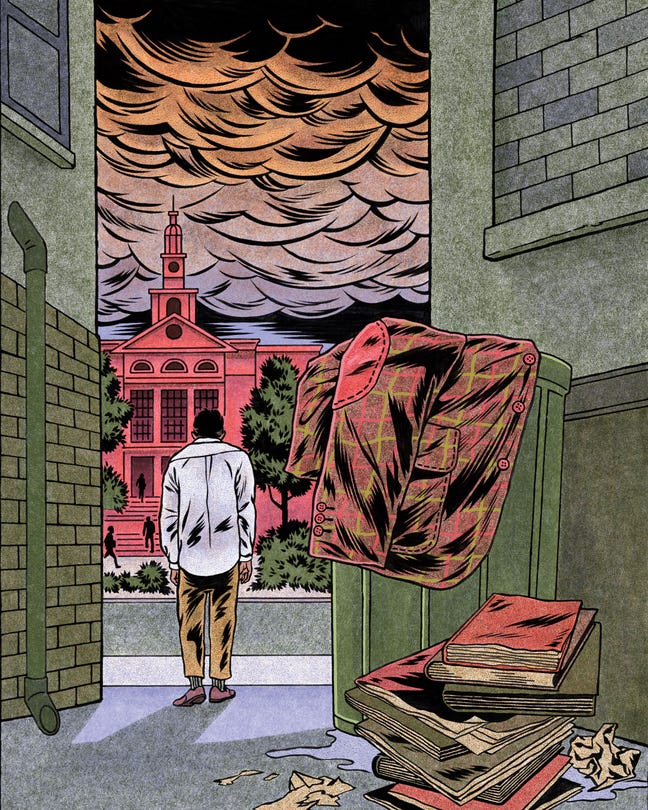
All of this social-justice rhetoric also felt wildly hypocritical. The same October day that the dean promised to abolish “retardants to progress”—including classism—adjunct faculty and staff announced that they were starting a union drive, citing “low pay, and poor working conditions at the college.” The union was intended to be “wall-to-wall,” meaning that it would include not just non-tenure-track faculty but also people working in facilities, the dining hall, and other nonacademic roles on campus. The administration’s skulduggery started almost immediately.
My colleague Tyler Austin Harper has written about realizing that he was the “token black professor” at an American college. His argument is that Woke 1.0 (as we’re apparently now calling it) became a great excuse for corporate hierarchies to quash basic labor activism while posturing as good people. The whole model of universities is incredibly creaky, between underpaid, insecurely employed staff and students racking up debt to send in AI-generated work. I hope someone fixes it.
A friend resurfaced this essay by the great Leigh Stein on her time moderating “Binders Full of Women,” a big and notoriously fraught Facebook group for female writers. I laughed with bitter recognition when it got to the bit about her conference being criticized online for not providing on-site childcare, and how she tried to set up a working group to discover if the community as a whole wanted that. Surprise! “No one volunteered.”
The former BBC staffer Robin Lustig on Rod Liddle: “He was not a fearless satirist but someone who never outgrew his days as a child who delighted in telling fart jokes.” (Substack)
This parody of bad modernized Shakespeare has been beamed onto the internet directly from my brain. Ooh look, you’ve redone someone getting a letter with the swoosh of a text message? Should we have a party? Should we invite Bella Hadid?
DRAG THEM HUGO: loved this column by Hugo Rifkind about how all the climate change sceptics have shut the f*** up and slunk away now we’re all broiling in our beds from May to September every year. I mean, I do like how Jeremy Clarkson notes how a new “fluke” bit of weather has ruined his harvest in every season of Clarkson’s Farm, but equally he was a key proponent of the “go away Greta you buzzkill” tendency. (Times, £)
PS. I’ll be in New York in September for The Atlantic Festival, which has a line-up so starry it’s almost embarrassing: tickets here. While I’m there, Jesse and I are doing a low-key Special Relationship event at the Comedy Cellar on Tuesday 22 September. (He nearly accidentally scheduled this for Yom Kippur, but then caught it in time.)
No posts
Comments
Nothing yet. Say the first thing.
Sign in to join the conversation.