
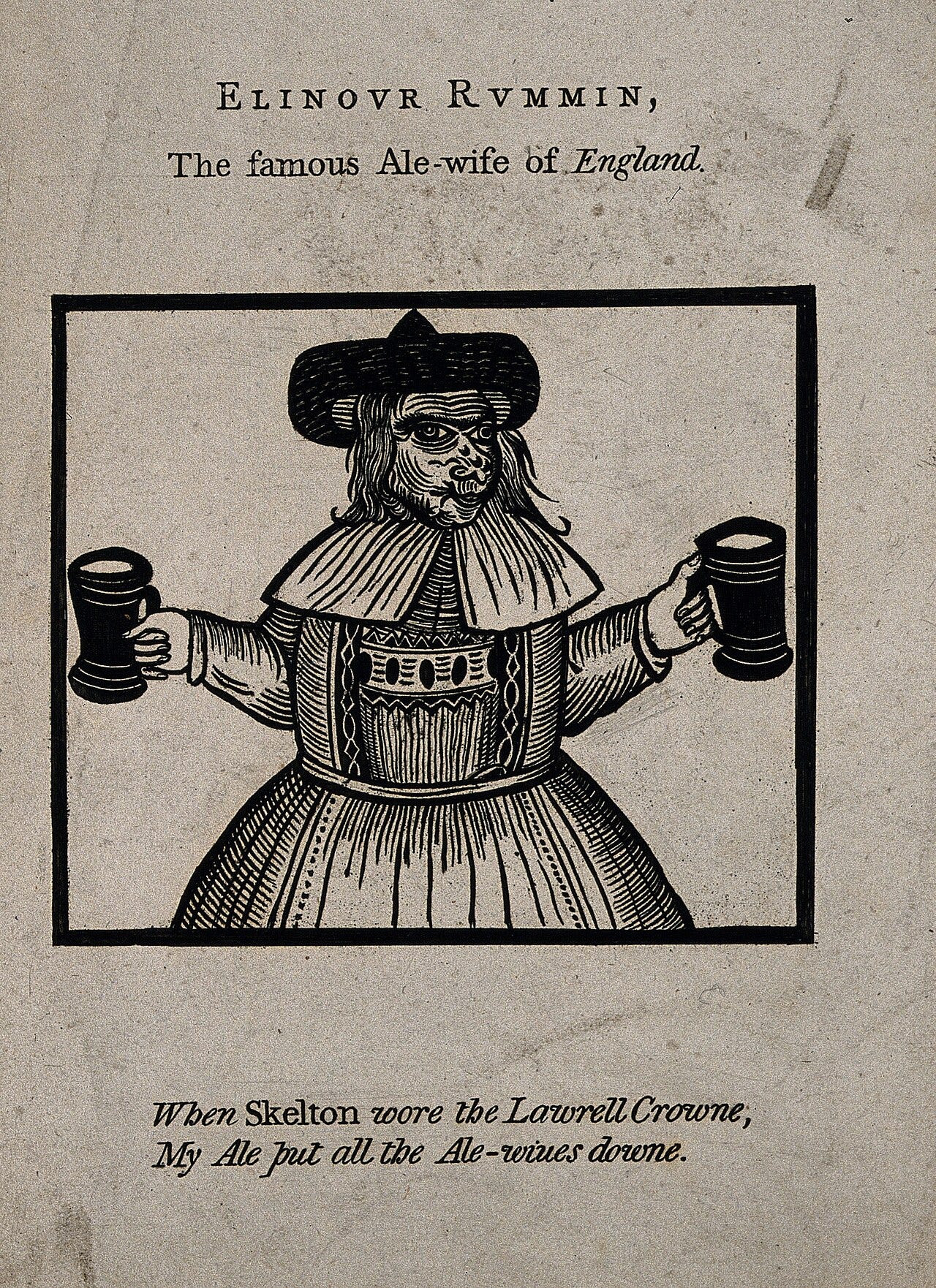
(This line-engraving is in the Wellcome Library)
Text within this block will maintain its original spacing when published
How to Construct an Ale Witch
She is a tonnysh gyb;
The devyll and she be syb.
	from John Skelton The Tunning of Elenor Rumming 1545
Assemble the materials
to fabricate a crooked alewife hat;
spring scissors, wire, dark cloth.
Build it high enough
to spot her in the marketplace.
Why make it difficult, Gentlemen?
Now rootle out the mouser
that stalks her barley store.
Harken how she calls to it
in that unchristian tongue?
Overturn the cauldron
and let her midden burn.
She is the very screech owl
that hunts inside the rookery heads
of all the King’s fine men.
Prepare yourself a godly brew
free of rabbit scut and bad magic;
build your factories, count your coins.
I thought this week I would share the first poem I wrote which led to the building of the manuscript for Constructing a Witch . Like much of my work, it is based on research. I became focused on the idea of the construction of the visual elements of the witch archetype – the hat, the cauldron, the broomstick, the cat – and wanted to trace back where they originated. I always need to get to the root of things – such heavy signifiers don’t just spring up from the imagination alone.
One of the theories about the pointed hat is that it came from market sellers such as the ‘alewife’, also known as an ‘alewitch’ who would wear a tall hat in order to be spotted in a crowded marketplace. Dating back to Ancient Mesopotamia, women were the original ‘Brewsters’, indeed one of the characters in The Epic of Gilgamesh is an alewife. Until The Black Death, in England women produced and sold most of the domestic and commercial ale. Ale was a way of making water clean enough to drink, so was consumed on a daily basis; ale-making was a very lucrative business.
The Commercialisation and Industrialisation of the brewing trade saw to the falling away of unmarried female Brewsters. Judith M Bennett’s Misogyny, Popular Culture, and Women's Work (History Workshop Journal, 1999) notes that in 1540, the city of Chester ordered that no women between the ages of 14 and 40 would be permitted to sell ale, in the hopes of limiting the trade to only women above or below an age of what was considered sexual desirability. (*sigh*) Alewives were accused of being disobedient to their husbands, sexually deviant, but also frequently cheating their customers with watered-down ale at high prices.
The Skelton poem I quoted in How to Construct an Ale Witch was the slanderous, misogynistic damning of Eleanor Rumming, one of the leading Brewsters of the time who was accused of some of the above (her husband who she was in business with, wasn’t accused of anything ). The lines I thought would work for the poem refer to her being a ‘tonnysh gyb’ – ‘tonnysh’ meaning shaped like a barrel. The word ‘gyb’ might refer to an ‘old cat’. And the second line calls her the devil’s sibling. The Devil comes up a lot when talking about witches. More of him and his workings in later postings.
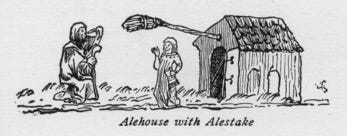
The broomstick could be traced back to the ‘alestake’, pictured below. I mean, look at it! This was placed outside to indicate a fresh batch of ale had just been brewed. A cauldron is used to boil wort, which is the liquid extracted from the mashing process in brewing beer. And the cat – of course you would need a mouser if you had a barley store. All these things are simple facts, but as we have seen, can be manipulated should you have a mind for monstering and othering women. And in this case, taking away their financial independence.
There is so much I could say about this whole subject, but I am not an academic. I lack the rigour and memory for detail. See how this piece is not footnoted! I did a Cultural Studies Degree, and although I was ok at the essays, I was always much more alive to how my creativity and imagination is fed by the compost of research. I am often researching for days to write eighteen lines like this. I always think of it as making marmalade, or in this case, let’s say beer. All that process to fill a single glass. I used to feel quite despondent if I’d been reading all day and had nothing to show for it, poem-wise. Now I trust that my brain is working it all out for me somewhere behind the scenes.
Text within this block will maintain its original spacing when published
No posts
Comments
Nothing yet. Say the first thing.
Sign in to join the conversation.