
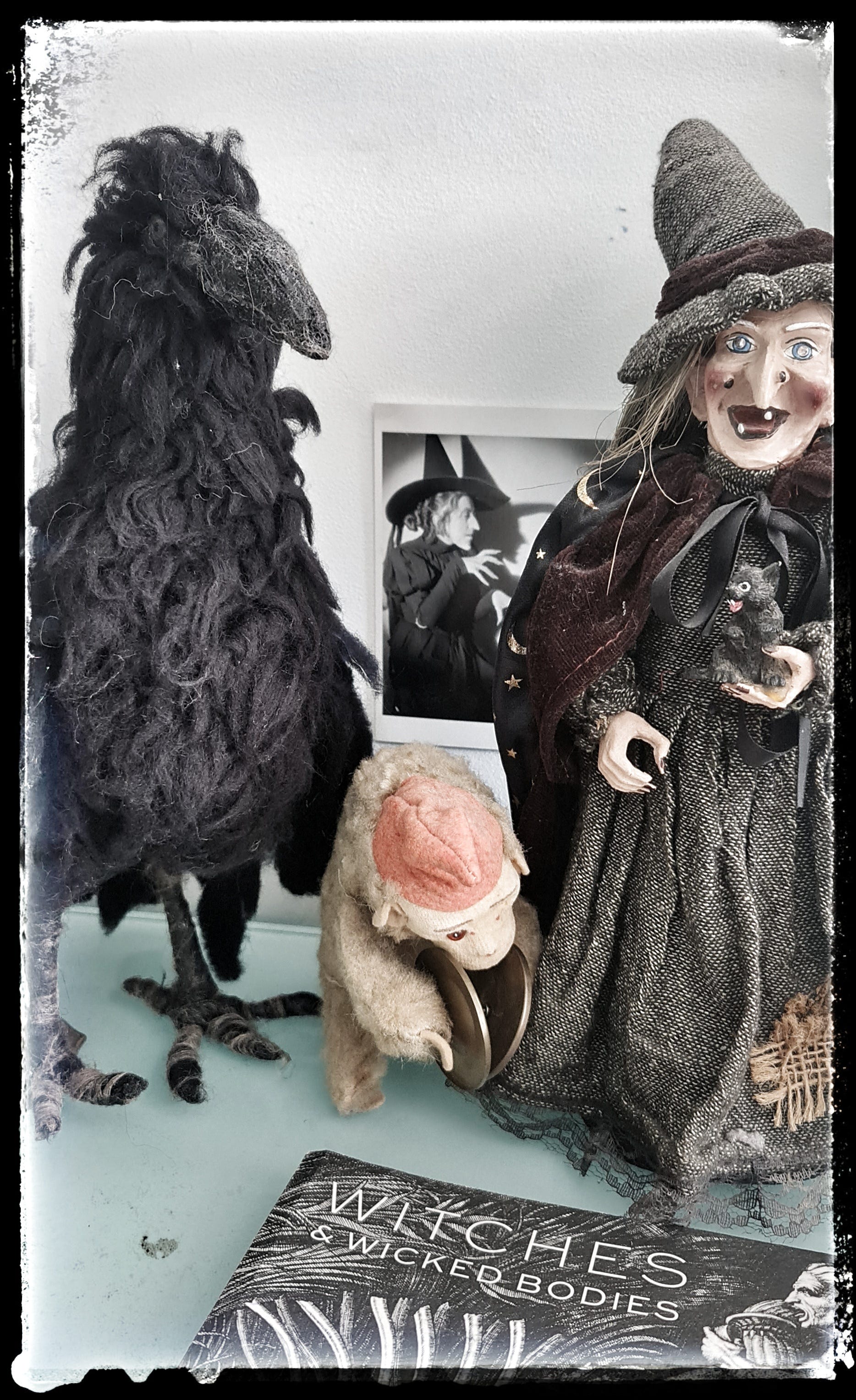
One of my paths through the forest while researching Constructing a Witch was interpretations of the witch in film. The witchiest witch of my childhood was the Wicked Witch of the West - that epitome of alliterative evil. I grew up watching MGM’s 1939 film interpretation of L Frank Baum’s The Wonderful Wizard of Oz. She of the green skin, broomstick, pointy hat (nose and chin) and riotous cackle, is played by Margaret Hamilton and ranked by the American Film Institute as Hollywood's fourth-greatest villain of all time, behind Hannibal Lector, Norman Bates and Darth Vader. Character actor Hamilton was in her mid thirties when she played the ugly old witch, a role that defined the rest of the career. Until her death at 85, she was still receiving fan mail from people around the world. Hamilton herself was by all accounts lovely and not in the least wicked.
I became interested in what constitutes polarities in the film. The opposite of the gleeful Wicked Witch of the West is the Glinda the Good Witch, played by Broadway and radio actor Billie Burke. Glinda is all pink and, well, good. The wand, the crown, the big dress . . . in the film she is basically a fairy princess. She is the more presentable side of femininity, whereas everything about the Wicked Witch is physical and raucous. Think of how they get about the place - the green skinned one straddles a broomstick (she does not go side-saddle), and the pink gentle one arrives, ladylike, alighting from a bubble. Now think of how they get things done - Glinda uses her wand as an extension of her body, whereas the Wicked Witch manifests things with her voice and with gestures. Her power emanates from her wicked body.
Fear of the female body and the demonisation of the female body is found across many texts. Its mutability and leakiness have all been elements of suspicion. In the Bible she is considered the weaker vessel, therefore easy access for the Devil and his workings. In The Wizard of Oz there is also mention of the wicked one as old - I’ll explore the fear of the female body and particular of ageing femininity in a future post. In my photograph here I’ve included Wicked Bodies, the catalogue from the 2018 National Galleries of Scotland exhibition of the same name, which is introduced by Deanna Petherbridge. It focuses on the representation of women and the enduring stereotypes they embody. The older grotesque hags all ready to corrupt the younger fecund maidens, the beautiful seductresses set on luring men to their death - it’s all here!
As a child I was scared of the Wicked Witch of the West and her familiars - those flying monkeys and the wolves who did her bidding. Of course I was - the polarities were set, it was clear who the baddies and the goodies were and how that was supposed to make me feel. When I first started to have any kind of style as a teenager though, I veered towards Goth and to be honest, it’s still in my bones now. Always the black fishnet tights rather than the frou-frou pink dress. And powering along on a broomstick always looks much more fun than wafting around in a bubble, doesn’t it? Did Glinda truly give herself over to laughter? Anyway, I digress.
Gregory McGuires's Wicked , a revisionist novel, takes on these two characters and explores the nature of evil. He describes the book in interview as "a cautionary tale . . . about what happens when we as a society decide to label anyone who differs from the norm as evil." He gives the green-skinned woman a name - Elphaba, and also a backstory, which immediately positions her as a person and not an archetype. If you haven’t read the book, you may have seen the musical or film, and possibly have Defying Gravity looping through your head as I do right now.
I could write a lot more about all of this, but I will spare you the time. Instead, here is the poem . . .
Text within this block will maintain its original spacing when published
Only Bad Witches are Ugly
Glinda the Good The Wizard of Oz (1939)
Do you light from the skies in the blush of a bubble
your gown all glamoured with stars,
or does the earth spew you forth in a retch of red smoke?
Are you more peaches and cream or frog in a quagmire;
opiate stoned in a cradle of poppies
or rattled awake in the dash of a blizzard?
Are you gooder than good in a basket of good
unbinding the bad with your charming white wand,
or is your scandalous body the root of your power?
Are you a good witch, or are you a bad witch?
Before I go, here are a couple of notes: a glamour is a spell which affects vision; a charm is an incantation or an object with magical power.
Now it only remains to leave the last word to the Wicked Witch of the West . . . ‘Going so soon? I wouldn't hear of it. Why my little party's just beginning.’ *cackle*
No posts
Comments
Nothing yet. Say the first thing.
Sign in to join the conversation.