
I am in hospice care and reflecting a lot on what a good life is. Writing is hard, this will take me days rather than just one morning or afternoon. But I want to share these thoughts. You can’t take it with you, yet we often feel ourselves immortal and act as if we can.
The richest man on earth is not happy yet he can buy and do whatever he wants. When we cherish people of the past they were not particularly wealthy. Marie Curie, Vincent Van Gogh, our wise grandmother … we love these people because of what they left us. Not because of what they had.
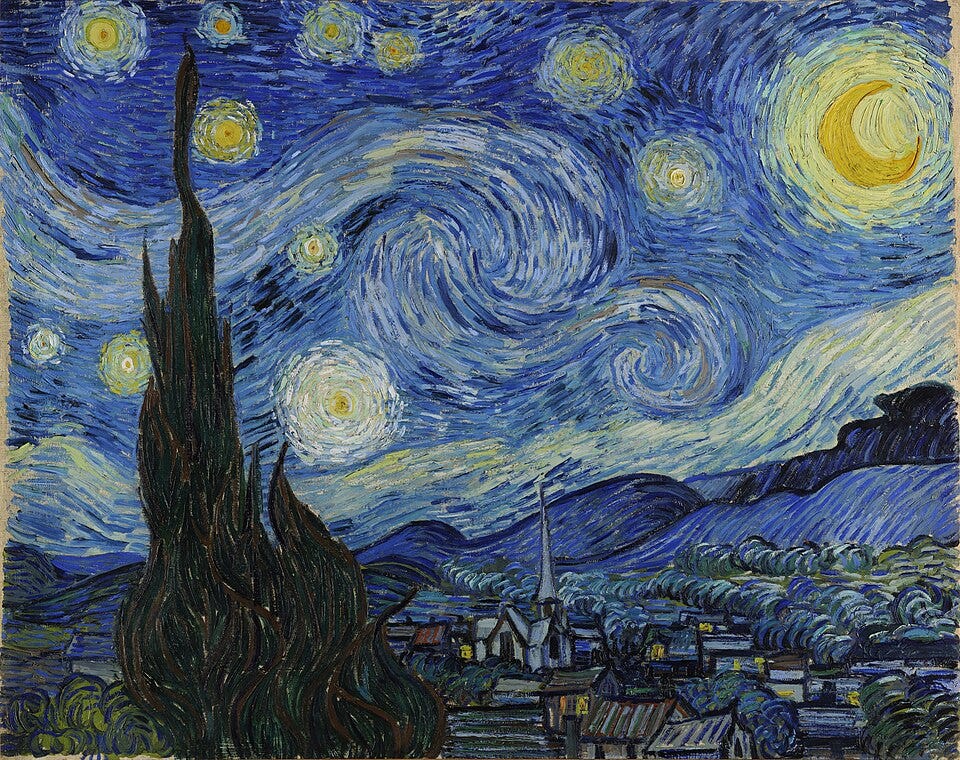
I remember seeing Van Gogh’s Starry Night in Moma three years ago and being profoundly moved. I had seen so many reproductions, of course, but the original moved me in a way no reproduction could have prepared me for. Yet Van Gogh was in an asylum, deeply unhappy, depressed and working in bouts of frenzied productivity. He saw the sky through the window of the room he was confined in. We certainly wouldn’t say Van Gogh had a flourishing, eudaimonic life. But he contributes to our flourishing. At least, he did to mine, on my first trip after the height of pandemic when I saw his painting live in 2022.
At funerals and other occasions we also notice that we cherish others for their quirks. Someone, say a recently deceased can be remembered as kind and loving, but also: he loved fishing and was a great Cardinals fan. It seems puzzling that being a sports fan contributes to someone’s virtue. But it does, because that was part of what made him who he is. Mark Alfano has done systematic studies on this by looking at obituaries and they show that the surviving relatives seem to think being a sports fan is a virtue. As is being a dancer or birder.

Susan Wolf already remarked in Moral saints that a perfectly moral being who would always act to help others would be boring. Such a person would not have hobbies or quirks. It’s all time that could be spent better. Yet, somehow these are valued and we love them in others. This intuition bolsters the idea that having projects and passions can be a virtue. But how?
Audre Lorde and Spinoza helped me to see that being a good person means flourishing in many domains. Lorde saw herself as a poet foremost, as Caleb Ward explains in his monograph on Lorde (in progress). But she was also a Black woman, a mother, an activist, and a lesbian (“a woman who loves other women” as she called it). She insisted on being recognised in all her dimensions.
Spinoza counterintuitively argued for an ethical egoism in Ethics. He says we need to benefit ourselves. But our selves are in his picture finite expressions of God. And in our limited way, we can be perfect. Becoming very rich, powerful or prestigious is not benefiting yourself because these are empty goods in his view. This explains why the richest man on earth is not happy and keeps on seeking validation. Also why this Turkish musician is probably happier living in relative simplicity.
Pursuing empty goods of prestige, honor you become anxious because, for instance, prestige is dependent on what others think of you. It is exhausting, hence Spinoza decided that he didn’t care of what others thought of him. And we still value his work for that.
Instead, you benefit yourself by expressing yourself as a full being, as a rose bush that flowers fully. People also delight in you. We delight in say, Lin Manuel Miranda’s work to bring us beautiful music. But even if you do not “produce” something, eg as a birder who just likes to watch birds, it is still something people value in you. That is because Spinozist full expression of yourself is virtuous. Spinoza also emphasized that you should not harm others in your pursuits. Do the things you love for yourself and your loved ones will find something good you left behind. I play the lute. I know, even though I am a mediocre player, that people value this in me.
This is more than just appreciating well roundedness in others. We see these quirks and passions as absolutely central to someone. It is something we can treasure long after they are gone.
—-
Note: lots of thoughts recur in this older piece but my thinking has evolved to see our passions for certain things and cultivating skills like dancing and poetry as virtuous. Obviously MacIntyre is in my head too but that would require a longer piece
No posts
Comments
Nothing yet. Say the first thing.
Sign in to join the conversation.