
I’ve made no attempt to hide the fact that AI runs my life. At least the admin, heavy-lifting side of my life.
Let me give you some context. In the last three weeks my agenda has looked like this:
Dublin - 4 days
London - 3 days
Paris - 1 day
London - 2 days
Home - 2 days
Manchester - 2 days
Madrid - 4 days
That’s a lot of travel, a lot of meetings, a lot of hotels, a lot of coffees and a lot of people. All co-ordinated by AI agents.
18 months ago, this schedule would have sent me into a tail-spin. Honestly, the travel is one of the reasons I need to take a sabbatical from venture capital. I couldn’t handle the pace of meetings at work and manage my life at home too.
Enter ChatGPT stage left.
By late 2023 and all through 2024 I was obsessively building AI-powered workflows. By the start of 2025 I actually started to see a world in which I could replace myself with AI. I was building custom-assistants and connecting them with Zapier to create AI automations on a huge scale.
Then in September 2025, things kicked up a notch when AI agents had progressed enough that I was happy to start using them every day. Even better when they lived inside an operating system I was already using to run my business - Notion.
It’s no exaggeration when I say AI has changed my life, the way I work and my capacity to work.
And most importantly, it gives me enough time and breathing room to be where I can’t be replaced. That just wouldn’t be possible without AI agents.
But when you read about AI agents online, you know, to actually build them in a useful way that has an impact, not a tech-bro, jargon confusing way that makes no sense and sounds like it didn’t even really need AI to do it and just creates more work way. You know? Anyway, when you read about AI agents online it seems like no one can actually agree what they are, how to build them or their use cases.
So to remedy that, what follows is my beginner’s guide to AI agents. This piece is based purely on my personal experience and perspective as someone who uses this technology every day.
I’m not a developer. I don’t have a computer science degree. But I do work in tech. I invest in tech and I’ve been in start-ups for the best part of two decades. You’ll find no fluff or technical jargon here and I hope to explain everything as clearly and succinctly as possible for complete beginners.
Ok let’s get into it…
Depending on who you ask, an agent is either a glorified chatbot, a workflow with a bit of AI bolted on, or a fully autonomous digital employee capable of running your business.
“AI agent” has become one of those terms that marketing departments love because it sounds futuristic. If you’ve already got AI inside your product, calling it an assistant suddenly feels a bit 2023. Call it an agent instead and it sounds like you’ve shipped the future.
The result is that we’ve reached the point where two completely different products can both describe themselves as AI agents, despite sharing almost nothing in common.
If you’re confused, you’re not the problem.
An AI agent is software that is given a goal rather than a list of instructions. It decides how to achieve that goal, uses whatever tools it has access to and keeps working until the task is complete or it needs your input.
That probably sounds a little abstract, so let’s compare it to something almost everyone has already used.
Imagine you open ChatGPT, copy in a transcript (that you had to convert yourself from a call recording) and type:
“Write me a follow-up email after today’s client meeting with the actions”
ChatGPT writes the email.
Job done.
Now imagine you ask an AI agent to do the same thing.
Instead of simply writing an email, it knows when the meeting finished, opens your meeting notes and grabs the call transcript, identifies the decisions that were made, extracts every action point, creates tasks for you or your team inside Notion, drafts the follow-up email, updates your CRM to show the meeting has taken place and then asks whether you’d like it to send the follow-up email.
Same objective but completely different level of capability.
Personally, I think the simplest way to think about AI agents is that they don’t just generate information — they actually do something with it.
One of the biggest mistakes I see people making is assuming that an AI agent is simply a more intelligent chatbot. It isn’t. In fact, intelligence is only one small part of the picture.
An AI agent is really made up of several different components working together.
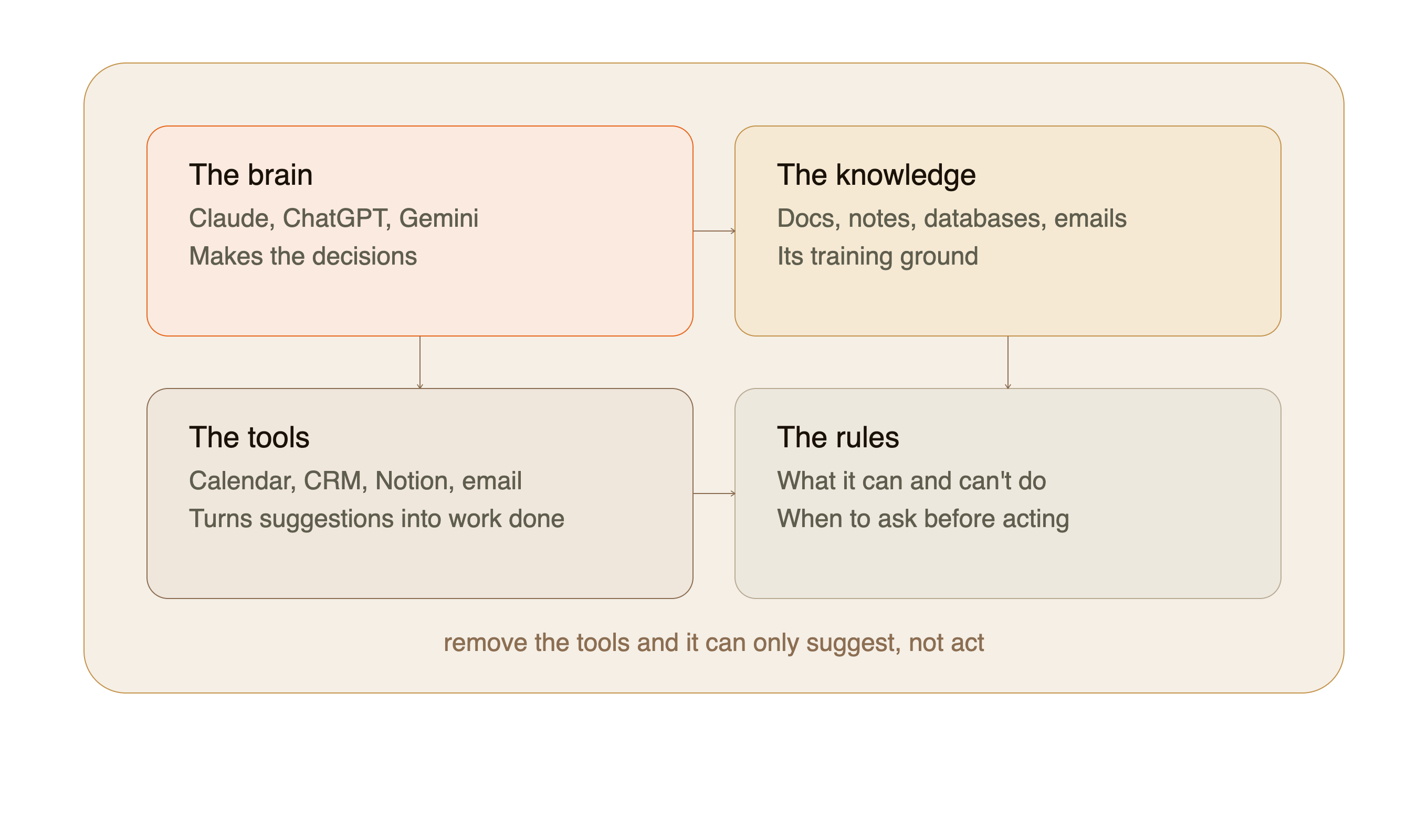
There’s the language model itself. That’s the “brain”. ChatGPT, Claude or Gemini might sit underneath the surface making decisions and generating text.
Then there’s the knowledge it has access to. Your documents. Your meeting notes. Your databases. Your emails. This is its training ground where it learns how to do what you want it to do.
Then there are the tools. Can it search your calendar? Update your CRM? Create a page in Notion? Send an email? Without tools, an agent can only make suggestions. With tools, it can actually complete work. For me, I have agents both in Claude and then inside Notion, so the tool and the AI agent are one and the same.
Finally, there are the rules you’ve given it. What it’s allowed to do, what it should never do and when it should ask for human approval instead of making a decision itself.
One of the easiest ways to understand AI agents is by comparing them to the tools you probably already use.
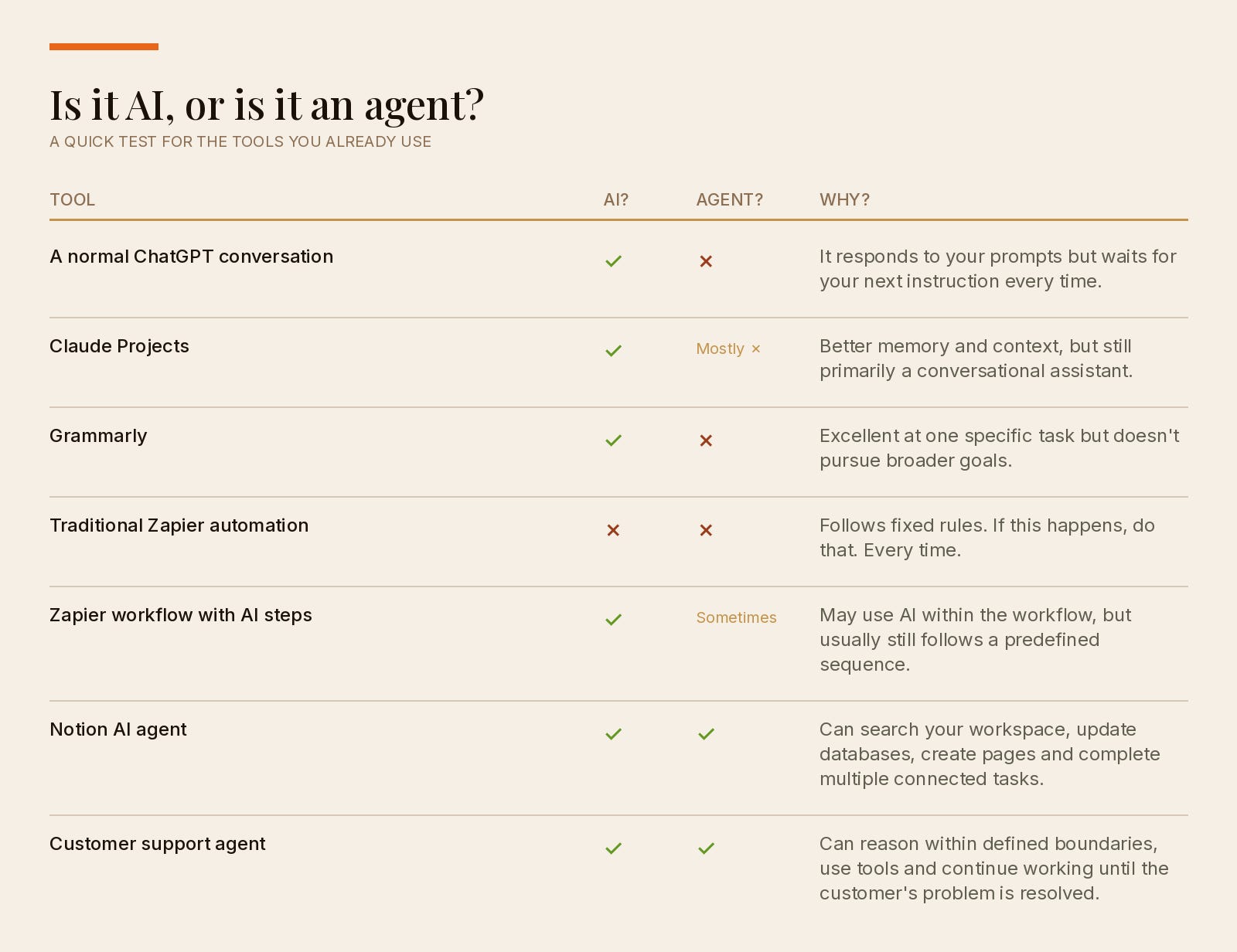
These definitions and context matter because people often use automation and agent interchangeably but they’re not the same thing.
An automation follows instructions. An agent pursues an outcome.
Another way to think about it is like this: imagine I asked AI to bake a cake.
An automation would faithfully follow the recipe I’d already written. Whereas an agent would notice we’d run out of eggs, add them to the shopping list, suggest a substitute if the supermarket was closed and adjust the recipe accordingly.
One of the reasons I think all of this can feel overwhelming is that often articles or videos will often assume you already know the terminology. So before I share any more I thought it would be useful to share a list of definitions that you can refer back to.
AI Chat
Software that responds to your prompts but generally waits for instructions before doing anything else. This is traditional chat windows with ChatGPT, Claude, Gemini et.al.
AI Agent
Software that works towards a goal, makes decisions within defined boundaries and can use tools to complete work.
Large Language Model (LLM)
The underlying AI model, such as ChatGPT, Claude or Gemini, that powers many assistants and agents.
Automation
A predefined sequence of actions that runs the same way every time.
Workflow
A series of connected automations or processes designed to complete a larger task.
Tool Calling
The ability for an AI model to interact with other software, such as your calendar, email or Notion workspace.
Memory
Information the AI remembers either during a conversation or across multiple interactions.
Knowledge Base
The documents, databases and information an AI agent can access that form its training so it knows what good looks like, but also can access information to complete tasks.
Context Window
The amount of information an AI model can consider at one time.
API
The mechanism that allows different pieces of software to communicate with one another.
MCP (Model Context Protocol)
A standardised way of giving AI models access to external tools and information without every integration needing to be built from scratch.
Guardrails
The rules and permissions that define what an agent is and isn’t allowed to do.
I know you want to believe that using AI agents means you have a set-up that suddenly looks like something from the Matrix and life is suddenly going to look like a sci-fi movie but the reality is that AI agents are good at something much more mundane, and in my opinion, more useful.
Admin.
The biggest productivity gains I’ve seen have come from completely removing all admin from my life. Every repetitive task. All the repetitive jobs that happen around the edges of knowledge work (the stuff that requires me and my brain).
I wrote recently about my most used AI agent in Notion which follows up on all my calls, adds the actions to my to-do list and drafts the follow up email all by clicking one button.
If you’re interested you can see the walkthrough of how I built it here
Other agents I have running to name a few:
Planning my week and reallocating tasks based on workload
Arranging travel plans, searching for hotels, suggesting flights and pulling itineraries
Organising my calendar and meetings when I travel to maximise the efficiency of the trip
Taking a first pass on investor decks I receive and ranking opportunities according to my investment criteria
Pulling a news and industry digest reading list each week so I can stay on top of what is happening in the industries I work in
None of those jobs are difficult, they’re just repetitive. And repetitive work is exactly where AI tends to shine.
I don’t think the future looks like one super-intelligent AI employee replacing your entire team.
If anything, I think it’ll be the opposite. Most of us will end up with a dozen or so very boring agents working in the background.
One organises meeting notes. One manages projects and deadlines. One prepares research. One keeps your CRM up to date. One on-boards new clients.
Individually, none of them are particularly exciting. But collectively, they remove hours of work every single week.
And I suspect that’s how AI will become part of everyday life. Not through one dramatic moment where everything changes overnight, but through hundreds of tiny improvements that gradually become impossible to imagine working without.
If you don’t have any AI agents up, running, and crucially, working for you then start by listing out all of your repetitive tasks. Literally write out everything you do more than once that happens in the same way every time.
Then allocate a time estimate to each one.
Start by building something that is AI agent worthy (i.e. not an automation workflow), that saves you the most amount of time. For most people it’s all the admin. The stuff you push to the bottom of the list each day. Everything that sucks away your energy and time. Meeting follow-ups, client on-boarding, meeting agendas, drafting proposals after sales calls…
I’d also recommend you start using Notion to run all of this. Honestly because it is the best solution on the market at the moment that will enable you to have a digital home for everything you are doing and native integration of AI agents.
If you’ve not read my beginner’s guide to setting up your life in Notion that’s your next read.
Your homework — don’t make this just another article you save and never actually do anything with. Let me know what you’re going to try and build for yourself first in the comments and then block time in your calendar to actually go and do it!
Remember if you want a step-by-step walk through of how I built my notion meeting follow up agent you can read that and what the tutorials here >>
Thanks for reading Really Rich! This post is public so feel free to share it.
No posts
Comments
Nothing yet. Say the first thing.
Sign in to join the conversation.