
“Seek truth from facts” is an ancient Chinese expression. So, let’s look at the factual timeline of our 2026 war with Iran.
28 February: America and Israel start the war. Iran counterattacks, stopping all shipping through the Straits of Hormuz.
6 March: President Trump declares on Truth Social, “There will be no deal with Iran except unconditional surrender.”
27 March: Iran’s ruling IRGC declares the Strait of Hormuz closed to all shipping to and from ports of the US, Israel, or their allies. Other shipping would be subject to Iranian tolls in exchange for safe passage.
5 April: President Trump posts his frustration on Truth Social, “Open the Fuckin’ Strait, you crazy bastards, or you’ll be living in hell.”
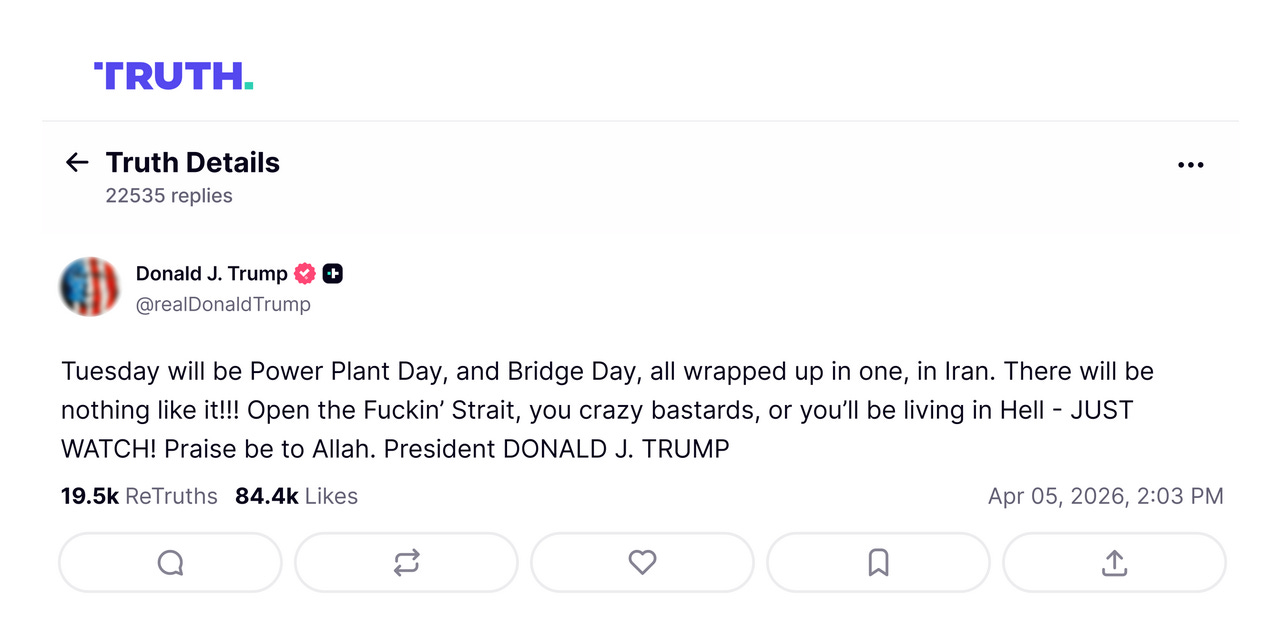
7 April: President Trump abruptly changes course and declares a cease fire. The next day, the conservative Wall Street Journal publishes a critical editorial entitled Trump Declares Premature Victory in Iran. It begins, “Did the war with Iran that began with a roar end with a whimper? That is the way it looks in the cold light on Wednesday after President Trump’s announcement late Tuesday of a two-week cease fire.”
13 April: The US Navy imposes a blockade of Iranian ports in retaliation for the IRGC ban on shipping to and from our ports. As a result, all shipping through the Straits of Hormuz stops again.
13 April-early June: A standoff ensues. Iran suffers far more than America does. According to the Wall Street Journal, abundant strategic oil reserves, alternative oil supplies, and the AI boom mitigates the impact on the US. The President confidently dismisses the domestic financial impact and emphasizes that his only focus is preventing Iran from getting a nuclear weapon.
14 June: In a stunning about face on the President’s birthday, the US and Iran agree to a Memorandum of Understanding (MOU) to end the war.
15 June: The conservative Wall Street Journal again publishes a critical editorial entitled, Trump Stages an Iran Retreat. It begins, “President Trump is touting his latest cease-fire deal with Iran as peace in our time, but the world is more likely to see it as a strategic retreat short of achieving his war aims.”
17 June: President Trump defends the MOU, saying that he wanted to avoid an “economic catastrophe” that could have resulted if the conflict we started had continued.
A Calm Assessment of These Facts
In February, President Trump dismissed warnings that the Iranians might close off the Strait because he expected their government to collapse in a matter of days. He publicly stated that he thought it would be like Venezuela. This was a grievous misjudgment on his part.
The President declared a cease-fire on 7 April because the US military had depleted their stockpiles of Tomahawk and Patriot missiles beyond prudent levels necessary to deter other threats around the globe, particularly in Asia.
Imposing the US naval blockade a week later was an improvisation but a very smart one. Hats off to whomever recognized that time was on our side. In May, the President was rightfully confident that America could bear moderate economic pain much longer than Iran could bear severe economic pain.
But as his 80th birthday approached in June, the President seemed to panic. He agreed to the MOU, walked away from the blockade which was working, and got less than President Obama got in 2015 on the nuclear front.
On 17 June, he tried to defend the MOU as something America needed to avoid “economic catastrophe” But in an 18 June editorial entitled Trump Explains Why He Cut a Deal with Iran, the Wall Street Journal derisively dismisses this argument. It says, “He makes a startling admission of US weakness.”
The Bottom Line
In all my years of faithful service to 7 Presidents from both parties, I’ve never seen anything so incoherent. Dictators as well as Presidents and Prime Ministers around the world see it too. This makes it is a moment of grave peril for America.
For more, please check out my website above.
No posts
Comments
Nothing yet. Say the first thing.
Sign in to join the conversation.