
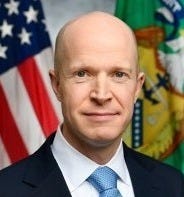
Brian Morrissey is a well-thought-of conservative lawyer. He graduated from Notre Dame Law School in 2007, clerked for Supreme Court Justice Clarence Thomas in 2009-2010, and was nominated by President Trump and confirmed by the Senate as the Treasury Department’s General Counsel in 2025.
On Monday, 18 May, Morrissey abruptly resigned this prestigious post. He has made no comment on why he resigned. However, the timing suggests that he had ethical objections to the settlement agreement announced between President Trump and the Internal Revenue Service.
American citizens should be interested in this case because it provides insights to the ethical challenges faced by government officials serving in the “move fast and break things” atmosphere inside the Trump Administration.
The Backstory
In January 2026, President Trump filed suit against the IRS for illegal leaks of his tax returns during his first term as President. The illegal leaks were committed by an IRS contractor who was convicted in 2023 and is now in jail. In addition, Trump asked for $10 billion in damages from the IRS for the leaks.
The federal judge in Florida hearing the case, Kathleen Williams, was dubious about its legitimacy. For a lawsuit to be legally valid, the parties involved must genuinely be on opposing sides. But in this case, Trump the citizen was suing Trump the sitting President with authority to fire IRS personnel. Williams set a deadline of 20 May for the plaintiffs to present a justification for continuing the case.
Fearing the Judge would throw the case out, Trump’s personal lawyers worked with Trump’s governmental lawyers in the Justice and Treasury Departments, including Morrissey, to find a mutually satisfactory settlement. According to a New York Times report of 12 May, just before the President left for China, the proposed settlement at that time included liberating the President and his relatives from IRS audits of past tax returns.
A settlement agreement was announced by the Justice Department on Monday, 18 May, just after the President returned from China. In it, Trump dropped the demand for $10 billion in exchange for a $1.776 billion “Anti-Weaponization Fund” which would not benefit the President directly. It was signed by Trump’s personal lawyers, a Justice Department lawyer, and witnessed by the “CEO” of the IRS (1).
Later that day, somebody told Acting Attorney General Todd Blanche that the agreed upon settlement neglected to include liberation of the President and his relatives from tax audits. Blanche’s subsequent decision to expand the settlement to include Trump’s tax audits was apparently the straw that broke Morrissey’s back and he abruptly resigned that evening.
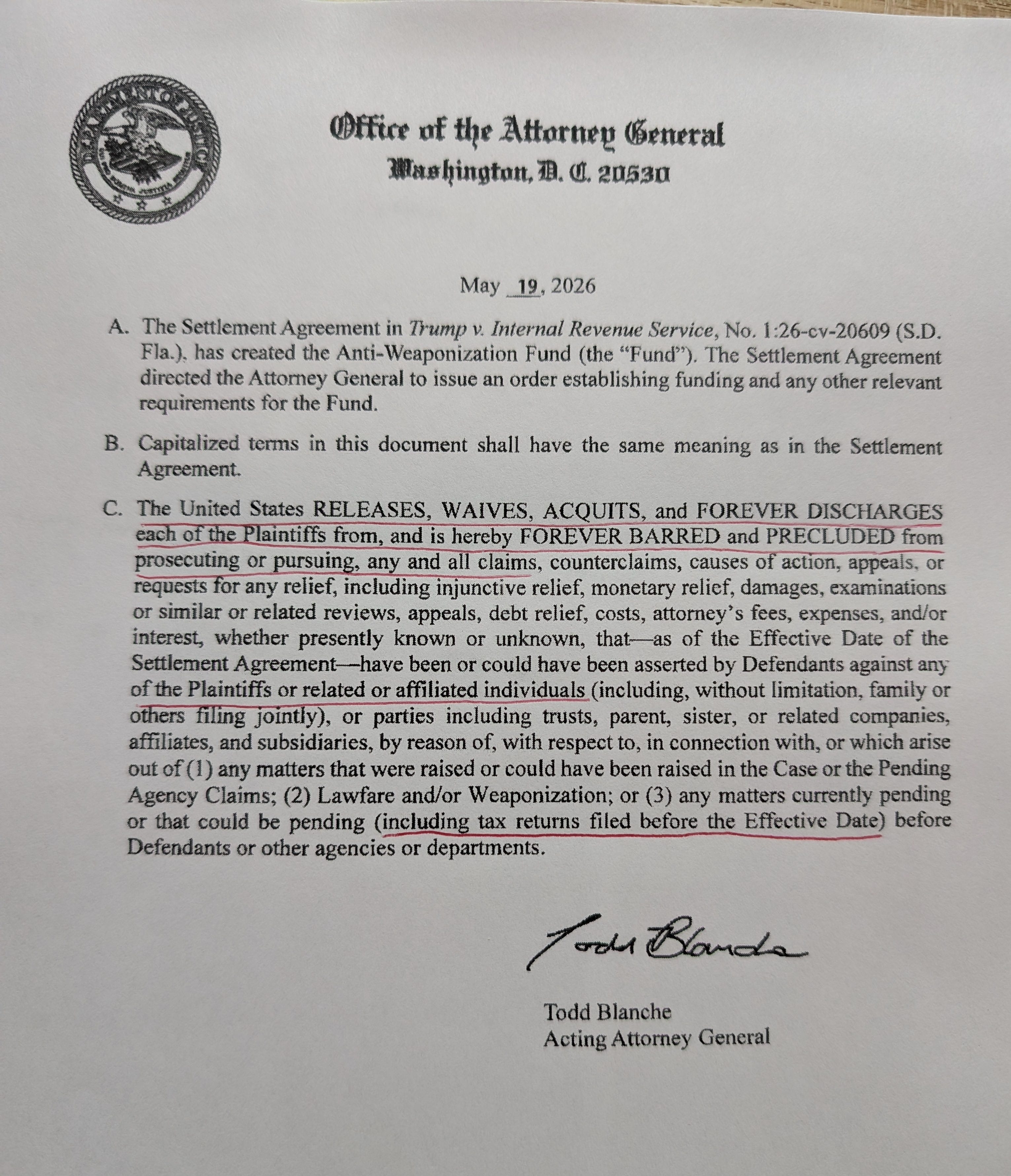
The Justice Department issued an unprecedented addendum to the settlement agreement on 19 May at 0750 in the morning which bars the IRS from auditing past tax returns of President Trump or his relatives. The addendum was signed only by Acting Attorney General Blanche. It is dubious whether Blanche has the authority to do this without the specific concurrence of Treasury Secretary Scott Bessent who has authority over the IRS.
Now What?
If allowed to stand, the Blanche addendum would terminate an IRS audit of a $72.9 million tax refund that Trump claimed and received circa 2010. If there was an adverse audit finding, Trump would have to reimburse the government that amount plus pay interest and penalties. His total liability would reach on the order of $100 million.
The ethical question facing Treasury Secretary Bessent as well as Senate Majority leader John Thune is whether to acquiesce in the Blanche addendum. The Honorable Brian Morrissey evidently would not.
(1) President Trump fired his hand-picked IRS Commissioner Billy Long in August 2025 less than 2 months after he was confirmed by the Senate. Instead of nominating a new commissioner for Senate confirmation, the President created the position of IRS Chief Executive Officer and named Frank Bisignano to it. Bisignano is also supposed to fulfill his other responsibilities as the Commissioner of the Social Security Administration. The IRS CEO position has no statutory authority, however, so the busy Treasury Secretary Bessent is the Acting IRS Commissioner as well.
For more, please check out my website above.
No posts
Comments
Nothing yet. Say the first thing.
Sign in to join the conversation.