
I am not talking about the kind of knowledge you get from a textbook, a college course, or a university degree. I have those, and they have given me choices, brought me joy and friendships, and opened my mind to possibilities I perhaps never considered for my career. That kind of knowledge is awesome if you have a dream or a goal that requires formal education.
No, the kind of knowledge I am talking about is the kind you gain from listening to people, engaging in conversation, and opening your mind beyond your own upbringing and worldview.
I love this about Substack.
I love that people respond to articles, disagree, share their opinions, experiences, and emotions. I love that we can choose to engage or not, to be drawn into a discussion or walk away. I love to see how different people express themselves, and which topics upset some and enlighten others.
My goodness, aren’t we a complicated, contradictory, kooky species?
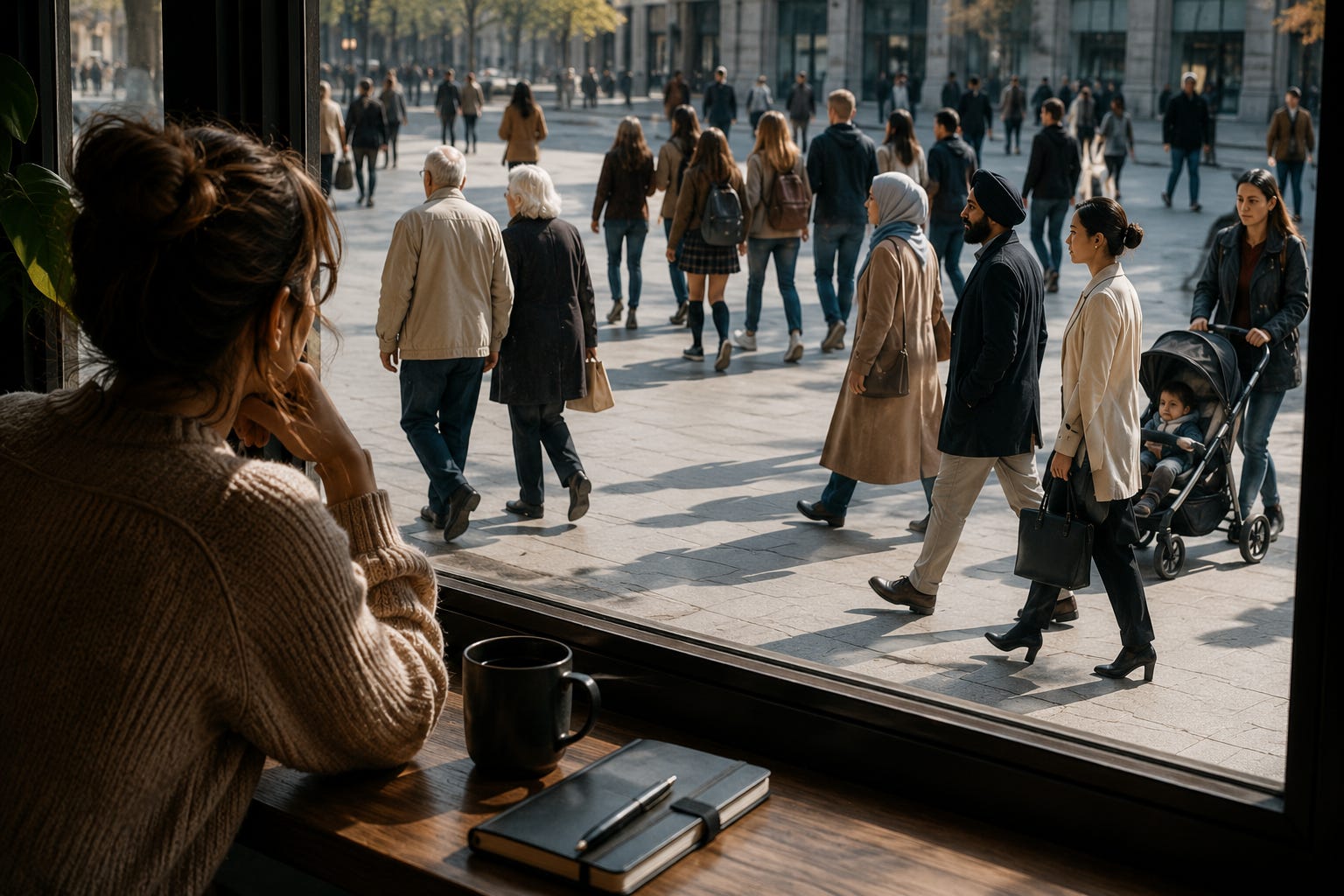
Perhaps that's why I find people so fascinating. For most of our history, humans lived very differently from the way we do today.
The societies we now live in are such a short chapter in our history. For much of our history, humans appear to have lived predominantly in small hunter-gatherer groups, many of which had relatively egalitarian social structures.
Today, we have created monstrous societies requiring cooperation on a mammoth scale. Given our countless differences in personality, opinion, worldview, upbringing, religion, culture, family circumstances and economic inequality, I am amazed we've maintained the level of societal cohesion we have.
How on earth does it work? How are we keeping hold of such a complex beast? I have a theory. I think it is because the majority of humans want societies to work. I think they want to live in a world that is safe, cooperative, and tolerant. And I think they want to be whoever they choose, and to be accepted and included for that choice.
No society on this earth is perfect. Everyone has strengths and weaknesses, and everyone is still a work in progress.
I do not have a rosy view of humanity. I think we have and still do terrible things to each other, and there are many ways of living this life that are incompatible with each other. How the world looks in another hundred years, five hundred, a thousand, is anyone’s guess. Will humans still be here, or will our extinction event have occurred by then? Who knows?
I have carved out a life that I enjoy, writing my books, walking, spending time with my family, and I do not hold to the idea that I can change the world or human nature. But I would like to learn more, think about it more, and understand more. For my books, for my happiness, and for my children.
Finding Substack has been brilliant. So much more rewarding than the quick-scroll dross of other social media platforms. I still enjoy the snapshots of other people’s worlds, the funny reels, the random thoughts, and I am not at all anti any of it.
The world is changing: technology, AI, social media, it’s here to stay, and I say bring it on! Change is necessary, exciting, and inevitable. There is always good and bad that comes with big shifts in the way we live.
Substack, for me, is a way of finding out how people are coping with this change, how they are feeling about it, and how they are making the changes work for them. There is community available when you find the place you fit, alternative ways to look at the world if you are interested in hearing about it, and a multitude of individuals who are bravely sharing their struggles and triumphs.
I’m loving all of it.
The older I get, the less interested I become in winning arguments and the more interested I become in understanding why reasonable people can look at the same world and come away with completely different conclusions. Sometimes that difference comes from personality. Sometimes from childhood. Sometimes from culture, education, religion, or simply the random experiences that shape us. Every conversation has the potential to show me something I hadn't considered before.
And the more people I listen to, the less certain I become that there are simple answers. Perhaps that's what learning really is—not collecting facts, but becoming comfortable with complexity.
Perhaps this is what real knowledge looks like: curiosity, communication, respectful debate, and compassion.
No posts
Comments
Nothing yet. Say the first thing.
Sign in to join the conversation.