
Last week fifty British MPs wrote to the government asking to pull Masha and the Bear from UK platforms. It was a magnificently omnipartisan effort, with supporters from six different parties coming together to support the ban.
The controversy escalated when Mark Galeotti, probably the country’s best-known Russia analyst, published a defense of the show in The Spectator. His case could be summed up as: do you really think a cartoon character will brainwash a generation of British toddlers?
The argument predictably caused a stir on Twitter, with people calling him a vatnik and a Kremlin apologist. Russian state media quickly dubbed Galeotti a martyr of Western censorship, an ironic designation for a man they themselves banned in 2022.
I have two young kids so I have suffered through my share of the show, which pops up practically by default on the junior Netflix channels. But until this controversy I had no idea of its reach. It’s available in forty languages. One of the episodes is the most viewed non-music video in YouTube history, with 4.6 billion views.
Propaganda or not, it’s certainly one of Russia’s most successful cultural exports.
All of which makes the arguments around the show pretty heated, with debates about principles quickly turning into ad hominem attacks. Galeotti is not a Kremlin stooge, and his argument has merit. But that does not justify his sarcastic derision toward his opponents, or his apparent blinders about the moral issues involved.
I can see, in other words, why reasonable people might be dissatisfied with his glib defense.
There are three different objections here, varying in their level of broadness:
Objection 1: The specific content of the show is propaganda.
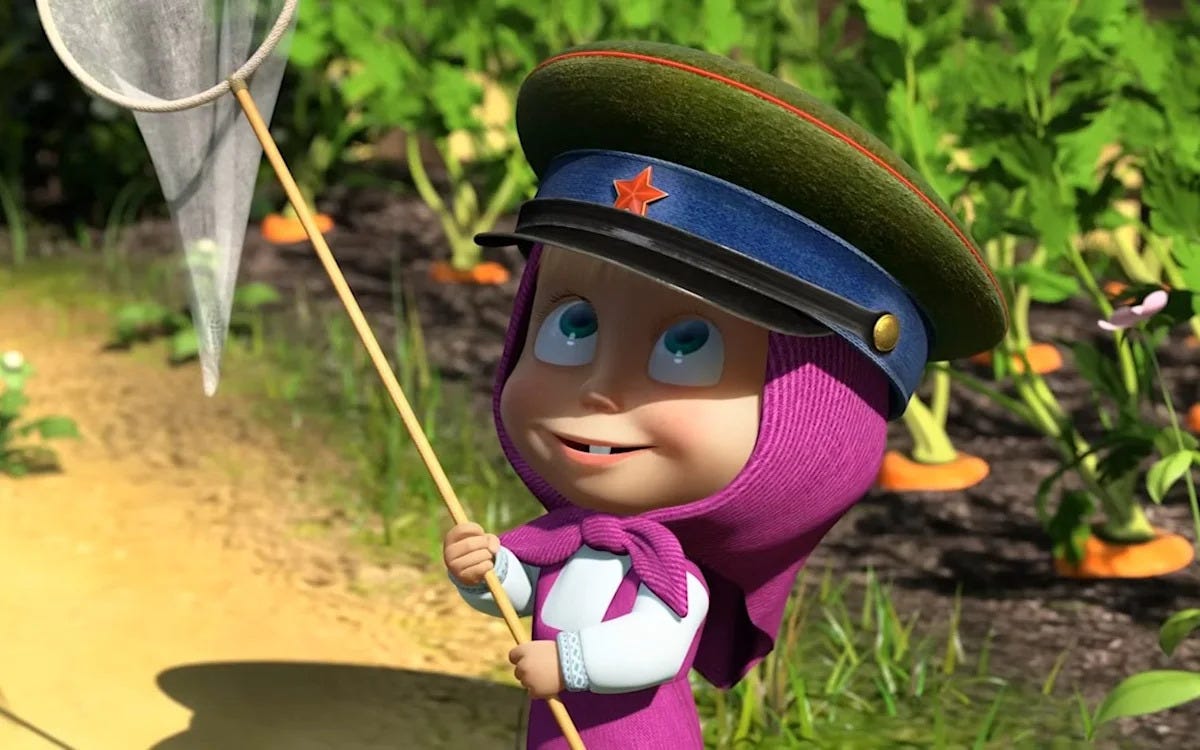
The British MPs cited an early episode in which Masha, guarding the Bear’s vegetable patch, puts on a peaked cap with the blue band and red star of the NKVD, then switches to a tank crew helmet. They noted the NKVD’s execution and deportation of tens of millions of people, many of whom view the organization as the Soviet equivalent of the SS. [edit 07/08/26: I should add that to a Russian audience the green cap would have been immediately legible as a border guard hat, which were organizationally a part of the NKVD, but for the victims and opponents of Soviet occupation the debate is not about the finer points of this insignia.]
Worse, in April 2015, the show’s official social media account ran an ad, since deleted, featuring the character wearing the NKVD-style cap with the caption “Hey, I’m in the army now.” That was about a year after Russia’s invasion of Crimea.
Do these two instances make the show propaganda? I’m not sure. I wouldn’t dismiss them as easily as Galeotti does, gesturing to the cap with mock horror. Children’s shows are not obliged to allude to their country’s secret police. But this one did. Twice. If a German cartoon showed the main character wearing an SS-style cap, but “only” twice, would that be considered sufficiently benign? Or would it be seen, even if not rising to the level of propaganda, at the very least distasteful and not worthy of a full-throated defense?
Objection 2: The show is a fiscal contributor to the war via taxes.
There’s no debate on this point: royalties from the show are taxed by the Russian government. Galeotti himself concedes this. The question is whether that’s enough for a ban.
The problem is that no sanctions regime works this way. After twenty sanctions packages, the EU has embargoed about half of Russia’s pre-war exports and about 60% of its imports. So around half the trade has stayed legal by design. The sanctions target commodities like oil and gas and metals, and deliberately stay away from food, medicine, and normal consumer goods to avoid punishing Russians for their government. Nowhere in any of the twenty packages is there a rule that reads: this product sends tax money to Russia, therefore it should be banned.
[Edit 07/08/26: Matthew C. Klein points out that the sanctions regime is organized around denying Russia export revenue, and the exemptions have to do with domestic tolerance for lost supply, not the avoidance of civilian punishment. Therefore “the only reason *not to* sanction Russian content exports is that doing so would somehow hurt parents in the allies more than it would hurt the Russian war effort.”]
The one big precedent for pulling Russian content off air operates on very different grounds. The EU suspended the broadcasting of RT, Sputnik, and other Russian state media outlets, and the latest package extended the ban to online platforms that replicate their content. (RT’s UK license was revoked in 2022.)
These measures have been justified as countering disinformation, and they target named state broadcasters, not Russian media as a category. To reach Masha through this precedent, you’d have to argue the show functions as state propaganda in the same way RT does. I don’t believe the NKVD cap clears that bar.
Objection 3: The show is an instrument of Russian soft power
The third, broadest argument is moral not legal. The Bear functions as a national symbol of Russia, the show builds warmth toward that symbol via a global preschool audience, and this constitutes a form of regime whitewashing in wartime. Estonia’s foreign minister recently described the show as an element of the Kremlin’s soft power arsenal, embedding pro-Russian and militaristic messaging in children’s entertainment.
I suspect where you land here might be a philosophical position, and one without a clear answer. It’s probably true that a lovable bear shown in 150 countries does more for Russian cultural presence than any ministry could buy. The problem, critics respond, is that the argument does not stop at Masha. Follow it and you end up banning Tchaikovsky, Tolstoy, Chekhov at the National, any work that humanizes the country.
But that’s a little too convenient. The real issue is that Galeotti’s framing smuggles the question onto free-speech terrain, where he wins easily. But the question is not just about censorship. It’s about whether a democracy is obligated to provide a frictionless commercial platform to an aggressor state’s cultural exports during wartime. That’s a moral and political question about complicity and normalization, not just a legal free-speech issue.
And Galeotti’s closing rhetorical move, that the West has erected an Iron Curtain to keep Russians out, is both factually wrong and morally backwards. He writes:
So far, so silly. Yet just as the new iron curtain dividing Russia from the west has been erected not like last time by Moscow, to keep its people in, but by us, to keep them out, so too we are witnessing the emergence of our own fun-hating commissars.
Excuse me? The wall now dividing Russia from the West was built by us? That’s a remarkable sentence to write in the fifth year of the war. Whatever curtain exists was hand-sewn in Moscow, in February 2022, as its tanks prepared to enter Kyiv.
Beyond its moral myopia this argument is also false. If the West’s goal is to keep Russians out, it’s doing a very bad job: in 2025 the Schengen countries approved more than 93 percent of Russian visa applications, a refusal rate less than half the global average.
Galeotti has not earned the smugness of his response, and I think it’s the smugness that bothers people as much as his defense. On speech grounds and as a matter of principle, government suppression is bad. But nobody is proposing to jail the animators. The key questions are about money and normalization. And you cannot wave normalization away as morally weightless because “it’s silly to ban things,” just as the case for boycotting South African wine in 1985 would not have been settled by observing that wine is not propaganda for apartheid.
Hannah Arendt noted in her 1968 essay Collective Responsibility that guilt “unlike responsibility, always singles out; it is strictly personal.” The animators are not guilty of the war any more than Russian cellists or novelists. Guilt attaches to people’s individual bad actions, and drawing a cartoon is not one of those actions. But responsibility is another matter; it follows from a membership you did not choose and cannot fully shed, and is the price you pay for belonging to a nation. “There is such a thing as responsibility for things one has not done,” she writes. “One can be held liable for them.”
You can decide the show is not propaganda nor the work of guilty individuals, and still feel a claim on your conscience for facilitating its distribution. You can believe the state should not ban the show, and still think there is nothing to celebrate in it, and that the people sprinting to its defense with a giant smirk on their face have missed the plot.
Masha and the Bear isn’t going to brainwash a generation of British toddlers; Galeotti is right about that. But those fifty MPs didn’t come together because they’re afraid of preschoolers turning into sleeper agents; they did it because they are wrestling with the messy realities of collective responsibility in a brutal genocidal war. What do we owe an aggressor’s culture while the aggression is still going on? I don’t think the answer is a ban, but I’m certain it’s not a shrug.
[Edit July 10, 2026: this post was discussed in The Observer as part of their coverage of the controversy.]
No posts
Comments
Nothing yet. Say the first thing.
Sign in to join the conversation.