
One of the most dangerous phrases in investing is: “This time is different.” I’m pretty certain that we are in a bubble, but the thing is that bubbles can go on for a long time. What I do know is that several risks are quietly building across different parts of the market, while investors seem increasingly comfortable ignoring them.
That doesn’t mean a crash is imminent as markets can remain irrational for far longer than skeptics expect. It does mean however that risk management deserves a larger role in portfolio construction than it has over the last few years.

The first thing that stands out is how concentrated equity markets have become. A handful of mega-cap technology companies account for an enormous share of major indices and the USA dominates global ETF weights. More importantly, many of those companies are effectively tied to the same underlying investment theme: artificial intelligence and its infrastructure buildout.
Whether we’re talking about cloud providers, semiconductor manufacturers, networking suppliers, hyperscalers, data center operator or AI software companies, investors are increasingly making variations of the same bet.
These companies target different parts of the value chain and are very different businesses, but they all rely on continued increase of demand for AI. We are still in the phase, where everybody is trying to find out where AI can help productivity and where products are subsidized. Nobody is making money with these models and once prices are hiked it’s uncertain if the benefits will outweigh the costs.
Microsoft recently cancelled all Claude subscriptions moving its engineers to its inferior Copilot product to save on costs, as Claude subscription costs overflowed. Furthermore, Microsoft changed its Copilot pricing from a predictable subscription to an unpredictable usage based model. Customers are reporting burning through their monthly token allowance within a few days now, making the product unviable. This is just the beginning of AI model makers trying to get to break even.
Right now, AI adoption accelerates, demand explodes, data center spending remains elevated and infrastructure investment is expected to continue for years.
If those assumption proves correct, these companies will likely continue performing well. Otherwise, these blown up valuations will correct.
One of the most common arguments supporting today’s AI spending boom is that it’s better to build too much infrastructure than too little. The logic is understandable for companies flush with cash, but it still questions the ROI on these hundreds of billion in investment.
If AI truly transforms the global economy, nobody wants to be the company that failed to invest enough. The problem is that history rarely rewards unanimous thinking. When every major participant in an industry simultaneously decides capacity must expand aggressively, oversupply eventually becomes a possibility.
The fact that investors increasingly dismiss the possibility altogether should make us uncomfortable. I’m not saying that this will end like the railroad bubble or the dotcom bubble, and there’s one good reason for that: The large builders are incredibly profitable right now and finance most of the investment through cash flows.
While they (likely) won’t go bankrupt, the shareholder value destruction could be immense.
Perhaps the most fascinating development is the way investors now discuss semiconductor companies. Historically, semiconductors were viewed as deeply cyclical businesses.
Demand surged→Capacity expanded→Supply eventually caught up→Margins compressed→Valuations contracted.
The cycle repeated itself over and over again, especially in memory, a notoriously cyclical part of the industry where differentiation is not as strong as GPUs for example.
Today, many investors behave as though semiconductors have permanently escaped this reality. Some of the largest companies in the sector are trading at exceptionally strong earnings levels while simultaneously receiving premium valuation multiples.
In other words, the market may be pricing these businesses as though current profitability is both sustainable and deserving of historically elevated valuations. That combination creates a potentially dangerous setup. Peak earnings combined with peak multiples rarely ends well if underlying demand slows.
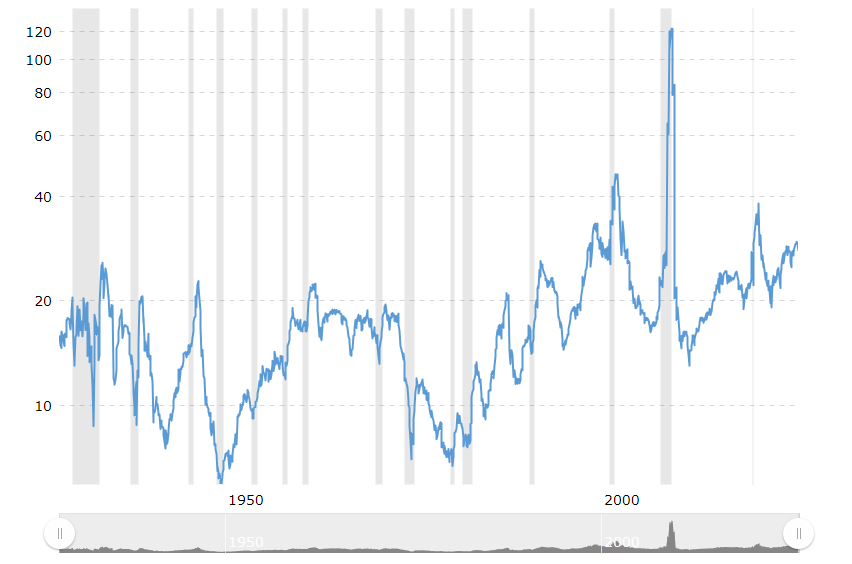
If we look at the last 30 years for Micron, we can see that margins are incredibly volatile. The chart is a bit hard to read maybe, but there’s a clear dynamic between operating/EBIT margins and PE multiple: When margins are high (often above 25% in the good parts of the cylce) people pay a low forward multiple, because they anticipate the next downcycle; peak earnings on trough multiples. We also see that Micron often becomes unprofitable in a downcycle and multiples spike above 100x forward PE; trough earnings on peak multiple.
Now people claim that Micron is still cheap at a 9x forward earnings, while generating record EBIT margins of 67%! These margins are way above the mean EBIT margin of 4% or median of 8% across cycles. Now the narrative is that margins will stay high, allowing Micron to trade at over a trillion dollars in valuation.
While enormous amounts of capital chase the AI narrative, many other parts of the market have quietly become neglected. Across Europe, small-cap stocks, family-controlled businesses, industrial companies, payment networks, software firms, healthcare suppliers and real estate businesses often trade at valuations that would have looked attractive only a few years ago.
Liquidity has become concentrated and investor attention has become concentrated on chasing the next big thing. Historically, concentrated capital has often created opportunities away from the most crowded trades.
If we look at the S&P 500 P/E, we can see that it is elevated, but not as bad as you’d expect at 29x current year. What people forget however is that these semiconductor and tech companies command a controlling share of the earnings part of the P/E multiple here. On a forward basis this concentration only increases. If semiconductor companies margin collapse we’d see a strong contraction in the earnings of the mayor indices. So yes, it’s not expensive as long as the story continues, but once it doesn’t we are faced with falling earnings AND likely a lower willingness to pay elevated multiples. This can quickly send an index down 30-50%. Other parts of the economy are cheap and those will likely also be hit in such an event, but there likely won’t be permanent destruction of capital.
My goal is not to predict the crash, but I want to secure my portfolio against getting caught up in the situation. Meanwhile, I continue to target a 15-20% IRR on my portfolio, but in a value investing style, where downside protection is more important than chasing the next momentum play.
One lesson I’ve learned over time is that risk and valuation cannot be separated. A wonderful business can become a poor investment if purchased at an unreasonable price. Likewise, a merely good business can generate excellent returns if purchased cheaply enough.
This is why I increasingly rely on a valuation framework that focuses on expected business performance, capital returns, margin evolution and multiple assumptions across a range of scenarios.
I want to understand what needs to happen for me to stop making a positive return and pulling the trigger when those odds are stacked in my favor.
What happens if growth slows? What happens if margins disappoint? What happens if valuation multiples compress? Using this framework often reveals that some stocks carry significantly less downside risk than headlines suggest.
One example is Edenred: Despite facing regulatory concerns and operating in an environment that many investors currently dislike, the company’s risk-reward profile remains surprisingly attractive when evaluated across multiple scenarios.
In many ways, Edenred represents the type of opportunity that becomes available when markets become obsessed with a single narrative and that’s why it’s my largest position.
I wrote extensively about Edenred on this blog, here is my latest article. The company is my largest position, even after taking some gains. I aggressively bought it under €20 and now keep it at 15% portfolio weight, with intention to trim it once it gets to fair value.
If we look at Edenred, we need to differentiate between the regulated business, which is under threat, and the unregulated business that isn’t affected. Edenred expects to continue growing the regulated business, but it’s pretty uncertain, similarly we don’t know if they can keep current margin levels. So I have a very wide range for this oligopoly business from €100-448 million EBIT in 5 years.
The unregulated business on the other hand is growing at least with GDP and should continue to do so between 3-11%. Margins are not fully known, so a wide range of 24-40% EBIT leaves us at a range between €508-1232 million in EBIT 5 years out.
Overall, my projections land at a range of €608-1682 million in EBIT and a revenue range of €3126-4576 million, well below management’s target of € billion in 2030.
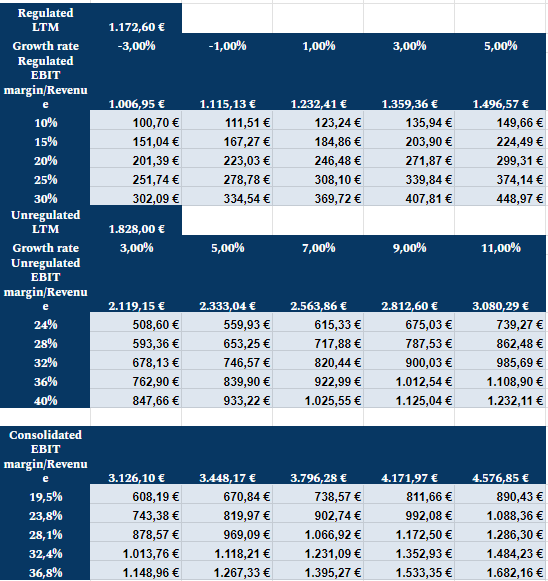
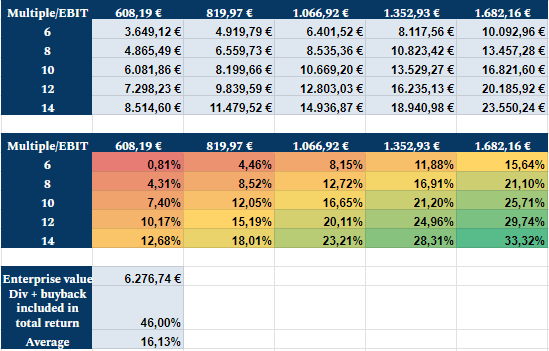
Using this EBIT range, I now map it against EBIT multiples. I used a conservative range of 6-14x EBIT, which should be very realistic for a capital light, oligopolistic business with strong margins and good management. In the past, Edenred frequently traded between 16-22x EBIT.
On top of that we have a current dividend yield of ~6% (was 8.6% at the bottom) and they are actively repurchasing shares. Alone with return of capital at these low levels we should get a 46%~ return.
I’d argue that these assumptions are very conservative on the low end and realistic on the high end, without a real bull case. Yet, I still land at a positive CAGR of 0.8% in the absolute worst case scenario. The average CAGR is 16% with a high case of 33% and as mentioned these assumptions aren’t even bullish.
That’s the type of scenario I’m looking for, unfortunately it’s hard to find similar. In the following section I’ll go through my scenario dashboard, where I have mapped all my companies using this method and my usual IRR model to get an overview of downside, upside and average return cases using two models. We’ll then talk about where I see some downside and if I want to act on this.
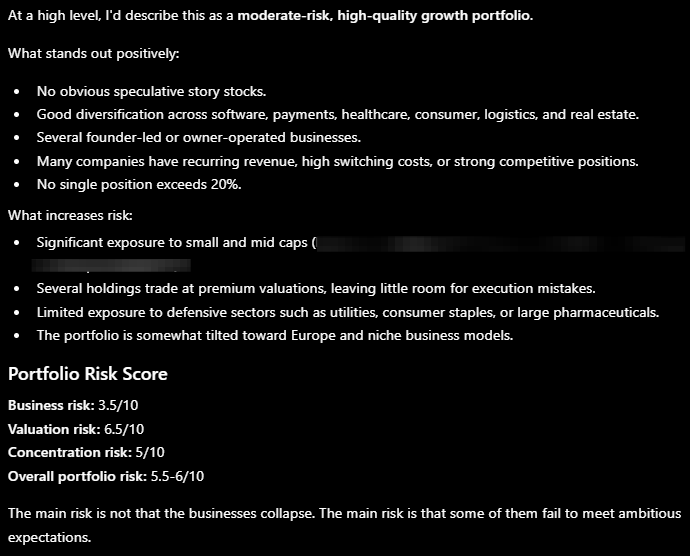
Before I ran my own analysis, I decided to give ChatGPT my portfolio and let it rank it. I’d argue that my portfolio has a much lower valuation risk than 6.5/10, but I’m fairly okay with the ranking. Let’s get into the details.
Comments
Nothing yet. Say the first thing.
Sign in to join the conversation.