
Some time ago, I sat down with Jim Hawthorn, a cornerstone of the Hendrix fan community for decades. His website, The Jimi Hendrix Record Guide, is a meticulously compiled discography and archive of Hendrix releases, both official and unofficial, and is a go-to resource for fans looking to unravel the complexities of Jimi’s vast musical legacy.
In this exclusive interview, we discussed Jim’s history as a young fan in the UK seeing Jimi on TV, then as a collector, historian, and online archivist. Jim gives his perspective on everything from the latest Electric Lady Studios box set to unreleased material sitting in Experience Hendrix’s vault, and even some recordings that exist only in whispered rumors among the most serious of collectors.
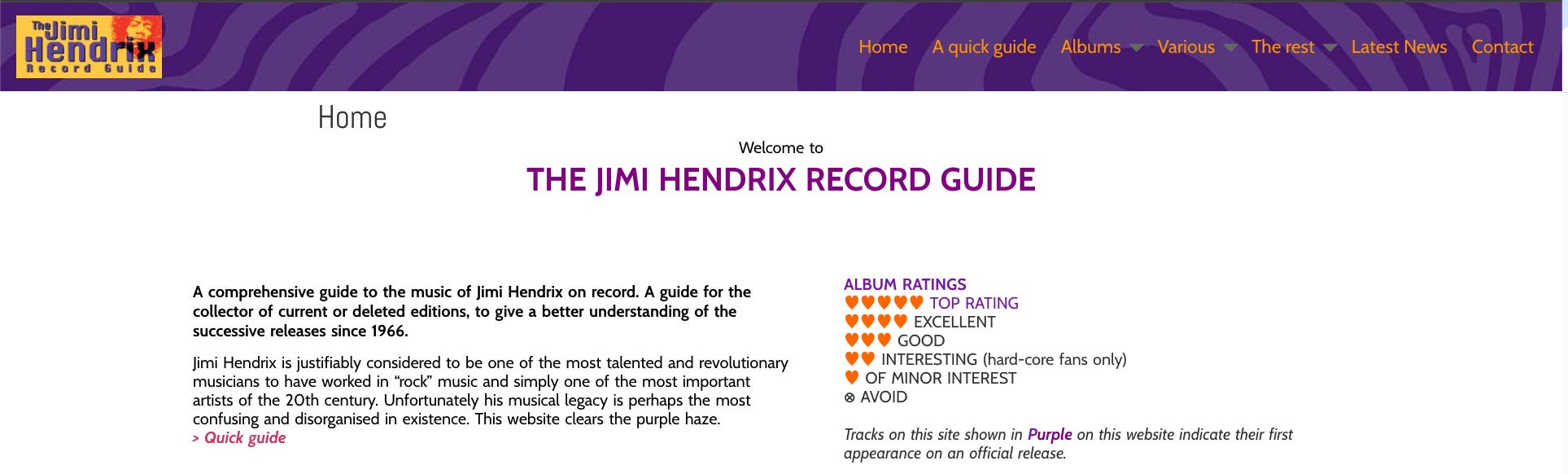
HR: Jim! I’ve been visiting your site for a long, long time and it’s great to finally meet. It’s a bit of a throwback to earlier internet days. To start, could you tell us about your site? When did you launch it and what motivated you to create it?
JH: Well, my passion has always been Hendrix. I actually wanted to write a book about him back in the 80s, and I even had a publisher interested, but it unfortunately didn't pan out. That setback, however, gave me the opportunity to pursue a discography online. You see, by the 90s, Hendrix's discography had become incredibly confusing with numerous releases over the years – hundreds, you know. I thought it would be worthwhile to try and bring some order to that chaos. Of course, the internet was a very different landscape back then.
HR: That’s fascinating. I came to Hendrix a bit later. My first CD was probably around 1993, Alan Douglas's The Ultimate Experience compilation.
JH: Ah yes, Ultimate Experience! That was actually the first CD I ever got too. I won it in a local radio quiz. The question was, “What was Hendrix’s first record?” “Hey Joe”---you win. But my first purchase was way back in 1970 or 1971, just after he died. That's when my collecting really began; I was 13 at the time.
HR: So, you didn't get to see him perform while he was alive?
JH: No, sadly not. I did see him on British TV, though. I have a strong memory of it being on a program called Scene at 6:30. Interestingly, another person has mentioned seeing Jimi on the same show. I can't recall what he played, perhaps "Purple Haze"? After that, it felt like Jimi disappeared from the UK scene for about three years because he went to America, and there were no new singles released here. It felt like he deserted the UK in a way.
HR: That's a perspective I'd never considered, coming from an American viewpoint. It makes sense that from a British perspective, where he initially broke out, it would feel like he left for a while.
JH: Yes. I was just too young to fully grasp what was happening until the news of his death broke. It was a strange experience because after his initial hits like "Purple Haze" and "The Wind Cries Mary," there weren't many singles in the UK. Even the reissue of "Fire”—retitled as "Let Me Light Your Fire" for some reason— in '68 was odd. Then '69 and '70 passed with no new UK singles.
HR: I didn't realize that.
JH: And then, BOOM, he was gone. It felt particularly strange because he was massive in the States, the highest-paid artist at the end of the 60s, yet somewhat off the radar in the UK before his death. The track that truly hooked me after his passing was "Voodoo Child (Slight Return)". I hadn't bought Electric Ladyland yet, as LPs weren't really my thing at 13. But that song blew me away, and I started buying everything afterwards.
HR: Tell us a bit about your background. Are you a musician yourself?
JH: No, I tried guitar in my teens, but I never really stuck with it. I played a bit of trumpet at school, but that was the extent of my musical pursuits. I went to art school and then worked in graphic design. That put me in a pretty cool environment with lots of music lovers. I was at university from '76 to '79, right in the midst of the punk rock era, so there was a lot of music happening. I’d already been a huge music fan since my early teens, with Hendrix, Led Zeppelin, Thin Lizzy, all the great English rock acts. Music is definitely my passion, my main hobby.
HR: You mentioned a few bands. Beyond Hendrix, what other groups or genres are you most into?
JH: Primarily, it’s music from the 60s and 70s. I have a strong preference for American music across various genres like rock, jazz, blues, rockabilly, and doo-wop. That forms the bulk of my collection. However, my ultimate favorites include the big English bands like The Rolling Stones, Led Zeppelin, and The Who. I'm also a big Frank Zappa fan, have quite a lot of his work. I love The Allman Brothers Band, ZZ Top, a lot of Aerosmith, Thin Lizzy, David Bowie – I'm a complete Bowie nut – and Prince, who I'm probably almost as passionate about as Hendrix.
HR: Quite eclectic!
JH: It is! I also love Earth, Wind & Fire, Hank Williams, Nina Simone, so many. Other artists I've collected extensively are probably The Stones, Zeppelin, Prince The Allman Brothers, and Neil Young. It often centers around the guitar players, I think that's my main obsession. While I appreciate all musicians, it's the guitarists that really resonate with me. Zappa gives me a similar thrill to Hendrix in some ways, that intensity and knowledge, even though they are totally different players.
HR: And they were friends, weren't they?
JH: Yes, they were. There are supposedly a couple of tapes in the archives – a jam session at Zappa's house when Jimi dropped by, and a recording from the Ambassador Theater where they played together. These recordings haven't been released, likely due to rights issues between the Zappa family and Experience Hendrix. It would certainly be interesting to hear them.
HR: I hadn’t known about that jam session. I knew Jimi appeared on the cover of We’re Only In It for the Money. There are some cool YouTube clips of Frank Zappa talking about Jimi too.
JH: Absolutely. And if you want to explore Zappa's guitar work, I highly recommend albums like Guitar and Shut Up 'n Play Yer Guitar, which is a dense compilation of solos – just incredible playing.
HR: I've dabbled in Zappa, but the sheer scale of his output is overwhelming.
JH: It is true that his catalogue is colossal. A lot of his work is quite comedic or theatrical. But if you focus on his more rock-oriented or even jazz-influenced albums, you'll find some great stuff. It does require some listening to discover what you like.
HR: Back to Jimi. What are your favorite Hendrix eras or albums?
JH: That’s always a tough question. I love all the later material – everything on The Cry of Love, Rainbow Bridge, and War Heroes. Those were particularly special because I bought them as they were released, so it felt like new Hendrix music at the time.
However, I do believe his songwriting was at its peak in the '66 to '68 period. The variety and originality of his work during that time were astounding. His playing was so full of fun and raw talent. So, perhaps the first three albums and the live material with The Experience are my absolute favorites. On stage, they were almost like a jazz trio, with incredible improvisation. They'd start with the foundation of a song like "Foxy Lady" or "Spanish Castle Magic," and then Jimi would just take off.
Then, when he teamed up with Mitch and Billy Cox, things were really cooking in the '70s. There was a total shift with that rhythm and blues influence coming in, a funkier sound. I think Mitch Mitchell's drumming on Electric Ladyland was superb and often underrated. So, while I might have a slight preference for the earlier stuff, I still deeply love the later material.
HR: Yeah, I'm similar in that when I think about the '69-'70 period, I mostly think of the live recordings and studio jams that have been released. I love hearing his improvisational stream of consciousness.
JH: Exactly! Albums like Hear My Music and Burning Desire capture that. Even Nine to the Universe, despite being an Alan Douglas release, opened the door to that more improvisational side. And on War Heroes, tracks like "Midnight" and "Tax Free" showcase him exploring. In a way, there was no one quite like him, except perhaps Zappa, in that free-form, anything-can-happen, instinctual playing. That’s why he’s often compared to Charlie Parker or John Coltrane – it came purely from his soul through his guitar and, of course, his amplifiers.
That was a crucial element of Jimi's sound. His instrument was truly the entire amplification system. That’s what shocked everyone in '66 and '67. While others might have played fast with various techniques, Jimi used feedback and distortion as integral parts of his massive sound. It must have been an incredible experience to witness live.
HR: I often think about how much I wish I could have been there.
JH: You would have felt it, the vibrations. You’d probably have needed earplugs because he played so loud. But we are fortunate to have so many recordings to explore.
HR: Favorite songs?
JH: Oh, there are so many. It’s incredibly difficult to choose. Obviously, "Voodoo Child (Slight Return)" holds a special place because it was the song that truly captivated me. But I love everything – "Purple Haze," "Love or Confusion," "Manic Depression"... "Power of Soul," "Dolly Dagger," fantastic! It's easier for me to list the ones I'm not as mad about.
HR: Which would be?
JH: More run-of-the-mill tracks like "Remember" and "Ain't No Telling" – they're okay. "Burning Desire" has never been a personal favorite either. There are definitely songs I like less than others, but overall, I love it all.
As for favorite albums, at the very top, the summit for me, would be Electric Ladyland. I think it's his ultimate creative peak.
HR: It’s a masterpiece.
JH: It is just beyond belief – the scope and majesty of that album are off the scale. But I also adore Are You Experienced, Axis: Bold as Love, and, as I mentioned, The Cry of Love, Rainbow Bridge, and War Heroes, which I actually prefer to First Rays in some ways. That’s how I still listen to those '70s releases. And the jam albums like Hear My Music are fantastic too. Of course, you must have heard the new box set?
HR: I saw your review on your site – two and a half out of five, if I recall.
JH: I've actually bumped it up to three since then. I had more time to really delve into it. Initially, I was comparing it to albums like Hear My Music with its dense, intense improvisation, which is what I really enjoy. My first impression was that the box set felt a bit rudimentary – running through songs, getting a feel for them, demos, alternate mixes – and I didn't find much substantial new material. Hence the two and a half.
But after listening more closely, I identified around 12 to 15 tracks that I really enjoyed. So, I felt it deserved a slightly higher rating. There’s good stuff there, but I don’t think it’s something I’d ever sit down and listen to from start to finish. Like with many of these releases, I’ll probably create my own compilations from it.
Of course, the version of "Midnight Lightning" that we know from bootlegs is great – really raw and gritty. And there’s a long jam on "Astro Man" that has been circulating in a longer form for years, so the decision to edit it down on the release was a bit strange.
HR: One thing I found frustrating with the new release, and I was quite confused, was the track order on the vinyl compared to the streaming version. It was wildly different.
JH: The order's different, yes.
HR: I assumed it was due to the limitations of space on the LP sides.
JH: Yes, probably.
HR: But they seemed to just chop it up. There were instances where tracks were clearly meant to be heard back-to-back – a jam leading into another piece – and they were split across different discs.
JH: Yeah, there was a bit of that. I think it happened on Burning Desire as well, where a long jam was split in two to change the order. I actually discuss that on my website somewhere. Certain liberties were taken, perhaps with the vinyl side limitations in mind. But that long jam on the new release isn't bad. There's a nice studio take on "Hey Baby," quite raw and spontaneous. And the improvisation at the end, where it revisits the bolero theme and then goes into "Keep on Groovin'," is lovely. There's definitely interesting stuff in that long jam.
HR: Are there things from that Electric Lady period that are unreleased that you wish would have been included in the box set, things you know exist?
JH: I don't think so, because he came to Electric Lady Studios quite late in the process, in June. He also took a ten-day holiday in Maui, which further compressed his recording time. So, I don’t believe there are any substantial unreleased jams from that specific period. He was likely focused on finalizing the structures of the songs for the albums he owed his record labels. He had to deliver a new studio album, the Rainbow Bridge soundtrack, and potentially more material for PPX/Chalpin, who were never satisfied. Remember, in 1969, he was supposed to deliver two albums to Warner Bros. Electric Ladyland, being a double LP, fulfilled that for 1968, but in 1969, nothing was delivered to the US market besides the Smash Hits compilation. By 1970, he was significantly behind. The PPX situation certainly added to his stress and affected his concentration.
So, regarding any other Electric Lady material, I honestly doubt it. Perhaps that "Midnight Lightning" and the longer "Astro Man" jam represent the extent of the in-depth exploration we’ll get from that time. I’d love to be proven wrong, though. My worry is that the well of unreleased material might be starting to run a bit dry. Looking through books like Ultimate Hendrix gives that impression. There are mentions of tantalizing snippets, but nothing concrete. I’m hoping there’s still more to be discovered, something akin to the raw, improvisational spirit of Hear My Music and Burning Desire. Maybe another box of forgotten TTG sessions will surface one day.
HR: You mentioned Ultimate Hendrix as a key reference guide.
JH: Yes, exactly. However, even the most dedicated specialists acknowledge that there are a few things that need correction or updating in it. Perhaps an updated version will be released if new tracks are found. Over the years, tapes have indeed turned up in various studios like Olympic and Record Plant. But who knows if there’s much left?
HR: Speaking of collector circles, how did you get involved, especially in the pre-internet era when people likely met up in person?
JH: That’s interesting. In the very early days, back in the 70s, it was all about small ads in the back of music papers like Melody Maker and New Musical Express. That was mainly for finding albums, not so much bootlegs, although I did pick up a couple from dodgy record shops. The tape trading scene really developed when I was in London. You could buy bootleg tapes quite easily in places like Camden Market in the early 80s. But the real circulation of tapes took off in the CD age, in the early to mid-90s. How did I connect with people? I suppose it was in the early days of the internet, perhaps thanks to my website. Then, we’d send off tape copies via snail mail. I traded a lot with a fellow collector named Kurt Max. Then, online forums like Crosstown Torrents became the go-to places. I was active there for a while. Now, JPIO (JimiPassItOn) has become a very good source for information, articles, books, and pretty much any recording you might want. You can even stumble upon things on YouTube sometimes.
HR: But then you often realize you already have it.
JH: Exactly. You think you’ve found something new, but then you remember you’ve had it for ten years. So, the snail mail days were with people I met through early websites and things like that. I was never a subscriber to fanzines like Univibes or Jimpress; I always found them a bit expensive back then. So, it was really the internet that facilitated trading for me. And then, with the arrival of fiber optic internet, downloading became much easier than swapping CDs. The early days of Napster opened the floodgates.
HR: How do people get to hear the non-circulating stuff?
JH: There are definitely instances where you had to be physically present at someone's place to hear recordings that weren't circulating. Some people do possess non-circulated material.
And then there's the famous Club Filips tape.
HR: I don’t think I know that one.
JH: You know, Hansson & Karlsson, the band behind "Tax Free"? Jimi jammed with them at Club Filips in Stockholm in September 1967. There's a tape of that extensive jam. Extracts have circulated in bootleg circles. But the complete jam exists and is owned by the ex-manager of Hansson & Karlsson. As far as I know, only he and one other person have heard it. I was in contact with the person who ran the Radioactive label, and he told me he went to Sweden to meet the manager and listened to the tape. He described it as a lot of intense jamming with three musicians. So, maybe one day that tape will see the light of day through a deal with Experience Hendrix.
HR: Amazing. Thank you so much for your time. It’s been truly fascinating.
JH: My pleasure. Always happy to talk Hendrix.
No posts
Comments
Nothing yet. Say the first thing.
Sign in to join the conversation.