
Last October I finished a book event with the wonderful Susan Barker—discussing her novel Old Soul and my novel Carrion Crow—and took myself to the cinema. I have landed upon this as an almost perfect combination of things, a book event then a solo cinema trip, because I am usually so wired after public events that my brain is running a thousand miles an hour and I either need a cocktail with friends or some time to chill in a dark room. This second option is exactly what a cinema is—in fact, you can have a cocktail in there as well, if you choose the right kind of cinema.
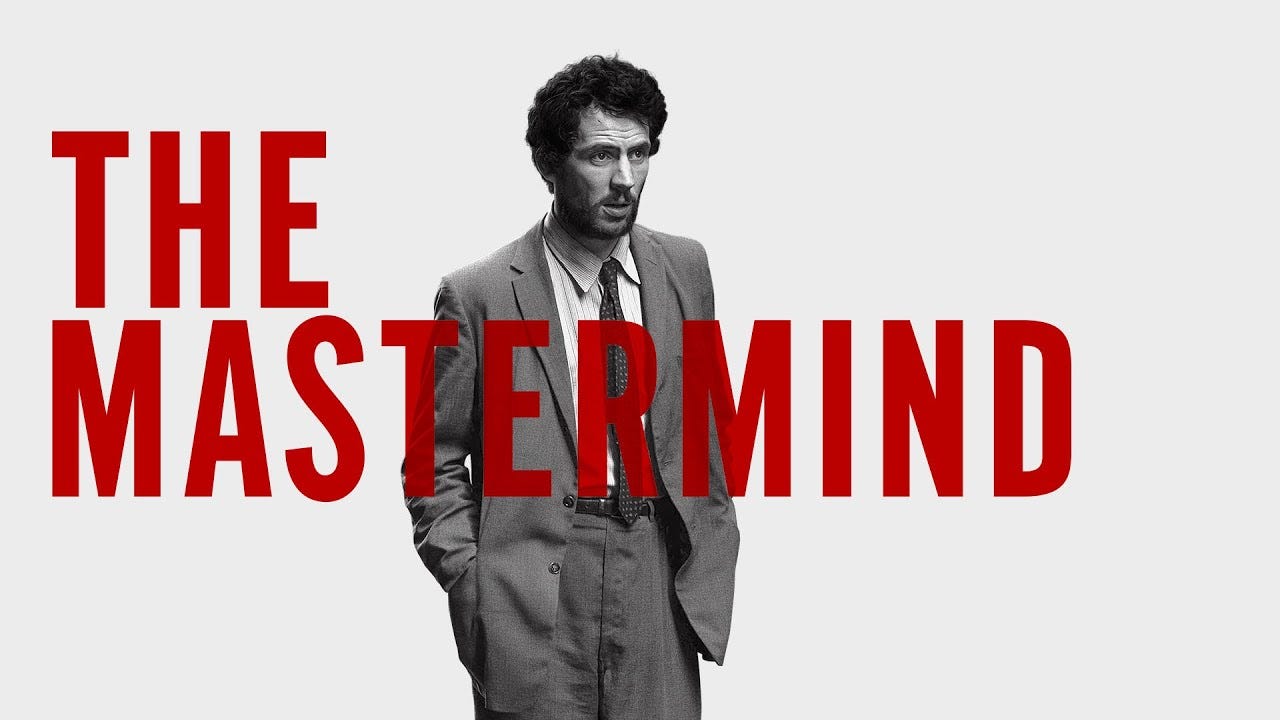
The film I watched that evening was Kelly Reichardt’s The Mastermind, starring Josh O’Connor, the first thing I’d seen him in since God’s Own Country (a better moors-based romance than Wuthering Heights in almost every way), though I had totally forgotten who he was, forgotten I’d seen him in anything. This is because Josh O’Connor is an Actor, with a capital A, one of those old fashioned ones who actually does transform into whatever character he’s playing—and he’s very good at accents, which has had the unfortunate effect of tricking me into believing he really is American, so now every time I hear him speak in his real voice it feels totally off-putting.
I’ve since also seen him in Wake Up Dead Man and The History of Sound, and have come to the realisation that I will watch almost any story told over the landscape of Josh O’Connor’s face. What both he and I need is a director who understands that the face is worth traversing, and really is not afraid of lingering on it. Enter: Kelly Reichardt, a woman who, I sense, has never submitted to being hurried along to wherever she’s going. Kelly Reichardt makes movies exactly like I drink the dregs of a cold coffee after my partner has tried to hustle me out of a cafe. Oh, you’re in a rush are you? Maybe I’ll just take my time.
The Mastermind tells the story of James, a seemingly talented but unemployed carpenter and art-school dropout; he is the son of a judge as well as a husband and a father. We meet the family at the fictional Framingham Museum of Art, at which James is planning a heist; he will pay two friends to steal four Arthur Dove paintings in hessian sacks sewn by his wife. This plot is drawn from real life—the real theft of two Gaugins, a Picasso and a Rembrandt from Worcester Art Museum in Massachusetts in 1972—but the details are Reichardt’s own. From the very first moment, she lingers, she makes us look. We meet the family in the gallery, where James is laying his plot; the sheer normalcy of him and his family acts as its own cover. No one thinks to pay attention as he unlocks drawers and even steals a small artefact in his pocket one afternoon, and it is this lack of attention (in the characters, not the filmmaking) that will form an integral part of the movie’s critique.
Reichardt has drawn the early 70s in pitch-perfect style: the clothes, the hair, the cars, the mannerisms, the society that has not yet succumbed to the relentless allure of the digital, even the sepia-tinted framing and the earth tone palette. The soundtrack is a work of art in itself, seemingly one long jazz piece that seeps into and out of the film without notice and then suddenly overwhelms with its intensity. The familiarity of all of this, even to those of us who weren’t born until a couple of decades later, creates a false sense of security; the director lulls us with a very light, almost imperceptible remember when things were better? overlay, which will be pulled out from under us as we realise what the movie is really about.
O’Connor is brilliant, completely convincing as this bumbling wannabe who stumbles from error to error without apparent malice. The supporting cast has not a single weak link. The kids playing James’ two sons (Sterling and Jasper Thompson) are wonderful; Reichardt has drawn them with the charming strangeness of real kids, not turning them into whimsical caricatures but using them perfectly for both plot advancement and comic effect (the timing of a vomit in particular). The highly imperfect way James deals with the clash between his parental responsibilities and his ‘scheme’ highlight early on that perhaps we are not dealing with the genius suggested by the movie’s title. The fact that we are introduced to the film through James’ son’s entanglement in a logic puzzle is a stroke of thematic genius.
And yet. On that first viewing, there was something that just didn’t quite sit right with me. I enjoyed the film but left the cinema feeling frustrated, and sure that the film was twenty minutes too long. Perhaps, with my mind whirring, I had wanted some sort of easy resolution, and had grown annoyed by the meandering nature of the movie, which necessarily follows the unravelling of James’ plan. It had been great to look at, great to immerse myself in, but I hadn’t really ‘got’ it—which was in part due to me, and in part due to the fact that Kelly Reichardt strains against what we’re being trained to expect from films. Still, I thought of it more, over the subsequent few months, than I thought of any other recent film. So I sat down with my partner and I watched it again. And this time, it clicked.
Perhaps the difference in this second viewing was the fact that I had made peace with the pace of the narrative in advance. I was excited to show my partner the insubstantial scenes that had nevertheless stuck with me: the scene, for example, in which James is hiding his stolen paintings in a barn, where the camera sits itself behind the ladder he is using to reach a mezzanine level and does not move. A pig snuffles around in the background, and other than that, we have silence. James sets the ladder in place, removes two of the covered paintings from the bespoke container he has made (with great skill, it seems; a little nod towards the fact that he could, in fact, be successful), and climbs the ladder awkwardly with them; the shot cuts to one on the mezzanine, to show us James depositing the pictures. But the next time, Reichardt makes us stay with the ladder: there is not a single cut as James descends the ladder, takes the next two canvases out of their holder, takes them up (we watch his legs), lays them with the others, descends the ladder again, decides he must lift the cabinet up there too, struggles to position it on his arms in such a way that he can lift it upwards as he climbs, and ascends the ladder one more time. When we do move, it is to once again watch him wrestle with the paintings and the cabinet, and then to knock the ladder away just as he needs to get down. Watching this I get a buzz of excitement in my guts, a strange reaction to what is in essence a dull and incredibly slow scene, yet is shot through with audacity. It is as if Reichardt has sat through the over-edited, barely-framed movies of the last few years, has endured the TikTokification of narrative films, and has taken a stand. No, she says. Sit here and watch. These are the details. These matter. This is real life.
You can’t handwave over these parts of the story, because you cannot handwave over life; it is the attempt to do so that causes James’ downfall. There is a suggestion that he intended to sell the paintings either to or via his old art teacher; we never see him speak to the teacher, not to anyone else who might actually be in the game of buying four infamously stolen artworks. He has no backup plan to pay back the money he borrowed from his mother to pay off the crooks who actually stole the paintings. He has little control over these crooks, who even refuse to take into the gallery the postcards he’s brought for them of the paintings he wants them to steal. Very quickly things go downhill when one of them pulls out a gun, against James’ express wishes. This same friend later holds up a bank, and, it’s implied, immediately rats out James and his scheme to the cops. James’ lack of attention to these rather large details scuppered him from the start, and they make his ridiculous responses throughout the movie almost painful to watch.
When he goes on the run, he has almost no money and almost no stuff. This is the world before mobile phones, the world before computers: he cannot just Google Maps his way to a convenient destination, can’t even buy a bus ticket without interacting with people who may know he’s evading the police. Very quickly you see James as a vulnerable little animal in a world he doesn’t understand, owing to the facts of his relative privilege and the comfortable life he previously enjoyed, even if that life was addled with frustrations. He had a decent home, a loving family, a wife and kids who adored him despite him limitations and the stresses his disaffection placed on their existence. His existence may have been largely beige, but it wasn’t bereft of colour: the very fact of the public amenities, the collective mindset behind public art, that gave his family the gift of culture, which makes it so awful that he planned to take this from others.
What’s striking, on your second watch, is that actually, everyone in this movie is trying to help James, trying to gently shepherd him towards an easy way out of the situation he’s got himself into. The cops at his house don’t arrest him; they give him the opportunity to just give the paintings back. He so successfully wields his father’s name that you get the impression he’d avoid jail time even if he were arrested. The organised crime guys who steal the paintings from him, so effortlessly picking him up and finding his secret ‘hiding place’, don’t hurt him at all, and even give him advice on how to do better next time. The friend at whose place he takes refuge, before his wife makes him leave their house, offers him another place to go, for the long-term: his brother’s farm in Canada. For every mistake he makes, there is someone willing to bail him out in some way or another: his is the existence of the coddled straight white middle class American man. But this can also be seen as enabling him, and in this regard the role of women is particularly interesting; it is his mother that gives him the money to pull off the heist. His wife makes him the sacks in which he will conceal the paintings. A kindly older woman rents him a cheap room when he is on the run, and it is an elderly women who offers him (a bleak and awful) reprieve at the end.
The slowness of the movie is key to forcing the audience to understand what it is really about, and what it is really about has two levels: on the one hand, it is a story of a slow coming-undone, which for me works as a critique of a particularly American type of entrepreneurism. So often we read stories of billionaires who’ve made their money through the ‘move fast and break things’ motto; it’s okay if you don’t really know how things will work out, this ethos says, as long as you just keep going. But this only justifies itself retrospectively, and only if it succeeds against the odds. Here, James has all the entrepreneurial spirit, and none of the success. Yet he clings so desperately to his disproven idea of individual success that when offered a true solution—an invitation to Fred’s brother’s farm, populated by what Fred describes as ‘draft dodgers, radical feminists, dope fiends…. nice people’—he cannot even consider it as an option. It is only a case of getting a bus over the border, and showing up to muck in; ‘Me in a commune?’, he asks. ‘It doesn’t sound like my kind of scene.’ This is his last chance, and he rejects it. For the rest of the movie we see him flailing, trying so desperately to get himself out of the hole he has dug that erodes his relationship with his family, his ability to be a friend, and even his morality; the choice he makes in the end of the film is genuinely awful to watch. Both he, and society, are the ultimate victims of his hubris.
The second, and I think more important meaning, comes through only when you engage in the periphery of this film. In giving us the long, measured scenes of detailed work—James in the hotel room trying to forge a passport being a perfect example—she gives us a point to focus on while she waves great flags on the edges of the frame: news reports and headlines about the Vietnam war, about Cambodia, about political corruption. The world is happening while James isn’t looking, while he is focused instead on his own ludicrous self-serving plan, which cannot even begin to meet the challenges of the world around him nor deliver his family from it. His kids, you realise, will have to grow up in the world that James is ignoring. This is very much a film about the death of the 60s, about the ways the hippie movement both failed and formed the foundations for the anti-war movement of the 70s. It is about how the concept of checking out of mainstream capitalist society can only ever yield results if you check into something better instead, something communal and different, in which you care for each other in the ways mainstream society won’t. If, instead, you isolate yourselves with no purpose—as Fred and Maud have done—all you can be is cold to the world, and embittered, and failures: you did not change the world in the end, you barely even tried. In many ways it asks: so you’ve tuned in and dropped out. Now what?
The ending, which comes out of the blue and yet is essential for Reichdart’s message, drives this meaning home. If you constantly turn away from the communal towards the individual, the structures of power will get you just like it gets everyone else. You can try to game the system but the system will sweep you up anyway. It does not matter how much privilege you have: if you try to ignore the political, it will bite you in the end. Check back into life, and try and build something better: really, you have no other choice.
No posts
Comments
Nothing yet. Say the first thing.
Sign in to join the conversation.