
Welcome! I’m author and writing prof, Heather Lanier. The Slow Take is my very occasional newsletter, inviting us to lean into what makes us feel more human. Think of it as the opposite of a botox billboard or an AI-written thank-you note. There are only real thank you’s here. Thanks for being here!
It’s fall, which means our household has gone from languid summer days arranged with a time management approach befitting a snail . . . to schedules packed so tight I have to micro-manage ten minutes at a time: meetings, classes, two different school districts for two different kids, adaptive tap dance, preteen theater . . . enough extracurricular activities to occupy a scurry of caffeinated squirrels. (Apparently, a group of squirrels is called a “scurry” or a “dray.”)
But I’m not here to talk about busyness. I’m here to talk about slowness, and how long writing and art-making can sometimes take.
I published a poetry chapbook earlier this year! I said almost nothing about it. That’s partly because the book took so long that I practically forgot about it. But here’s the story: I wrote a bunch of pregnancy poems while I was pregnant in 2010 and 2012. Then I set all those poems aside, and wrote a book I didn’t publish and a book I did publish. Flash forward eight years: the world shut down, and I found myself curating all those pregnancy poems into a collection. I found a publisher a year later. There were delays from the publisher, and more delays because I released a different book of poems, and at long last, this little collection of poems about pregnancy came out this year, when I haven’t been pregnant in 13 years.
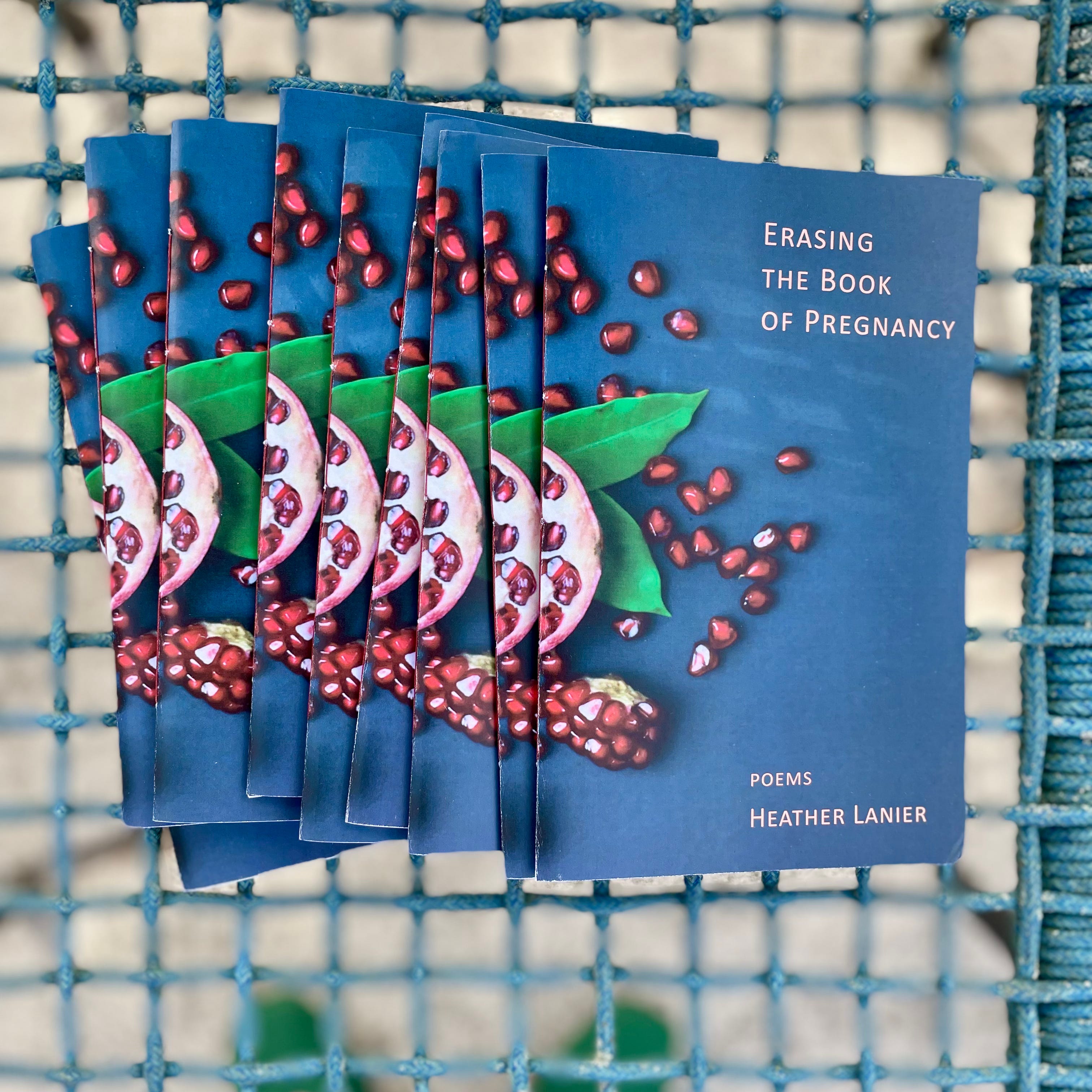
It’s called Erasing the Book of Pregnancy. I’m proud of this book. It’s lean and makes me laugh and is graced on the cover with a glorious half-pomegranate. It also reminds me that pregnancy is a wild mystery the world tries to lasso into sexist subordination, usually by telling women again and again what to eat.
The title comes from a short series of “erasure poems” that I made by erasing words from one of those hilariously bad advice books for pregnant women. You know the ones? They offer almost zero scientific explanation for anything, although they give you plenty of reasons to worry. (Why do your hips hurt? Girl, it’s hormones?! Why are you weeping at cookie commercials? Hormones, Girl! Now go buy a bassinet, and make sure it’s not a baby death trap!)
I never found pregnancy to be “magical” because “magical” implies fairy dust and pegasuses (pegasi?) flying though rainbow skies. Pregnancy is wild, though! A human inside a human!? It still seems like a riddle. And poetry enabled me to look at it from many angles.
Here’s a fact you probably knew but I want to share again: Babies leave DNA behind in their mothers’ blood, and it stays with the mother for decades! The mother becomes more than herself. She becomes less of an isolated self, and more of a walking collective. (Which, yes, is why I want more mothers in Congress. Also more women.)
The chapbook took eleven years to write. It’s about 30 pages. Let me say that again: eleven years, thirty pages. (Hi there, my newsletter is called “The Slow Take.”)
For most of that decade-plus, the collection was sitting quietly as a scattered bunch of Microsoft Word files, waiting for me to gather them all together and make some sense of them. During that time, I was writing other things. (This is how I work. Always little pots on the burners, many of them down to the lowest possible simmer, some turned off completely, hopefully none burning or totally forgotten while I concentrate on whatever’s really in the oven.) Once I did spend time making a collection, it was delightful work, selecting and arranging the poems to create a bigger whole.
How do you shepherd your work years after you wrote it? How do you keep believing in it, even when it takes eons?
In the event that it’s helpful, here are a few things I do to stick with my art, even or especially when it takes well over a decade:
I make myself lists and notes. For instance, I have a running, handwritten list of every poem I’ve started but haven’t finished. It used to be on a mid-sized post-it (see photo below), then extended to two post-its. I recently transitioned it to two pages in a notebook. (Forty+ poems and counting.) I usually never consult this list, but it’s there for me if I ever want to tend to this unruly garden.
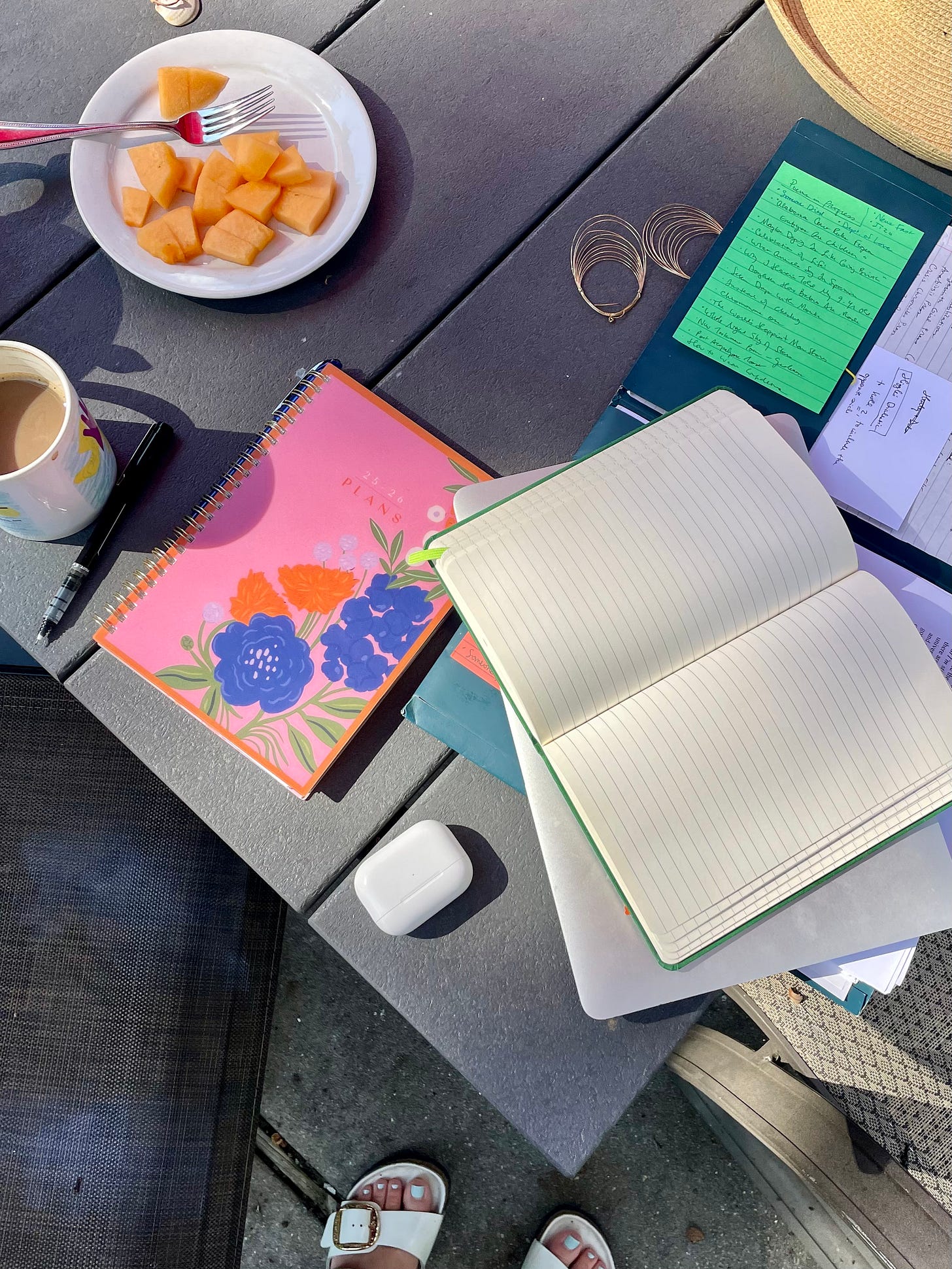
I try to fit the type of project to the season I’m in, and the kind of time I have. For instance, putting together a collection of already-written poems was the perfect project in the pandemic, when any new words I wrote seemed to fall upon a landscape of quicksand. Whenever I struggle to start something new, I turn to my lists of unfinished things.
I don’t see time as a measure of success. A poem that took two months is no better or worse than one that took two or ten years. This reminds me of a conversation Leonard Cohen once had with Bob Dylan, as relayed by Cohen. Leonard was like, “I really love that song you wrote, ‘All Along the Watchtower.’ And Bob was like, “I really like that song you wrote, ‘Hallelujah.’ How long did it take you?” And Leonard was like, “Five years. How about your song?” And Bob was like, “A few hours.” A few hours, a few years! Both are masterpieces. Time seems to be an illusion to the Muses.
I know that not everything needs to be finished. I might never finished those 40+ poems. Sometimes writing a half-poem or half-essay changes me, just by writing it, even if I never share it. And that’s enough to ask of art. That’s a lot, actually.
So there you go. A few tips. Do you have your own? Here’s to giving name to the mysteries of being human, no matter how long it takes us.
And you can grab a copy of Erasing the Book of Pregnancy at Seven Kitchens Press!
Comments
Nothing yet. Say the first thing.
Sign in to join the conversation.