
In August 2026, Tyson Foods announced it is permanently closing its beef processing facility in Joslin, Illinois, and its case-ready operation in Eagle Mountain, Utah, while also pursuing the sale of its plant in Pasco, Washington. More than 3,000 workers will lose their jobs—over 2,500 at the Joslin facility alone, which had the capacity to process roughly 3,000 head of cattle per day.
Why Tyson Says It’s Happening
Tyson’s stated rationale is straightforward: “one of the most historic cattle shortages the country has ever experienced.” The U.S. cattle herd has shrunk to its lowest level in roughly 75 years, driven by years of drought that forced ranchers to liquidate herds, combined with high feed costs and rising interest rates that made it expensive to retain and rebuild breeding stock.
The financial damage to Tyson has been severe. The company reported nearly $2 billion in increased cattle procurement costs during its 2025 fiscal year, culminating in an adjusted loss of $426 million in its beef segment. Projected losses for fiscal 2026 could reach $650 million. With too few cattle to fill existing slaughter capacity, Tyson is doing what any corporation would do—closing underutilized plants and consolidating operations around what it considers its most efficient facilities.
Tyson plans to move capacity to three anchor plants: Dakota City, Nebraska; Holcomb, Kansas; and Amarillo, Texas. The company says this will allow it to “maintain a similar level of cattle harvesting across a more efficient and modern network.” Tyson also plans to ramp up a second shift at Amarillo as cattle supplies eventually recover.
Why This Is Devastating for American Beef
While Tyson’s reasoning makes sense from a spreadsheet perspective, the broader implications for the U.S. beef industry are deeply troubling.
Hyper-consolidation is getting worse. The American beef packing sector is already one of the most concentrated industries in the country. Just four companies—Tyson, JBS, Cargill, and National Beef—process roughly 85% of U.S. beef. Every plant closure further reduces competition, giving remaining facilities even more leverage over cattle prices. Ranchers and feedlot operators in Illinois and the Pacific Northwest now have fewer buyers competing for their cattle, which historically translates to lower prices at the farm gate even when retail beef prices stays high.
Rural communities are gutted. The Joslin plant was not just an employer—it was an economic anchor for the Rock Island County region. When Lexington, Nebraska lost its Tyson plant in late 2025, a town of 10,000 people lost over 3,200 jobs virtually overnight. The same devastation is now hitting Joslin. These closures wipe out grocery stores, restaurants, schools, and housing markets in towns that cannot easily absorb such shocks.
Supply chain fragility increases. When the beef packing industry concentrates into fewer and fewer facilities, the entire system becomes more vulnerable to disruption. A fire, blizzard, cyberattack, or labor stoppage at one of the three remaining Tyson plants could paralyze a massive swath of national beef production. The 2019 Holcomb, Kansas fire proved how quickly a single incident could send boxed beef prices soaring while cattle prices collapsed.
Regional producers lose market access. The National Cattlemen’s Beef Association called the Joslin closure troubling, noting the plant had played a “vital role in the Midwest beef supply chain” for decades. The Pasco plant was similarly described as “critical for cattle producers in the Northwest.” As packing capacity shifts exclusively to the central Plains, ranchers on the coasts and in the Upper Midwest face higher transportation costs and fewer options, effectively pushing them further from profitable markets.
And Then There’s the Lactating Steers
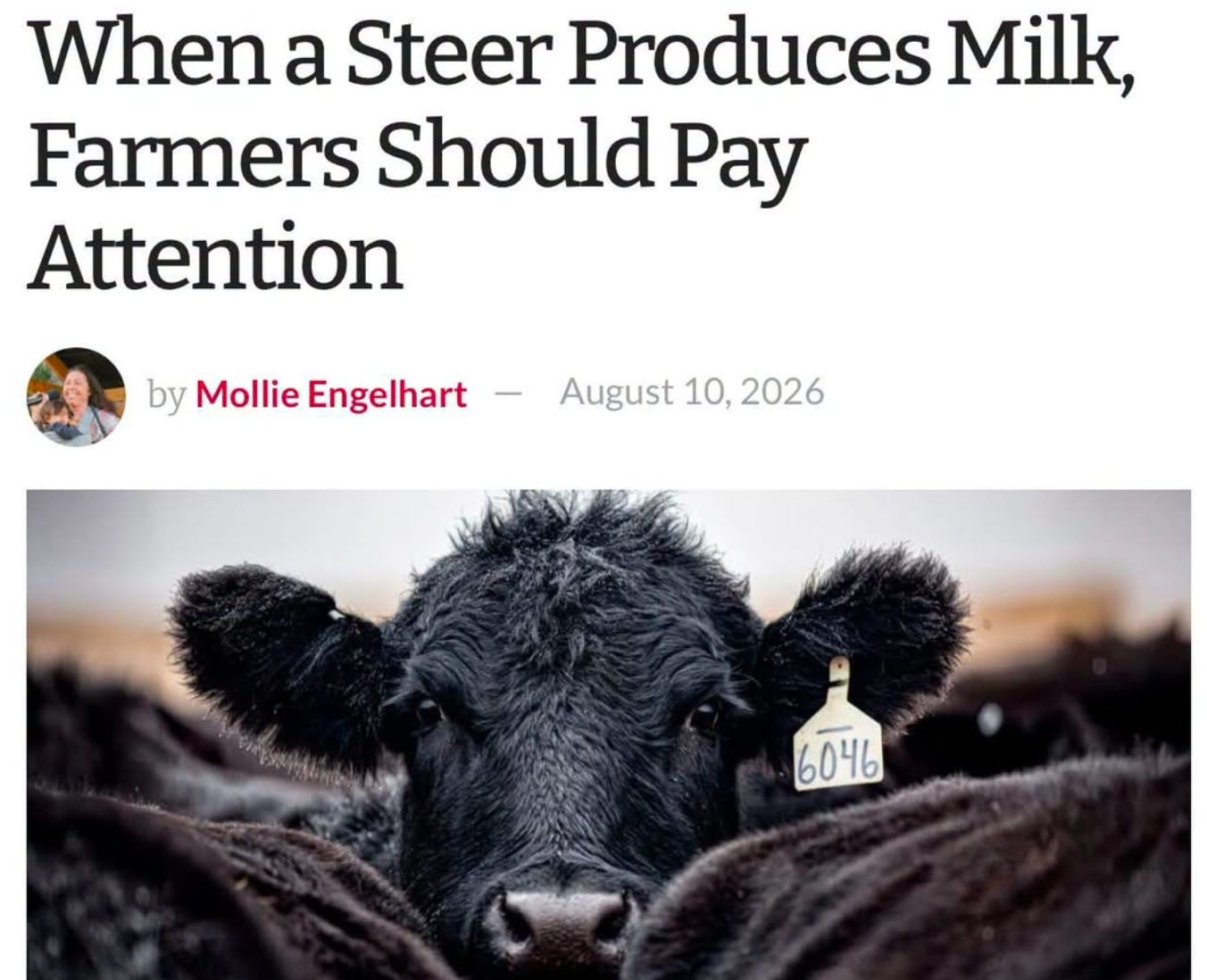
In a slightly surreal footnote to this story, the Wall Street Journal ran an article on the cattle shortage accompanied by a stock photo whose caption referred to ”lactating beef cattle, including a brown steer” standing in a feedlot pen. In case anyone needs a refresher on bovine biology: steers are castrated male cattle, and they cannot lactate. The image description was almost certainly an AI captioning error or stock-photo metadata glitch, but it circulated widely and became an unfortunate symbol of how disconnected the media apparatus can be from the actual cattle industry it covers.
In a way, the lactating steer perfectly captures the absurdity of this moment: an industry already squeezed by weather, economics, and corporate consolidation is now being documented by algorithms that can’t tell a bull from a milk cow. For American ranchers watching their regional packing plants vanish into a three-state monoculture, it is one more sign that the institutions surrounding their livelihoods are operating on autopilot.
The bottom line is that Tyson’s restructuring will save the company money, but it comes at a cost to rural economies, cattle producer leverage, and national food system resilience. When an entire nation’s beef production funnels through a shrinking handful of facilities in Nebraska, Kansas, and Texas, the question is no longer whether the industry is consolidated—it is whether it can still be called an industry at all, or simply a pipeline.
Thanks for reading! This post is public so feel free to share it.
No posts
Comments
Nothing yet. Say the first thing.
Sign in to join the conversation.