

Hi there,
Welcome to the 137th edition of Heartcore Insights, curated with 🖤 by the Heartcore Team.
If you missed the past newsletters, you can catch up here. Now, let’s dive in!
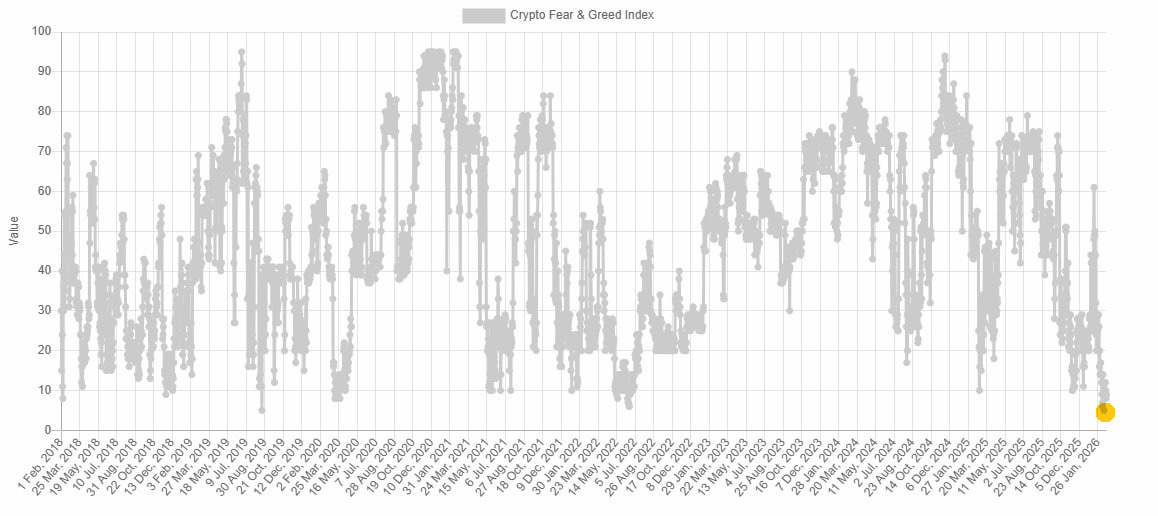
Crypto’s Fear & Greed index has clawed its way back to neutral after its Feb dip to multi-year lows. And every macro pundit has, once again, mistaken six weeks of price action for regime change.
We keep coming back to Amara’s Law: humans overestimate change in the short term and underestimate it in the long term. The list of things being mispriced on exactly that axis is getting longer. Energy prices (cheap forever or expensive forever, depending on the week). European sovereignty (a slogan in 2022, a procurement line item in 2026). Stablecoin rails (a meme three cycles ago, rivaling Visa in settlement volume today). Add agentic commerce, post-quantum security, the nuclear renaissance, the quiet reindustrialization of the continent and the tokenization of real-world assets. Each looks like noise this quarter and inevitability by 2033.
Which is why we keep returning to an old line: in the short run, the market is a voting machine; in the long run, it is a weighing machine. Blitzscaling has been an excellent way to torch capital over the past decade. Patient, systematic capability building (the unsexy, compounding kind) in the startup journey is what the weighing mechanic eventually rewards. And hence we would rather be early to the weighing than loud at the voting.
~Max Niederhofer, Partner, Heartcore Capital
Anyone looking at crypto these days must feel the structural changes of the industry. OGs are in complete dismay while fintech and regulators are excited about the prospects of stablecoins, 24/7 trading and immutability of the underlying ledgers. We wanted to take the time to shed some light on what’s happening.
The crypto industry is being reborn, and the resulting split is healthy. On one side (the side OGs have known for the better part of two decades), the industry is contracting. It is the wild west known for anonymous founders launching useless tokens full of promises, retail investors chasing asymmetric returns and product-market fit hiding behind heavily incentivised private deals.
The other side of the split looks nothing like this. Blockchain technology, dressed in compliance and applied to real problems, is attracting a new and very different class of attention and excitement. We see historically non-crypto investors such as Accel (OpenFX’s $23M round), Creandum (Midas’s $50M Series A round), Franklin Templeton (Midas, $7.5M seed round for Cap stablecoin) or institutional banks ($136M Series C round of Fnality) write checks into the technological unlock that existing rails cannot match: settlement in seconds, cross-border transactions without correspondent banking intermediaries, programmable compliance built directly into the asset layer and cost structures that reduce operational overhead by an order of magnitude.
The core driver of this shift is not technology; this technology has existed for years. It is regulation. The US GENIUS Act, signed into law in 2025, created the first federal framework for stablecoins and the US CLARITY Act working its way through the Senate is set to form clarity for the security/commodity classification of tokens, while the EU’s MiCA is actively reconfiguring usage patterns across Europe. The era of operating in a legal grey zone is functionally over, which inevitably leads to more accountability across the space.
The industry stakeholders sarcastically say that ‘token is the real product’ but it is also the major driver of failure within this industry. Governance tokens in their grey-zone regulatory treatment amplify short-term incentive thinking, misaligning both founder (“let me launch a token so that I can exit in 12 months instead of building for 10 years”) and user interests (“let me use this product so that I can get free money in a form of a token, not because I’d actually need this”).
Accountability flushes this behaviour. It also changes the initial value proposition of techno-anarchism the early adopters fell in love with. The result is the same. Some are leaving voluntarily (in 2025, we have seen some of the largest distributions on record from long-term holders); others are being pushed out. Both are making room for operators who are here to build long-term.
The old “crypto” will not die, but it will contract to irrelevance. Instead, the technology will shine and the financial industry will be the main benefactor: trading, lending, payments and capital formation on blockchain rails; these protocols are already generating real revenue at scale and earning institutional trust. Tokens will continue to exist, but the industry will converge toward clear, standardised token structures with tokens and equity gradually merging into a single instrument with clearly defined rules and value-accrual mechanisms.
We already see a case study for such tokens in our largest portfolio company, Hyperliquid 🖤. Hyperliquid’s HYPE token behaves like equity, capturing all protocol economics, and it benefits greatly, while altcoins declined 40-60% in Q1, Hyperliquid rallies 51% at the same time. The market is sending an unmistakable message: either you put token holders first or you don’t get any holders.
So where exactly are we spending our time taking advantage of this shift? We look for investments within a few, selective areas:
B2B capital markets infrastructure, particularly tokenization of difficult-to-access real-world assets, which is already a $185B market today and projected to reach $30T by 2030,
Agentic payments, where AI agents transacting autonomously demand a settlement layer that legacy fiat rails cannot provide,
Post-quantum security solutions that protect blockchain immutability and the fintech future we envision,
and builders who understand the new paradigm we are moving into.
If you are a builder or you know anyone building with this thesis in mind, we would love to chat!
~Tomas Fanta, Investor, Heartcore Capital

Vertically Integrated Capital Aggregators, Decentralised
Cybersecurity Looks Like Proof of Work Now, Drew Breunig
Prompting is the Worst Way to Use Claude, Ruben Hassid
Bad Analogies, Packy McCormick
When the Intangible Threat Becomes Tangible, Project11
10 Must-Have Skills for Claude (and Any Coding Agent) in 2026, unicodeveloper
Corti 🖤 launches Symphony for medical coding, a model outperforming OpenAI, Anthropic and Google by >25% on clinical accuracy benchmarks! 📊
Natural Cycles 🖤 now integrates with Garmin, bringing their non-hormonal birth control to even more women worldwide! ⌚
Skynopy and Nūmi 🖤 were named among the Challenges 100 start-ups to invest in 2026! 🚀
PARIMA (creators of GOURMEY) 🖤 becomes the FIRST company to receive cultivated food approval across two species! 🐓 🦆
GetYourGuide 🖤 forms new partnership with Rome2Rio! 🚌
Thank you for being a loyal subscriber of our monthly Insights. Please feel free to share this newsletter with anyone you’d think would appreciate it!
Comments
Nothing yet. Say the first thing.
Sign in to join the conversation.