
This article is a companion to this one written by Cal. These articles represent each author’s independent perspective, and were written without our usual collaborative input. We are super excited about them.
Most of the information and images in this article come from the Complex Systems Framework Collection website. It’s delightful and simple, and I highly recommend you explore it.
In one of my first pieces I wrote that we agree on nothing in massage therapy. Not education, not the definition of massage, not who our clients are, nor how best to serve them. We have no consensus, and that has prevented us from moving forward. We’re like the pushmi-pullyu from Dr Dolittle times a thousand.

Cal’s piece proposes we break up into separate groups so that some of us can pursue professionalization in healthcare and some can continue on as a vocation. Cal says we’ve proven repeatedly that we’re so incompatible we can’t move forward. We rehash the same fights and arguments we have for decades, like walking around in a cursed forest where all trails lead back to the same spot.
You might be surprised to know that the staff at Healwell doesn’t agree about everything. (This is how you got two Substack articles this week). You might be more surprised to know that it is one of the things that make us effective.
Not all problems are created equal, and the methods that will solve one kind are very different from what you need to solve the other. Oftentimes problems are a combination of simple, complicated, or complex; or vacillate between the distinctions with time. Thinking about the features of each can help us decide how to approach them.
Simple problems are straightforward. The same solution works every time, which makes consensus useful, and you don’t need a lot of expertise to carry out the solution. The most common example used is baking a cake. Anyone who follows the directions (especially the ones on the back of the box) can make a decent cake. The ingredients are always the same, and the cake tastes more or less identical each time.
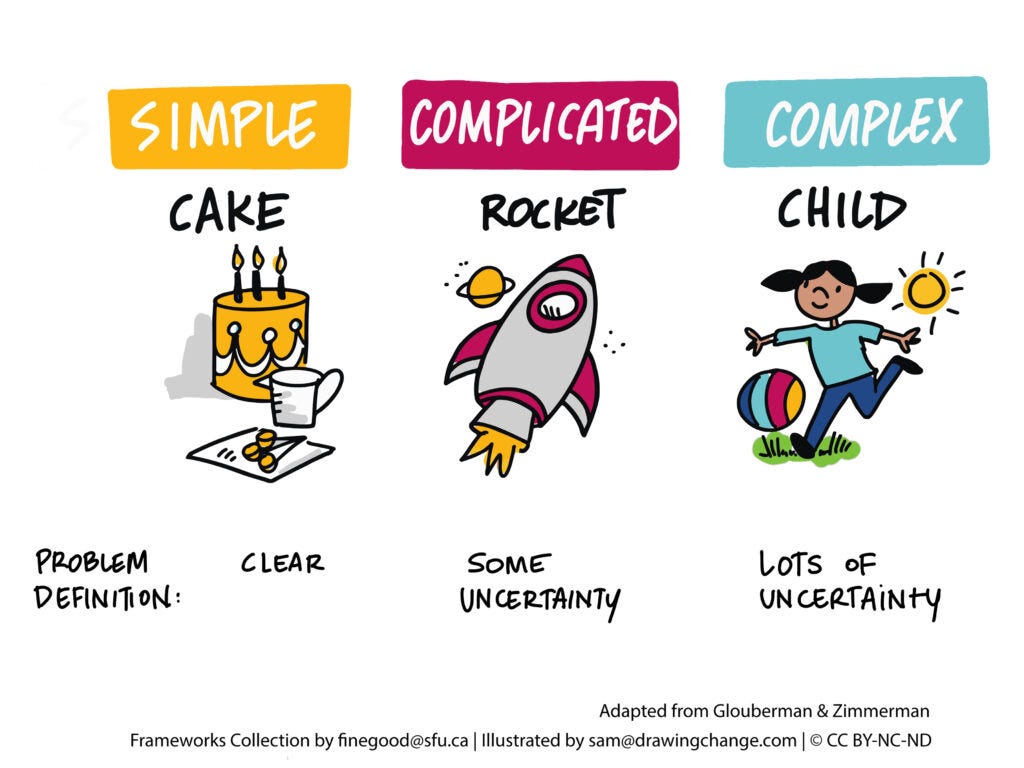
Complicated problems are often described as the process of building a rocket. In a complicated problem you can see the whole thing, even if the problem is a messy, disordered 10,000 piece jigsaw puzzle. Since you can see all those pieces, you can also predict outcomes with relative certainty. Since you can predict outcomes, you can design systems, rules, and solutions that will likely ensure the outcome you want. Complicated problems are relatively stable.
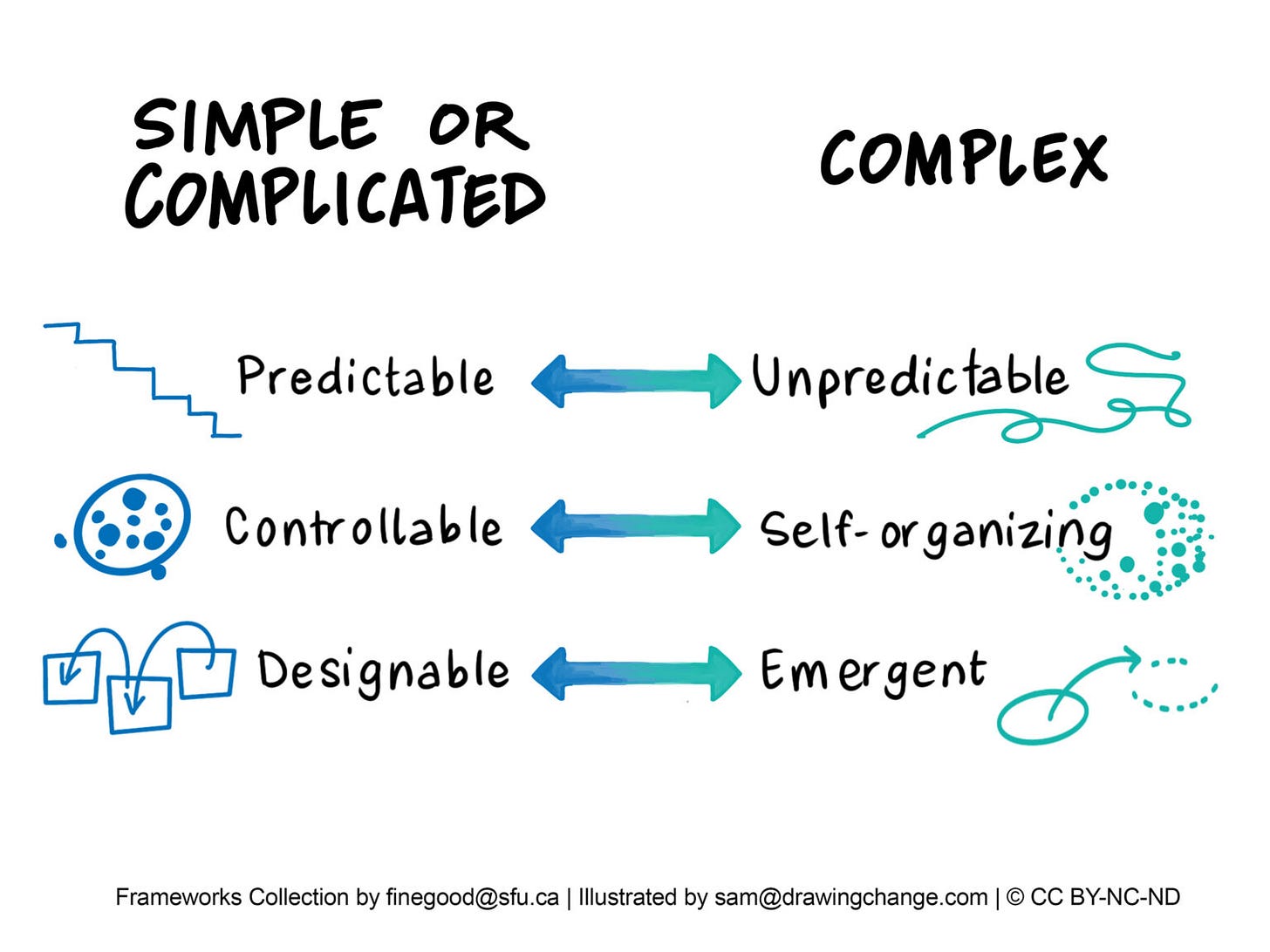
The process of raising a child is often used to describe complex problems. In a complex problem, you cannot see all the pieces. Complex problems are better described as complex systems, because they have multiple parts that interact with each other. Complex systems are self-organizing which means the structure of the system comes from how the parts interact instead of the parts being put in an order by external forces.
Complex systems can learn and adapt, so the whole system will be altered in response to one change, even if it is a very small shift. This makes the system unpredictable, because it is impossible to know what will happen after one change, let alone multiple changes.
Any alteration to the system can cause a ripple effect across other parts, which then creates more changes. This means solutions have to be emergent: they must never stop evolving because the system will never stop changing.
Imagine one day that child spills Kool-Aid on their white shirt, and learns that the drink has dyed it blue. Perhaps that’s the beginning of a lifetime fascination with textiles, or maybe it’s just a funny memory. There’s no way to predict the outcome in advance.
Complex systems operate at many levels: in massage therapy what happens in foundational education affects how regulations are written, which affects how therapists are allowed to practice, which might change foundational education requirements for future therapists. This chain of events is already complex and it doesn’t even begin to take into account other influences like shifting job landscapes, local and regional changes, actions of associations, or outside factors such as healthcare or economic recessions.
Massage therapy is an extremely complex system. If you’re reading this and thinking, “If that’s true, what can we even do about it?” Good news! People way smarter than I have been thinking about this stuff for a long time now, and the truth is that none of the solutions are straightforward but there are ways out of the complex woods.
The first step is realizing we have a complex problem, not a complicated one.
The next step is thinking about what we’ve been doing that isn’t working, and what we could do instead. We keep trying to eat soup with a fork, and the result is that we’re perpetually hungry. How do we get ourselves a spoon?
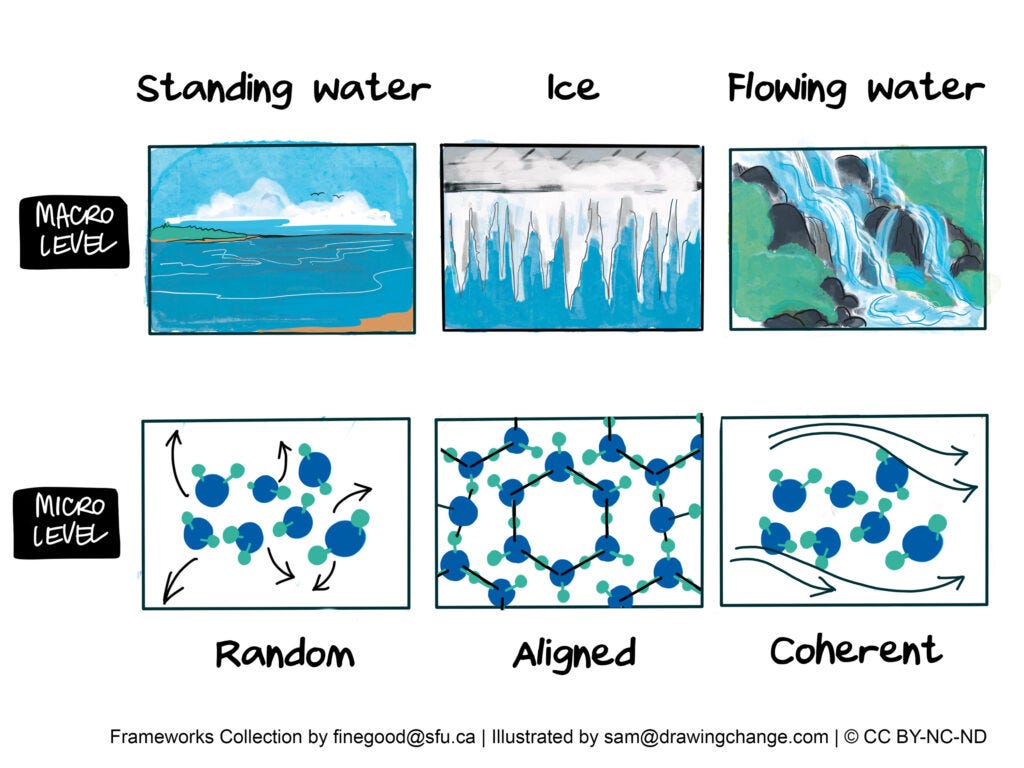
Complex systems don’t respond well to traditional solutions, namely orderly rule-based interventions. The more rigid a solution is, the less effective it will be in a complex system. Instead of rules, it is best to think in principles. Rules focus on outcomes (A + B -> C) but principles focus on process (When X happens, we start with Y, see how it goes, and then make the next step).
Rules require alignment; they need everyone to be rigidly organized, like an ice cube. Principles need coherence; everyone pulls in the same direction, but with a great deal of freedom, like a river.
When you’re working with clients, you know (or you’re about to learn) that doing the same routine with every person will not yield the same result, and it certainly won’t have the same effectiveness.
Having a rule that a person with shoulder pain gets their upper trapezius rubbed misses the possibilities of deeper injury, rib subluxations, cross-body dysfunction, open wounds, or irritated nerves. Instead of a rule, it’s more effective to have a principle: when a client reports pain, you follow up with intake questions and assessments to evaluate how you can best help. As you work, you continuously re-evaluate based on your observations, client feedback, and other information that develops.
What solutions have we tried to deal with our complex system of massage therapy? Mostly we’ve relied on a few organizations to create blanket rule-based solutions. This involves the dubious assumption that Someone Must Know Best, and that our problems are Complicated, Not Complex.
The AMTA/MTF/NCBTMB trifecta in particular is very rules and procedure based. The trifecta does things through regimented channels:
The Massage Therapy Foundation (MTF) is involved in research, and research is a very rule-based paradigm.
The National Certification Board of Therapeutic Massage and Bodywork (NCBTMB) restricts what kinds of classes can get CE approval and fiercely protects the image of their Board Certification as the only credential worth credentialing.
The American Massage Therapy Association (AMTA) is internally structured as a hierarchy with a high and somewhat mysterious barrier to entry. They make all major decisions for MTF and NCBTMB, because both those organizations are member-based with a single member– which is AMTA. AMTA tends to be very focused on only the things they consider important, and they don’t often look to other associations, professions, or disciplines for solutions.

Associated Bodywork and Massage Professionals (ABMP) is much smaller than the trifecta and somewhat more loosely structured but they operate in a similar top-down manner. A small group of people at the top try to figure out what their members want, and then deliver it though a variety of channels, including a magazine, CE courses and webinars, and some conference-type events.
The Commission on Massage Therapy Accreditation (COMTA) runs school accreditation, which is a government-related process. This automatically makes them rules-based in the same way our research organization has to be.
The Federation of State Massage Therapy Boards (FSMTB) is probably the most principle-led, but that has resulted in them expanding their scope to try to cover a lot of ground. FSMTB runs our national licensing exam, and approves some CE (in a restrictive manner similar to NCBTMB) and they also undertake government-related matters like the Interstate Compact (IMpact). Again, working with the government means adhering to the rules.
The Alliance for Massage Therapy Education (AFMTE) is supposed to assist in educating teachers, but it doesn’t have enough internal structure or financial support to accomplish very much, whether that be rules-based or principles-based.
All of these associations are trying to wrap their arms around the complex system that is massage therapy. Whether these groups are rules-based by choice or necessity, they are each so rigid that they end up smashing into each other like titans. The fallout from the smashing lands on practitioners, and we end up not gaining real ground in any area.
What is the alternative?
Cal suggested that we break up completely. I think we should work together, but only a little bit, and very differently than we have in the past.
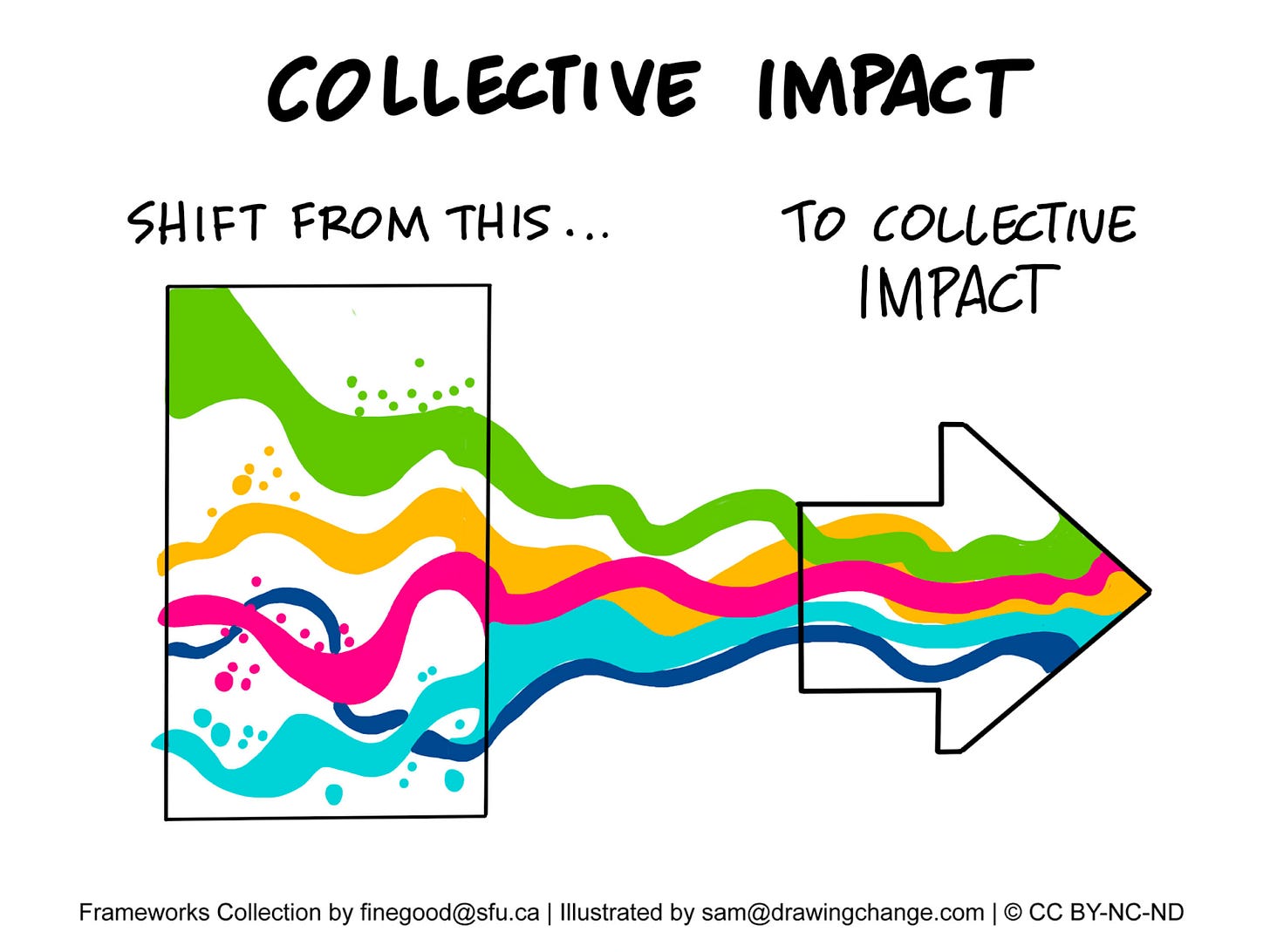
Collective Impact is when different groups come together and create an agenda to solve a common problem. The groups agree on a shared vision, and an understanding of what the problem is. They come up with a measurement system that everyone will use to track success and hold each group accountable. They coordinate efforts, so that each group can complement and support the others. One group acts as the backbone of the initiative, providing staff, planning, and management. All groups communicate regularly and openly with trust and honesty.
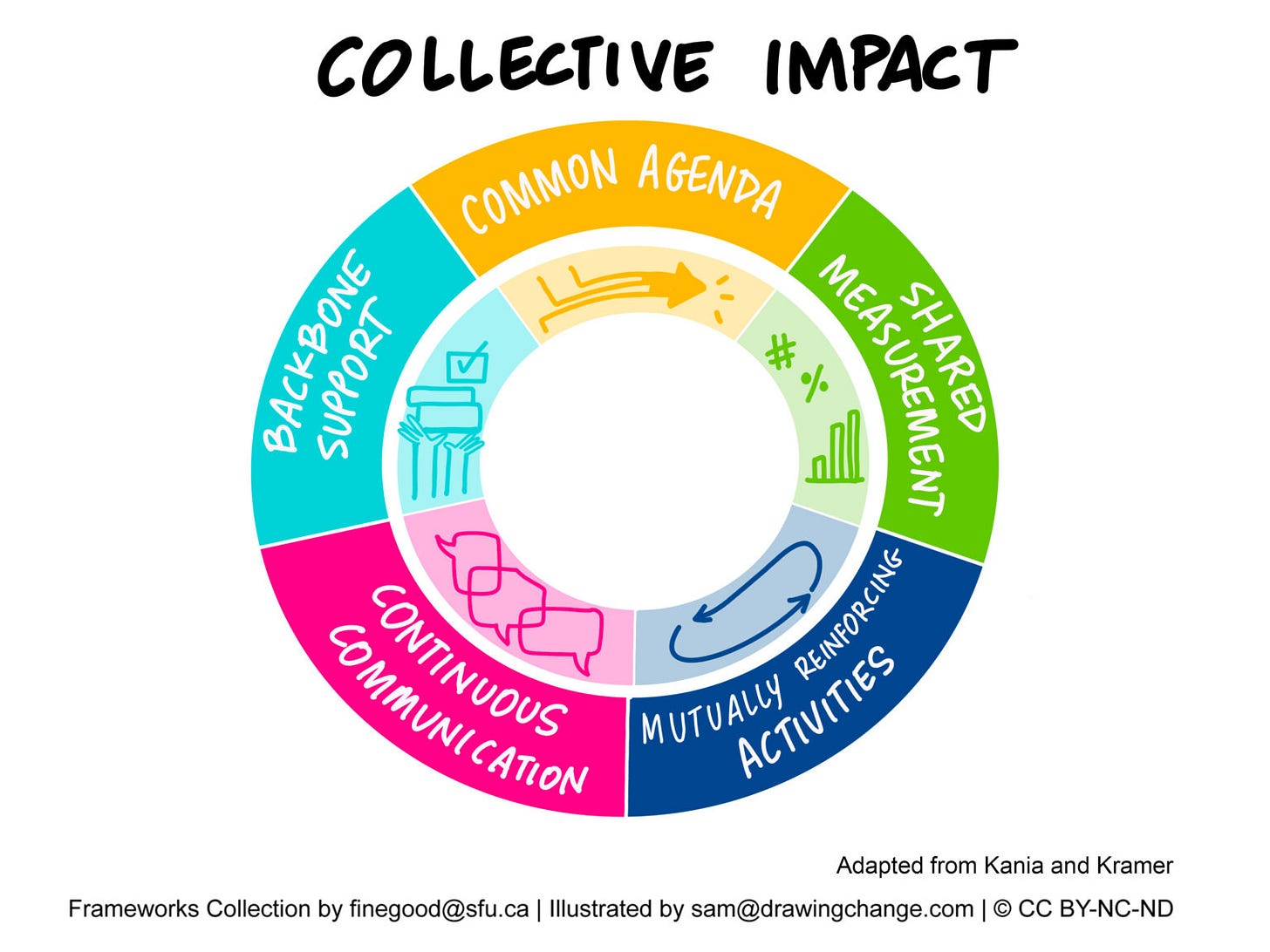
This is how Healwell operates. Executive Director Cal Cates, along with our board, acts as the backbone. Each department operates with relative autonomy within their area of expertise, asking for help when they need it, and supporting other departments to accomplish Healwell’s goals. Despite living in five states and several different time zones, the staff makes a lot of effort to keep trust high and communication lines open.
We don’t have to be in lockstep. After this many decades, it’s clear we’re not going to agree on everything. But I think there are at least three things we do agree on:
All massage therapists deserve to feel safe and supported in their jobs. This includes physical, psychological, and financial safety.
All humans deserve access to safe massage therapy that is effective for them and their bodies.
Massage therapy is profound.
If we got together to talk seriously about it, we could come up with a few more things we all agree on. Once we drop the pressure of having to reach a consensus, there will be a lot more room for finding commonalities.
I don’t want massage therapy to continue being a bunch of titans lobbing fists at each other, so preoccupied with infighting they don’t notice other professions creeping into their territory. I want us to be like Ghidorah,1 the golden three-headed dragon in the Godzilla movies.

Each of Ghidorah’s heads has a brain, and they operate independently. Sometimes they get annoyed with each other and fight. But they share a body and they can cooperate when they need to defend themselves.
They can even defeat Godzilla.
Maybe Cal is right, and we need to break up. But I don’t think massage therapy has ever tried a collective impact approach in our entire history. There are a ton of resources that can help us organize like this. The website I got all these amazing graphics from has so much information about dealing with complex issues. I want to approach the complex system of massage therapy in a logical, deliberate way by following the work of other people who have spent their lives grappling with how to solve problems like ours.
I want to stop trying to build a rocket when we need to raise a child.
I’ve been waiting a long time to make a Godzilla reference.
Comments
Nothing yet. Say the first thing.
Sign in to join the conversation.