
We spend years developing specialist knowledge, frameworks and ways of understanding the challenges we face.
That expertise helps us interpret new legislation, standards and guidance, understand their implications and advise organisations with confidence.
The challenge is that organisational issues rarely arrive one at a time. They overlap, influence one another and often require responses that extend beyond the boundaries of any single discipline.
Looking at what’s emerging over the next 12–18 months
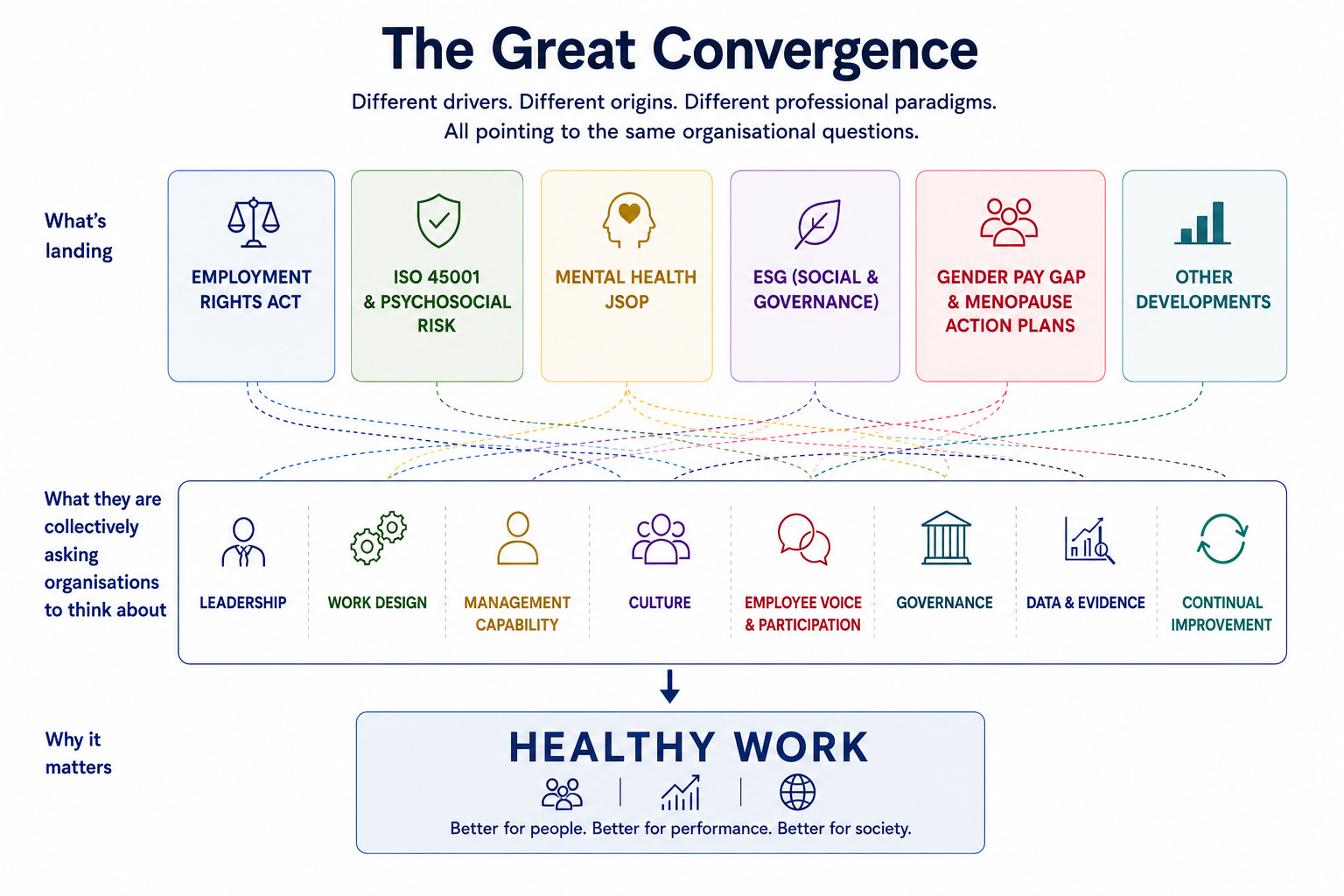
The phased implementation of the Employment Rights Act, developments in gender pay gap and menopause action planning, the forthcoming revision of ISO 45001, the growing prominence of psychosocial risk management, the continuing influence of ISO 45003, the emerging Mental Health JSOP and the evolution of ESG all originate from different professional disciplines and have their own technical requirements.
Viewed together, however, they seem to tell a much bigger story. Rather than asking organisations to respond to a series of disconnected developments, they appear to be pointing towards a fundamental shift in how work, health, safety, wellbeing, inclusion and leadership need to be understood and governed.
The more interesting question, then, is not how we respond to each individual development, but whether we’re doing enough to see the whole system rather than simply becoming better at managing our own part of it.
Over the next 12–18 months, organisations will be navigating a significant number of developments affecting the way they manage people, health, safety and organisational performance.
Some are legislative. Others are revisions to established standards. Some reflect evolving professional guidance, while others signal changing regulatory expectations. Each has its own rationale, technical language and implementation requirements.
Consider just a few examples.
The phased implementation of the Employment Rights Act will introduce a wide-ranging package of reforms affecting employment practice. Beyond legal compliance, organisations will need to consider the implications for policy, management capability and organisational culture.
The growing emphasis on action planning reflects a broader shift from reporting towards demonstrating how organisations intend to improve outcomes. Increasingly, organisations will be expected not only to measure issues but also to show how they are are addressing them.
The forthcoming revision of ISO 45001 is expected to strengthen the emphasis on psychosocial risk, organisational culture and leadership. Alongside ISO 45003, it reinforces the expectation that psychological health should be managed with the same systematic approach as physical health and safety.
The emerging Mental Health JSOP adds to a growing body of guidance emphasising prevention, organisational responsibility and the creation of healthy work, rather than relying solely on reactive support.
Although often associated with environmental sustainability, ESG has evolved into a much broader agenda encompassing workforce health, wellbeing, diversity, human rights and governance. Like many of the developments discussed here, it reflects a growing recognition that organisational performance cannot be separated from the way organisations lead, manage and support their people.
Taken individually, each of these developments has its own purpose and professional context.
Viewed together, however, they raise a much more interesting question.
Are they simply a series of separate developments, each requiring its own response? Or are they evidence of something more fundamental changing in the way organisations are expected to manage work, people and risk?
The more I looked across these developments, the more I found myself thinking about where they naturally sit within organisations.
Most have an obvious professional or functional home. Employment law sits naturally within HR and legal. ISO 45001 is the domain of Health and Safety. ESG emerged from the sustainability agenda.
There is nothing inherently wrong with that. Professional disciplines exist for good reason. They provide the knowledge, frameworks and ways of thinking needed to interpret increasingly complex issues.
What interests me, however, is how these developments are beginning to stretch the boundaries of those disciplines.
Take psychosocial risk as an example. Its inclusion within occupational health and safety management systems doesn’t simply broaden the scope of Health and Safety. It introduces a category of risk that cannot be fully understood through a traditional occupational health and safety paradigm alone. Understanding and preventing psychosocial harm requires organisations to consider work design, leadership, management capability, organisational culture, organisational change and employee voice. These are issues that have traditionally been understood through different professional lenses and influenced by different parts of the organisation.
ESG illustrates a similar shift. Although rooted in environmental sustainability, its social dimension now encompasses workforce health, wellbeing, human rights, diversity and organisational governance. Again, the issues themselves extend beyond the boundaries of any single professional discipline or organisational function.
The same pattern is beginning to emerge elsewhere. Mental health guidance increasingly focuses on the conditions that create healthy work rather than simply supporting people once problems arise. Employment law increasingly has implications that extend beyond legal compliance into leadership, management practice and organisational capability.
Perhaps that is where the real convergence lies.
Not because these developments are becoming the same, but because they increasingly expose organisational challenges that sit at the intersection of professional disciplines, requiring organisations to bring together different perspectives, different forms of influence and different sources of organisational authority if they are to respond effectively.
If this analysis is correct, then perhaps the biggest challenge facing organisations over the next few years is not understanding each individual development. There is already a wealth of technical guidance available to help organisations interpret employment law, implement ISO standards, develop action plans and respond to emerging professional guidance.
The greater challenge may be understanding how these developments relate to one another.
Most organisations are structured around professional disciplines and functional responsibilities. That has served them well, enabling specialist knowledge to develop, technical standards to improve and accountability to be clearly defined.
The developments we’ve been discussing do not make those structures redundant. They do, however, increasingly expose their limitations.
As professional boundaries are stretched, organisations are finding themselves dealing with issues that no longer sit comfortably within a single function or professional paradigm. The expertise remains essential, but responding effectively increasingly depends on how well organisations bring different perspectives together before deciding how to act.
The question is no longer whether one discipline should take ownership of another. It is whether organisations have created the conditions for different professional perspectives to come together in a coherent way. That is as much a question of governance as it is of technical expertise.
It also raises a more practical question.
If these developments are increasingly asking organisations to examine many of the same organisational factors—leadership, work design, management capability, culture, employee voice, organisational change and continual improvement—why do we so often approach them as separate conversations?
Once I started looking for these connections, I found them almost everywhere.
Take organisational surveys. Most organisations already invest significant time and effort in employee engagement surveys. Increasingly, they are also considering psychosocial risk assessments, while many periodically undertake safety culture surveys.
Each has a different purpose and each has evolved from a different professional tradition. Yet when you look beneath the labels, many of them are exploring remarkably similar organisational themes. Leadership, communication, trust, workload, employee voice, organisational change, management capability and role clarity appear repeatedly, although they are described through different language and interpreted through different professional lenses.
The question this raises is not whether organisations should stop measuring these things. Rather, it is whether they are recognising how closely related they have become. If engagement, psychosocial risk and safety culture are all seeking to understand different aspects of the same organisational system, does it still make sense to think about them as entirely separate activities?
I find myself asking similar questions about management development.
Managers are expected to create psychologically safe teams, lead inclusively, manage organisational change and fulfil their health and safety responsibilities. Most organisations recognise the importance of each of these areas, yet they are often developed through separate training programmes, owned by different functions and explained using different language.
From a manager’s perspective, are these separate conversations?
Perhaps the challenge is not to train managers in more subjects, but to help them understand how these responsibilities fit together in the reality of leading teams. Technical knowledge will always have its place, but it is the underlying capabilities—self-awareness, curiosity, sound judgement and the ability to have conversations that build trust, surface concerns and support good decisions—that enable managers to apply that knowledge well, whatever the context.
The same questions might be asked of governance. Are we examining different aspects of the same organisational issues?
If the landscape is converging, perhaps the way we make sense of it needs to converge too.
If this really is a great convergence, then I think it asks us to work differently.
When a new piece of legislation, revised standard or professional guidance lands on your desk, resist the temptation to see it as another standalone project. Before asking “What do we need to do?”, ask three questions.
What else is happening that is trying to achieve a similar outcome? Many of these developments are asking organisations to think about the same underlying issues—leadership, work design, management capability, culture and governance—even though they arrive through different professional disciplines.
Who else should be involved in making sense of this? Don’t wait until the policy has been written or the implementation plan agreed. Bring together the different professional perspectives while you’re still trying to understand the issue.
What can we build on rather than create? Could an existing management development programme be strengthened rather than introducing another one? Could an engagement survey provide evidence that also informs psychosocial risk? Could an existing governance forum consider this issue rather than creating another group?
Only then ask who should own the work.
Professional expertise remains fundamental, but perhaps our role is changing. Increasingly, our value lies not only in interpreting developments within our own discipline, but in helping organisations recognise where they connect with everything else that is already happening.
No posts
Comments
Nothing yet. Say the first thing.
Sign in to join the conversation.