
Has your garden taken off for the season? All that extra light around the solstice signals plants to start growing like crazy.
Unfortunately, all that beautiful growth also makes our gardens very appealing to pests.
Japanese beetles go after my grapevines and potato beetles gobble up my groundcherry plants. Whether it’s destructive vine borers or swarms of mosquitoes, some bugs can really put a damper on our enjoyment of the garden in summer.
But getting to understand how these pests work can help us take steps to limit the havoc they wreak on the garden. Pest problems vary with where and what you’re growing, so while some folks have trouble with slugs, others of us are more familiar with cucumber beetles or squash bugs.
My least favorite garden invaders are Japanese beetles, squash vine borers, and the dreaded Asian jumping worm. Below are tips on managing them gleaned from countless hours of research and many years dealing with them in my garden.
I generally have a live-and-let-live attitude in the garden. I don’t worry too much about weeds — so many of them are edible, anyhow — or the bugs who call our yard home. That is, unless they start damaging more than their fair share of my plants.
Then I get serious. And sometimes vengeful.
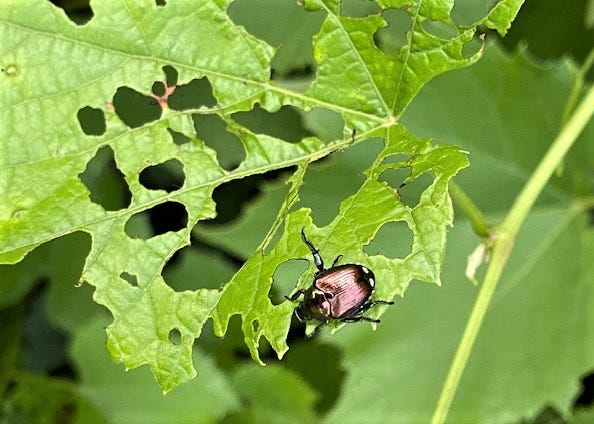
Japanese beetle feeding season is only about 6 weeks, but these creatures can do a truly astonishing amount of damage in that time.
Unfortunately, my edible landscape has many plants that Japanese beetles find utterly irresistible, especially my beloved grapevines, which shade our porch from summer heat and screen us from the view of passersby. They also like the leaves of my plum trees and the jewelweed that pops up every summer.
As much as I detest their garden-wrecking habits, I have to admit that Japanese beetles are kind of gorgeous, with their metallic bronze and green colors. But allowing some to remain means inviting a full-blown infestation, because their presence attracts boatloads of their buddies to feast on my plants.
Until every single leaf is nothing but a skeleton, and they move on to their next victim.
My state’s extension says that the damage is mainly ‘cosmetic,’ but if you have a huge wall of grapevines they’ve skeletonized, it’s not only unsightly, but the leaves also can’t serve their purpose of providing cooling shade.
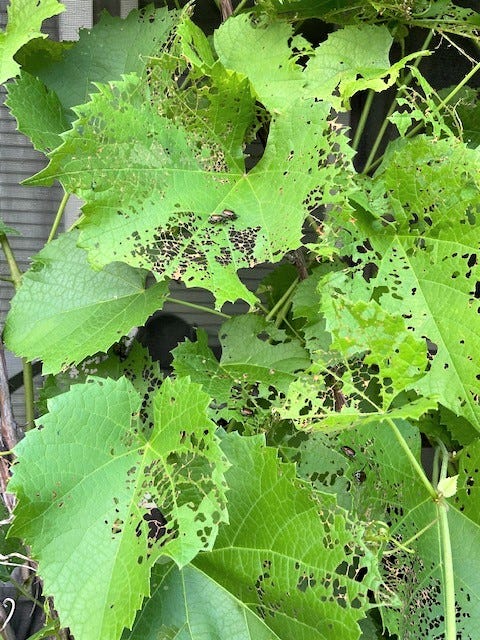
The most critical thing in your battle against these voracious critters is EARLY intervention. If you get rid of any Japanese beetles you find early on, they won’t have a chance to invite all their friends to join them or to reproduce, so you may avoid an infestation.
I’ve read the leaves they chew on give off scent to tell other Japanese beetles in the area where the good eating is, so the longer you allow them to nibble your plants, the more beetles you invite to the feast.
So keep your eyes peeled for damage and GET THEM as soon as you notice they’re there. The first year I found Japanese beetles on my grapevines, I had no idea what I was in for until it was too late.
They multiply quickly. One day you don’t see them at all and the next you may find hundreds. Be vigilant if you’ve spotted them in your garden, as it’s so much easier to deal with them when there are only a handful.
The easiest way to get rid of Japanese beetles is knocking them off the plant into a container of soapy water, where they quickly drown. The soap provides surface tension that keeps them from getting out.
The best time of day to get them is in the morning, when they’re more sluggish and the dew on their wings makes flying more difficult. I’ve had success in the evening as well, but they’re more prone to fly away. During the day, they’re much harder to knock into your pail of water, as they tend to fly off when you try.
A simple row cover can keep Japanese beetles from getting access to your plants, though that won’t work in all cases. Our grapevines go up a good ten feet and stretch the length of the porch, so covering them isn’t practical. Even a mature dwarf fruit tree is too tall to cover.
If pollination is an issue, covering your plants may keep pollinators out as well, so bear that in mind as you consider your options.
A couple years ago, I decided to cut back my grape vines once the beetles showed up, and it helped in several ways:
1) There was less available food for them, so the total numbers I was dealing with went down.
2) Thinning the vines made it harder for them to hide than in dense leaf cover, making it easier for me to find them on my daily drowning rounds.
3) Nibbled leaves are far less awful looking when it’s not an entire wall of sick-looking vines. The damage is less noticeable than when I let the leaves remain in large numbers and they all get skeletonized.
Since then, I’ve started trimming back the vines before the beetles’ season starts at the end of June, so there’s much less to attract them here in the first place.
While I miss the dense leaf cover on the porch and the cooling it provides, this strategy seems like a decent solution to the problem while other control measures are underway.
I learned from a permaculturist I interviewed for a magazine article that Japanese beetles have no interest in kiwi vines, and she advised all her clients whose grapevines were suffering from Japanese beetles to replace them. I took her advice and planted some and they’re slowly taking over some of the area previously covered by grape leaves. I’ll keep cutting back the grapevines until the kiwis can provide a similar level of cover. This year I added schisandra vines as well.
Your Japanese beetle population may be greatly reduced if you can get rid of the larvae before they get a chance to become beetles.
Some experts recommend driving the larvae out of the soil in fall and spring with a weekly soaking with soapy water. Birds will eat the surfaced grubs, helping to keep your Japanese beetle population down.
Bacillus popilliae, also known as milky spore, is a bacteria that causes disease in Japanese beetle grubs, though it isn’t harmful to other animals or humans. It’s sold as a treatment for grubs, but university research trials have not found it especially effective. Users have reported success if you want to give it a try.
Beneficial nematodes go after the larvae and may help keep populations of Japanese beetles as well as a number of other pests down. Here’s more on nematodes from the University of Vermont.
Nematodes are most effective when added to your soil in late summer and early fall, which will lower populations the following year. However, nematodes can be added to the soil anytime, as long as you keep your soil watered.
You can find further details about Japanese beetle control here.
I hope some of those ideas help you in your beetle battles this summer!
Squash vine borers are whitish larvae with distinctive brown heads that make their home inside the stem of your squash plants. Those large hollow stems of squash plants make it easy for them to travel along their paths of destruction.
You’ll see damage along the stem where they’ve nibbled. The orange-brownish gunk is called frass, the term for squash vine borer poop.
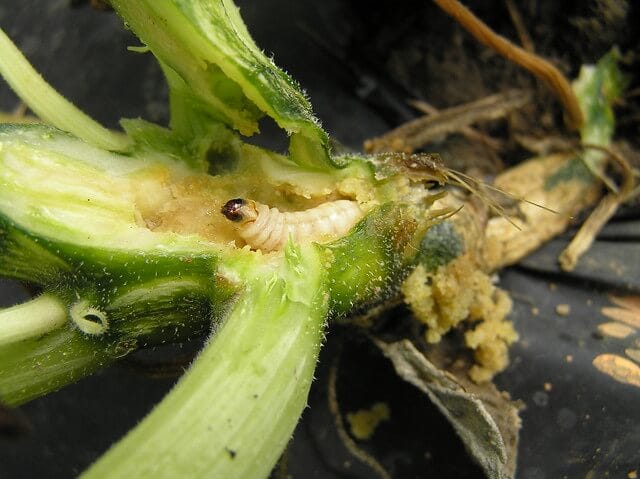
Charming, right?
As these nasty creatures munch their way through your plant, they impair its ability to move nutrients and water around. Leaves yellow and wilt.
Instead of plump, green, rapidly-growing zucchinis, ends shrivel and soften until they begin to decay.
First, the vines look a little droopy. Then one squash begins to shrivel. Then another. Soon the whole plant is a sad, withered mass and your zucchini crop is no more. (Cue tragic music.)
If you’ve never been afflicted with these vile creatures, you might think I overreact. But if you have, I’m sure you know exactly what I’m talking about.
If you know how to deter these menaces, you can save yourself much garden agony. I hope some of these prevention strategies work for you!
To prevent borers from destroying your squash crop, my local extension recommends placing yellow buckets filled with water around in late June (earlier if you live somewhere warmer than Minnesota, which I hope most of you do). This simple DIY squash vine borer trap helps drown the adults before they can lay eggs on your plant.
Since squash vine borer moths lay only one set of eggs per year, delaying your planting until after that time can keep them from infesting your prized squash plants. Zucchini are among the fast growing vegetables that can reach maturity even if you’re planting late.
Check with your local extension service about timing. In Minnesota, planting in early July should miss the window for squash vine borer eggs, though it makes it challenging to get all the squash to maturity before our first frost. If you have a longer growing season, you’ll have more luck with multiple plantings.
You can also cover your vines with floating row covers to keep squash vine borer moths from laying eggs on the plants, as long as it’s not an area where you had plants in the squash family planted the prior year. If vine borers were there the previous season, borer moths may emerge from the soil and lay eggs under your row cover. (Not what you want!)
Rotating where you plant your squash crops can help as well.
Don’t forget to remove row covers once flowers begin to appear, or pollinators won’t be able to work their magic. You can also try wrapping the stem with cut row cover material extending below the soil line. I’ve also seen people use pieces of ace bandage or aluminum foil.
A weekly wipe-down with insecticidal soap should help remove squash vine borer eggs.
Too late for prevention strategies? There are ways to handle borers if you find them that can save your squash crop.
If you see signs that the vine is being attacked, you can try stabbing into the vine with a paperclip in hopes of mortally wounding the borer. I haven’t had much luck with this method, but it’s a good way to vent some of your frustration.
Another method for removing the larvae is a little grosser, but works better, so it’s ultimately more satisfying.
I pull off stems with visible damage and pull them apart lengthwise. I will often find one of the fat borer larvae sitting there, contentedly murdering my plant.
This method works on the hollow stems of summer squash, but not the denser stems of winter squash vines, unless you’re really lucky and a larva is working its way up to a leaf. Mine seem to stay in the stems.
You can try slicing carefully into the stem of your squash vine with a sharp knife anywhere you can see damage and see if you can find any larvae hiding there. Just don’t sever the stem, and you should be able to remove borers without killing your plant.
You can kill any larvae you find by dropping them in soapy water, or any other means that suit you. Just be sure you kill it. Dropping larvae in the compost will likely mean they will continue to plague your garden.
If you manage to remove the larvae, your plant has a much better shot at survival. The next step will help also.
You can buy an infested plant more time by covering damaged areas of the vine with soil. Having the wound covered can help your plant muddle through a bit longer and may help you see more squash to maturity.
Anywhere along the vine you see damage, cover with soil and water well. Keep replacing the soil if rain washes it away, and watch carefully for damage further down the vine.
It’s best to remove any flowers and small squash at this point so the plant can put its energy into ripening the bigger squash. Its days are probably numbered, but I have managed to eke out several more zucchini from plants that had borers with this method.
Learn more about dealing with squash vine borers here.
Stay tuned for part two, where we meet the dreaded Asian jumping worm.
Wishing you sunny and mostly pest-free summer days!
—> What’s your garden nemesis? Feel free to vent (or share tips) in the comments.
No posts
Comments
Nothing yet. Say the first thing.
Sign in to join the conversation.