
Dear Readers,
Welcome to the latest edition of the HealthVC newsletter.
HealthVC is the go-to newsletter for founders, LPs, and emerging managers who want to master fundraising, build institutional-grade data rooms, and understand how investors actually make decisions.
Many founders think the company becomes more impressive when it is doing more.
More markets. More customer types. More use cases. More partnerships. More pilots. More investor narratives. More strategic options. More product directions. More possible business models. More ways the company could win.
From the inside, this can feel like ambition. The founder sees the scale of the opportunity and wants investors to understand how much the company could become. They want to show the platform potential, the market breadth, the customer demand, the strategic relevance, and the number of doors that appear to be opening.
But from the outside, doing more can create a different signal.
It can make the company look less clear.
This is one of the most common problems in early-stage fundraising. The founder is working hard, the company is active, the story is full of potential, and there are many possible paths forward. But the investor struggles to understand what the company is actually choosing.
That matters because investors do not just fund activity. They fund focus. They need to believe that the founder understands which path creates the most value, which risk matters first, which customer matters now, which market should be prioritised, and which milestone the round is designed to unlock.
The strategic clarity problem appears when a company has motion but not enough direction. The founder can describe many opportunities, but not the sequence. They can explain many use cases, but not the wedge. They can talk about many customer types, but not the buyer. They can reference many partnerships, but not the commercial logic. They can show many investor narratives, but not one strong investment case.
This does not mean ambition is bad. Investors want founders who see large outcomes. They want companies with room to grow. They want businesses that can become much bigger than the first product, first customer, or first market. But ambition needs structure. Without structure, breadth starts to look like confusion.
The strongest founders do not make the company look bigger by saying yes to everything. They make the company look more investable by showing what matters first.
Early companies are full of activity. That is normal. Founders need to speak to customers, build product, test assumptions, recruit talent, raise capital, manage advisors, explore partnerships, and create momentum before the company has institutional support around it.
The problem begins when activity starts to replace strategy.
A founder may have twenty customer conversations, but no clear view of which customer segment matters most. They may have several pilot discussions, but no defined criteria for which one should move forward. They may speak to investors across different categories, but keep changing the story depending on who is listening. They may pursue partnerships because the logos look impressive, without knowing whether those partnerships reduce a real risk.
This can create the appearance of progress while hiding a lack of prioritisation. The company is busy, but the direction is still unclear. Investors can sense this quickly because fundraising forces the founder to explain not only what is happening, but why it matters.
When an investor asks what the next twelve months are meant to prove, the answer cannot be a list of activities. It needs to be a strategic argument. The company is choosing this market because it creates the cleanest path to evidence. It is prioritising this customer because they have the clearest pain, budget, and adoption pathway. It is building this product wedge because it reduces the most important risk. It is raising this amount because it gets the company to a milestone that changes the financing case.
That is strategy.
Strategy is not everything the company could do. It is the discipline to choose what the company should do now.
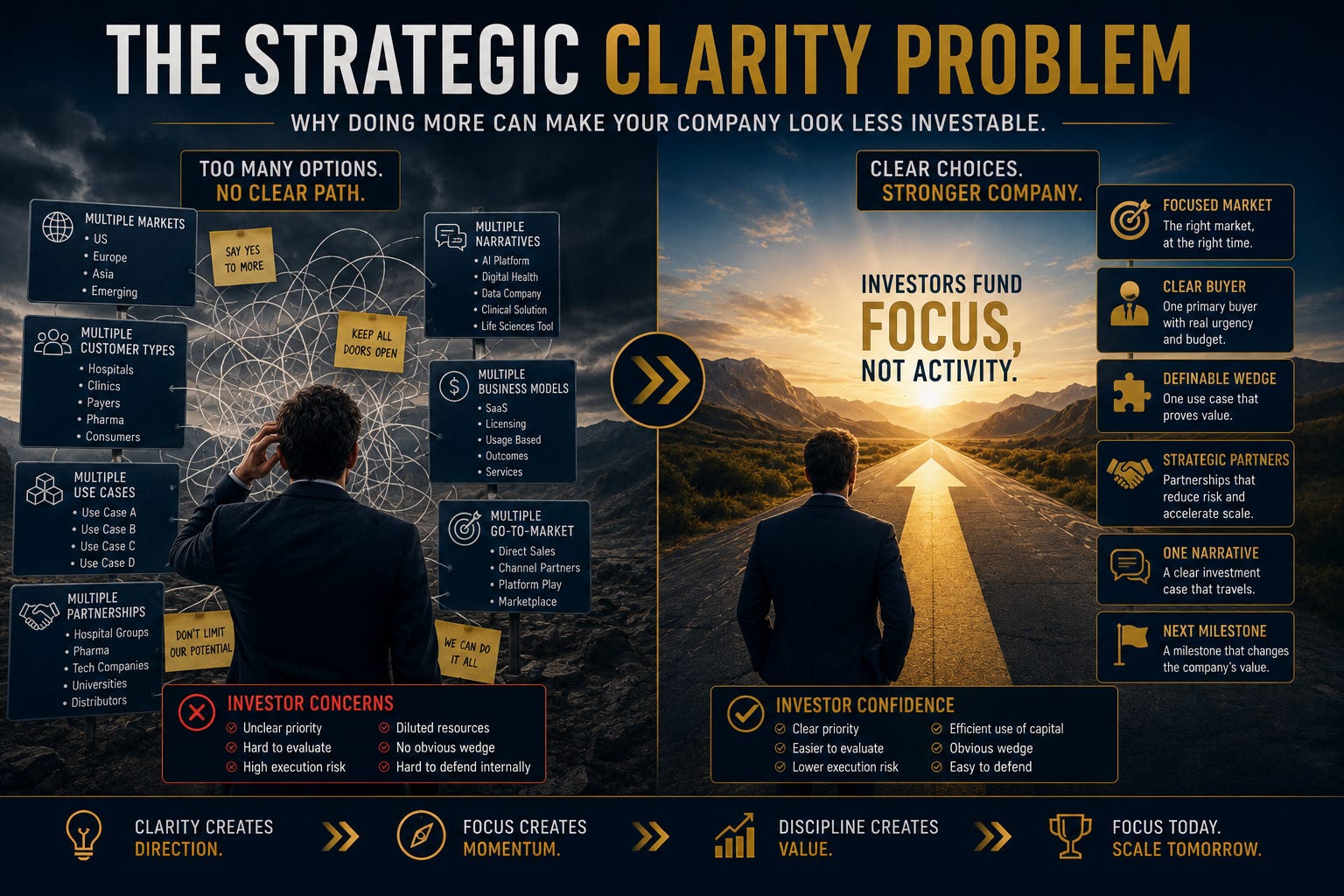
One of the fastest ways to lose investor confidence is to present too many markets at once. This happens often in health because many technologies genuinely have broad potential. A diagnostic platform may apply across several disease areas. A digital health product may help providers, payers, employers, and pharma. A medtech innovation may have multiple clinical use cases. A data platform may be relevant to hospitals, life sciences companies, insurers, and public health systems.
The founder sees this breadth as strength. The investor often sees it as unfinished thinking.
The issue is not whether the company could eventually serve multiple markets. The issue is whether the founder knows which market creates the strongest first investment case. Investors are not only asking where the company could go. They are asking where the company should start, why that starting point is credible, and what it proves about the larger opportunity.
If every market is presented as equally attractive, the investor has to do the prioritisation themselves. That creates friction. It also raises concerns that the founder may not understand the adoption path deeply enough. Different markets have different buyers, budgets, timelines, evidence needs, regulatory questions, pricing models, and sales motions. A company that tries to pursue all of them too early can spread itself thin and learn too slowly.
Focus does not make the company smaller. It makes the first path more believable.
A founder can still explain the broader vision, but the first market needs to be clear. The investor should understand why this market comes first, what evidence supports that choice, what will be learned, and how success there opens the next path. Without that sequence, the market story becomes a collection of possibilities rather than a strategy.
The same problem appears with customer types. Many founders describe several possible buyers because they do not want to close off optionality. They say the product could be sold to hospitals, clinics, pharma companies, payers, employers, consumers, governments, or research institutions. In some cases, that may be true. But it also creates a serious problem.
Each customer type represents a different business.
A hospital buyer is not the same as a pharma buyer. A payer is not the same as an employer. A clinician is not the same as a procurement department. A patient user is not the same as an institutional customer. A research team is not the same as a commercial buyer. Each has a different problem, incentive, budget, decision process, implementation barrier, evidence requirement, and sales cycle.
When a founder describes too many customers at once, investors may worry that the company has not yet found its buyer. That is different from having a large market. A large market is useful only if the company knows how to enter it. Without a clear buyer, the go-to-market strategy becomes vague.
This matters because investors need to understand how demand becomes revenue. Interest is not enough. Clinical enthusiasm is not enough. Strategic curiosity is not enough. The buyer story has to explain who feels the pain strongly enough to act, who controls the budget, who influences the decision, what evidence they need, how long the process takes, and what makes the purchase urgent.
A founder who cannot answer this clearly may still have a strong product, but the commercial path will feel weak. The investor may like the opportunity and still pass because the company has not made a clear strategic choice about who it is serving first.
Use case expansion is another common source of strategic confusion. Founders often want to show that the product can solve many problems. The platform can support many workflows. The technology can apply to many disease areas. The data can inform many decisions. The tool can serve several parts of the organisation.
Again, the founder sees this as upside. Investors may see it as a lack of discipline.
Every use case adds complexity. It may require a different workflow, different evidence, different user behaviour, different integration, different success metric, and different buyer conversation. Even when the underlying technology is the same, the adoption path may not be.
If the founder leads with too many use cases, the investor may struggle to understand what the company is actually building. Is this a product, a platform, a service, an infrastructure layer, a clinical tool, a workflow solution, a data asset, or a strategic capability? More importantly, which use case proves the company is valuable?
The strongest founders are able to separate future optionality from current focus. They can say, “This could apply more broadly, but this is the use case we are prioritising because it has the clearest pain, the strongest evidence path, the most urgent buyer, and the best route to adoption.”
That sentence creates confidence because it shows judgment. It tells the investor the founder is not trying to win every possible market at once. They are choosing the use case that can make the company easier to believe.
A narrow wedge is not a lack of ambition. It is often the only way to make ambition fundable.
Partnerships are often used to show momentum. Founders mention conversations with hospitals, pharma companies, universities, corporates, distributors, accelerators, innovation teams, strategic investors, and international partners. These relationships may be useful, but they can also create noise if the founder cannot explain their purpose.
Investors do not automatically value partnership activity. They want to know what each partnership changes.
Does it give access to customers? Does it reduce clinical risk? Does it support regulatory progress? Does it create distribution leverage? Does it generate revenue? Does it validate demand? Does it help with data access? Does it shorten the path to market? Does it make the company more valuable before the next round?
If the founder cannot answer those questions, the partnership may look like activity rather than strategy.
This is especially important in health because the sector is full of slow-moving partnership conversations. A company can spend months speaking to respected institutions without getting closer to revenue, adoption, evidence, or investment readiness. The logos may look impressive, but investors have seen enough exploratory conversations to know that not all strategic interest converts into company value.
A clear founder knows which partnerships matter and why. They do not collect logos for the deck. They use partnerships to reduce specific risks, open specific markets, or create specific proof points. That distinction is important.
Partnerships should sharpen the investment case, not make it harder to understand.
Founders often adjust the story depending on the investor. A healthtech founder may present as a digital health company to one fund, an AI company to another, a data infrastructure company to another, a clinical workflow company to another, and a pharma services company to another. Some flexibility is useful. Different investors care about different parts of the story.
But too much narrative flexibility becomes dangerous.
If the founder changes the company too much depending on the room, investors may wonder whether there is a clear strategy underneath the pitch. A company can have multiple angles, but it should not feel like a different business each time. The narrative should adapt to the audience without losing the core investment logic.
This matters because investors need to carry the story internally. If the founder cannot explain the company with strategic clarity, the investor cannot easily explain it to partners, investment committees, advisors, or co-investors. The story becomes harder to defend. The company becomes harder to categorise. The decision becomes harder to make.
The founder’s job is not to say whatever sounds most attractive to each investor. It is to explain the company clearly enough that the right investors understand why it fits their mandate.
Not every investor needs to like the company. But the right investor needs to understand it.
Strategic clarity helps the founder stop chasing every possible interpretation of the business and start building conviction around the one that matters most.
Many founders resist focus because they worry it will make the company look smaller. They want to show a large market, a platform opportunity, multiple revenue streams, international potential, and strategic optionality. They worry that choosing one path will reduce investor excitement.
This is a misunderstanding of how investors think.
Focus does not make ambition smaller. Focus makes ambition believable.
Investors can understand that a company may expand over time. They can underwrite a wedge that opens into a larger market. They can believe in a platform if the first application proves something important. They can back a company with multiple future paths if the first path is strong enough to carry the financing case.
What they struggle with is a company that wants credit for every future possibility before proving one current path.
Strategic clarity is the bridge between ambition and belief. It tells the investor how the company moves from now to later. It explains which proof point comes first, why it matters, and how it changes the next decision. It gives the investor a way to understand risk, sequencing, capital use, and value creation.
The best founders can hold both ideas at once. They can explain the big vision and the immediate focus. They can show the long-term opportunity without pretending everything must happen now. They can make the company feel large without making it feel scattered.
That is the difference between ambition and strategic confusion.
Investors read strategic clarity as a leadership signal. It tells them how the founder thinks, not just what the company does. A founder who can prioritise clearly is more likely to use capital well. A founder who can say no is more likely to avoid distraction. A founder who can sequence risk is more likely to survive a difficult market. A founder who can explain tradeoffs is more likely to lead a team through uncertainty.
This is why strategic clarity matters before the company is fully mature. Investors know early companies will change. They are not expecting the founder to have every answer. But they do expect the founder to know what matters now.
A founder who says, “We are exploring several markets,” may sound open-minded. A founder who says, “We explored several markets, and we are prioritising this one because it gives us the strongest path to adoption and evidence,” sounds much stronger.
A founder who says, “There are many use cases,” may sound ambitious. A founder who says, “There are many possible use cases, but this one is the wedge because it creates the clearest buyer urgency,” sounds more investable.
A founder who says, “We have lots of partnership conversations,” may sound active. A founder who says, “These two partnerships matter because they reduce implementation risk and create access to the customer segment we are prioritising,” sounds strategic.
The difference is not effort. It is judgment.
Comments
Nothing yet. Say the first thing.
Sign in to join the conversation.