
Physical AI is the new VC darling. Suddenly, robotics startups that were considered “not VC” 5 years ago get instant funding. Everybody is looking for a business that’s safe from Anthropic’s next feature release.
Last week, Midjourney - yes, the AI image creation company - announced their version of physical AI in healthcare: It announced building a medical scanner. A full-body ultrasound machine, which in technical terms is called USCT (ultrasound computed tomography).
I’ll be honest, the launch video is rather creepy… check it out here. Why does this look like an underground spa that sells your organs to finance Sam Altman’s data centers?!
Anyways, let’s focus on the business and technology for now. I’ll walk through why the medical doctor in me has questions - but as an investor I’m intrigued.
Side note: Long-term readers know that I’m skeptical of scanning healthy people at scale without medical indication. It often produces too many false-positives and risks overburdening our healthcare system. Which is ironic because those startups promise the opposite! I’ve written a full article about it here. Midjourney will face the exact same issues. But because it’s awesome to invent a new imaging technology, I’ll look past it in this article. I do think in responsible hands a new, fast and radiation-free full-body scanner is a net positive.
The interesting part of Midjourney’s announcement is the imaging modality they picked. While most health screening startups have bet on MRI, cameras and blood tests, Midjourney picked ultrasound.
Why is that cool?
Ultrasound might be the most underrated tool in medical imaging. It has zero radiation, is non-invasive and fits in small portable machines with cheap hardware. In contrast to other imaging tech, it produces live, real-time images without any side effects, which is great to observe how things move inside of the body. It can be used for almost any organ in the body. Plus there’s a ton of imaging data already out there, acquired through millions of scans.
The catch is:
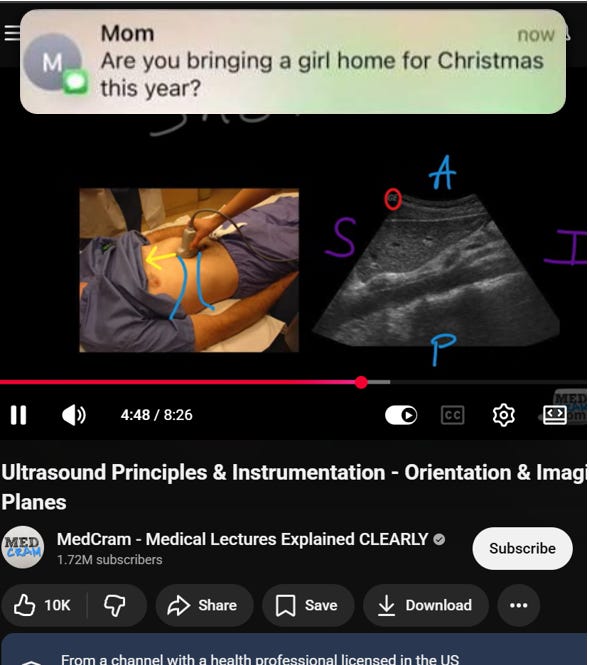
The human user. Ultrasound is painfully operator-dependent. If the sonographer sucks, the technology is basically worthless. As a med student, I spent entire days scanning patients and pretending I was actually seeing something... experienced sonographers were like Jedi masters to me
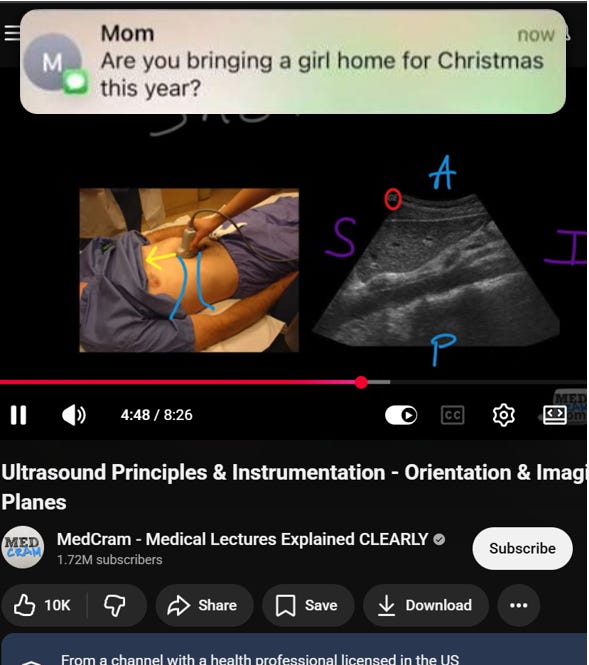
The resolution isn’t stellar and there’s limits to the scan depth. Hence, medicine has always used it for rather local, targeted and functional exams. Like a cheap, slightly unreliable but agile search squad
Looking at the strengths and limitations, it’s a tempting vision to a) remove the human (the part that prevents standardisation) and b) throw massive resources at improving precision and depth.
Midjourney’s idea is exactly that: Upgrade ultrasound to a full-body imaging modality by automating it and brute-forcing the physics. Here’s how they imagine it, and how it compares to existing tech:
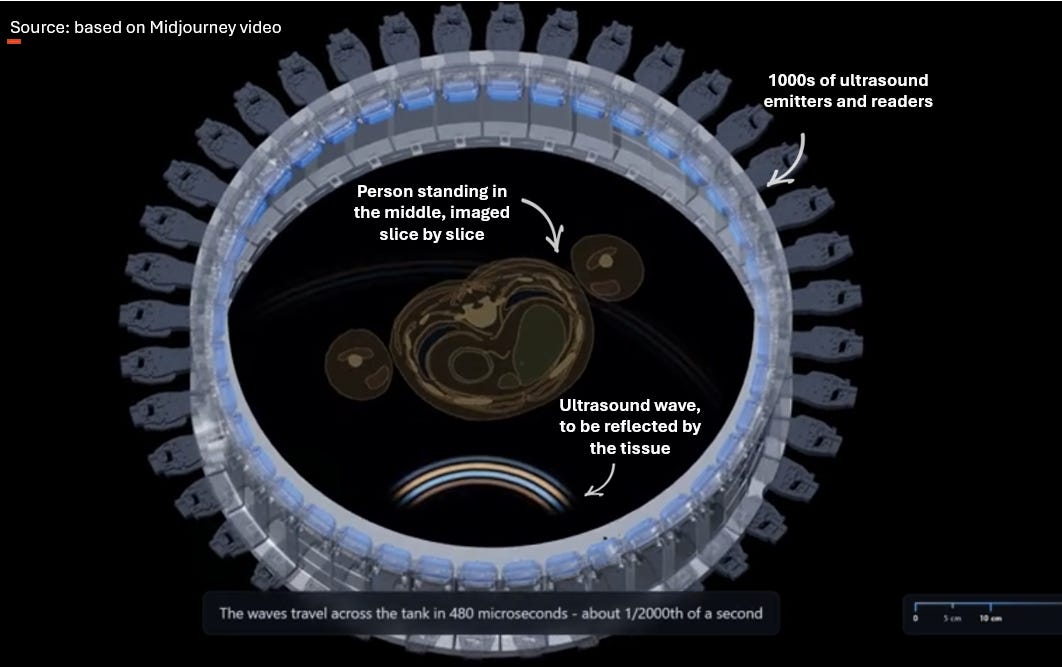
You stand on a platform that slowly lowers into warm water, around 5 cm per second. So far so simple. The water is not a gimmick btw, but necessary for the ultrasound waves to reach your body - more on that later
A ring of sensors sends ultrasonic waves through your body from every angle, then tracks how they come back. This is classic ultrasound technology, but in 3D and at a massive scale. For comparison, existing and medically certified systems today (e.g., for breast cancer scans) use about 2,000 of these sensors. Midjourney wants roughly 500,000 of them, and they’re both receiver and transmitter
The underlying ultrasound logic remains the same: Because sound moves at different speeds through fat, muscle and bone, you can map the tissue accordingly. And since we’ve got a 360 degree setup, you should be able to triangulate for a complete and accurate map of the body
With that massive setup, they’ll need to handle terabytes of data per second with a compute cluster. Again, this is a scale far beyond what has been attempted. And Midjourney wants it done almost in real-time
The entire procedure will be packaged in a fancy spa experience, where you go the sauna and in between get your scan. That’s a real SF-tech-bro idea, but I understand why: They’re avoiding medical device regulation by positioning it as a wellness scan, while offering their wealthy lifestyle customers an attractive premium experience. Still weird, but if that’s the bridge it requires to develop a breakthrough imaging modality, so be it.
Midjourney makes it sound like a completely new idea. Of course it’s not - researchers have been at USCT for over 30 years. Existing systems have mostly focused on breast imaging, for example Delphinus’ SoftVue (FDA-approved for cancer in dense breasts) and QT Imaging.
So the core idea exists, but imaging the whole body is a completely different animal. Some experts say it’s basically impossible. Let’s dissect the technical barriers:
Bone. Ribs, spine and pelvis reflect and scatter sound waves and block whatever is behind them. So far, the field has only ever imaged small bones, like a wrist, in research settings. A full ribcage sounds challenging compared to that - and many interesting organs sit behind it
Air. Similar to bone, air bounces back almost all sound waves. That’s a problem since lungs and part of your gut contain air/gas. I’m not aware of ultrasound that fully sees through pockets of gas. For a full-body scanner, you’d have to circumvent these air-filled structures
Depth vs resolution. Deep organs sit 15-25 cm inside you. Reaching them needs low-frequency sound, which penetrates but is less accurate. Sharp detail needs high-frequency sound, which is crisp but shallow. The proven systems image roughly 10-15 cm of breast tissue at about 1 mm resolution. Midjourney is claiming sub-millimeter detail across a 30-40 cm torso
Speed and motion. A 60-second scan spans dozens of breaths and heartbeats, and motion smears the image. Today’s breast scanners take 2-3 minutes - on an organ that holds perfectly still. It sounds doable with tons of data, but is unsolved at this point
In short, Midjourney isn’t completely reinventing the wheel, but needs to 10x existing technology on every axis at the same time: deeper scans, faster execution, better resolution, circumventing bone and air.
Let’s be honest: There’s a very high chance this never reaches a useful resolution, imaging depth or scan time. But if it did… pretty cool.
At this point, it would be easy to call this the Theranos of medical imaging and move on. But holding it against the rest of consumer health startups, I do believe it’s a great bet.
Consumer health and imaging are booming right now, but almost all of them rely on existing machines and tests. Function, Superpower, Prenuvo and Neko Health all re-package existing medical technology.

The fancier end of that spectrum, which include fully-body scans (mostly MRIs) in their program, tend to struggle with a margin problem. The underlying scans are expensive, and usually run by external partners.
Take a full-body MRI scan startup at a €2,500 retail price per scan for example. Rough unit economics look something like this:
€700-1,000 is the scan itself: the machine time, the scanner, the facility
€300-400 is the radiologists and other staff who interpret, sign off and consult
The rest, call it ~40-50% gross margin, is what the startup keeps. This needs to cover hefty customer acquisition costs (500€+), software development and overhead
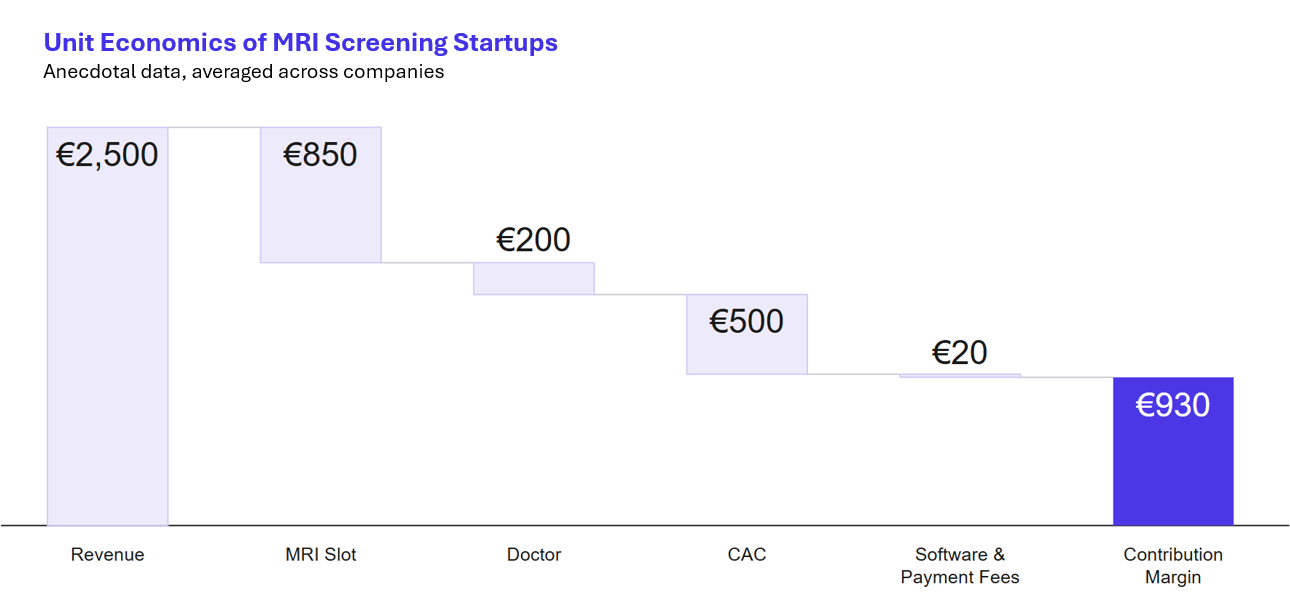
The single biggest slice is the scanner and the imaging process itself. In other words, these screening startups risk becoming a costly marketing layer for radiologists, labs and MRI manufacturers.
Midjourney is going straight for one piece in the value chain that’s untouched: The imaging hardware. MRI, CT and ultrasound have not materially moved in decades. The core machines you get scanned in today are basically the ones from when I was born.
What I’m trying to say: I’d prefer any startup that adds true innovation to this value chain over the next wrapper. Even if it’s as insane as a full-body ultrasound.
I think medical imaging deserves another breakthrough that’s not just throwing more AI at existing images. Ultrasound is a refreshing place to start. While I remain skeptical of screening people in masses (and in wellness spas), I support developing new, safe and precise imaging tools.
My summary is:
Team: 6/10, midjourney does bring interesting AI expertise, hope they nail the medical and hardware part
Market: 7/10, there’s increasing demand and momentum for preventive tools
Technology: 10/10, amazing idea to advance ultrasound
Business model: 9/10 for choosing to innovate the scanners, 2/10 for putting them in a spa
Healthcare impact: 5/10, really depends on responsible positioning of this
I know many engineers and medical experts will trash-talk the idea.
But look at what massive tech investments have enabled in the past 20 years! SpaceX is now a 2 trillion+ public company, outpacing NASA despite all odds. They’ve been told the same. And AI labs have made unbelievable progress by throwing more and more compute at their LLMs. Midjourney is merely repeating this playbook for ultrasound. Let’s give them a shot.
I assume this is the beginning of a new wave of startups attacking hardware imaging problems that were long untouched.
Speak soon,
Lucas
P.S. If you’re a researcher in this space - tell me where this breaks, and who else you’d bet on in this space
Comments
Nothing yet. Say the first thing.
Sign in to join the conversation.