

A top-of-mind question for founders and investors these days is how to build a business that gets stronger as frontier models improve, without becoming vulnerable to them. How do you build a business that is both AI-Native (taking full advantage of frontier models in a way that shows up in the P&L) and AI-Proof (unlikely to be disrupted by frontier models)?
Recent adoption of AI in healthcare has been faster and more organic than in any prior era, and the initial products have largely been focused on 1) better intelligence and 2) automation of administrative work. But healthcare now reflects a broader AI-era theme: as generalist frontier models keep improving, those value props become progressively less defensible, so value moves from intelligence and automation alone to intelligence and automation plus accountability.
Accountability requires capabilities that sit outside the model layer. Even as models improve, they won’t automatically simplify infrastructure and real-world operations, solve regulatory complexity, or facilitate human relationships, let alone make companies more willing and able to bear risk.
When the CEO of a frontier model company wakes up in the morning (if they’ve even slept to begin with!), the priorities on their mind are: lawsuits, staying on the good side of the government, anticipating what China will do, raising enough capital to cement access to compute and top talent, competing with the most formidable companies of all time, and the list goes on… What’s the likelihood that the CEO wants to take on even more regulatory risk and liability by owning the underlying healthcare itself?
Therein lies the opportunity: in vertically integrating into the healthcare accountability layer - where a licensed, contracted, or regulator-approved entity has to deliver an outcome, stand by a claim, and accept the consequences of being wrong (or right).
So which healthcare product form factors own enough of the accountability to be both highly AI-Native and AI-Proof? Here are three:
Delivering care and IRL services
What’s AI Native: An AI-native clinical services business can operate with a) disruptively low cost structure (e.g. you’re more likely to have run towards the CMS ACCESS program than away from it) and b) faster and more scalable growth and product expansion (e.g. operating nationally, with higher panel leverage, and more specialty coverage, sooner that prior generations of services companies).
What’s AI Proof: A medical practice still has to obtain state-by-state licensure, credential with payors, get malpractice coverage, contract and integrate with referral partners, and implement IRL care delivery operations. Even non-regulated, sub-clinical services are subject to rigorous safety validation, clinician oversight, and last-mile integration into care workflows that represent a level of liability that goes far beyond the intelligence layer.
Bearing financial risk
What’s AI Native: AI can arguably automate the majority of the admin work that comes with being a risk-bearing entity, and meaningfully changing the cost structure of managing a population at scale.
What’s AI Proof: A full-stack risk-bearing entity may have to raise reserve capital, get state licensure (if fully insured), secure provider network contracts, engage with members and doctors to manage the total cost of care, and win high-touch sales. And even software-only businesses can bear financial risk, e.g. by only getting paid when multi-party transactions are completed or when the customer gets paid.
Developing an FDA-regulated product
What’s AI Native: AI can increasingly automate the operational and cognitive parts of the diagnostic or drug discovery and development process.
What’s AI Proof: A company ultimately still has to manufacture the product, put it through years of human clinical trials, and get FDA approval to make a definitive claim about the diagnostic or therapeutic benefit. Not to mention we have only scratched the surface of understanding human biology, so we still need to generate new data and build validation loops at scale to expand the search space over which AI can effectively operate.
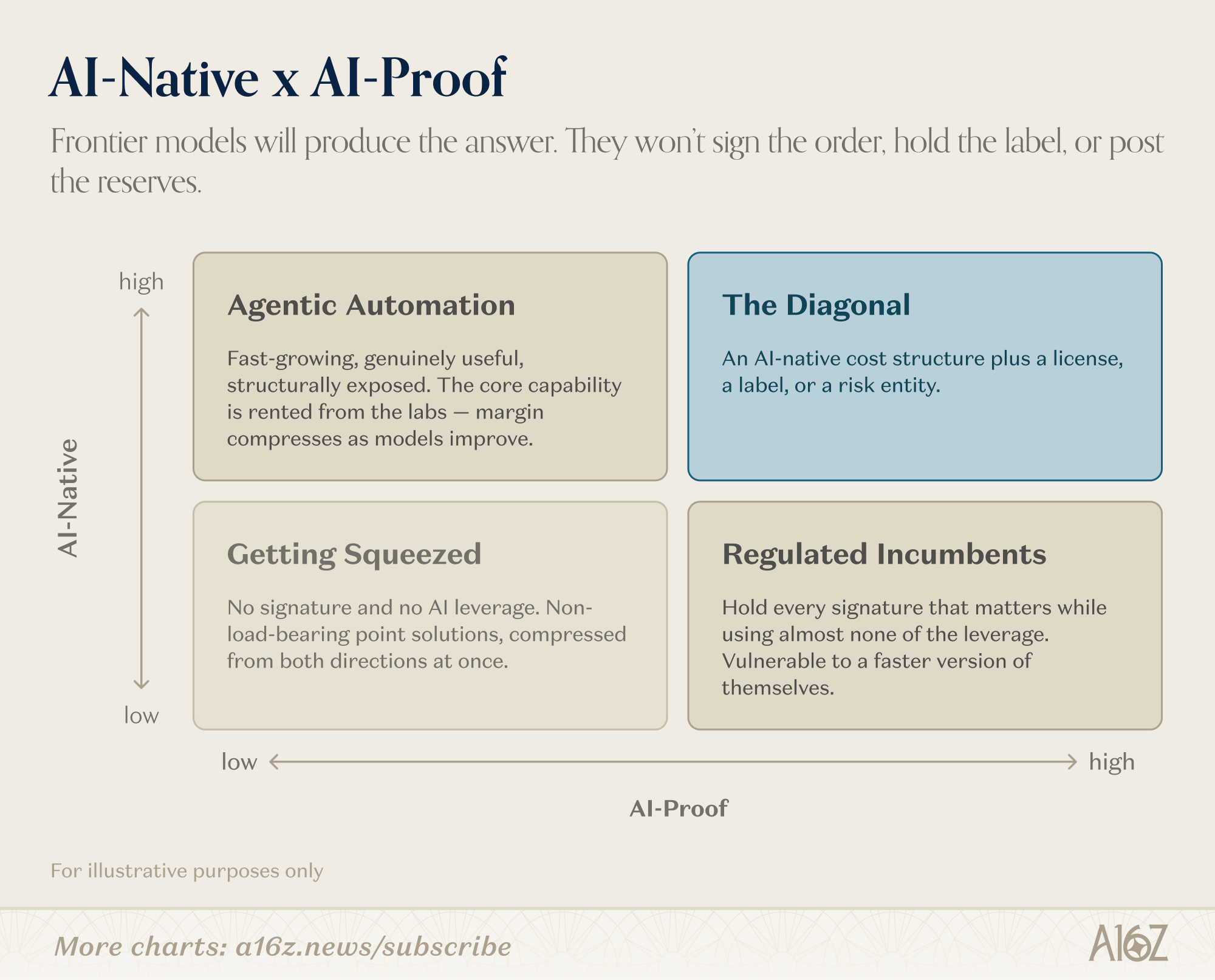
Of course, the pace of evolution in the space means this framework could have a shorter half-life than we might think. Deregulation could lower the bar for autonomous AI products to do more without licensure or approval. Agentic provider-network contracting could lower the barriers to fully autonomous health plans in the employer-sponsored market. Frontier models could mature to a point that those existential risks on the minds of their CEOs every morning become far more manageable, freeing them up to explore taking on more risk, liability, and ultimately, accountability.
That said, many of the best-performing healthtech companies today are already implementing one or more of the models above: delivering outcomes, bearing financial risk, and/or developing a regulated diagnostic or therapeutic. And the strongest AI-native performers whose centers of gravity are still “better intelligence” or “administrative automation” are actively figuring out how to take on more accountability - and hence become more AI-proof.
Comments
Nothing yet. Say the first thing.
Sign in to join the conversation.