
Today’s buzz about ultra-processed foods reminds me of the noise around sugar-sweetened beverages 20 years ago. People increasingly saw the connection to obesity, and those of us working in public health were excited that we might finally do something meaningful about it.
And then we took some swings at soda. Not surprisingly, the big soda companies swung back. Reviewing how this fight played out can offer lessons for today’s battle over ultra-processed foods.
Push and pushback
Before 2000, people tended to blame obesity on individuals’ overeating or high-fat foods. But around that year, it became clear that obesity was a population-wide epidemic and that sugary drinks - while not the entire cause - were major contributors.
Studies increasingly showed that sugar-sweetened beverages were not (as dietitians often described them) “empty calories” but instead were actively toxic. Swallowing a bottle of liquid sugar overloads liver cells with fructose, causing fats to accumulate in the liver and blood, and floods the blood with glucose, which prompts the body to release insulin and store those fats.
Armed with this information, health advocates from school nurses right on up to Michele Obama took on sugary drinks in several ways:
Protecting kids in school
In 2000, many school districts across the U.S. had lucrative multi-year contracts that obligated them to sell soda to kids through vending machines in cafeterias and hallways. Believing that schools shouldn’t make kids sick, people in public health pushed state and local laws to banish those machines.
The soda companies (and the schools benefiting from the sales) pushed back, with furious lobbying in city councils and statehouses, combined with proposals for voluntary guidelines. The truce that finally emerged is a disappointing middle ground. Under the federal law passed as part of Michele Obama’s Let’s Move, schools can’t sell sugary drinks during regular school hours. But they can still sell diet soda in high schools all day and sell full-sugar soda in all schools after regular hours - which means that soda vending machines still sit in many schools, theoretically locked up from 8 to 3.
Educating people
Most people get most of their health information, directly or indirectly, from the mainstream media. One way to nudge people to change risky habits is to just generate news stories about the problem. In the 2000s and 2010s, health advocates worked hard to make noise about the connection of sugary drinks to obesity, with some success. Stories in newspapers that mentioned “obesity” and either “soda” or “sugar-sweetened beverages” surged between 2000 and 2016.
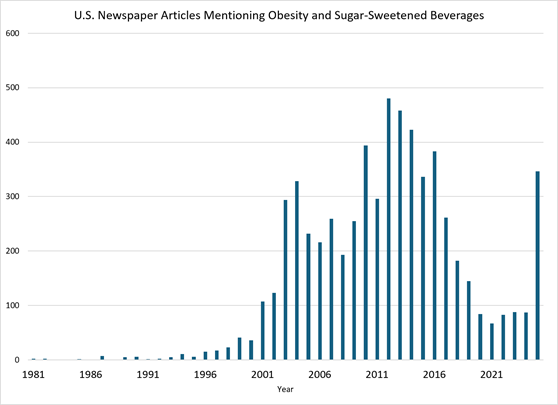
After that, though, the topic dropped from the headlines, eclipsed by the opioid crisis and COVID-19. The one exception is the blip in 2025 as states got waivers to exclude sugary drinks from the SNAP program.
The soda companies didn’t leave the messages unanswered. They continued to advertise their full-sugar drinks like crazy, constantly reminding people that, for example, that drinking Coke makes you happy. There is plenty of reason to worry that these pro-soda ads are the only messages that people have been seeing for the past 10 years.
Meanwhile, the companies also invented or acquired new drinks that didn’t carry the weight-gain stigma of regular soda. Some had artificial sweeteners instead of sugar, but others just included faddish ingredients to sugar water so that the companies could sell them as healthier – ingredients like electrolytes, caffeine, vitamins, botanicals, probiotics, protein, and even fiber.
Counter-ads
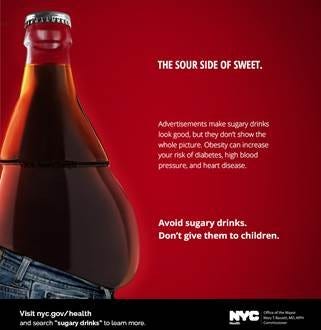
Much of the success in fighting smoking came from paid television counter-advertising – those spots that connect smoking with its ugly consequences, from holes in the throat to lost teeth. These ads hit harder than the news stories do, and if they are novel or outrageous, provoke their own press attention.
A few cities have tried counter-ads against soda, and they’ve worked. But these campaigns are expensive, and health departments never had the steady funding needed to sustain them, I suspect because appropriators in Congress and statehouses didn’t want to pick a fight with Coke and Pepsi.
Taxes
If the 2000s was the decade of awareness-raising, the 2010s was the decade of the soda tax. Or so it seemed mid-decade. Between 2015 and 2018, many U.S. cities considered and seven passed taxes on sugar-sweetened beverages. These taxes worked exactly as health economists predicted. By raising prices, they led people to buy less or switch to low- or no-calorie beverages. More exciting, cities passing taxes have seen a relative slowing of the increase in body weight in kids.
But the soda giants mounted ferocious resistance, with lawsuits, lobbying, and funding of front groups and political campaigns. They mostly won. While sugary drink taxes are spreading in other countries, no U.S. city or state has enacted one since 2018.
Warning labels
A great way to tell people that a product is bad for them is to put that message right on the product’s package. Graphic warnings on cigarette packs have helped cut smoking rates in other countries.
Singapore now requires that beverages carry “Nutri-Grade” labels like this one, with grades C and D used for those high in sugar.
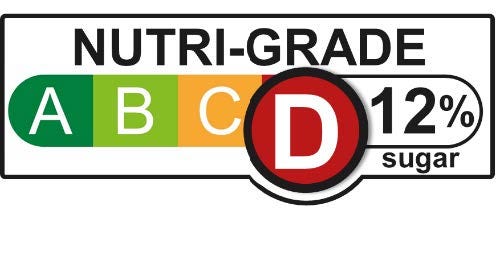
Compared to the nasty cigarette pack warning, those Nutri-Grade labels are very tame. But after they appeared, sales of C and D beverages in Singapore plummeted by 44%.
In 2020, the City of San Francisco passed a law requiring warning labels on sugary drinks, but the soda companies blocked them with a lawsuit. The FDA could require these kinds of labels nationwide, but the soda companies have had too much sway with the federal government for that to happen.
SNAP restrictions
In 2011, New York City tried to prohibit the use of SNAP benefits to buy sugary drinks, and the USDA turned it down. After that, no other city or state tried this idea until RFK Jr. resurrected it last year. Today 23 states have USDA-approved waivers to do it.
The soda companies are going after these waivers with an army of lawyers. Recently a judge ruled in favor of the companies in a lawsuit involving five states. The waivers in other states look vulnerable to similar lawsuits.
The score
Before people worried about the health effects, sugary drink consumption was skyrocketing. Between 1965 and 2002, Americans’ soda intake roughly doubled, rising to deliver 21% of our total calorie intake. (The WHO recommends that sugar from food and beverages should be below 5% of daily calories.)
I couldn’t find any surveys of Americans that tracked sugary drink consumption consistently over the decades, but the surveys that are available hint that 2000 was the high water mark. Here’s sugary drink consumption in New York City, in a survey that ran annually from 2007 to 2020:
And here’s a survey of high school students nationwide, conducted in odd years from 2007 to 2023.
In both surveys, it looks like consumption fell from 2007 into the 20-teens but leveled off around the time that the press attention fell.
Since 2014, soda companies have been reporting national data on beverage sales, which show a slow fall. Over ten years, with people shifting to bottled water and diet drinks, they are buying 10% more beverages but taking in about 15% fewer calories per day.
So in the past 25 years, while we’ve made some progress, Americans are still taking in an average of about 170 calories per day of sugar in liquid form; many are consuming far more than that. That’s way more than is healthy.
Considering how awful the obesity epidemic is (half a million deaths per year), and how unnecessary sugary drinks are, it’s shameful that we haven’t made more progress over two decades. This should have been an easy win. But the story shows how big, powerful businesses can thwart even popular efforts to protect our health.
Unless something dramatically changes how this country makes decisions on health, this is how the war over ultra-processed foods will likely unfold. Battles over school food, media messages, labelling, and taxes, involving not just health facts but also advertising, lobbying, lawsuits, community mobilization, and political campaigns. And progress that is achingly slow.
Any movement that hopes to protect Americans from ultra-processed foods needs not just the facts in its favor, but also the weapons and the stomach for this kind of fight.
Comments
Nothing yet. Say the first thing.
Sign in to join the conversation.