
“You know what the trouble is, Brucey? We used to make sh*t in this country, build sh*t. Now we just put our hand in the next guy’s pocket.” - Frank Sobotka from The Wire
I know you already have too many public health risks to worry about, from Ebola to autism, but there’s another one that deserves your attention. This health risk doesn’t involve micro-organisms or toxic chemicals, so you may see it as more of a social problem. But, as with all social problems, this one wind up as a health problem.
The gambling tsunami
When I was a kid, you had to go to the racetrack or fly to Las Vegas to gamble legally. Then came off-track betting and state lotteries. Then casinos on Indian reservations, on gambling boats, and in cities hungry for tax dollars. Then video poker warrens. Then in 2018 the Supreme Court struck down the federal ban on betting on sports, which created “sportsbooks”.
Then a tsunami happened when gambling moved online. Today, Americans can place bets – mostly on sports – 24/7 through computers in their pockets. Sportsbooks are now legal in 37 states, almost all of which also allow online betting.
With this constant availability, the “handle” (dollars bet) on sportsbooks surged 10-fold since 2019.
The sportsbooks now keep more than 10% of the dollars bet (up from 7% in 2019), so $165 billion in bets gives them revenue that tops $16 billion a year.
Gambling companies spur on this online betting with tricks that get users to stay on the sites longer, bet more often, and place bigger bets. These tricks take advantage of the deep information that the apps have about users’ habits, preferences, and vulnerabilities. For example, companies pitch in-game bets, like whether a favorite player will score next. They offer “parlays” (multiple linked bets), nudges like “You have a free bet expiring today!”, introductory bonuses for new users and “reload bonuses” to users whose activity drops.
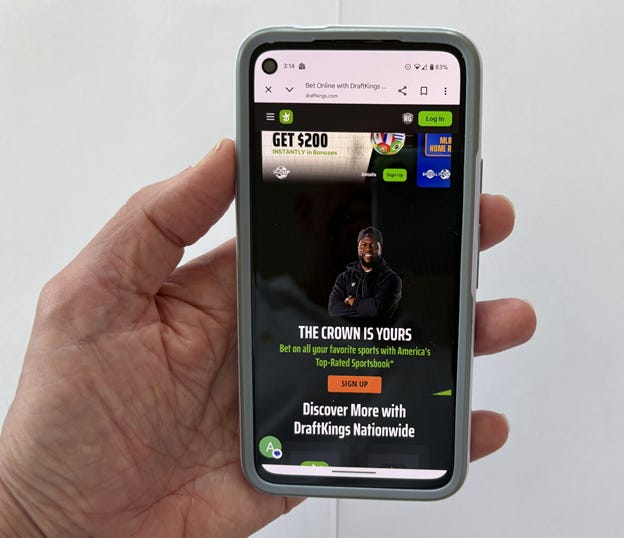
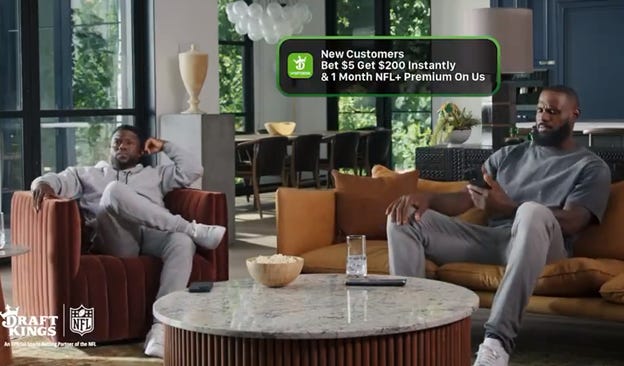
To draw in more users, gambling companies run huge advertising campaigns, including ads like this one with Kevin Hart and LeBron James.
Beyond sportsbooks are prediction markets (mainly Polymarket and Kalshi), which also involve betting on sports, rebranded as investments. Prediction markets have grown more than 100-fold just since 2024 and now handle billions in bets every month.
The losers
Researchers measure problems caused by gambling with surveys that ask gamblers nine questions, such as “Have you bet more that you could really afford to lose?” and “Have you gone back on another day to try to win back the money you lost?” People answer on a scale of 0 to 3 points for “never”, “sometimes”, “most of the time”, or “always”. Those who score 1-4 points are considered low risk, 5-7 points moderate risk, and 8 or more points “problem” gamblers. (Our President would call them “suckers and losers”.) Most problem gamblers meet psychiatrists’ definition for gambling addiction.
Most surveys that are available on gambling were fielded before the online tsunami, so they underestimate the problem. But surveys conducted in New Jersey in 2015 and 2021 show the early effects of online wagering. Between those years - but before online gambling had fully taken hold - the proportion of adults who admitted to risky or problem gambling jumped by about 30%, to nearly one in five.
In 2021, risky and problem gambling were much more common in men, young adults, Blacks, and people with household incomes in the lower and middle range - between $30,000 and $100,000 a year. (I’m guessing that luring that target demographic was the reason DraftKings chose Kevin Hart and LeBron James as pitchmen.)
The most important finding in the 2021 survey was that those who gambled online were more than 10 times as likely as those who gambled only in land-based venues to be problem gamblers.
The consequences
Of course, while people may win or lose on individual bets, in the long run every gambler loses. What happens when they gamble away big chunks of their income? A study that analyzed a massive trove of data from bank accounts showed that heavier gamblers skip credit card payments, take out payday loans, and miss payments on their car loans and mortgages.
Problem gamblers may also steal from relatives, friends and employers, and lose their jobs. Risky gamblers also spend less money on healthy and social activities.
All this harms their health, bigly. Problem gamblers are more likely to use alcohol or drugs and develop several types of mental illness, and they are much more likely to attempt or die by suicide.
Suicide is not the only fatal outcome, though. Gambling aside, people living on the financial edge have much shorter life expectancies and higher mortality rates from a long list of diseases, from heart disease to cancer. So when gambling companies vacuum up people’s money, the health effects are far-reaching. The bank account study showed a gradually increasing rise in overall mortality with increasing gambling. Over a five-year period, those who bet more than 30% of their monthly income were about 30% more likely to die.
The curve
The industry would have you think that gambling is only a problem for the small percent of their customers, who can be given individual help. By this line of argument, for others gambling is innocent pleasure. Here’s from DraftKings’ “commitment to promote responsible gaming”:
“While the vast majority of our customers play for fun and entertainment, we’re also committed to raising awareness of resources for those who may be facing problem gaming-related challenges.”
But as the graphs above show, the relationship between gambling and its harms is continuous. Sure, problem gamblers suffer a lot, but the much larger group of those at low or moderate risk are also damaged.
Treatment for gambling addiction can’t solve this. If the New Jersey survey is representative of the U.S. as a whole, this country has 15 million problem gamblers and 35 million at low to moderate risk. Only about 10% of problem gamblers seek treatment, and this treatment isn’t curative. That means treatment offers very little to nearly all of those 15 million problem gamblers – and nothing to the 35 million risky gamblers.
The solution
In 2025, DraftKings alone pulled in $6 billion in revenue. A study in Connecticut found that 70% of gambling revenue came from just 7% of the population who are risky and problem gamblers. That means that this one rich company has taken roughly $4 billion from Americans – mostly lower-income, many Black – whose gambling habits they can’t control and who can’t afford to lose that money. To me, this isn’t commerce. It’s theft.
In a saner time, our government would fix this injustice. I like the simplest solution: prohibiting online gambling. That would just bring us back to 2018.
But if that’s too radical an idea today, there are many ways to make online gambling less rapacious. For example, the government could restrict advertising by gambling companies, prohibit in-game bets and teaser promotions, limit the size and frequency of bets, and lower the percent of the handle that companies keep.
In concept, the solution is easy. But it won’t happen until enough of us admit that we have a very big problem.
Comments
Nothing yet. Say the first thing.
Sign in to join the conversation.