
I live in Washington, DC, and when I want to stretch my legs, I sometimes walk through a nearby cemetery that doubles as a dog park. Recently this memorial stopped me short, though it took me a few minutes of study to get how profoundly sad it was.
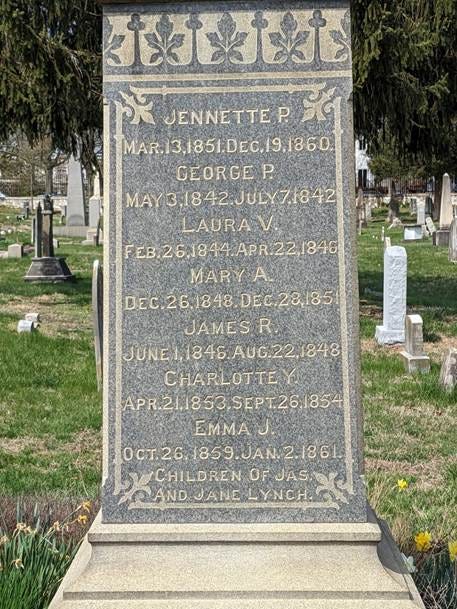
Between 1842 and 1861, James and Jane Lynch buried seven children, five between their first and fourth birthdays.
Today we take for granted that children rarely die, but that’s new. In the 1850 census, families were asked who had died in the previous year and from what cause. The mortality rate for young children recorded in that census was roughly 2,500 per 100,000, which is almost certainly an undercount. Even accepting that number, though, means that American parents on average lost 10% of their children between their first and fifth birthdays. The monument doesn’t say how many Lynch children survived, but if we assume that Jane bore a dozen children, more than 50% of hers didn’t live to reach age 10.
A good bet would be that the Lynch children died from gastrointestinal and respiratory infections. I took statistics on deaths of young children from that census and grouped them based on how common and preventable they were:
About a third of these deaths were counted as having been caused by cholera, dysentery, and other gastrointestinal infections, and even that’s probably a big underestimate because it misses many vaguely-described causes like “fever” that I’ve grouped as “other infections”. Adding tuberculosis, influenza, other respiratory infections, and diseases that we now prevent with vaccines, at least 75% of child deaths were due to infectious diseases.
Beneath these fatal infections lay a pathogenic neighborhood environment. The 1850s were early days in the industrial revolution, when people had moved from farms into cities to be near factories, or in Washington DC to be near government jobs. In those new cities, families maintained their country habits, using maybe an outhouse in the back yard and a water source that was a shallow well or a nearby spring or stream. Those habits were mostly safe on isolated farms but highly dangerous in crowded cities.
If the Lynches lived near the cemetery, odds are good that they got their water from the Anacostia River. That river was contaminated with human feces from people living upstream (it still is after a hard rain), making it a great killer during the cholera epidemics that terrified Washington in the 1850s.
Another toxic feature of cities at that time was crowding within homes, which enabled the spread of respiratory bugs like the influenza virus and tuberculosis bacteria. The two types of infections compounded each other; respiratory infections were much more likely to kill children who were malnourished after repeated bouts of diarrhea.
Make America Healthy Again, circa 1850?
The Lynches couldn’t have known that their water may have been a source of cholera, because John Snow’s hypothesis about it wasn’t accepted even in England until the mid-1860s. But they might have understood that something about the city was killing their children. If so, you couldn’t blame them if they were to consider moving out of that pestilence to a farm in Maryland – that is, trying to go back in time.
Instead, though, cities changed. In 1864, Washington’s city leaders built an aqueduct to bring in clean water from far upstream on the Potomac River. In the early 1900s, for added safety, they began filtering and chlorinating that water. In roughly those same years, city leaders throughout the U.S. built similar systems to supply uncontaminated water to their residents.
The clean water, combined with improved housing and nutrition, worked better than any could have imagined. From 1850 to 1950, mortality rates in U.S. children fell by at least 95%.
So while the Lynches surely endured many dark days, in retrospect they stood on the verge of what was probably the greatest improvement in child health in human history.
The Washington DC aqueduct was made possible by the prosperity caused by the industrial revolution, but it also required a new role for government: assuming public responsibility for what had been seen as a personal matter. As Geoffrey Rose put it, “The great public health reforms of the nineteenth century… were undertaken for people rather than by people.”
Lessons for today
Looking at today’s health problems, we blame features of today’s world, and with good reason. Our food system is driving epidemics of obesity and chronic diseases. The gun industry and the media marketing of violence are promoting shootings. Smartphones are causing depression.
In search of solutions, we tend to look to the past. It’s an alluring idea that this country was once an idyllic place that has become contaminated by modernity. That idea leads to the try to solve our problems by rejecting the modern world. That idea, with a fascist spin, is what animates Make America Great Again. Less hatefully, that idea is behind the Make America Healthy Again movement. The anti-junk food, anti-vaccine, anti-chemicals, and anti-GMO views fueling MAHA are fundamentally backward-looking.
A page on Robert Kennedy’s 2024 campaign website opened with this:
“The current generation is the sickest in American history. When John F. Kennedy was president, 6% of American kids had a chronic health condition. Today it is 60%.”
Of course, Kennedy’s numbers are complete bunk. But the quote’s outrageous lie is more dangerous than the made-up numbers. Children today are healthier than they’ve ever been. Mortality rates have fallen 75% since JFK was president.
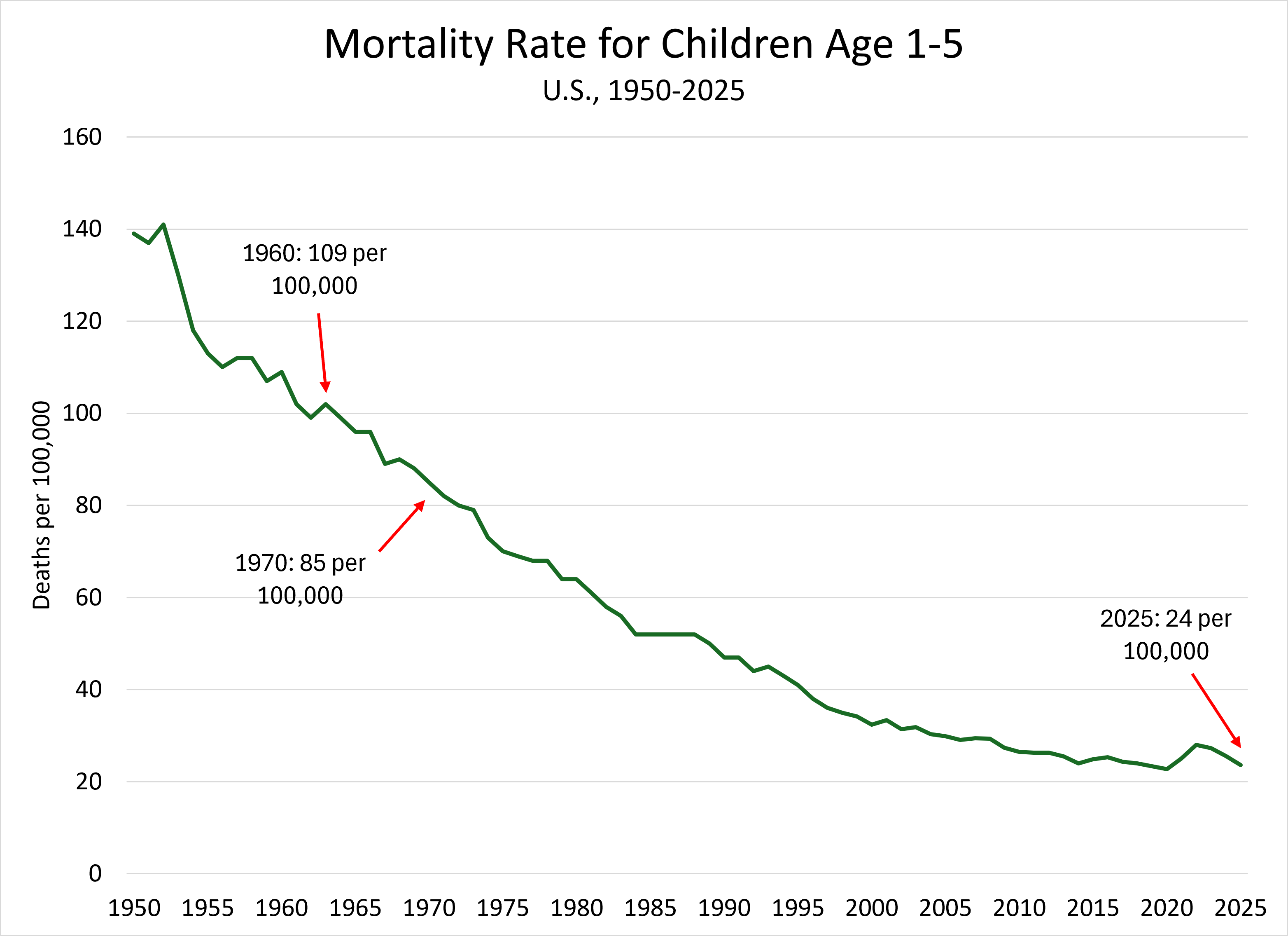
What’s behind this recent fall in child mortality? Here are numbers for 1970 compared to last year:
Since 1970, deaths in children from infectious diseases, already a tiny fraction of what they were in 1850, have almost disappeared. Deaths from other causes – including injuries – have also plummeted. Give credit to vaccines, antibiotics, other forms of medical care, and regulation of the safety of products like cars and toys. That’s progress, not a fall from Eden.
Today’s solutions for today’s problems
Of course, we all want our children to be still healthier. While very few children die today, many are accumulating damage that will kill them later by eating ultra-processed food, being physical inactive, and watching video screens and smartphones.
The solutions to these 21st century problems do have some retro elements to them. Children should be eating more food that grows out of the ground and less that comes in a box. They should be outside playing with friends instead of inside watching screens. But our nation’s answer to these problems cannot be to return to the era of VW bugs and LSD. As in the 19th century, our answer has to be taking public responsibility for protecting kids from our era’s major risks to their health. In the 19th century that meant building an aqueduct. Today that means, for example, restricting the marketing of ultra-processed foods, regulating smartphones, and building the physical and social infrastructure for kids to play with each other.
Today – as in 1850 - the solutions to the health problems lie not behind but ahead of us. When we talk about making America’s children healthy, we have to stop saying “again”.
Comments
Nothing yet. Say the first thing.
Sign in to join the conversation.