
by Alexandra de Scheel, Citizens’ Council for Health Freedom
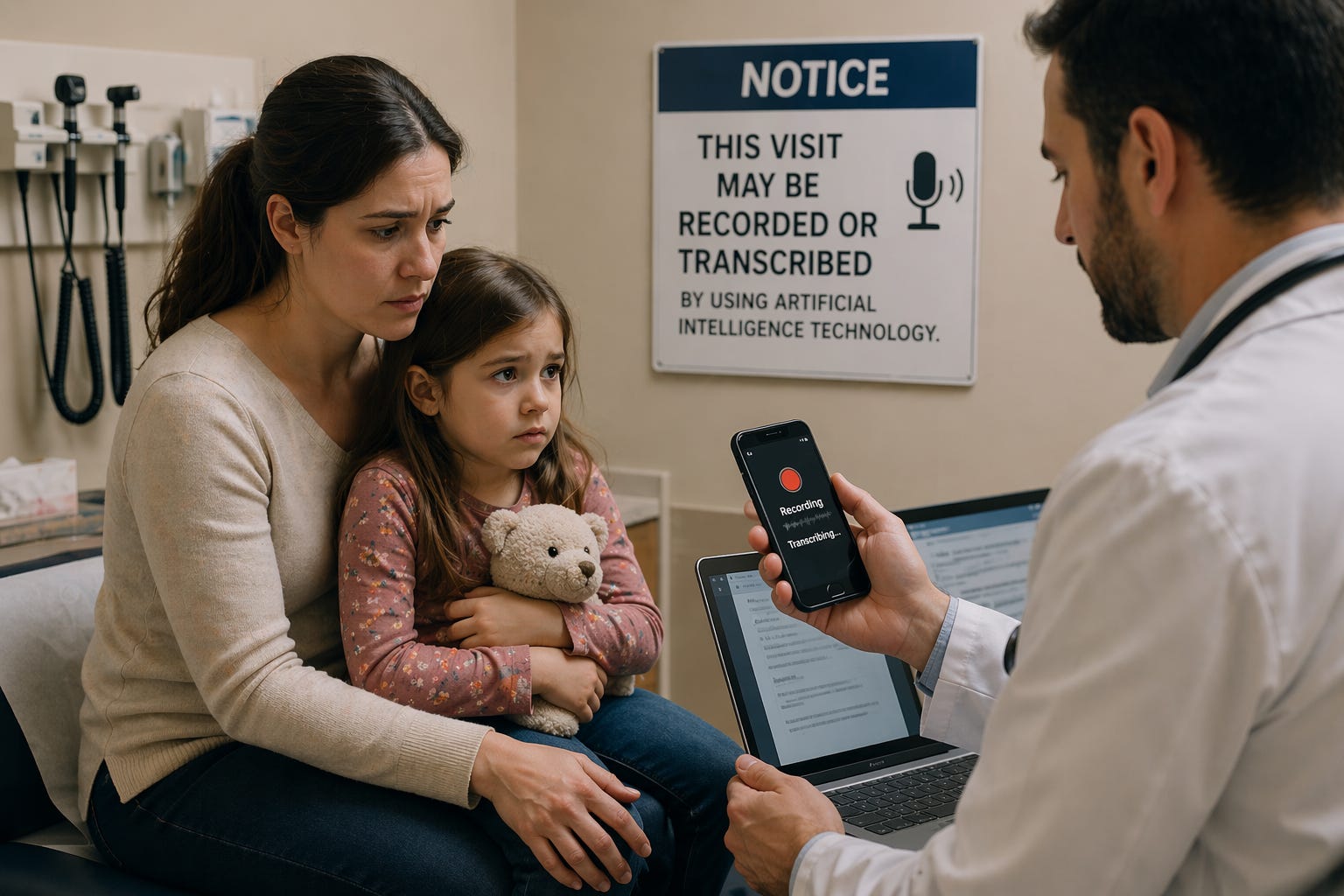
Last July, a patient walked into a San Diego clinic for a routine physical and left believing the conversation with his doctor had been private. A recording device captured the entire visit without his knowledge, transmitting the audio to a third party that generated the clinical note. Only later, when he reviewed his patient portal, did he discover the record claimed he had been informed and had agreed to the recording. He had not agreed to the recording; in fact, he didn’t know about it at all. He subsequently filed a lawsuit.
This case is now one of several. Patients in California and Illinois have raised similar claims against health systems using AI recording platforms in exam rooms without clear notice or meaningful consent.
What these cases reveal is not a one-off failure. They reveal a shift that has already taken place. AI is no longer being tested at the edges of health care. It is inside the exam room itself, layered onto a data infrastructure that was built without patient consent as its foundation.
The Quiet Expansion of “Ambient Listening”

Hospitals and clinics describe these tools as AI scribes. These computer systems function as always-on listeners, converting conversations into structured records to reduce burden on physicians.
Patients now pay the price: their most vulnerable conversations may be recorded, transcribed and processed by AI programming.
In one clinic, a physician walked into the room holding his phone and casually mentioned that he would be recording the visit. When the patient objected, he hesitated and explained that the documentation would not be “as complete.” The patient held her ground. Only then did he turn it off and put it away.
Another patient went through an entire appointment without any mention of recording. Only at the end did the clinician add, almost as an afterthought, that the visit had been recorded. When challenged, the explanation was simple: he had meant to ask but forgot.
Some exam rooms do not include a direct request for consent at all. Instead, signs on the wall inform patients that “ambient listening” is in use and that remaining in the room constitutes consent. The patient, vulnerable and in need of medical care, is forced to make a choice the patient should not have to make. Walking out is often not an option, and by staying, they are treated as having consented. A signature on a consent form is not really consent. It’s a form of coercion.
This is what “consent” now looks like in many places.
A peer-reviewed study indexed by the National Library of Medicine found that patients can unknowingly agree to AI scribe recordings through consent language buried in documents they do not fully read. Patient visits can then be turned into raw material for commercial AI development.
The AI-generated note that enters the electronic health record (EHR) — the government-mandated digital record system, now present in virtually every clinic and hospital — may contain errors, misattributions, or fabrications that researchers call “hallucinations.” A MedStar Health study found errors in 70% of AI-generated draft notes.
What Gets Recorded?
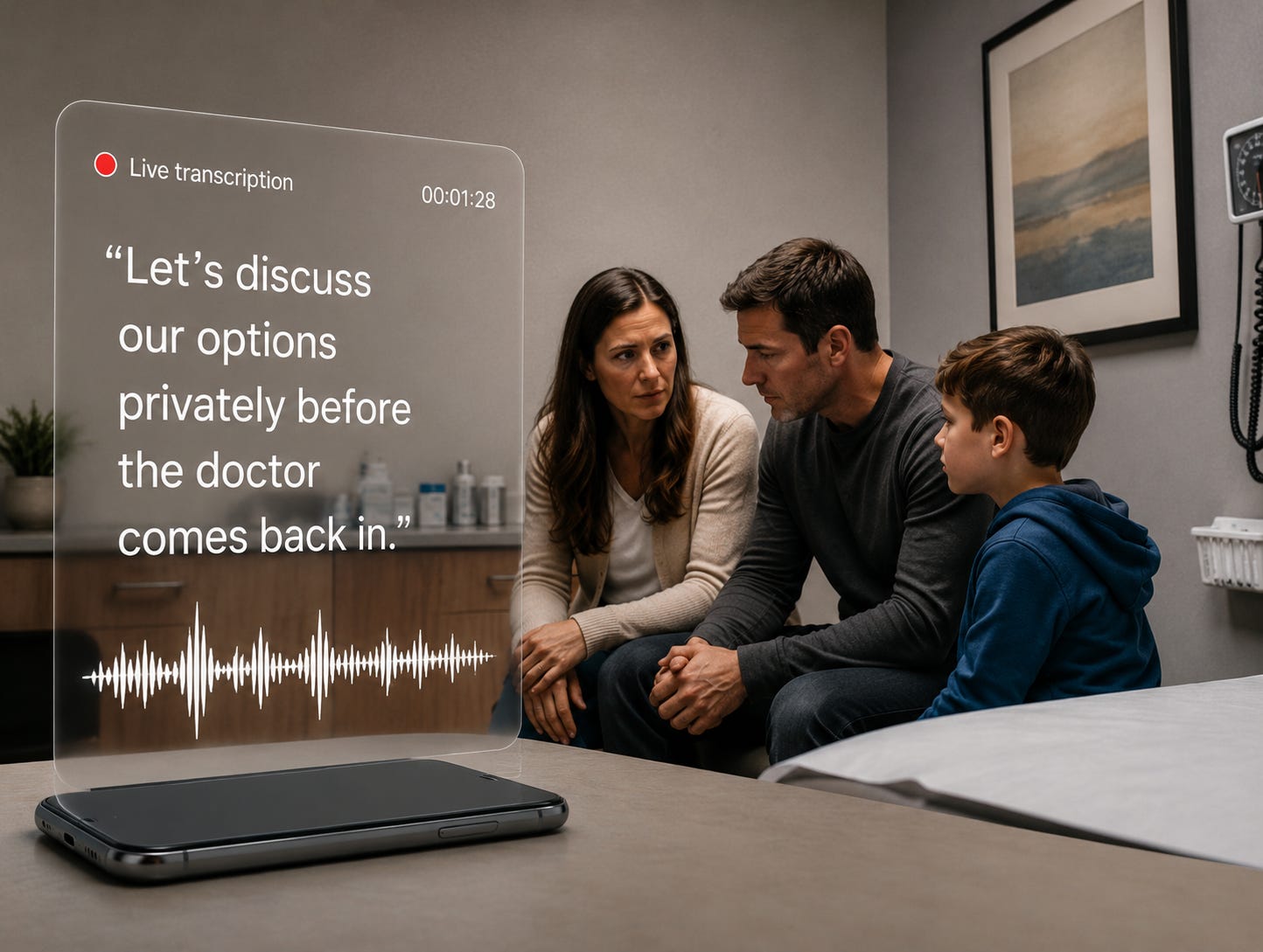
The assumption behind ambient listening tools is that they capture pertinent information. In reality, they capture everything that is said. Every word.
This distinction matters more than it sounds.
A medical visit is not a scripted exchange. It includes side conversations, emotional reactions, and moments when patients are not carefully choosing their words. It includes what happens when the clinician steps out of the room, and the patient speaks privately with a spouse or a parent.
Words said during these private, unguarded moments are now at risk of being recorded, transcribed, and encased in a permanent record.
One of the concerns raised in discussion of AI scribe recordings is not theoretical. Imagine a parent in the emergency room with a child, speaking candidly with a spouse while waiting for the doctor to return. A comment made in frustration or fear — something that would never have been documented in the past — is now captured. Once it is in the record, it can be accessed, interpreted, and potentially used in ways the patient never anticipated, including in interactions with authorities.
Another scenario is more mundane but no less consequential. A patient involved in a car accident is careful when speaking to the doctor, but less guarded when speaking privately to a family member. If both conversations are recorded, the difference between them may become discoverable in a legal dispute. Imagine if what was once an off-the-record moment becomes part of a formal record.
AI scribes do not distinguish between what is clinically relevant and what is not. They simply collect. Everything.
When the Record Changes the Story

Recording is only the first step. The next is interpretation.
AI scribes convert speech into structured notes, organizing conversations into categories like symptoms, history, and treatment plans. This process forces AI systems to make judgment calls about what was said, what it meant, and in what order it happened.
These judgment calls are not always correct.
Physicians who have worked with ambient listening tools describe a pattern that is easy to miss if you are not looking for it. Much of what the AI recording platform produces appears accurate, which builds trust, until a detail is inserted that is simply not true. AI fills in gaps, smooths inconsistencies, and occasionally fabricates connections that were never there. But how will you know?
Everyday errors can be inconvenient. A medical record error becomes part of the patient’s documented history. It is deemed to be “truth.”
At that point, the responsibility for catching the error shifts to the patient, who may not know the recording occurred and may not even think to review the note or may be given only a summary of the full note. The error may go unnoticed until years later, if ever.
What Patients Can Still Do
Today, patients can ask a simple question: Is anything or any device in this room recording our conversation?
Simply asking changes the dynamic. It makes the invisible visible, at least for a moment. It puts the advance of ambient listening in question. Anyone who hears the question won’t forget. The ethical and moral element inserted by that question cannot be ignored.
Some clinicians may respond by turning off the device. Others may not have this flexibility. But you need to know, and they need to know that you know. Knowing changes everything.
Some independent practices operate outside large, interconnected data systems. Their documentation is often more limited, and the flow of information more contained. They are not the norm, but they do exist. Asking the question will encourage other practices to join them.
What Has Already Changed
There was a time when the doctor’s office was understood to be private by default. This assumption no longer holds.
Today, there may be a device listening, a software system processing, and a third party receiving the result — all without a direct conversation with the patient about that reality or what this means.
AI did not force its way into the exam room. It entered through a system that had already made room for it.
AI is now in the room, and it is not simply observing.
It is recording, organizing, and increasingly shaping what happens next.
No posts
Comments
Nothing yet. Say the first thing.
Sign in to join the conversation.