
When I started my undergrad at The University of Bristol, I affected a slightly posher English accent than the one I had honed in the leafy Surrey suburbs during my school years. I had heard rumours that the university took in a large proportion of the private and public school educated who couldn’t get into Oxbridge. Suspecting I would once again be a minority amongst rich White people, I started to gently elongate my vowels and enunciate my consonants. I was, of course, immediately detected by a posh White boy when I couldn’t name an elite and historic institution as my alma mater.
The deliberate changing of my accent and the pronunciation of my surname1 started when I arrived in Guildford as an awkward mixed race 11-year-old South African immigrant. Kids would mock the way I said words like poor - my middle-class adolescent peers rhyming it with pour while my version was closer pwoo-ur. I quickly adapted my accent to fit in. I guess nearly a decade of affecting that accent made it actually stick. But knowing I was going alone into a new environment with my lowly state school education brought back the start of crippling imposter syndrome that plagued my entire academic life.
I can’t help but reflect on this after the vicious and racist hounding of Jason Arday. Many academics (and indeed other professionals) experience imposter syndrome as the uncomfortable gap between what we are expected to do or know and what we consider ourselves capable of. The insidious fear that we will be found out to be frauds. I have met only a handful of academics who don’t experience imposter syndrome to some degree, no matter their level of achievement. The rare ones who don’t experience it are usually the extremely entitled ones (I would hazard a guess Nathan Cofnas is not questioning his skills or abilities as he considers himself part of a superior race2).
I had the meta-type of imposter syndrome. It was so deep, that when the discussion came up with other academics I would think to myself- "these people have imposter syndrome but are clearly very intelligent. I have imposter syndrome, but I am actually an imposter. They don’t understand that I am genuinely not supposed to be here”.
And that is the truly pernicious part of imposter syndrome- the feeling that you don’t inherently belong. I’ve written about how I experienced academia as if at the top of the ivory (skinned) tower looking out, but not welcomed in. Too often when we talk about imposter syndrome, it is in the context of not being smart enough or capable enough. But, for those who don’t see themselves represented, it is something much more. It is the feeling of an accent that stands out, a religious practice that’s not catered for, a curriculum centred on one region and one version of history. It is the feeling that even with an accent affectation, or an impeccable CV, we are always waiting to be labelled as frauds. Because the correct thing to be is not us. The default is establishment.
Lets try a little experiment. Which one of these characters is the imposter, which one doesn’t belong?
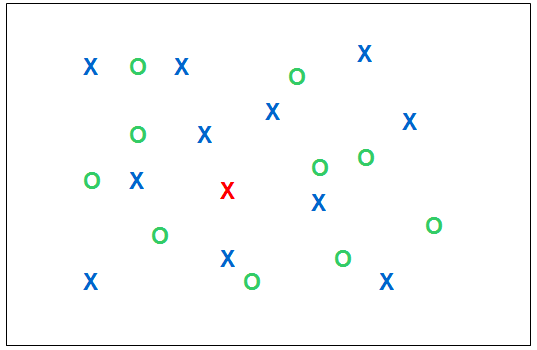
How long did it take you to spot it? Is it the one that obviously stands out? This is the sort of visual search array we would use to show how the brain finds a target amongst distractors. When the target has a single obvious feature (here its the colour red), the target pops out - no matter how many distractors there are. When you are the little red cross, in rooms and rooms full of blue crosses and green circles, you might start to feel like an imposter. And all the evidence seems to suggest you are the imposter - there is no one else like you, you are treated differently, you have to do more and you get less. The problem is, its virtually impossible to ignore that you are red -especially when it is the first thing people see about you and you exist within systems that actively work against your redness.
Here is what deeply concerns me about being a minoritised academic in a society that will be led by a white supremacist to digitally lynch a person based on acquitted accusations of plagiarism . We are already walking around with imposter syndrome. But now, every mistake you ever made, every person you ever butted heads with, every claim you ever exaggerated becomes fair game to rip your reputation to shreds. No one can survive under that level of scrutiny. Most people have absolutely no idea what it is like to be under a spotlight that intense. If you have ever had anything go viral, you might have experienced the anxiety that goes with millions of people seeing your silly YouTube video or reading your Substack post. Imagine that on the scale of the national press using paid advertising to relentlessly tear you apart. Imagine having minor moments, like awarding 70% to a student who felt they deserved 75% used as evidence that you were a fraud all along? Imagine your very existence being used to justify racism towards your colleagues, claiming all of you really are imposters.
I have sat on endless DEI committees, reviewed hundreds of applications, grants and CVs and I have never known how to account for the sheer weight of being a Black academic and just existing let alone fearing scrutiny at this level. In lieu of anything more useful to solve this problem I encourage you to go read this post about the perfect storm that killed Jason Arday
and this post about what we can do when we see a pile on start to happen:
I still say V-eldsman instead of, the correct pronunciation, Feltsman
That the worst examples of our species elevate themselves to genetic superiority is truly something to be studied
Comments
Nothing yet. Say the first thing.
Sign in to join the conversation.