
In my previous post, I broke down the routine I am using to complete a first draft of my next novel project in 30 days. That post focused mainly on the habits and structures I use in my day-to-day life to produce a lot of words in a short amount of time.
In this post, I am going to share the novel planning pre-work when I want to draft quickly. This step-by-step process is how I make sure I know the structure of my story and always have something to write.
Let’s get into it.
If we haven’t met before, hi, I’m Hayley. My day job is to talk to bestselling writers about their writing routines and translate that into courses and products that can help writers succeed.
(Yes, I’m super lucky!)
Because of my work, I’ve been fortunate enough to speak with dozens of bestselling authors, editors, and writing teachers to learn about their processes and tips and tricks. What I’ve cobbled together from that is the routine that works the best for me to truly understand my story.
The planning process I’m about to share is extremely detailed. I would say that I spent about three weeks to a month going through these phases before I started my draft. And I easily could have spent more time.
I don’t always do this much planning before I start drafting. Sometimes, I have an idea and enjoy exploring that idea through the writing itself.
But when I want to draft quickly, I need to have a plan—and a detailed plan at that.
If you read my previous post on my writing routine, you’ll know that I approach fast drafting in 30-minute session increments. In order to meet my goals, I need to know exactly what I am writing during those 30-minute sessions. Even 5 or 10 minutes sat wondering can have a serious impact on my productivity.
Thus, I spend a lot of time planning before I try to fast draft. The final step in my detailed planning process (building a list of scenes) means that I always have an idea of what I can write. If I start working on one scene in a session and it isn’t flowing the way I want, I can just open another.
For me, having that list of scenes is like having an endless supply of writing prompts, tailored exactly to the story I’m writing. All of the steps before that in my planning process are to make sure I have enough inspiration to build that list of scenes.
So, in short—this process is long and detailed. You absolutely do not need to follow it. I’m a big believer that there is no “one size fits all approach” to writing.
However, I’m sharing in the hopes that you find it useful and maybe even learn some new tools that you can fit into your writing process.
The first step of my writing process is always the same: make a mind map (or ten). Even when I don’t follow the other steps of this planning routine, I nearly always make mind maps before I begin.
A mind map is a visual diagram that helps you organize your ideas. Basically, you put a big idea in the center and then draw lines to little bubbles that are offshoots from that idea.
I usually create at least two mind maps: one for the overall story and one for the main character (or characters).
For my main story mind map, I write the premise in the big bubble in the center. Then I create branches for characters, plot, setting/world, and themes/motifs.
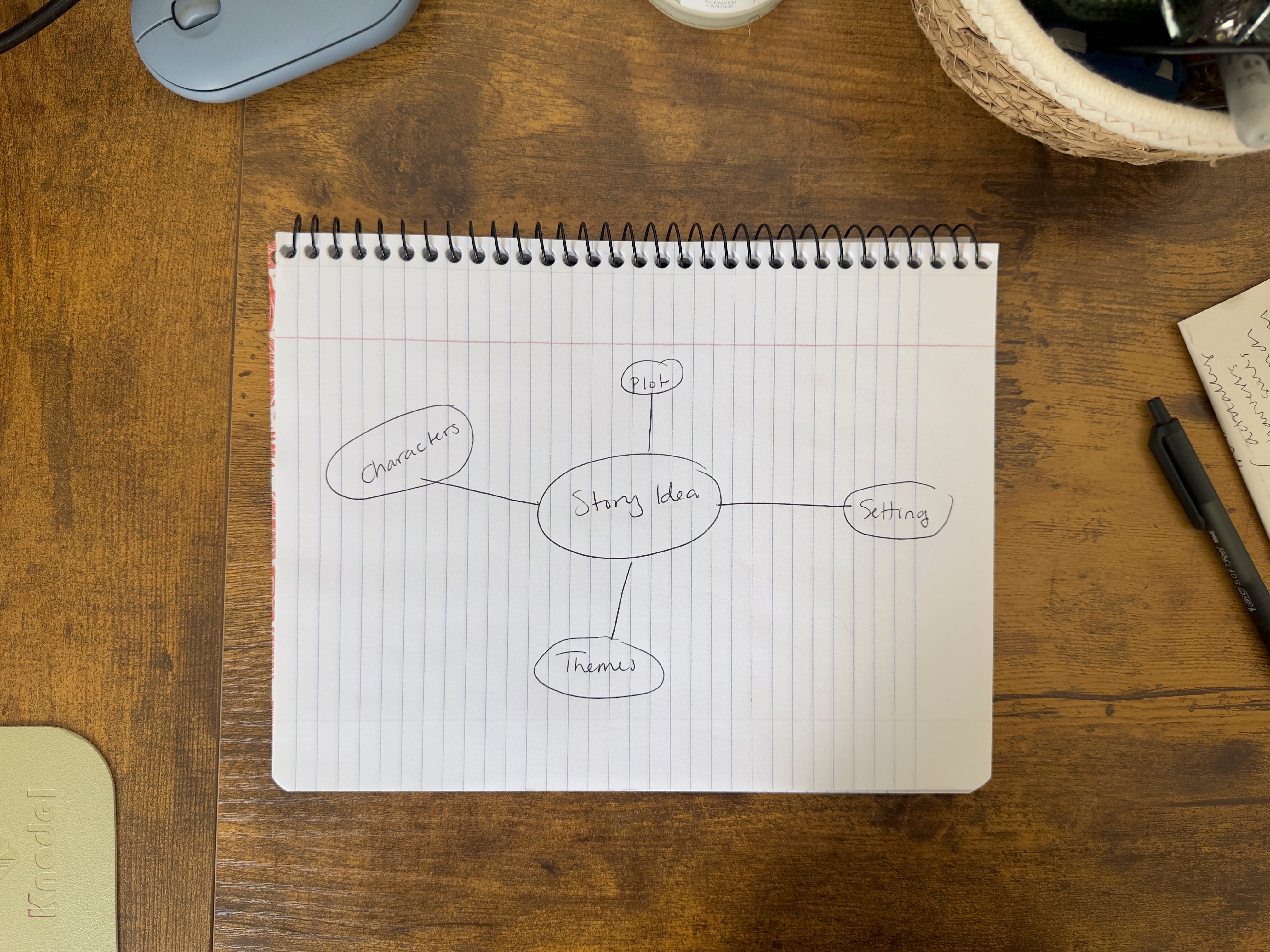
I add ideas to each of the branches until I run out of steam. For instance, for characters, I’ll add notes like “MC (main character): 30s female, dead end job, wants power”. I keep my notes high-level, without too much detail, and keep going until I run out of room.
For my main character mind map, I put the character’s name in the center. Then, I add branches for traits, relationships, core want, hidden need/flaw, and beliefs/ideals.
This work takes me into step 2.
Mind maps help me explore different ideas in a low pressure way. Once I feel confident in my mind maps, I move on to clearly defining my main character’s want and need.
In a recent interview I did with Alison Espach, who is a writing professor at Providence College and the author of the exceptional book The Wedding People, she shared that the opening of your novel and the ending should be the same question, asked twice. Whatever your character wants on page one—a kiss, a job, a way home—the story ends the moment we know whether they got it.
I found that framing incredibly helpful. I aim to establish what my main character wants and needs as early as possible in both my planning process and in the draft itself.
For this step in the process, I fill in the following template.
My main character is ______. The character’s stated/outward goal is to __________. They think that they want this because __________.
But what the character actually needs is ________. This needs comes from __________ (history/backstory about the character).
That need/history/backstory has created this flaw: __________. This flaw shows up when __________ (a behavior or pattern), and it’s rooted in __________ (backstory or belief that created it).
For me, understanding want, need, and flaw are core to writing a good story.
The character’s want is the external driver, the true catalyst that sets the story in motion. Their flaw is the internal wound that gets in the way of them achieving that want. Until they address that wound and meet their core need, they won’t achieve their goal.
After I feel confident in my character’s wants and needs, I move on to writing a summary of my novel using the snowflake method.
Here’s how it works:
First, I write three sentences about the novel. One sentence for what happens in the beginning, one sentence for what happens in the middle, and one sentence for what happens in the end.
Next, I write three paragraphs about the novel. One paragraph for what happens in the beginning, one paragraph for what happens in the middle, and one paragraph for what happens at the end.
I aim to write 3-4 sentences for each paragraph. This exercise helps me start to flesh out what will happen in each act of the story.
As an optional exercise, I will sometimes take this one step further and write one page for what happens in the beginning, one page for what happens in the middle, and one page for what happens in the end.
I don’t try to make the language pretty or impressive in these summaries. Often, it’s very rough:
[MC] does this. Then they do this. But then this happens.
The snowflake method isn’t about getting reader-ready text, but instead about helping me understand what will actually happen in the story.
After I’ve completed my snowflake summaries, I usually have a strong idea of where the story is going.
Likewise, because my day job involves a lot of study of story structure, I find that I naturally think in story beats and often have key beats like the inciting incident, midpoint, and climax built into my summaries without having to think too much about them.
However, I’m a perfectionist about my novel projects—and when I’m fast drafting, I want to make sure I have the story right. So at this point, I usually take the snowflake summaries I have written and map them to a beat sheet table I have created that corresponds to the genre of the project.
There are dozens (maybe even hundreds) of versions of beat sheets out there. I will typically spend some time researching what might fit the novel project I’m working on, or pulling out a tried and true template that I enjoy.
When I’m writing in a familiar genre, like romance, using a template like Romancing the Beat is more of a checkpoint to make sure I’ve covered major moments.
For my most recent project, however, I am working in a new genre, so I spent some time studying different beat sheets and thinking about what might fit my story effectively.
Beat sheets for me are mostly about ensuring I’ve thought appropriately about tension and pacing so that I feel confident in how the action in my story rises and falls.
After I have completed my beat sheet I work on the last step of my planning process: creating a list of scenes.
Most story beats take place over several scenes, even if the culminating moment happens in one moment. For this phase, I write a sequential scene list of what will happen in each beat.
I keep the list short and sweet: [MC] wakes up at home and discovers her ring is missing. Calls one night stand to confront him.

I will often pull directly from the snowflake summaries I built for this, as the sentences in those summaries are usually the starts of scenes. I then fill in any places where I don’t have enough scenes or remove anything that doesn’t make sense.
What I’m left with is a list of anywhere from 50-80 scenes that will make up the novel. I organize each scene as a page in a bigger table in Notion. When I start drafting, I simply open up a page and write.
So that’s the whole process—mind maps to character wants/needs to snowflake summary to beat sheet to scene list. Each step builds on the last, and by the time I finish that final list of scenes, drafting doesn’t feel like staring at a blank page anymore. It feels like picking which prompt I want to answer today.
Is this a lot of upfront work? Absolutely. Like I said, this process can take me three to four weeks before I write a single word of the actual draft. But that’s the trade-off I’ve made peace with: when I’m fast drafting, I need to spend a month getting to know my story inside and out so I don’t get stuck when I’m writing.
That said, I want to reiterate what I said at the top—this is my process, built from years of talking to other writers and adoping the bits that worked for me. It’s not a formula you need to follow exactly, or even at all. Some of you are discovery writers who’d feel suffocated by this much planning, and that’s a completely valid way to write a novel too.
If you try any of these steps, I’d love to hear how it goes. And if you’ve got planning rituals of your own that I haven’t mentioned here, send them my way—I’m always collecting new tools for my toolbox.
Comments
Nothing yet. Say the first thing.
Sign in to join the conversation.