
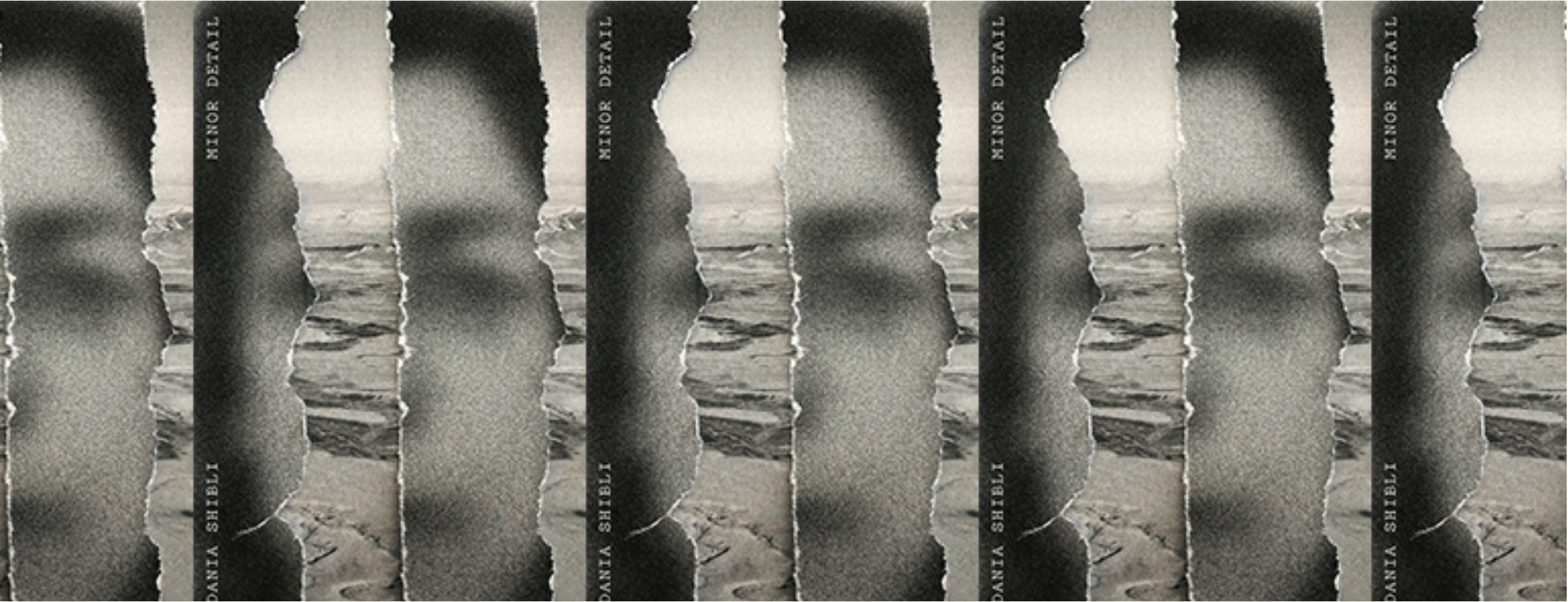
Minor Detail begins with a displacement of the reader, to a scene we are not told much about to ground it, where a nameless man goes about his days in an army camp.
The date (1949) places it one year after the first Nakba, in which hundreds of thousands of Palestinians were forcibly displaced from their land and many were killed. In that year (1948), Israel declared independence and has continued to wage a genocide on Palestinian people since.
The book takes a certain approach to the beginning in that there are not many defining features of the man, and we are not privy to what he is thinking, or feeling, so we must extrapolate details from his actions: he is ill from something that bit him, suffering some malady, and is still continuing his ‘work’ in the camp, leading soldiers on expeditions to find ‘Arab infiltrators’ in the desert.
At one point he refers to a girl, shot and in pain on the ground in black clothing, as a ‘still-moaning black mass’. The man has no regard for any living thing, from bugs to the dog at the camp to the girl who is never named, but humiliated, assaulted and killed.
The first half is the man doing mundane things like washing himself, inter-spliced with violence so cruel that it doesn’t seem to fit with his earlier activities. But we understand that the violence is normal, to him, and likewise to the Israeli military, as we have seen so clearly.
In the second half of the book, a Palestinian woman lives under Israeli occupation, going about her days in her new job. Normalcy, to her, is the state of her life under occupation: nearly being shot at, strip searched, and the brutal ‘incidents’ that she hears of around her.
She speaks of her resistance to borders, and equates it to stupidity, not naivety, that causes her to trespass, both in abstract and concrete borders. She struggles with borders because they are ever-present, and an enduring consequence of what happened in the first Nakba, where Israel took Palestinian land by force. She is afraid of the borders because they restrict her freedom, a freedom that she is holding onto through acts of resistance that take the shape of trespassing. On the other hand, she seemingly cannot make peace with borders because she knows they are not supposed to be there. Borders cause her to act ‘stupidly’ as she says, perhaps because they do not make sense to her.
With the genocide happening today, these borders are still present; Israel has been ceaselessly bombing Palestine, shrinking the supposedly ‘safe’ places until there are none left, and there are none left, today, if they ever existed in the first place. At the border, Israel has blocked aid trucks from entering Gaza, effectively starving men, women, and children to death. Borders are volatile in Minor Detail, just as they are now, and they dictate both freedom of movement and hold control over the lives and deaths of Palestinians.
The woman’s dedication to her work, she says, demonstrated when she promptly clears her desk of the dust that comes in the window from a bombing and gets back to work, comes from her inability to process situations such as these properly, and results in a sort of disassociation. Her only reprieve is her solitude, but under occupation, even this is never free from violence; while sitting at her table in the morning, a routine she’s developed that grounds her, she reads about an incident that begins to haunt her. Much about this points to the invasion into every facet of life in occupied Palestine, and how nothing goes untouched by the violence of it.
The writing is beautiful, and sharp, and the story is devastating, both outwardly and quietly. Shibili presents us with outwardly horrific situations, and, in the minor details, the parts tucked away by our characters, presents us with equally disturbing details.
The book is not only about Palestine and Israel— it is also about the complicity of the US and Canada. At one point, the woman mentions Canada park in Tel Aviv, and I hadn’t heard of it before, but it’s a park that was made on the ruins of Palestinian villages, where the residents were forcibly displaced and their homes destroyed. The name comes from where the funding came from— the Jewish National Fund of Canada. Canada, while often seen as a benevolent country, has been complicit in the genocide of Palestinians going on today—just last week, a group of NGO’s reported that Canada, despite stating it is not currently selling arms to Israel, is, in fact, still doing just that.
The woman mentions, while in an Israeli museum, seeing a US made gun that was used in the Korean War and the Vietnam War. Imperial powers, such as the US, are intertwined with violence and can be seen through the involvement in many wars, in forced displacements, and the killing of civilians, and if not so explicitly, the funding of it.
Shibili traces the lineage of violence through the book—from the soldier at the beginning committing the act, to the woman, years later, intent on finding out more about the act that happened on the day she was born, to the gun that was used in the act, and the dog that howls through the act and (assuming) long after it, reaching the woman. The violence doesn’t end, but traverses through time.
The woman’s seemingly compulsive need to find out what happened to the girl in the story she’s read about is marked with fear: of leaving what is familiar to her, crossing the multiple checkpoints, the unpredictable and often aggressive behaviour of the IDF, and fear of her own rising feelings of grief and understanding of what the girl went through.
It may seem, at first, as though she is distant from the occupation and its violence, but it becomes clear that not only does it permeate every aspect of her life, but it is the only way she has found to survive it. Through the girl and her story, that reality and the oppressed feelings follow the woman, and her fear of confronting it is compounded with the fear for her safety. It is of utmost importance to her to understand what the girl went through, what her name was, who she was, because in the woman’s mind, it is incomprehensible that this girl is forgotten.
I urge you to read this book, not only because it has such brilliant writing, and is a masterful work that explores the legacy of violence and displacement, life under occupation, the nature of fear, and the lingering trauma of war, but because it is such an unutterably important story.
No posts
Comments
Nothing yet. Say the first thing.
Sign in to join the conversation.