
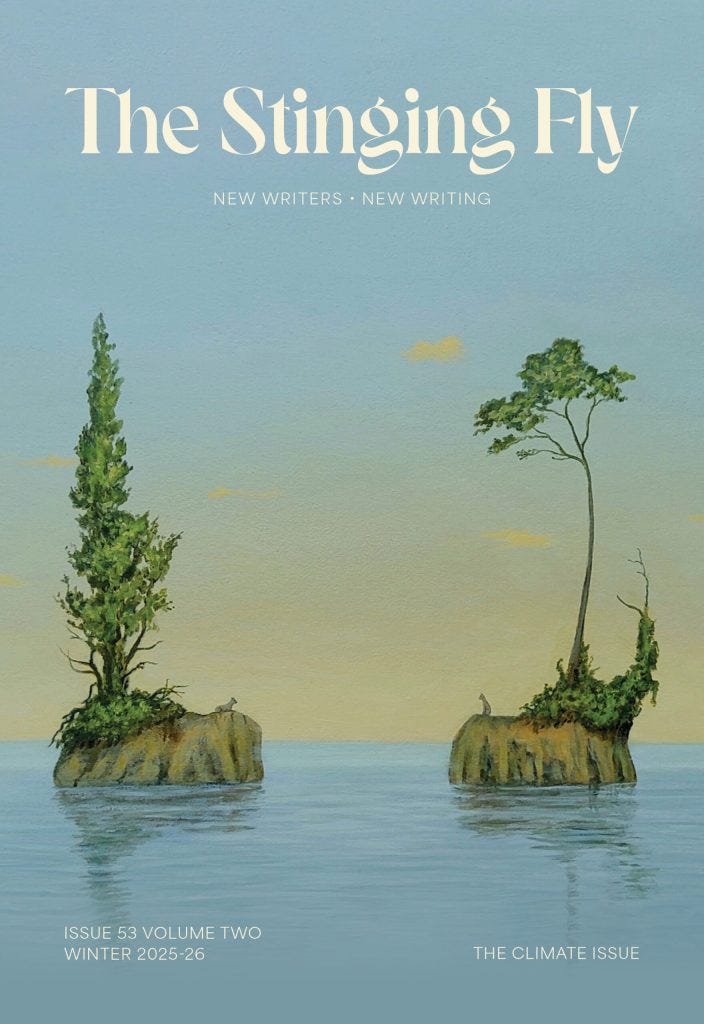
The latest issue of the Stinging Fly, Ireland’s beloved bi-annual literary journal, is subtitled The Climate Issue. Climate issues have drifted to the back pages of newspapers and collective consciousness, so there is something comforting about the centre of Irish literary culture dedicating half a year’s output to writing about the emergency of our lives.
Unfortunately, the issue is mostly a testimony to the absolute inability of literary writing to engage in our slow death by petro-capitalism. Many of the non-fiction pieces suffer under the enormous gap between the scale of the problem and the obligatory turn towards optimism in the last couple of paragraphs. A lot of the poems gesture towards post-humanism, but most don’t really distinguish themselves from pre-modernist nature poetry in any moral way. Most of the stories, despite the terror that lingers just off page, remain short stories about the interpersonal tangle of feelings and regrets and family history.
The “Climate Round-Table” is especially egregious, the panellists swing wildly between vague optimism “Across Ireland, communities are engaging with climate and nature projects” and the genuinely apocalyptic “Food security is going to become a very large issue as climate shocks increase in intensity and frequency.” I did appreciate one panellist’s suggestion that “activists need to build lasting campaigns and institutions that rival governments”, but the fact that they were calling for Leninist Dual Power didn’t seem to stop the organic farmer from saying that consumers have “real power” when they buy their food.
One panellist reminds the reader, after quoting Slavoj Žižek, “how the arts and humanities help us to understand our pasts, rethink our presents, and script a better future.” Unlike the more limited view of the editorial, “The artists...can’t hold back the tide, nor really define the tide”, the panellist makes the argument that writers do have power to analyse and shape the intellectual, emotional and material relationship between us and Anthropogenic Climate Change. I think this is true, but first we have to accept what the warming hyperobject might do to us and our writing.
Liadan Ní Chuinn, the pseudonymous writer that published an excellent and much-lauded book of short stories with the Stinging Fly Press last year, has a story in the issue that takes up the charge. Their story, “I Want You to Live”, gives us no ground to stand on. It admits that somewhere out there “there is a world”, “there is a story”, but it doesn’t make it into this character’s voice, “it is not remembered”. “I” finds herself in a safe house without a name, being inducted into some kind of resistance cell. But there are no dates or places or names.
What “I” is resisting is named simply “the forces”. Whatever they are, they seep into everything. They’re sticky, like oil or pollution. Even in resistance, you cannot be clean of them. “I” looks at the man who has taken her into the resistance movement: “He is profoundly sad, I realise. He is, in a sense, grieving. The forces are everywhere, all through his home.”
Dirty water, with “everything that runs into it, all of the plastic, all of the shit” floods the story. In fact, it threatens the story with dissolution. “i” repeatedly declares that they are just a person, but this seems suspect. They seem to start to understand that “person” is not the best unit of agency or action, cause or effect, to think about Anthropogenic Climate Change:
“I used to tell myself, they are all just people, every terrible government, every murdering force, just people, just born and living until they die, people who had to learn the walking, people who had to be weaned onto food, people who lie on a bed and dream at night. I used to tell myself, we are all just people, but I don’t know what it means anymore. I am, at times, fear given a body. Fear given a voice.”
The story follows the character then, losing names and history and individuality. Becoming something else, something like a conviction that is as dispersed and fluid as the conviction’s enemies. To be in a dying world means to die, just a little bit.
But it also means becoming something strong and simple and true, like the last words of the story:
“I want you to live.”
Comments
Nothing yet. Say the first thing.
Sign in to join the conversation.